
Plan commercial and industrial security for selected Maryland facilities, including Baltimore, with cameras, access control, alarms, fire, monitoring, infrastructure, and practical upgrade options.
Request a Maryland commercial security assessment
Confirm the Scope of a Maryland Project
Use this Maryland directory to organize a business and facility security project before selecting individual systems. Begin with the building address, the areas included, the operational concern, and the people responsible for the property. NERSA considers selected commercial, industrial, logistics, healthcare, institutional, office, contractor, and multi-site work.
Pennsylvania is NERSA’s primary service area.
Maryland availability depends on the property, location, system type, project scope, licensing, permitting, inspection responsibilities, travel, scheduling, and long-term serviceability.
For regional context, visit Pennsylvania and Mid-Atlantic commercial security systems.
Choose the Security System You Need
- Video surveillance for entrances, interiors, parking, loading areas, gates, and incident review
- Access control for credentials, schedules, visitors, contractors, and restricted spaces
- Commercial intrusion alarms for perimeter openings, interior zones, panic devices, and monitored response
- Fire alarm and life-safety systems for qualifying detection, notification, monitoring, upgrade, and inspection-readiness projects
- Remote video monitoring for selected exterior events that benefit from operator review and defined escalation
- Infrastructure and cabling for power, networks, pathways, cabinets, fiber, wireless links, and multi-building connectivity
Match Security to the Property
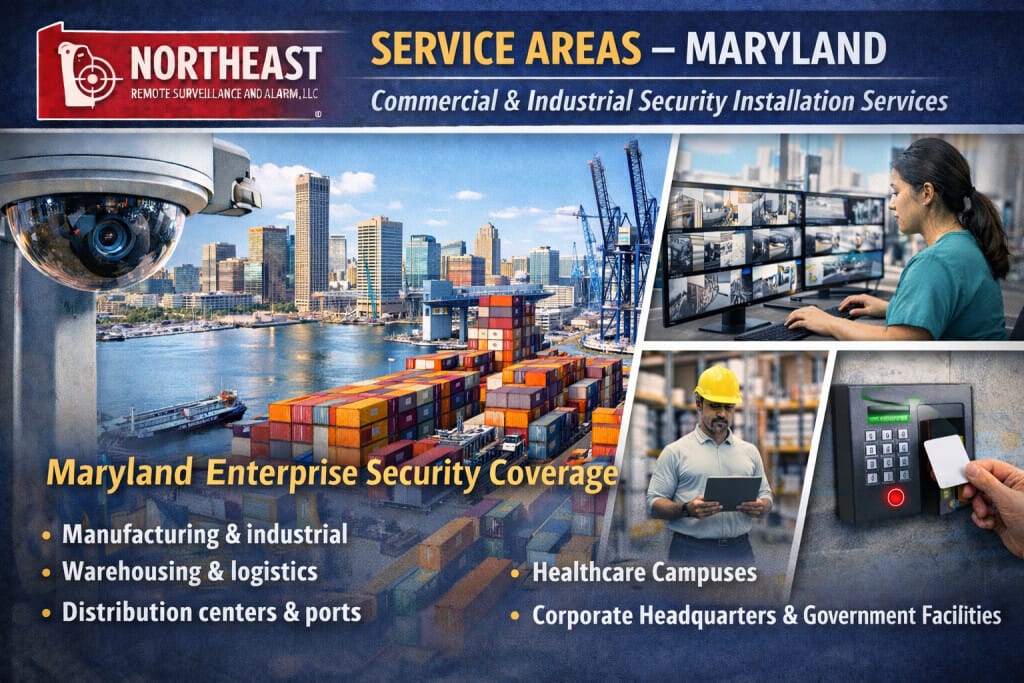
- Warehouses, logistics, and corridor-connected facilities with freight, docks, trucks, inventory, and multiple shifts
- Manufacturing facilities with production, tools, materials, contractors, and restricted areas
- Healthcare properties, schools, municipalities, institutions, and public-facing facilities
- Office buildings, government-contractor workplaces, multi-tenant sites, contractor operations, and commercial campuses
Define the Facility Boundary and Operating Route
A Maryland project may involve a single occupier, shared premises, or several connected buildings. Map the route from visitor or freight arrival to the relevant work area. Identify which entrances, parking areas, loading positions, and utilities belong to the proposed scope and which remain under another party’s control.
For a warehouse or logistics property, distinguish gate admission, yard visibility, and the dock transfer. For offices or public-facing facilities, begin with reception and the boundary between public and staff-only areas. Choose the linked service guides for each task once those routes are clear.
Coordinate Building and Project Responsibilities
Security improvements should be coordinated with door hardware, accessible egress, fire-alarm operation, emergency procedures, building requirements, and the local Authority Having Jurisdiction. Regulated or government-adjacent organizations should also involve the professionals responsible for their facility-specific requirements.
Review commercial security code and compliance planning.
NERSA does not replace architects, engineers, code officials, fire marshals, safety professionals, compliance officers, or legal advisors.
Assess the Existing Installation and Transition
Record installed equipment, available drawings, account ownership, current service arrangements, and recurring faults. Identify whether the limitation is coverage, equipment condition, unsupported software, recording capacity, or an operating change. Retention of existing components depends on the proposed configuration and the results of an assessment.
Use the upgrade and takeover guide to organize a phased change, or the physical-plant assessment guide to define a wider review.
Agree how work will be coordinated with existing providers and occupied areas.
Set Handover and Support Expectations
Identify the people who will manage credentials, retrieve evidence, maintain response contacts, and report faults. Check those actual tasks at handover. A functioning device is only part of acceptance; operators also need understandable location names, appropriate permissions, and usable records.
For several Maryland locations, establish common naming and administration rules while documenting differences in schedules, connectivity, and equipment. Confirm the service arrangements for each location rather than assuming a shared platform makes every property identical.
Information Needed to Review Availability
Provide the location, building use, proposed systems, current service issues, and requested timing. Include known approval or access requirements and the people responsible for coordinating them. NERSA’s primary service area is Pennsylvania; a Maryland project requires a specific review of scope, scheduling, applicable requirements, and long-term support.
Frequently Asked Questions
Does NERSA accept commercial security projects throughout Maryland?
NERSA considers selected Maryland commercial and industrial projects, including Baltimore; statewide availability should not be assumed. Pennsylvania is the primary service area. Maryland work requires review of location, systems, project scope, scheduling, applicable licensing and permitting, and long-term support.
What information is needed to confirm Maryland project availability?
Provide the property address, building use, proposed systems, current service issues, and requested timing. Include known approval or access requirements and the people coordinating the project. NERSA uses those details to review scope, availability, and support responsibilities.
Can existing equipment be retained in a Maryland security project?
Existing equipment may be retained after an assessment of condition, coverage, software support, recording capacity, account ownership, and compatibility. Supply available drawings and current service records. The proposal should identify what stays, what changes, and how operation will be managed during the transition.
Request a Maryland Security Assessment
Tell us where the property is located, how it operates, what is not working, and what needs to improve.
Request a Maryland commercial security assessment.
Customer Project: Phillips Mushroom Farms
The Phillips Mushroom Farms case study in Warwick, Maryland covers a 15-year customer relationship and a facility-wide system with video surveillance, video analytics, wireless bridges, security network infrastructure, and remote viewing.
The system documents product movement, activities, and safety procedures at the growing facilities.
Browse additional projects in the Case Studies.
Compliance, Codes & Project Standards
NERSA plans commercial and industrial security work with applicable code, documentation, inspection and authority-having-jurisdiction requirements in mind. Requirements vary by system, property and jurisdiction. These resources support project planning; they do not establish legal compliance, certification or AHJ approval.
Related guidance: NERSA project standards · Documentation, testing & inspection readiness