
Cargo theft prevention systems for warehouses and distribution centers help protect inventory, shipments, trailer yards, loading docks, truck courts, shipping areas, employee entrances, gates, and after-hours freight activity.

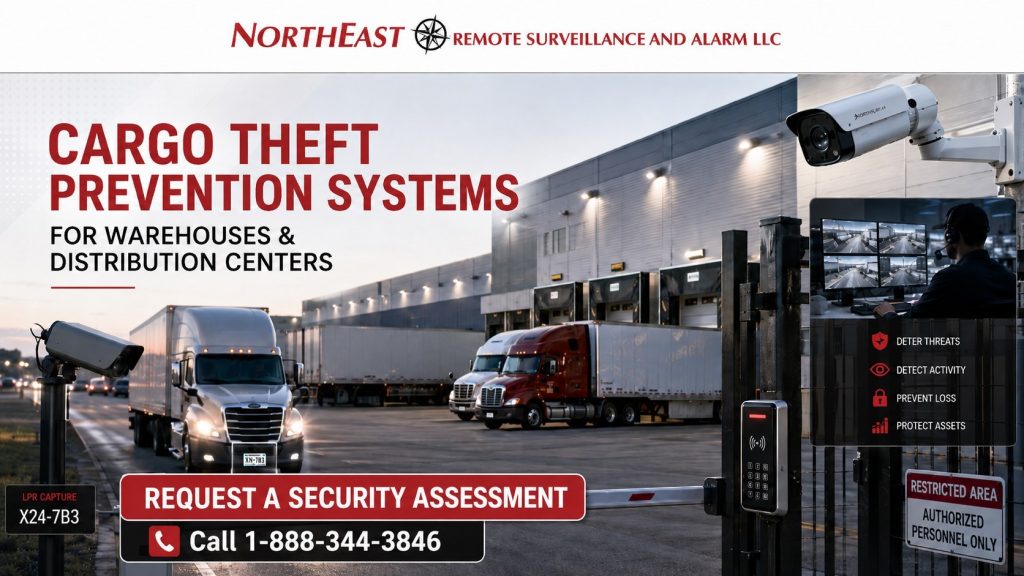
Protecting Inventory, Shipments, Trailer Yards, Loading Docks, and Supply Chain Operations with Industrial Security Systems
This guide covers only warehouse and distribution-center cargo theft risk, including dock visibility, trailer-yard monitoring, truck movement, vehicle documentation, access control, intrusion detection, remote review, and incident evidence.
For broader building-wide warehouse protection involving cameras, alarms, access control, docks, inventory movement, and after-hours risk, use the Warehouse Security Systems page.
Cargo Theft Is a Warehouse and Distribution Center Security Problem
Cargo theft is not only a trucking issue. It is a facility security problem that often begins where freight, people, vehicles, docks, trailers, and access points are not properly controlled or documented.
Warehouses and distribution centers can contain high-value inventory moving through multiple operational zones at the same time. Shipments may arrive at receiving doors, move through staging areas, sit in warehouse storage, transfer to outbound docks, or remain in trailers before final departure.
Northeast Remote Surveillance and Alarm, LLC designs cargo theft prevention systems around the way warehouse and distribution operations actually work. The goal is to reduce opportunity, improve visibility, document movement, support investigations, and give management a clearer way to review what happened before, during, and after a loss or suspicious event.
For broader logistics facility planning across freight, distribution operations, multi-site warehouses, and supply-chain facilities, use the Distribution and Logistics Center Security page.
Where Cargo Theft Risk Appears in Warehouses
Cargo theft can develop anywhere product movement, vehicle activity, or access control breaks down.
Common warehouse and distribution center risk areas include:
- Loading docks
- Trailer yards
- Truck courts
- Shipping and receiving areas
- Trailer staging lanes
- Gate entrances
- Employee entrances
- Warehouse office entrances
- Inventory storage areas
- High-value product zones
- Pallet staging areas
- Outdoor storage areas
- Side and rear doors
- Fence lines and perimeter corners
- After-hours parking and trailer areas
Start by identifying where freight enters, is staged, and is transferred. Review vehicle routes and who can access each area. Then define how staff will investigate a shipment, trailer, pallet, or product claim.
Loading Dock Cargo Theft Prevention
Loading docks are one of the most important areas in warehouse cargo theft prevention. They combine freight movement, open overhead doors, drivers, vendors, forklift traffic, staged pallets, employees, and shipment documentation.
A dock-focused cargo theft prevention design may include:
- Cameras above or near dock doors
- Views of trailer backing zones
- Shipping and receiving camera coverage
- Staging-area visibility
- Overhead door activity review
- Dock-side personnel door monitoring
- Lighting coordination
- After-hours dock alerts
- Recorded evidence for shipment disputes
Dock security is not only about seeing the door. The system should document what moved, when it moved, who was near the area, and whether the camera view is usable when management needs to review an event.
For dock-specific planning, use the Loading Dock Security Systems page.
Trailer Yard and Truck Court Protection
Trailer yards and truck courts are common exposure points for cargo theft because trailers may sit outside, vehicles may move frequently, and activity may occur beyond normal management visibility.
Cargo theft prevention in trailer yards may include:
- Trailer row camera coverage
- Wide-area yard surveillance
- Gate-lane cameras
- Truck court visibility
- Fence-line cameras
- Parking area views
- Long-range fixed cameras
- PTZ support where appropriate
- Exterior lighting review
- After-hours event monitoring
Fixed cameras should cover the views that matter most every day. PTZ cameras may help with live review or investigation, but they should not replace fixed documentation at gates, trailer rows, dock lanes, or high-risk yard approaches.
For yard-focused planning, use the Truck Yard Security Systems page.
Gate Control and Vehicle Documentation
Unauthorized vehicle movement can weaken the entire warehouse security plan. If a facility cannot clearly document which vehicles entered, which vehicles exited, when the activity occurred, and whether access was authorized, cargo theft investigations become harder.
Gate and vehicle security may include:
- Gate access control
- Keypad or credential-controlled vehicle entry
- Intercom-supported gate entry
- Gate cameras
- License plate recognition cameras
- Driver and vehicle documentation
- Vehicle history tied to incidents
- Controlled access schedules
- After-hours entry restrictions
For controlled vehicle entry, use the Commercial Gate Access Control Systems page.
For plate capture and vehicle documentation, use the License Plate Recognition Camera Systems page.
Warehouse Cameras for Cargo Movement Review
Cargo theft prevention depends on usable video, not just camera presence. A camera that shows a large area but cannot clearly document activity may not help when a shipment is missing, a trailer is damaged, or a product claim needs review.
Warehouse camera coverage may include:
- Warehouse aisles
- Pallet storage areas
- Shipping lanes
- Receiving lanes
- Packing stations
- Staging areas
- Forklift travel paths
- High-value product zones
- Warehouse office entrances
- Restricted storage areas
- Interior doors between office and warehouse space
For broader camera design around warehouses and distribution centers, use the Warehouse Security Camera Systems for Distribution Centers page.
For industrial camera planning across larger facilities, use the Industrial Security Camera Systems page.
Access Control for Shipping, Receiving, and Restricted Areas
Cargo theft is not always an outside threat. Warehouse and distribution centers also need to control access to employee doors, shipping offices, receiving offices, warehouse-to-office transition doors, inventory cages, tool rooms, IT rooms, and high-value storage areas.
Access control may help with:
- Employee entry accountability
- Restricted room control
- Shift-based access rules
- Contractor access review
- Temporary labor management
- Lost key reduction
- Door event records
- After-hours entry review
- Separation between office, warehouse, and restricted spaces
For warehouse-specific controlled-entry planning, use the Warehouse Access Control Systems page.
For broader commercial and industrial access control planning, use the Commercial & Industrial Access Control Systems page.
Intrusion Alarms and After-Hours Cargo Exposure
Warehouses and distribution centers may be most vulnerable when the building is closed, lightly staffed, or operating with limited overnight supervision. Intrusion alarms can help detect unauthorized activity around doors, offices, overhead openings, storage rooms, and vulnerable building areas.
Cargo theft prevention may include alarm coverage for:
- Side and rear doors
- Employee entrances
- Shipping and receiving offices
- Overhead doors
- Interior warehouse zones
- High-value storage rooms
- Secondary structures
- Detached storage areas
- After-hours entry points
For commercial alarm planning, use the Commercial & Industrial Alarm Installation page.
Alarms work best when they are part of a layered security plan. Cameras, access control, gates, LPR, and alarm events should support each other instead of operating as disconnected systems.
Remote Video Monitoring and Live Talk-Down
Some warehouses and distribution centers need more than recorded footage. When trailer yards, dock areas, gates, parking areas, exterior approaches, or after-hours zones are vulnerable, event-based monitoring and live talk-down may help improve awareness and deterrence.
Remote video monitoring may support:
- After-hours event review
- Person or vehicle alerts
- Yard activity verification
- Dock-area review
- Gate-area review
- Speaker talk-down
- Escalation procedures
- Multi-site visibility
For monitored video and active deterrence planning, use the Remote Video Monitoring and Live Talk-Down page.
If a compatible intrusion alarm needs camera context before an agreed response, review video verification for intrusion alarms.
Monitoring schedules, escalation contacts and any authorized response actions must be defined for the property.
AI Analytics for Cargo Theft Detection
AI-supported video tools can help warehouse and distribution operators search footage faster and focus attention on meaningful activity. Analytics can be useful when large facilities generate too much motion for manual review.
AI video may support:
- Person detection
- Vehicle detection
- Line-crossing alerts
- Restricted-area alerts
- After-hours activity detection
- Faster search by event type
- Reduced time spent reviewing irrelevant footage
- Event-based monitoring workflows
For broader AI planning, use the AI Video Surveillance Cost and Planning Guide page.
AI tools still need proper camera placement, lighting, distance, field of view, and alert design. Analytics cannot fix a poorly planned camera layout.
Common Cargo Theft Scenarios NERSA Plans Against
A professional cargo theft prevention system should be designed around real-world warehouse and distribution center exposure.
Common scenarios include:
- Trailers parked overnight without clear camera views
- Unverified trucks entering the yard
- Shipment pickups that are difficult to verify later
- Missing product claims at shipping or receiving
- Pallet staging areas without camera coverage
- Drivers or vendors moving near restricted zones
- Employee entrances without access records
- Side doors used outside normal procedures
- Parking areas with limited lighting or visibility
- Gate activity not tied to vehicle documentation
- After-hours yard movement without monitoring
- Disconnected cameras, alarms, access control, and gate systems
Each property should be reviewed around its actual layout, truck movement, dock schedule, access points, operating hours, and inventory risk.
Top Cargo Theft Prevention Strategies for Warehouses and Distribution Centers
A strong cargo theft prevention plan combines security technology with operational procedures and facility design.
Important strategies include:
- Install usable camera coverage at docks, yards, gates, and warehouse interiors
- Monitor trailer rows with fixed views and proper lighting
- Use LPR cameras where vehicle documentation matters
- Secure loading dock activity with dedicated dock views
- Control employee and contractor access to restricted areas
- Monitor shipping and receiving areas
- Review gate procedures for unauthorized vehicle access
- Improve lighting in trailer yards and parking areas
- Use remote monitoring where after-hours exposure is high
- Maintain video evidence for incident investigation
- Review camera retention and export procedures
- Conduct periodic security assessments as the facility changes
The goal is not to add random devices. The goal is to create a security system that makes cargo movement, vehicle activity, employee access, and after-hours events easier to verify.
Regional Logistics Markets NERSA Supports
Northeast Remote Surveillance and Alarm, LLC designs commercial and industrial security systems for warehouse and logistics properties across Pennsylvania and the Mid-Atlantic.
Regional logistics and industrial markets may include:
- Lehigh Valley logistics corridor
- Route 33 industrial corridor
- I-78 warehouse corridor
- Greater Reading distribution region
- Greater Scranton logistics guide
- Northeastern Pennsylvania logistics markets
- Greater Philadelphia industrial and logistics corridors
- Selected New Jersey, Delaware, and Maryland commercial markets
For broader Pennsylvania and Mid-Atlantic service planning, use the Commercial and Industrial Security Systems in Pennsylvania and the Mid-Atlantic page.
For the broader cargo-theft topic across warehouses, truck yards, trailer lots, industrial properties, and outdoor freight exposure, use the Cargo Theft Prevention Systems page.
Cargo Theft Prevention System Installation
Northeast Remote Surveillance and Alarm, LLC installs cargo theft prevention systems for warehouses, distribution centers, logistics hubs, and freight terminals. We also serve manufacturing-connected warehouses and industrial facilities. Planning covers inventory, shipments, access points, trailer yards, docks, and after-hours exposure.
Start cargo theft prevention design with the site layout and freight movement. Review dock counts, trailer routes, gates, warehouse aisles and employee entrances. Then assess lighting, network pathways, alarm points, recording needs, access control and how managers review incidents.
The result should be a system that helps deter theft, document movement, improve accountability, support investigations, and secure the areas where warehouse and distribution center cargo theft risk is highest.
Request a Cargo Theft Prevention Assessment
NERSA can evaluate your warehouse or distribution center and recommend a cargo theft prevention plan. Tell us about high-value shipments, truck traffic, trailer staging, dock operations, and inventory movement. The system should fit how your team handles freight.
Request a Security Assessment to discuss cargo theft prevention systems for warehouses and distribution centers.
Frequently Asked Questions About Cargo Theft Prevention Systems for Warehouses and Distribution Centers
What is a cargo theft prevention system for a warehouse?
Cargo theft prevention uses several layers of security around inventory, docks, trailers, shipping areas, and access points. Depending on the site, the design may include cameras, door and gate controls, license plate recognition, intrusion alarms, and remote monitoring. Lighting review and incident documentation also support the plan.
Why are warehouses and distribution centers vulnerable to cargo theft?
Warehouses and distribution centers often handle high-value freight, frequent truck traffic, multiple shifts, trailer staging, dock activity, vendor access, and large property areas. Those conditions can create exposure when visibility, access control, or after-hours monitoring is weak.
What areas should be covered first?
The highest-priority areas are usually loading docks, trailer yards, gate entrances, truck courts, shipping and receiving areas, warehouse aisles, employee entrances, restricted storage areas, and side or rear doors.
Can cameras prevent cargo theft?
Cameras can deter theft, improve visibility, and provide evidence for investigations. The value depends on camera placement, lighting, recording quality, field of view, retention, and whether footage can be found quickly when needed.
Do distribution centers need license plate recognition?
Many distribution centers benefit from LPR at vehicle entrances, gate lanes, truck approaches, and recurring vehicle paths. LPR helps document vehicle entry and exit and can support investigations involving unauthorized vehicles or shipment pickup questions.
How does access control help prevent cargo theft?
Access control helps restrict who can enter employee doors, warehouse offices, shipping areas, receiving areas, inventory cages, IT rooms, and other controlled spaces. It also creates an event record that can support incident review.
Are intrusion alarms still important for cargo theft prevention?
Yes. Intrusion alarms can help detect forced entry, unauthorized motion, side-door activity, office intrusion, and after-hours building access. Alarms are strongest when paired with camera coverage and access control records.
Can remote monitoring help warehouse cargo security?
Yes. Remote monitoring can help review after-hours activity around docks, trailer yards, parking areas, gates, and exterior approaches. Live talk-down may also help deter suspicious behavior before it becomes a theft or damage event.
How long should cargo theft video footage be stored?
Retention depends on facility risk, shipment value, truck volume, incident history, insurance expectations, camera count, recording quality, and management review needs. Higher-risk warehouses and distribution centers may require longer retention than lower-traffic facilities.
How do I start a warehouse cargo theft prevention project?
Request a Security Assessment. Northeast Remote Surveillance and Alarm, LLC can review the facility layout, dock activity, truck movement, access points, alarm needs, camera coverage, monitoring options, and cargo theft risk areas.
Compliance, Codes & Project Standards
NERSA plans commercial and industrial security work with applicable code, documentation, inspection and authority-having-jurisdiction requirements in mind. Requirements vary by system, property and jurisdiction. These resources support project planning; they do not establish legal compliance, certification or AHJ approval.
Related guidance: Regulatory compliance & inspection readiness · Warehouse & logistics compliance · NERSA project standards