
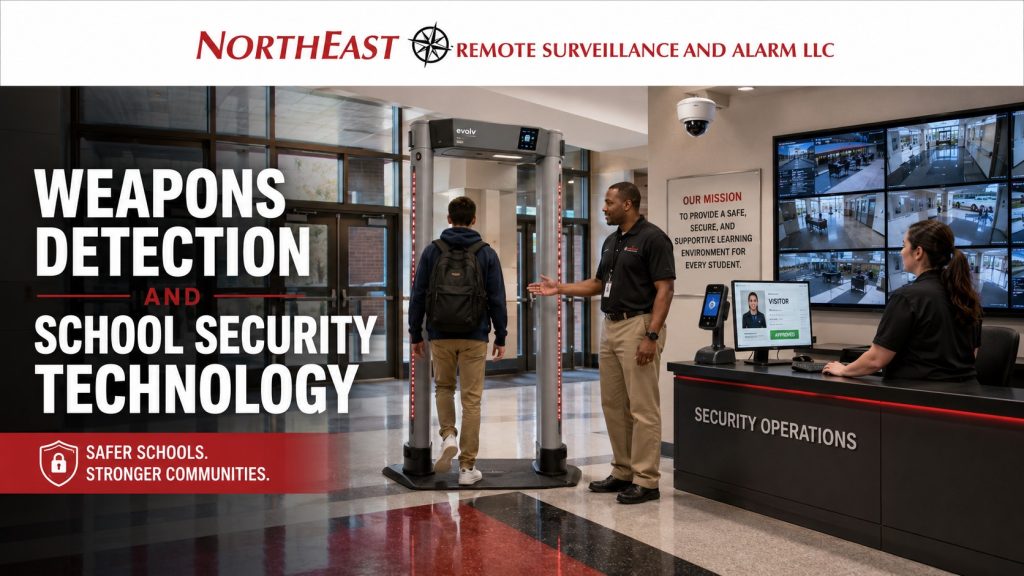
Weapons detection and school security technology can help schools identify potential threats earlier, improve situational awareness and strengthen controlled entry when used as part of a broader safety and response strategy.

Request a School Security Assessment
Northeast Remote Surveillance and Alarm, LLC (NERSA) designs, installs, integrates and supports school security technology for public, private, charter, technical and other educational facilities.
School security may involve:
- Weapons detection technology
- Video surveillance
- Access control
- Visitor entry
- Video intercoms
- Door-forced-open alerts
- Door-held-open alerts
- Panic and duress systems
- Emergency communication
- IP speakers
- Remote video monitoring
- Alarm integration
- Security-system documentation
Weapons detection should not be treated as a standalone promise of prevention.
The objective is to create a layered security environment that improves detection, verification, controlled entry, communication and response while supporting the school’s normal operation.
For broader planning by facility type, visit Industries We Serve.
For the complete commercial and institutional security service structure, visit Commercial & Industrial Security Services.
For regional and city planning, visit NERSA Service Areas.
Commercial and Institutional Systems Only • Schools • Educational Facilities • Campuses • New Installations • Upgrades • Monitoring • Integrated Security
School Security Technology Built Around Real Campus Operations
Schools do not operate like standard commercial buildings.
They may have students, staff, visitors, deliveries, buses, athletic activities, public meetings and after-hours events using different entrances and areas throughout the day.
Security planning should reflect:
- Arrival and dismissal
- Main student entrances
- Visitor entry
- Staff access
- Athletic entrances
- Parking
- Bus areas
- Exterior doors
- Restricted rooms
- After-hours events
- Emergency procedures
NERSA designs school security technology around the way the campus actually operates rather than around one product or detection device.
Weapons Detection for School Entrances
Weapons detection technology may be used at selected controlled entrances where schools want an additional screening layer.
Potential applications include:
- Main student entrances
- Visitor entrances
- Event entrances
- Gymnasium entrances
- Athletic facilities
- Board-meeting entrances
- Large public events
- Other controlled high-traffic entry points
Placement should account for traffic flow, staffing, secondary screening procedures and how students, visitors and staff move through the entrance.
A weapons-detection system that creates unmanaged congestion or unclear response procedures can create new operational problems.
The technology should therefore be planned together with entry control, cameras, staff procedures and the school’s response plan.
Video Verification and School Security Cameras
Video surveillance can provide context around weapons-detection alerts and other school security events.
Camera systems may help authorized personnel review:
- Entrance activity
- Weapons-detection alerts
- Unauthorized entry
- Door-forced-open events
- Parking-lot incidents
- Visitor activity
- Athletic-area events
- After-hours campus activity
- Emergency-response events
Camera placement should support useful incident review while respecting privacy-sensitive areas.
For broader camera-system planning, visit Commercial & Industrial Video Surveillance Systems.
Access Control for School Entry
Access control can strengthen school entry by managing who may enter selected doors, when access is permitted and how door activity is documented.
Applications may include:
- Main entrances
- Staff entrances
- Visitor vestibules
- Administrative areas
- Classroom wings
- Gym entrances
- Cafeteria doors
- Maintenance areas
- IT rooms
- Nurse areas
- Records rooms
- Athletic facilities
- Exterior gates
Access control can also support credential management, schedules and alerts for selected door conditions.
For broader planning, visit Commercial & Industrial Access Control Systems.
Visitor Entry and Video Intercom Systems
School visitor entry should be controlled, visible and understandable to staff.
A visitor-entry system may include:
- Locked main entrance doors
- Video intercom stations
- Remote door release
- Entry vestibules
- Camera views
- Access-control integration
- Office notification
- Visitor procedures
- Door-position monitoring
The goal is to reduce uncontrolled entry while allowing parents, vendors, guests and approved visitors to enter through a managed process.
For broader intercom and communication planning, visit Two-Way Communication and IP Speaker Systems.
Door Monitoring and Unauthorized Opening Alerts
School security often depends on exterior doors remaining secured when they are not being actively used.
Selected doors may require monitoring for conditions such as:
- Forced opening
- Held-open conditions
- Unexpected after-hours activity
- Roof-access events
- Side-door use
- Maintenance-door activity
When compatible systems are coordinated, a door alert may also be associated with nearby video to provide additional context.
Door monitoring should support the school’s operating procedures rather than create excessive or meaningless alerts.
Panic, Duress and Emergency Alerts
For one specific event-detection workflow, review SDS and Alarm.com gunshot-detection planning.
Detection, verification, notification, and human response should be evaluated as separate requirements.
Panic and duress technology can provide authorized personnel with a faster way to initiate an emergency alert when a serious concern occurs.
Potential applications may include:
- Main offices
- Administrative areas
- Reception
- Nurse offices
- Athletic events
- Selected staff locations
The response process should be established before devices are deployed.
A panic button alone does not define who receives the alert, what actions follow or how the event is escalated.
For dedicated planning, visit Panic, Duress and Emergency Alert Systems.
Emergency Communication and IP Speakers
Schools may require communication across entrances, hallways, parking areas, athletic facilities and other campus spaces.
Systems may support:
- Facility announcements
- Emergency messaging
- Area-specific communication
- Exterior speaker coverage
- Entry-point communication
- Approved live audio warnings
- After-hours communication
Communication technology should support the school’s approved emergency and operational procedures.
For broader planning, visit Two-Way Communication and IP Speaker Systems.
Remote Video Monitoring and After-Hours School Security
Some school security concerns occur when normal staffing levels are reduced.
Remote video monitoring may support selected exterior areas during evenings, weekends, holidays or other low-occupancy periods.
Applications may include:
- Parking areas
- Athletic facilities
- Exterior doors
- Perimeter areas
- Roof-access locations
- Playgrounds after hours
- Repeated trespassing areas
Monitoring should be based on defined cameras, schedules, event conditions and response procedures.
For dedicated planning, visit Remote Video Monitoring and Live Talk-Down.
Layered School Security Design
Weapons detection is one layer of school security.
A stronger design may combine:
- Controlled entry
- Weapons detection at selected entrances
- Camera coverage of screening areas
- Access control
- Visitor intercoms
- Door monitoring
- Panic and duress alerts
- Emergency communication
- Remote monitoring
- Alarm integration
- Response procedures
- Staff training
- Testing and documentation
No single technology should be expected to solve every school security concern.
The value comes from coordinating the appropriate systems around the school’s actual operating and response procedures.
For broader multi-system planning, visit Unified Commercial and Enterprise Security Systems.
Fire, Life-Safety and Compliance-Aware Planning
School security technology may interact with emergency egress, fire alarm operation, electrified door hardware, accessibility, emergency communication and inspection-sensitive building conditions.
Security systems should not interfere with required life-safety functions.
Planning involving lockdown support, controlled doors or emergency release may require coordination with responsible design professionals, school leadership, emergency responders and authorities having jurisdiction.
For broader fire and life-safety planning, visit Commercial Fire Alarm and Life-Safety Systems.
For code-aware planning, visit Regulatory Compliance and Inspection Readiness.
Privacy, Policy and Responsible Use
School security technology should support safety without creating unnecessary overreach.
Important planning considerations may include:
- Where weapons detection is appropriate
- Who receives alerts
- Who reviews camera footage
- Which areas are monitored
- How events are documented
- How visitors are handled
- How after-hours activity is managed
- How staff are trained
- How emergency procedures are supported
Technology should support school leadership, policies, staff training and emergency coordination.
It should not replace them.
School and Educational Facilities NERSA Supports
NERSA supports qualifying security projects for:
- Public schools
- Private schools
- Charter schools
- Career and technical schools
- Training centers
- Administrative education buildings
- Athletic facilities
- Multi-building campuses
- Maintenance facilities
- Municipal education buildings
- Specialized learning facilities
Each property requires its own security plan based on layout, population, entrances, activities and response procedures.
Existing School Security Systems
Schools may already have cameras, access control, intercoms, alarm systems or other security technology that requires evaluation before new equipment is added.
An existing system does not automatically require complete replacement.
NERSA can evaluate system condition, administrator access, compatibility, infrastructure and documentation to determine what may reasonably be retained, repaired, expanded or upgraded.
Begin with Commercial Security System Inspection and Assessment.
For modernization planning, visit Commercial Security System Upgrades, Retrofits and Takeovers.
Why Schools Choose NERSA
Northeast Remote Surveillance and Alarm, LLC focuses on commercial, industrial and institutional security systems rather than single-family home alarm packages.
NERSA plans school security around:
- Campus operations
- Students and staff
- Visitors
- Entry points
- Exterior doors
- Parking
- Athletic areas
- Cameras
- Controlled access
- Emergency communication
- Panic and duress alerts
- Monitoring
- Infrastructure
- Documentation
- Long-term service
The objective is not to promise that technology can prevent every incident.
The objective is to provide better awareness, stronger control, clearer communication and more useful response information within a layered school security environment.
Request a School Security Assessment
A school security assessment may review:
- Student and visitor entrances
- Staff access
- Weapons-detection locations
- Visitor procedures
- Exterior doors
- Parking
- Athletic facilities
- Camera coverage
- Access control
- Door monitoring
- Panic and duress requirements
- Intercoms
- Emergency communication
- Remote monitoring
- Existing systems
- Fire and life-safety interfaces
- Documentation
- Future expansion
Request a School Security Assessment.
Frequently Asked Questions About Weapons Detection and School Security
What is weapons detection technology for schools?
Weapons detection technology is a screening tool that may be used at selected entrances or event areas as one layer of a broader school security program.
Does weapons detection replace school security staff?
No. Weapons detection does not replace staff, security personnel, policies, training or emergency-response procedures.
Where can weapons detection be used?
Potential locations include main entrances, visitor entrances, athletic entrances, gym entrances and other controlled entry points depending on campus operations.
Can weapons detection be supported by cameras?
Yes. Compatible video surveillance may provide additional visual context around screening areas and alerts.
Can school access control work with weapons detection?
Yes. Access control can help manage controlled entrances, schedules and restricted areas as part of a broader layered-security design.
Do schools use panic or duress systems?
Many schools use emergency alert technologies for selected staff or locations. The appropriate design depends on the facility and response procedures.
Can NERSA support after-hours school security?
Yes. Qualifying properties may use alarm integration, video surveillance and remote monitoring for selected exterior areas and schedules.
Is school security technology a guarantee against incidents?
No. Security technology cannot guarantee prevention. It can support detection, awareness, controlled access, communication and response as part of a broader school safety strategy.
How does a school security project begin?
The project begins with a campus-specific assessment of entrances, visitors, staff movement, existing systems, exterior exposure, emergency communication and response requirements.
Compliance, Codes & Project Standards
NERSA plans commercial and industrial security work with applicable code, documentation, inspection and authority-having-jurisdiction requirements in mind. Requirements vary by system, property and jurisdiction. These resources support project planning; they do not establish legal compliance, certification or AHJ approval.
Related guidance: Public-sector & institutional compliance · NERSA project standards · Documentation, testing & inspection readiness