
Plan food processing and cold storage security around controlled entry, deliveries, inventory areas, environmental conditions, and after-hours operations.

Request a Food Processing or Cold Storage Security Assessment
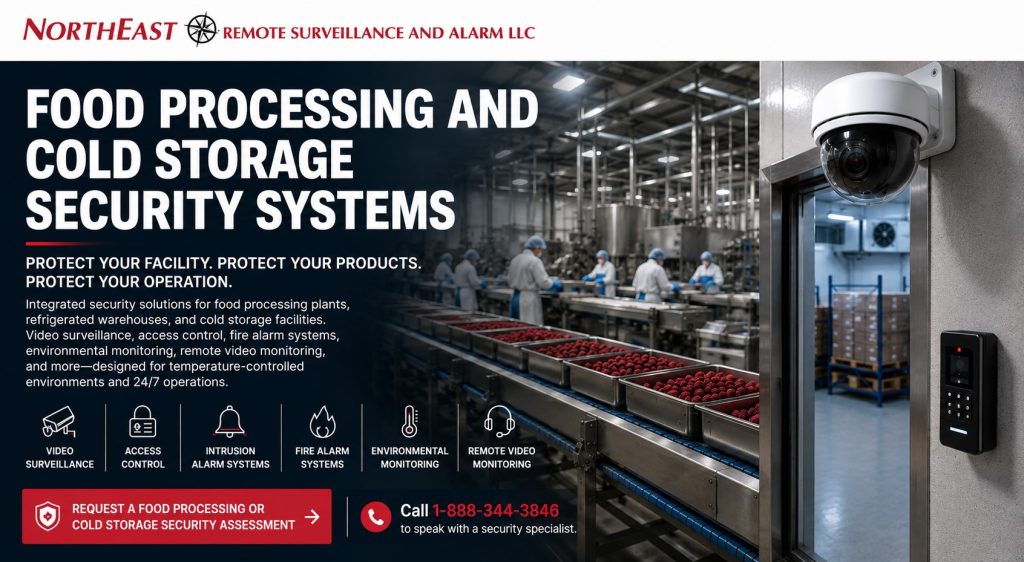
They must support employee accountability, controlled production areas, refrigerated rooms, freezers, loading docks, trailer activity, ingredient storage, finished-product movement, sanitation operations, contractor access, environmental supervision, fire and life safety, and around-the-clock facility operations.
On this page: Facility planning · Assessment process · Common questions · Request assessment
Northeast Remote Surveillance and Alarm, LLC designs, installs, integrates, upgrades, monitors, and supports commercial security systems for food processing plants, refrigerated warehouses, freezer buildings, cold-chain distribution centers, commercial kitchens, packaging operations, ingredient-storage properties, and temperature-controlled logistics facilities.
This is NERSA’s primary facility-type planning page for food processing and cold storage properties.
For security planning organized by other commercial, industrial, institutional, and logistics property types, begin with Industries We Serve.
USA Pork Packers: Hazleton Food-Processing Case Study
Explore the USA Pork Packers case study for video surveillance, AI-enabled cameras, and intrusion alarms supporting food-safety procedure documentation, employee safety review, humane handling documentation, and facility security.
The original installation dates to 2008.
Security Planning for Temperature-Controlled Facilities
The Berks County cold-storage and food-processing guide applies this planning approach to local facilities with temperature-controlled operations.
Food processing and refrigerated facilities present operating conditions that differ from those of a standard office or dry warehouse.
A single property may contain:
- Refrigerated production rooms
- Walk-in coolers
- Low-temperature freezers
- Blast-freezing areas
- Ingredient and packaging storage
- Finished-product storage
- Shipping and receiving docks
- Trailer staging areas
- Sanitation and washdown spaces
- Mechanical and refrigeration rooms
- Quality-control laboratories
- Maintenance shops
- Employee welfare areas
- Administrative offices
- Restricted storage rooms
- Exterior tanks and utility areas
- Multiple temperature zones
- Detached warehouses or support buildings
The security system must operate reliably across these different environments.
A camera that performs well in a dry warehouse may experience condensation near a refrigerated opening. A standard magnetic contact may not be appropriate for a freezer door. Conventional notification equipment may not be listed for a low-temperature or washdown area. Network equipment without appropriate protection can become a recurring point of failure.
NERSA plans food processing and cold storage security systems around actual temperatures, moisture, sanitation procedures, traffic, production schedules, door construction, network availability, fire alarm requirements, maintenance access, and long-term serviceability.
Food Processing and Cold Storage Facilities NERSA Supports
NERSA supports qualifying commercial and industrial properties such as:
- Food-manufacturing plants
- Meat and poultry processing facilities
- Seafood-processing operations
- Produce-packing and distribution facilities
- Commercial bakeries
- Beverage-production facilities
- Dairy-processing and storage properties
- Frozen-food production plants
- Refrigerated warehouses
- Public and private cold storage facilities
- Freezer warehouses
- Temperature-controlled distribution centers
- Ingredient-storage facilities
- Packaging and labeling operations
- Commercial commissaries
- Institutional food-production facilities
- Refrigerated cross-dock operations
- Cold-chain transportation terminals
- Multi-building food logistics properties
A smaller refrigerated warehouse may need dependable cameras, controlled employee entry, a monitored intrusion alarm, and selected freezer-condition alerts.
A larger processing campus may require centralized video management, access-controlled production zones, dock and truck-gate monitoring, fire alarm coordination, environmental supervision, fiber infrastructure, separate alarm partitions, and standardized administration across several buildings.
Facilities that combine refrigerated storage with warehouse, freight, dock, and trailer operations can also use Warehouse and Logistics Security Systems for Pennsylvania and the Mid-Atlantic for broader warehouse-security planning.
Layered Security for Food Processing and Cold Storage Operations
No single technology can protect every part of a processing plant or refrigerated facility.
A layered security plan may include:
- Interior and exterior video surveillance
- Controlled employee entrances
- Visitor and contractor access management
- Production-area access control
- Refrigerated-room door monitoring
- Shipping and receiving cameras
- Trailer-yard surveillance
- Intrusion detection
- Remote video monitoring
- Panic and duress notification
- Fire alarm and sprinkler supervision
- Environmental and equipment-condition alerts
- Intercoms and paging
- Low-voltage and fiber infrastructure
- Centralized event administration
- Documented system permissions
- Primary and backup communication paths
The objective is to improve visibility, accountability, response, product protection, employee safety, and system reliability without unnecessarily disrupting production, sanitation, loading, shipping, receiving, accessibility, or emergency egress.
Video Surveillance for Food Processing Facilities
Video surveillance can help document activity at entrances, production transitions, storage areas, loading docks, shipping lanes, parking lots, mechanical-room approaches, and other operationally important locations.
Camera placement should begin with a defined purpose.
A camera may be intended to:
- Identify a person entering a restricted area
- Document product or material movement
- Monitor a shipping door
- Review loading-dock activity
- Verify an alarm event
- Observe a production-area transition
- Monitor employee or visitor entry
- Document vehicle arrivals
- Review maintenance or sanitation activity
- Provide an overview of a freezer aisle
- Monitor a mechanical-room entrance
- Support an incident investigation
Installing cameras without defining their purpose can produce blind spots, unusable images, inadequate retention, excessive bandwidth use, and general views that do not provide the detail required after an incident.
Potential camera locations include:
- Employee and visitor entrances
- Reception and check-in points
- Production-area transitions
- Ingredient storage
- Packaging areas
- Finished-product storage
- Cooler and freezer entrances
- Loading docks
- Shipping and receiving offices
- Trailer staging areas
- Maintenance shops
- Mechanical-room entrances
- Parking lots
- Vehicle gates
- Exterior utility areas
- Building approaches
- High-value inventory locations
- Detached storage buildings
Camera planning should consider identification requirements, field of view, mounting height, lighting, glare, steam, condensation, frost, moisture, washdown conditions, vibration, temperature, network distance, retention, cybersecurity, and user permissions.
For broader planning around camera selection, recording, video retention, remote access, analytics, user permissions, and system management, visit Commercial and Enterprise Video Surveillance Systems.
Cameras in Coolers, Freezers, and Refrigerated Areas
Cold environments require cameras and supporting components selected for the actual operating conditions.
Potential challenges include:
- Subfreezing temperatures
- Condensation
- Frost accumulation
- Rapid temperature changes
- Moisture
- Washdown activity
- Low light
- Reflective surfaces
- Ice buildup
- Limited mounting positions
- Long cable distances
- Restricted equipment access
A camera installed inside a freezer may require different environmental ratings, housings, seals, connectors, cable, and mounting methods than equipment installed in a normal warehouse.
Doorways between warm and refrigerated spaces are especially challenging. Warm air contacting cold surfaces can produce moisture, fogging, frost, and image obstruction. Frequent door movement, plastic strip curtains, vehicle traffic, and changing lighting can also affect the view.
NERSA evaluates whether the camera should be:
- Installed within the refrigerated space
- Mounted outside the opening
- Positioned within a protected enclosure
- Located at a different angle
- Supported by a second identification view
- Installed with environmentally suitable cable and connections
The most expensive camera is not automatically the correct camera. Equipment selection should match the required image, operating temperature, environmental exposure, installation conditions, service access, and expected life cycle.
Loading-Dock and Shipping Security
Shipping and receiving areas are among the most active and exposed parts of a food processing or cold storage facility.
These areas may involve:
- Tractor-trailer arrivals
- Refrigerated trailers
- Driver check-in
- Seal verification
- Product loading
- Ingredient deliveries
- Returned goods
- Outside carriers
- Temporary labor
- Multiple dock doors
- After-hours shipments
- Trailer staging
- Yard movement
- Temperature-sensitive products
- Shipping documentation
A loading-dock security plan may include:
- Dock-door cameras
- Trailer-position views
- Driver check-in video
- Shipping-office cameras
- Door-position monitoring
- Intercom communication
- Access-controlled personnel doors
- Intrusion detection
- Trailer-yard surveillance
- License-plate views
- Remote video monitoring
- Recorded video associated with access events
Overview cameras can document general activity, while focused cameras may be needed at individual dock doors, vehicle lanes, driver entrances, seal-handling locations, or other evidence-critical positions.
The system should help authorized personnel determine who arrived, when a trailer was positioned, which opening was used, and what activity occurred around the loading or receiving process.
For focused planning around dock doors, shipping lanes, trailers, drivers, receiving areas, personnel entrances, and after-hours exposure, visit Loading Dock Security Systems.
Employee, Visitor, and Contractor Access Control
Food processing and cold storage facilities frequently have several user groups with different access requirements.
These may include:
- Production employees
- Sanitation personnel
- Maintenance technicians
- Quality-control staff
- Warehouse employees
- Drivers
- Office personnel
- Contractors
- Equipment vendors
- Temporary employees
- Inspectors
- Visitors
- Emergency responders
Access control allows the organization to assign permissions according to role, department, building, entrance, room, shift, or schedule.
Controlled locations may include:
- Employee entrances
- Production-floor transitions
- Quality-control areas
- Ingredient rooms
- Packaging storage
- Freezer entrances
- Maintenance shops
- Mechanical rooms
- Refrigeration rooms
- IT and server rooms
- Administrative offices
- Records areas
- High-value product storage
- Exterior gates
- Detached buildings
A production employee may need access to one portion of the facility during an assigned shift. A maintenance supervisor may require broader permissions. A contractor may receive temporary access limited to a mechanical area and approved work period.
When employment or authorization ends, credentials can be disabled without rekeying every affected opening.
For broader planning around cards, key fobs, mobile credentials, schedules, permissions, controllers, audit trails, electrified hardware, and multi-building administration, visit Commercial and Industrial Access Control Systems.
Commercial Door Hardware and Refrigerated Openings
Access control depends on the complete door assembly.
A reader and controller cannot compensate for:
- A damaged door
- A weakened frame
- Misaligned hardware
- A failing closer
- Ice around the opening
- A deteriorated gasket
- Unsuitable locking equipment
- An inappropriate request-to-exit device
- An exposed cable path
- Inadequate power
- An unmonitored door position
Refrigerated doors may use specialized construction, seals, latches, closers, heaters, releases, or operating hardware. The security design must account for the actual opening rather than assuming it functions like a standard hollow-metal door.
A controlled refrigerated opening may require coordination among:
- Access-control equipment
- Mechanical locking hardware
- Electrified hardware
- Door-position monitoring
- Request-to-exit devices
- Emergency egress
- Accessibility requirements
- Fire alarm operation
- Refrigeration requirements
- Freezer-door safety provisions
- Backup power
Door conditions should be evaluated before equipment is selected. Security, egress, life safety, operational safety, accessibility, and temperature control must remain coordinated.
Intrusion Detection and After-Hours Protection
Food processing and cold storage facilities may operate continuously, seasonally, or through several shifts.
A single building-wide alarm schedule may not work when production, sanitation, maintenance, shipping, or refrigeration operations remain active while other sections are closed.
Intrusion protection may include:
- Exterior personnel-door contacts
- Overhead-door contacts
- Interior motion detection
- Glass-break detection
- Restricted-room protection
- Roof-hatch monitoring
- Gate inputs
- Separate alarm partitions
- Individual user identification
- Cellular or IP communication
- Professional monitoring
- Video verification
- Supervised communication paths
Alarm partitions can allow a shipping department, freezer operation, sanitation team, or maintenance crew to remain active while unused portions of the property stay protected.
The alarm plan should account for:
- Shift changes
- Cleaning schedules
- Overnight deliveries
- Maintenance work
- Holidays
- Contractors
- Temporary labor
- Early arrivals
- Late pickups
- Legitimate after-hours entry
Clear point descriptions and individual users are essential. A notification identifying “Receiving Overhead Door 6” provides more useful information than a generic “Zone 12 Alarm.”
For broader intrusion planning involving zones, partitions, users, detection devices, communication paths, environmental inputs, and monitoring procedures, visit Commercial and Enterprise Intrusion Alarm Systems.
Remote Video Monitoring and Event Verification
Large exterior areas, loading docks, trailer yards, vehicle gates, employee parking areas, and isolated building approaches may benefit from professionally planned remote video monitoring.
Depending on the property and approved response procedures, remote monitoring may support:
- Scheduled video tours
- Alarm-event verification
- After-hours perimeter observation
- Loading-dock review
- Unauthorized-person detection
- Vehicle activity review
- Live audio communication
- Responsible-party notification
- Event escalation
- Recorded documentation
Remote monitoring should be designed around:
- Defined detection zones
- Useful camera views
- Lighting
- Network reliability
- Communication methods
- Expected activity
- Operating schedules
- Responsible-party instructions
- Approved response procedures
Analytics should not be treated as infallible. Weather, animals, steam, shadows, reflections, moving machinery, headlights, vegetation, and environmental activity may affect detection performance.
Human procedures, maintained contact lists, system testing, and documented escalation instructions remain important parts of the monitoring program.
For focused planning around camera alerts, event review, live audio intervention, responsible-party notification, and after-hours exterior protection, visit Remote Video Monitoring and Live Talk-Down.
Environmental and Facility-Condition Monitoring
Food processing and cold storage operations may need notification of conditions that are not traditional intrusion events.
Potential monitored conditions include:
- High temperature
- Low temperature
- Refrigeration-system alarm contacts
- Freezer trouble signals
- Power loss
- Generator status
- Water leaks
- Sump conditions
- Equipment-room alerts
- Door-left-open conditions
- Communication failure
- Network-equipment trouble
- Selected process or supervisory contacts
Environmental monitoring may provide an additional notification path, but it should not be represented as a replacement for the facility’s primary refrigeration controls, food-safety systems, process controls, building-management systems, or required supervisory equipment.
A monitored security or alarm platform may receive an approved dry contact or other permitted signal from separate equipment when properly designed. Responsibility for the original sensor, controller, calibration, process logic, refrigeration equipment, and primary control function remains with the appropriate refrigeration, mechanical, electrical, process, or facility professional.
Alarm messages should clearly identify:
- The affected area
- The reported condition
- Who receives the notification
- The escalation procedure
- The expected response
- The testing responsibility
- The communication path
A generic message such as “environmental alarm” does not provide enough information for a critical refrigerated operation.
Fire Alarm Systems in Cold Storage Environments
Fire alarm planning in food processing and cold storage facilities requires careful coordination.
Low temperatures, high ceilings, airflow, moisture, washdown areas, insulated construction, refrigeration equipment, storage arrangements, conveyor systems, production machinery, and unusual building layouts may affect detection and notification requirements.
Depending on the facility and approved design, the fire alarm and life-safety system may involve:
- Automatic detection
- Manual pull stations
- Audible and visible notification
- Environmentally suitable notification appliances
- Sprinkler waterflow monitoring
- Valve-tamper supervision
- Fire-pump monitoring
- Specialized detection methods
- Duct or air-handling interfaces
- Elevator interfaces
- Controlled-door release
- HVAC shutdown
- Monitoring communication
- Remote annunciation
- Backup power
- Inspection and testing documentation
Standard devices should not automatically be assumed suitable for freezers, refrigerated rooms, corrosive locations, or washdown environments.
The selected equipment must be appropriate for the temperature, moisture, mounting location, listing requirements, and intended function. Some facilities may require specialized detection strategies developed by qualified fire-protection professionals.
NERSA evaluates security, controlled doors, monitoring, communication paths, infrastructure, and related conditions that interact with fire and life-safety systems.
For broader planning involving commercial fire alarm installation, notification, sprinkler supervision, monitoring, documentation, inspection readiness, and building-system interfaces, visit Commercial and Industrial Fire Alarm Installation.
Final fire alarm requirements are determined by approved plans, adopted codes, responsible design professionals, equipment listings, project stakeholders, insurers, and the Authority Having Jurisdiction.
Refrigeration and Mechanical-Room Security
Mechanical and refrigeration rooms may contain equipment essential to production, storage, and facility continuity.
These areas may require:
- Controlled access
- Door-position monitoring
- Entrance video
- Intrusion protection
- Environmental supervision
- Communication capability
- Event documentation
- Restricted credential permissions
- Emergency-access procedures
Facilities using industrial refrigeration, compressed gases, chemicals, fuels, or regulated processes may have requirements beyond conventional electronic security design.
Security equipment should not be installed in classified, corrosive, hazardous, or otherwise specialized environments without verifying that the selected equipment and installation method are suitable.
Process safety, gas detection, ventilation, emergency shutdown, refrigeration controls, and hazardous-location requirements should be handled by the appropriate qualified professionals. Security integration should occur only through approved interfaces and clearly documented responsibilities.
Intercoms, Paging, and Facility Communication
Food-processing properties may need dependable communication across noisy, isolated, refrigerated, restricted, or exterior operating areas.
Systems may support:
- Visitor-entry communication
- Driver check-in
- Vehicle-gate communication
- Loading-dock calls
- Office-to-production paging
- Area-specific announcements
- Emergency messaging
- Maintenance communication
- Detached-building communication
- Exterior speaker coverage
Communication systems should be planned around intelligibility, ambient noise, temperature, moisture, mounting conditions, network reliability, backup power, user permissions, and approved facility procedures.
A speaker that performs well in an office may not provide understandable communication on a processing floor or active loading dock. Coverage should be evaluated under realistic operating conditions.
Paging and intercom systems should also be coordinated with required fire alarm notification so routine communication does not interfere with or create confusion around life-safety functions.
Low-Voltage Cabling, Fiber, and Network Infrastructure
Modern food processing and cold storage security systems depend on dependable infrastructure.
A complete project may involve:
- Structured copper cabling
- Fiber-optic backbones
- Industrial network switches
- Power-over-Ethernet capacity
- Equipment racks
- Network cabinets
- UPS backup
- Surge-protection coordination
- Wireless bridges
- Cellular communication
- Network segmentation
- Environmental enclosures
- Protected cable pathways
- System labeling
- Accurate time synchronization
- Remote-building connections
The environment may expose infrastructure to moisture, temperature changes, washdown activity, vibration, corrosion, forklifts, production traffic, and accidental physical damage.
Cable routes should not create sanitation concerns, physical hazards, service obstructions, or unsupported vulnerable wiring. Penetrations between temperature zones may also require appropriate sealing and building-envelope coordination.
Security networks should be coordinated with the facility’s IT personnel. Administrator permissions, firmware management, secure remote access, password policies, event records, network segmentation, software updates, and backup procedures should be established before final turnover.
For broader planning around structured cabling, fiber, PoE switching, equipment racks, wireless links, network pathways, UPS support, labeling, and system infrastructure, visit Commercial and Industrial Infrastructure and Cabling.
Multi-Building and Multi-Site Food Operations
Food manufacturers, refrigerated distributors, and logistics companies may operate several buildings or facilities.
A standardized multi-site security program may include:
- Shared camera-naming conventions
- Consistent access-control roles
- Centralized video management
- Site-specific alarm partitions
- Standard retention policies
- Common credential procedures
- Central event reporting
- Coordinated monitoring instructions
- Standard documentation
- Defined administrator permissions
- Consistent service procedures
- Phased upgrade plans
Standardization does not mean that every facility receives identical equipment.
A processing plant, freezer warehouse, distribution center, administrative office, and detached mechanical building may have different environmental conditions and operational risks. The objective is consistent administration and documentation while allowing each location to use equipment appropriate for its purpose.
Assign permissions by job responsibility. A local manager may need access to one facility, while corporate teams may need reports across several sites. IT staff may manage networks and servers without having unrestricted control over cameras, alarm partitions or door access.
Security-System Upgrades, Takeovers, and Expansions
Many food processing and cold storage facilities have systems installed in phases by several contractors.
Existing conditions may include:
- Mixed camera manufacturers
- Analog and IP cameras
- Unsupported recorders
- Inadequate video retention
- Failed freezer cameras
- Shared administrator passwords
- Unlabeled cabling
- Obsolete access-control panels
- Active credentials for former employees
- Poorly described alarm zones
- Unsupervised communication paths
- Incomplete drawings
- Limited network capacity
- Damaged door contacts
- Disconnected systems
- Inconsistent service records
A complete replacement is not always necessary.
NERSA can evaluate which components remain serviceable, which equipment can be integrated, what requires immediate correction, and how the system can be modernized in manageable phases.
A phased upgrade may begin with:
- Failed recording equipment
- Uncontrolled employee entrances
- Critical loading-dock blind spots
- Unsupported access-control hardware
- Unreliable alarm communication
- Freezer or cooler camera failures
- Incomplete environmental notification
- Network and cabling weaknesses
- Administrator and credential cleanup
- System documentation
This approach allows the organization to address the most important conditions first while creating a long-term plan for the remaining facility.
Documentation and Responsible Administration
A dependable security system requires more than installed equipment.
Food processing and cold storage facilities should maintain procedures governing:
- Live and recorded camera access
- Video exports
- Video retention
- Credential issuance
- Credential removal
- Temporary access
- Contractor permissions
- Alarm response
- Environmental-alert escalation
- Monitoring contacts
- System testing
- User training
- Software administration
- Service access
- Equipment naming
- Network responsibilities
- Documentation updates
User permissions should follow actual responsibilities.
Production supervisors, warehouse managers, quality personnel, maintenance staff, IT administrators, facility engineers, and corporate leadership may require different levels of system access. Shared administrator accounts should be avoided when individual accountability is practical.
NERSA can provide device naming, system labeling, alarm-zone descriptions, user guidance, training, and technical documentation appropriate to the project.
The NERSA Food Processing and Cold Storage Security Assessment
A food processing or cold storage security project should begin with an assessment rather than a predetermined equipment list.
The assessment may review:
- Property layout
- Production and warehouse operations
- Employee entrances
- Visitor and driver procedures
- Cooler and freezer conditions
- Loading docks
- Trailer yards
- Restricted areas
- Mechanical and refrigeration rooms
- Existing cameras
- Video retention
- Access-control equipment
- Commercial door hardware
- Intrusion-alarm zones
- Fire alarm interfaces
- Monitoring paths
- Environmental signals
- Paging and intercom systems
- Network and fiber infrastructure
- Multi-building connections
- User permissions
- Existing documentation
- Current failures
- Expansion plans
- Operational priorities
The objective is to identify where improved visibility, stronger access management, clearer alarm reporting, better environmental notification, more dependable infrastructure, or phased modernization can support the operation.
Why Food Processing and Cold Storage Facilities Choose NERSA
Northeast Remote Surveillance and Alarm, LLC focuses on commercial, industrial, institutional, logistics, and specialized business facilities—not single-family home alarm packages.
Food processing and cold storage organizations choose NERSA when they need a security partner that understands:
- Refrigerated operating environments
- Production and warehouse workflows
- Loading-dock activity
- Trailer-yard exposure
- Controlled employee access
- Contractor permissions
- Commercial door hardware
- Intrusion-alarm partitioning
- Environmental notification
- Fire alarm coordination
- Network and fiber infrastructure
- Security-system upgrades
- Multi-building administration
- Long-term serviceability
NERSA can support a smaller refrigerated property that needs a practical camera, access, and alarm system as well as a large processing campus requiring centralized administration, multiple buildings, specialized environments, scalable infrastructure, and phased long-term planning.
The objective is not to install the greatest possible number of devices. It is to develop a dependable system matched to the property, operating conditions, responsible users, infrastructure, risks, and expansion requirements.
Request a Food Processing or Cold Storage Security Assessment
Food processing and cold storage security systems should be planned around production activity, refrigerated environments, shipping operations, employee access, environmental conditions, fire and life safety, network infrastructure, and long-term service requirements.
Northeast Remote Surveillance and Alarm, LLC can evaluate new installations, existing systems, freezer-camera failures, loading-dock blind spots, employee entrances, intrusion alarms, fire alarm coordination, environmental signals, network limitations, multi-building management, and phased upgrade priorities.
Frequently Asked Questions About Food Processing and Cold Storage Security Systems
What security systems can NERSA provide for food processing and cold storage facilities?
For qualifying facilities, NERSA can design, install, integrate, upgrade, monitor and support cameras, access control and intrusion alarms. Other options include remote video monitoring, visitor intercoms, selected environmental alerts, fire alarms and paging. We also plan structured cabling, fiber, network infrastructure and unified security platforms.
Can security cameras operate inside coolers and freezers?
Yes, when the cameras, housings, connectors, cable, and installation methods are selected for the actual temperature and environmental conditions. Condensation, frost, moisture, washdown exposure, lighting, and temperature transitions should be evaluated before equipment is installed.
Can NERSA support both small refrigerated warehouses and large processing campuses?
Yes. NERSA supports qualifying projects ranging from smaller refrigerated storage properties to processing plants, multi-building campuses, cold-chain distribution centers, and multi-site organizations requiring centralized management.
Can NERSA upgrade an existing cold storage security system?
Yes. NERSA can assess existing cameras, recorders, access-control panels, credentials, alarms, commercial door hardware, fire alarm interfaces, monitoring paths, cabling, fiber, environmental signals, and network equipment to determine what can be retained, repaired, integrated, upgraded, or replaced.
Can access control be used on freezer and cooler doors?
Access control may be used on suitable refrigerated openings, but the complete door assembly must be evaluated. Locking hardware, latching, frame construction, seals, door position, emergency release, egress, power, temperature, and operational requirements all affect the design.
Can the security system monitor freezer temperature?
A security or alarm platform may receive approved temperature or equipment-condition signals and transmit notifications. It should not replace the facility’s primary refrigeration controls, food-safety monitoring, process-control system, or building-management platform.
Can cameras help document loading-dock and product activity?
Yes. Cameras can help document truck arrivals, driver activity, dock-door use, product movement, shipping operations, and incidents when each camera is designed around a defined view and evidence requirement.
Does NERSA provide fire alarm systems for refrigerated facilities?
NERSA provides qualifying commercial fire alarm services and can coordinate approved interfaces with security systems. Refrigerated and low-temperature areas may require specially selected detection or notification equipment based on environmental conditions, approved plans, equipment listings, and AHJ requirements.
Can alarms be partitioned for facilities operating multiple shifts?
Yes. Properly planned partitions may allow active production, sanitation, shipping, maintenance, or freezer areas to remain occupied while other portions of the property stay armed.
How should a food processing or cold storage facility begin a security project?
Begin with an assessment of the property, production operations, refrigerated areas, employee and visitor entrances, loading docks, exterior grounds, existing systems, environmental signals, fire and life-safety conditions, network infrastructure, known failures, and long-term plans.
Request a Food Processing or Cold Storage Security Assessment.
Review alarm planning for cold-storage and food-processing operations.
- Cold Storage and Food Processing Alarm Systems — Review alarm planning for temperature-controlled and food-processing environments.
Customer Project: Phillips Mushroom Farms
The Phillips Mushroom Farms case study in Warwick, Maryland covers a 15-year customer relationship and a facility-wide system with video surveillance, video analytics, wireless bridges, security network infrastructure, and remote viewing.
The system documents product movement, activities, and safety procedures at the growing facilities.
Browse additional projects in the Case Studies.
Compliance, Codes & Project Standards
NERSA plans commercial and industrial security work with applicable code, documentation, inspection and authority-having-jurisdiction requirements in mind. Requirements vary by system, property and jurisdiction. These resources support project planning; they do not establish legal compliance, certification or AHJ approval.
Related guidance: Regulatory compliance & inspection readiness · NERSA project standards · Documentation, testing & inspection readiness