
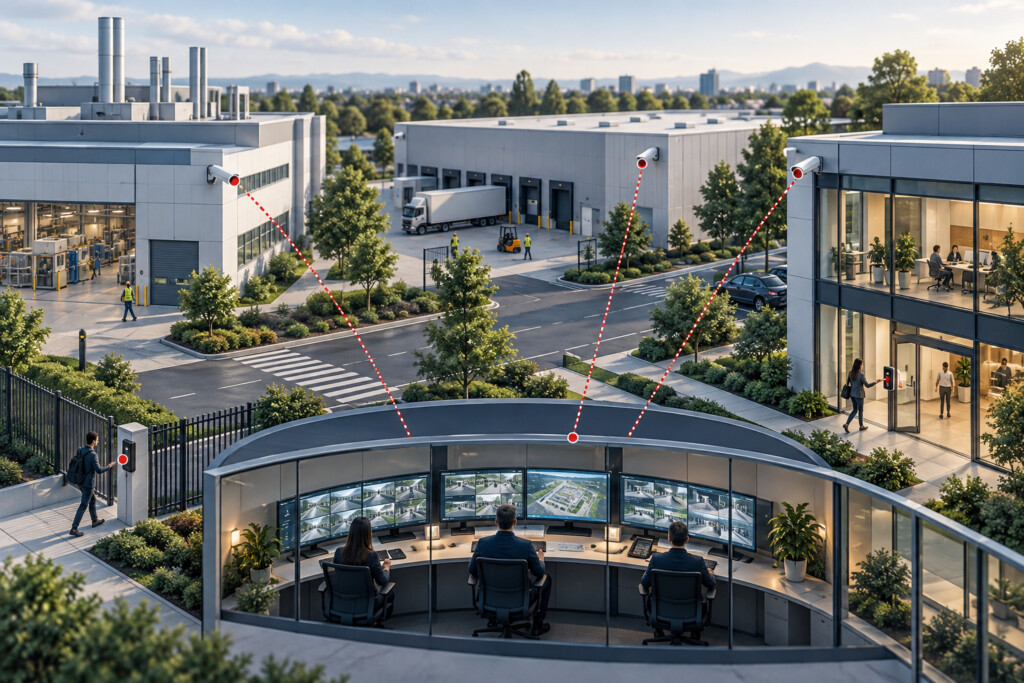


Enterprise security systems integration connects video, access control, alarms, and supporting infrastructure so people can manage security across buildings and locations. Northeast Remote Surveillance and Alarm, LLC helps commercial and industrial organizations plan supported integrations, clear responsibilities, reliable local operation, and a practical path for upgrades and growth.
Request an enterprise assessment 1-888-344-3846
NERSA supports small businesses, growing companies, and enterprise operations. This guide focuses on coordinating connected systems and shared responsibilities. For a focused business installation, start with Small Business Security Systems; for individual technologies, explore Commercial & Industrial Security Services.
What makes a security environment an enterprise system?
Enterprise requirements can arise in a single manufacturing campus or across a network of locations. The defining challenge is coordinating systems and responsibilities that cross buildings, departments, or administrative boundaries. Start by documenting the organization, regions, sites, buildings, and operating areas that the security platform must represent. A shared framework should make local differences visible rather than hide them behind identical equipment lists.
Recognize the signs of an enterprise planning gap
A growing organization may need several applications to investigate one event, depend on a former employee for administrator access, or discover that each branch follows a different permission standard. Other warning signs include untested outage behavior, inconsistent camera names, unsupported equipment, and no clear owner for recording failures. These are coordination problems. An enterprise assessment should connect them to a shared operating model and a practical sequence of improvements.
Connect workflows before selecting technology
Describe the event an operator must handle, the information needed to decide what happens next, and the person authorized to act. A door alarm may require the relevant camera view, a reliable location label, an escalation instruction, and an incident record. Confirm each interface against the exact hardware, software, licenses, and supported actions. An integration should have an identified owner on both sides and a test for loss of communication.
Establish organization-wide ownership
Assign corporate, regional, local, IT, and service responsibilities before accounts are created. Identify who approves permissions, maintains the device inventory, owns subscriptions, receives health alerts, and accepts completed work. Local managers may need operational control at their facility without authority to change the corporate standard. Exceptions should carry an owner, a reason, and a review date.
Choose cloud, on-premises, and hybrid functions deliberately
Decide separately where management, recording, identity, and event processing will operate. Cloud management can support central administration, while local components may preserve selected site functions during a wide-area interruption. On-premises operation brings responsibilities for servers, storage, updates, and recovery. A hybrid design must explain the boundary between local and hosted functions, the subscriptions involved, and how information reconciles after an outage. Validate these decisions with the customer’s IT team and the supported product configuration.
Make resilience and system health measurable
Specify the functions the organization needs to retain during loss of a link, server, recorder, or power source. Then identify how a failure is detected, who receives the alert, and who verifies restoration. Local door operation, recording, remote viewing, event delivery, and administration may behave differently. Acceptance should demonstrate the required behavior and record any gaps, rather than treating a redundancy feature or a green dashboard as proof of continuity.
Keep useful systems and plan the transition
A new enterprise layer does not automatically require replacing every camera, controller, or cable. Discovery should establish condition, compatibility, support status, administrative access, and the costs of retaining each component. Pilot the target operating model at a representative location, then schedule migration around occupied buildings and operational constraints. Define rollback criteria before a cutover begins.
What your enterprise security plan should deliver
The planning stage should produce decisions that the organization can approve and test: required operator workflows, customer account ownership, supported interfaces, local continuity requirements, rollout priorities, and acceptance criteria. Record unresolved questions with an owner and next step. This gives procurement, IT, facilities, and security teams a common basis for comparing proposals and approving work.
Move from assessment to an accepted operating environment
A coordinated project begins with discovery and an agreed basis of design. Next, validate critical integrations and a representative site before expanding through controlled rollout waves. At handover, the organization should receive the agreed administrator ownership, configuration records, device inventory, drawings, training, test evidence, and support contacts. Ongoing reviews then keep permissions, health reporting, documentation, and lifecycle priorities aligned with changes in the business.
Enterprise security integration FAQs
Can the enterprise layer work with several manufacturers?
Potentially. The assessment must confirm the exact devices, software versions, licenses, event types, and functions supported by each interface. A connection that displays video may not also support every analytic event, access command, or administrative task. Platform selection should follow the required workflows and a clear ownership plan for each integration.
Does every facility need identical equipment?
No. Common administration, naming, documentation, and acceptance standards can coexist with different local equipment and layouts. A smaller branch and a manufacturing campus may have different recording and connectivity needs while using the same organization-wide rules for approvals, site identifiers, and support responsibility.
Can modernization happen while facilities remain occupied?
A phased program can be planned around operating schedules, site constraints, and temporary procedures. Feasibility depends on the existing system and proposed changes. Establish coexistence, testing, and rollback conditions before each cutover, and coordinate any work affecting controlled doors or critical operations with the responsible project team.
What does NERSA need to scope the work?
Start with the locations involved, existing systems, current administrator responsibilities, known failures, and planned growth. Include available drawings and approximate camera and door counts. NERSA can discuss the discovery needed to resolve missing information and define a commercial scope for design, integration, deployment, and ongoing support.
Explore the enterprise security collection
- Enterprise Security System Modernization — Modernizing an enterprise security environment is a transition program across equipment, people, data, and operating procedures.
- Physical Security Network and Infrastructure for Enterprise Systems — Enterprise security infrastructure connects local equipment to shared management, identity, time, storage, and support services.
- Enterprise Security Operations — Enterprise security operations define how people use a shared security environment across locations.
- Enterprise Security by Industry — Enterprise standards must work across facilities with different operating conditions.
- Enterprise Security Planning and Procurement — Enterprise security procurement works best when proposals answer the same operating requirements.
- Enterprise Access Control Systems — Enterprise access control connects people, permissions, buildings, and administrative authority.
- Enterprise Video Security — Architecture, permissions, recording, resilience, and investigation across large and multi-site video environments.
- Managed Enterprise Security — Ongoing system health, administration, service coordination, and lifecycle support.
- Enterprise Security Platforms — Established platform guidance for compatibility, ownership, and long-term fit.
- Unified and Integrated Security Systems — Plan supported connections between security technologies around defined operator workflows.
- Multi-Site Enterprise Security — Coordinate shared standards and local responsibilities across facilities.
Let’s talk about your next step
Tell us what you want to improve and which locations are involved. We can help you work through the questions, check what your systems support, and define a practical project scope.