Northeast Remote Surveillance and Alarm, LLC designs, installs, upgrades, expands, repairs, integrates, and supports commercial access control systems in Easton, Pennsylvania for businesses that need dependable control over employee entrances, restricted areas, commercial doors, credentials, schedules, permissions, and recorded access activity.
NERSA supports qualifying offices, warehouses, distribution centers, manufacturing facilities, healthcare properties, contractor operations, industrial facilities, multi-tenant properties, commercial buildings, campuses, and multi-location organizations throughout Easton and surrounding Northampton County.
A properly designed commercial access-control system should help a business answer four basic questions:
- Who is permitted to enter?
- Which doors or areas may that person access?
- When is access permitted?
- What activity is recorded when the credential is used?
Access control is more than a reader mounted beside a door.
A dependable controlled opening may require the credential, reader, controller, lock, frame, latch, closer, exit hardware, power transfer, door contact, request-to-exit device, power supply, battery backup, field wiring, network communication, software, programming, and administrative procedures to work together correctly.
For broader property-wide security planning involving video surveillance, intrusion alarms, fire alarm systems, intercoms, monitoring, gates, and infrastructure, visit Commercial and Industrial Security Systems in Easton, PA.
For commercial access-control services throughout Pennsylvania and the Mid-Atlantic, visit Commercial and Industrial Access Control Systems.
Access Control Built Around the Complete Opening
Every controlled door should work correctly from the moment a credential is presented until the door closes and securely relatches.
Depending on the opening, the system may need to:
- Validate the credential
- Confirm the user’s permissions
- Apply the correct schedule
- Release compatible locking hardware
- Permit authorized entry
- Maintain required egress
- Detect door position
- Recognize request-to-exit activity
- Relock correctly
- Identify selected forced-door conditions
- Identify selected held-open conditions
- Record useful access activity
Many problems that appear to involve access-control electronics are actually problems with the physical door or hardware.
A valid credential may be accepted while the door remains locked because of:
- Failing electrified hardware
- Insufficient lock power
- Damaged wiring
- Door or frame misalignment
- Mechanical pressure on the latch
- Worn exit hardware
- Incorrect programming
The opposite problem can also occur.
A door may release correctly but fail to close and latch afterward, leaving an electronically controlled opening physically unsecured.
NERSA evaluates the complete controlled opening so the electronic system and the physical door work together.
Commercial Access Control for Easton Properties
Electronic access control can help businesses manage movement through their properties without relying entirely on mechanical keys or shared door codes.
Common controlled areas may include:
- Employee entrances
- Rear and side exterior doors
- Office suites
- Tenant entrances
- Warehouse personnel doors
- Office-to-warehouse transitions
- Shipping offices
- Production areas
- Inventory rooms
- Tool rooms
- IT and telecommunications rooms
- Records areas
- Maintenance spaces
- Restricted departments
- Detached buildings
- After-hours entrances
- Selected vehicle gates
Access should reflect what each employee, manager, contractor, vendor, tenant, or administrator actually needs.
A warehouse employee may require one staff entrance and selected operational spaces.
A supervisor may need broader access.
A contractor may need temporary access through one exterior entrance and into one mechanical room.
An office employee may need administrative-area access without unrestricted entry into warehouse, inventory, or production spaces.
Electronic access control makes those differences easier to manage through individual credentials, schedules, permissions, and controlled doors.
Cards, Key Fobs, Mobile Credentials, and PINs
Commercial access-control systems can support several credential methods depending on the equipment, property, workforce, and operating requirements.
Options may include:
- Cards
- Key fobs
- Mobile credentials
- Individual PINs
- Other compatible electronic credentials
Credential selection should consider:
- Number of employees
- Employee turnover
- Operating environment
- Administrator responsibilities
- Lost-credential procedures
- Temporary personnel
- Future expansion
Where individual accountability matters, individually assigned credentials generally provide better administration than shared cards or shared codes.
User Permissions
A credential should not function as an unrestricted master key unless the user’s responsibilities genuinely require that level of access.
Permissions may be organized according to:
- Employee
- Department
- Job responsibility
- Shift
- Door
- Building
- Tenant
- Restricted area
- Contractor assignment
- Temporary project
- Management role
This allows management to provide the access people need without automatically giving them unrestricted entry throughout the property.
Access Schedules
Access can also be limited according to time.
Schedules may reflect:
- Weekday operating hours
- Evening shifts
- Overnight shifts
- Weekend work
- Holidays
- Cleaning schedules
- Contractor work periods
- Vendor access
- Temporary projects
- Maintenance windows
- After-hours authorization
A contractor who needs access for a limited project should not automatically retain unrestricted access after that work is completed.
Employee Onboarding and Offboarding
Access-control administration should include clear procedures for employees entering, changing roles within, and leaving the organization.
Businesses should establish responsibility for:
- Creating users
- Issuing credentials
- Assigning permissions
- Changing permissions
- Handling lost credentials
- Removing former employees
- Reviewing inactive users
- Protecting administrator accounts
When an employee changes departments, shifts, locations, or responsibilities, existing permissions should be reviewed rather than simply adding additional access.
When employment ends, electronic credentials should be disabled promptly.
Customer-Controlled Administration
The customer should understand who controls the access-control system.
Important administrative questions include:
- Who owns the primary account?
- Who has administrator privileges?
- Who can create or remove users?
- Who can change schedules?
- Who can modify door permissions?
- How is administrator access recovered?
- What recurring licensing or service costs apply?
- What happens during a communication interruption?
- How can system control be transferred if necessary?
Clear customer ownership reduces the risk of a business becoming dependent on a former employee or previous service provider to administer its own system.
Cloud, On-Premises, and Hybrid Systems
Commercial access control can use cloud-managed, locally hosted, or hybrid administration.
The appropriate approach depends on factors such as:
- Number of doors
- Number of users
- Number of buildings
- Remote-management requirements
- Network availability
- IT resources
- Licensing
- Reporting requirements
- Administrator responsibilities
- Future growth
A smaller business with several doors may have different requirements than a multi-building organization with multiple administrators and hundreds of credentials.
The system should fit the customer’s actual operation rather than forcing every property into the same platform or management model.
Planning for Current and Future Growth
A smaller Easton business may initially require only one or two controlled entrances.
As the organization grows, it may later need:
- Additional doors
- Additional employees
- Restricted departments
- Mobile credentials
- Additional tenant areas
- Another floor
- Another building
- Multiple administrators
- Remote management
The system should satisfy today’s requirements without unnecessarily limiting reasonable future expansion.
Easton Commercial Access Control Resources
For completely new commercial access-control system design, door hardware, credentials, user permissions, schedules, controller setup, testing, and turnover, visit Commercial Access Control Installation in Easton, PA.
For warehouse personnel doors, inventory areas, restricted rooms, office-to-warehouse transitions, secured cages, and warehouse-specific controlled entry, visit Warehouse Access Control Systems in Easton, PA.
For warehouse employee entrances, individual staff credentials, shift-based permissions, temporary personnel, and workforce access, visit Warehouse Employee Access Control Systems in Easton, PA.
For dock-adjacent personnel doors, shipping and receiving entrances, vendor schedules, employee dock access, and after-hours entry around active loading operations, visit Loading Dock Access Control in Easton, PA.
For employee vehicle entrances, truck gates, contractor entry, vendor traffic, deliveries, gate credentials, and after-hours vehicle access, visit Commercial Gate Access Control Systems in Easton, PA.
For production-area entrances, maintenance rooms, tool rooms, contractor access, manufacturing shifts, and restricted production spaces, visit Manufacturing Access Control Systems in Easton, PA.
For employee entrances, tenant suites, shared building doors, server rooms, records areas, common-area access, and separated tenant administration, visit Office & Multi-Tenant Access Control Systems in Easton, PA.
For staff entrances, medical records areas, supply and medication rooms, restricted healthcare spaces, contractor access, and after-hours staff entry, visit Healthcare & Medical Office Access Control in Easton, PA.
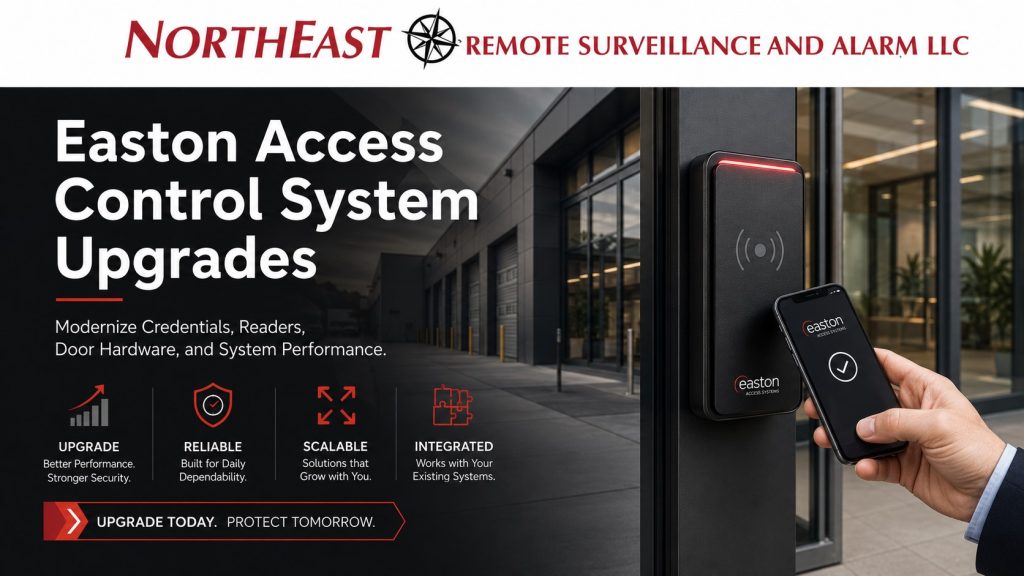
For older readers, unsupported controllers, outdated credentials, additional controlled doors, administrator cleanup, system takeover, migration, and modernization, visit Easton Access Control System Upgrades.
For electric strikes, electrified trim, exit devices, readers, keypads, request-to-exit devices, door contacts, power transfer, and modernization of existing controlled openings, visit Easton Door Hardware & Access Control Retrofits.
For failed readers, intermittent credentials, door unlock problems, controller communication faults, power-supply issues, door contacts, request-to-exit devices, wiring problems, and troubleshooting of existing systems, visit Access Control Maintenance & Repair in Easton, PA.
For individual employee cards, key fobs, compatible readers, credential enrollment, lost-credential replacement, door permissions, and schedule-based access, visit Keycard & Key Fob Access Control Systems in Easton, PA
For smartphone-based employee entry, mobile credential enrollment, individual user permissions, access schedules, lost-device management, and compatible mobile-enabled readers, visit Mobile Credential Access Control Systems in Easton, PA
Access Control for Easton and the Route 33 Commercial Corridor
Easton, Palmer Township, Forks Township, Wilson, West Easton, Williams Township, and the Route 33 and I-78 commercial corridors include warehouses, distribution facilities, manufacturing operations, contractor properties, offices, industrial buildings, and mixed commercial sites with varied access requirements.
These properties may involve:
- Multiple work shifts
- Large employee populations
- Contractors
- Vendors
- Delivery personnel
- Temporary employees
- Restricted inventory
- Production spaces
- Vehicle entrances
- After-hours activity
Access control should support everyday operations without giving every employee, contractor, vendor, or temporary worker unrestricted access throughout the property.
Existing Access-Control Systems
Not every existing system requires complete replacement.
Existing components may remain useful when they are compatible, dependable, serviceable, supported, and appropriate for the completed system.
Equipment that may be evaluated includes:
- Readers
- Keypads
- Credentials
- Controllers
- Field wiring
- Door hardware
- Power supplies
- Batteries
- Door contacts
- Request-to-exit devices
- Network communication
- Software
- Administrator accounts
A careful evaluation can help determine which components should remain and which should be corrected or modernized.
For modernization, migration, takeover, or broader improvement of an existing system, visit Easton Access Control System Upgrades.
The NERSA Access Control Process
Facility and Door Assessment
NERSA reviews the property, proposed controlled openings, existing doors and frames, locking hardware, employee and visitor movement, operating schedules, wiring, available power, network conditions, and known concerns.
User and Permission Planning
Employees, managers, contractors, vendors, tenants, temporary personnel, and administrators are organized according to the access each role actually requires.
System Design
Readers, controllers, credentials, locking hardware, door contacts, request-to-exit devices, power supplies, communication paths, software, and administrator responsibilities are coordinated around the approved controlled openings.
Installation and Configuration
Approved equipment is installed and configured according to the project’s doors, users, credentials, schedules, permissions, and operating requirements.
Testing and Commissioning
Controlled openings are tested for:
- Credential response
- Door release
- Relocking
- Closing and latching
- Door-position monitoring
- Request-to-exit operation
- User permissions
- Access schedules
- Communication
- Included system functions
Administrator Training
Authorized customer personnel can be trained to manage users, credentials, permissions, schedules, lost credentials, temporary access, and routine system administration.
Documentation
Documentation may identify:
- Controlled doors
- Controller assignments
- Credential technology
- Access levels
- Schedules
- Equipment
- Administrator information
- Network requirements
- Other information needed to support the system
Why Easton Businesses Choose Northeast Remote Surveillance and Alarm
Northeast Remote Surveillance and Alarm, LLC has focused on commercial and industrial electronic security systems since 2008.
NERSA approaches access control as part of the property and its daily operation rather than simply installing a reader beside a door.
The objective is to provide:
- Dependable controlled openings
- Manageable user permissions
- Reliable door operation
- Clear customer ownership
- Useful access records
- Practical documentation
- Future expansion capability
Frequently Asked Questions
What does commercial access control do?
Commercial access control manages who may enter selected doors or areas, when entry is permitted, and what activity is recorded through credentials, permissions, schedules, controllers, locking hardware, and management software.
What types of Easton properties use access control?
Commercial access control can be used in offices, warehouses, distribution centers, manufacturing facilities, healthcare properties, industrial buildings, contractor facilities, multi-tenant properties, commercial campuses, and multi-location organizations.
Can different employees have different permissions?
Yes. Permissions can generally be organized according to user, department, job responsibility, shift, door, building, schedule, tenant, contractor assignment, or management responsibility.
Can lost credentials be disabled?
Yes. Compatible systems allow individual credentials to be disabled without changing access for every other user or rekeying every controlled opening.
Can access be limited according to work schedules?
Yes. Compatible systems can allow credentials to operate only during approved periods.
Can existing access-control equipment be reused?
Sometimes. Existing readers, controllers, wiring, locking hardware, credentials, power supplies, and other components should be evaluated for condition, compatibility, reliability, supportability, and future usefulness.
Can an existing system be expanded?
Sometimes. Expansion depends on controller capacity, licensing, software, wiring, power, network infrastructure, locking hardware, and the capabilities of the existing system.
Can one system manage multiple buildings?
Compatible commercial systems can support users, credentials, doors, schedules, permissions, and administrators across multiple buildings or locations.
Can access control work with existing commercial doors?
Often, yes. The door, frame, locking hardware, wiring, power, exit hardware, and required operation should be evaluated before electronic access control is added or modified.
Does NERSA work only with commercial properties?
Yes. Northeast Remote Surveillance and Alarm focuses on commercial and industrial systems.
Request an Easton Commercial Access Control Assessment
If your Easton business needs a new access-control system, additional controlled doors, better credential management, modernization of an existing system, door-hardware corrections, or a practical path for future expansion, Northeast Remote Surveillance and Alarm, LLC can evaluate the property and discuss the available options.
Request an Easton Commercial Access Control Assessment or call 1-888-344-3846