Video Surveillance, Access Control, Intrusion Alarms, Fire Alarm Systems, Monitoring, Intercoms, Upgrades, and Low-Voltage Infrastructure
Greater Reading Area commercial and industrial security systems should be planned around how each property actually operates—not around a predetermined camera count, alarm package, product manufacturer, or collection of disconnected devices.
Northeast Remote Surveillance and Alarm, LLC designs, installs, integrates, monitors, upgrades, takes over, and supports security, life-safety, and low-voltage systems for qualifying non-residential properties throughout Reading and Berks County.
NERSA supports projects for:
- Warehouses and distribution facilities
- Manufacturing plants and industrial properties
- Commercial offices and multi-tenant buildings
- Healthcare and medical facilities
- Schools and educational properties
- Municipal and institutional buildings
- Contractor yards and service facilities
- Industrial parks and commercial campuses
- Smaller commercial properties
- Multi-building and multi-location organizations
A project may involve several cameras, one controlled employee entrance, or a professionally monitored business alarm. Larger properties may require multi-building video surveillance, access control, intrusion detection, fire-alarm coordination, remote video monitoring, visitor entry, gates, fiber infrastructure, and centralized administration.
Since 2008, NERSA has focused on professionally planned systems for commercial and industrial environments. Each project begins with the property, operating conditions, users, existing equipment, required response, infrastructure, and long-term objectives.
Request a Greater Reading Commercial Security Assessment or call 1-888-344-3846.
Commercial and Industrial Only | Establishedin 2008 | New Installations | Upgrades | Retrofits | Takeovers | Monitoring | Small Business Through Enterprise
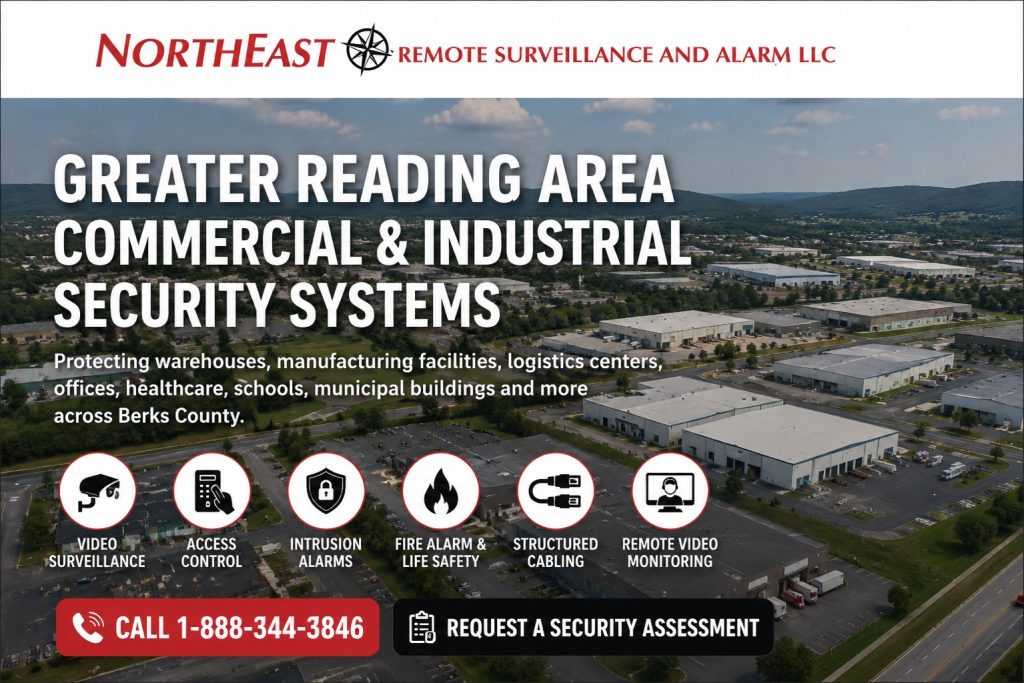
Commercial Security Planning Across Greater Reading and Berks County
Greater Reading and Berks County contain a wide range of operating environments, including older masonry buildings, renovated commercial properties, converted industrial structures, modern warehouses, manufacturing plants, office campuses, healthcare buildings, schools, municipal facilities, business parks, and multi-building industrial sites.
Each environment creates different security requirements.
An older commercial building may require careful planning around thick walls, limited cable pathways, older doors and frames, separate additions, legacy telephone service, mixed analog and IP equipment, and devices installed by several providers over many years.
A manufacturing facility may require installation phases coordinated around production, machinery, employee shifts, maintenance activity, restricted processes, contractor access, material movement, inspections, and permitted downtime.
A distribution or logistics property may require coordinated visibility and control across:
- Loading docks and overhead doors
- Shipping and receiving
- Truck courts and trailer areas
- Driver and visitor arrival
- Employee entrances
- Inventory and staging areas
- Parking and pedestrian routes
- Exterior equipment and material storage
- Vehicle gates
- Multiple shifts and after-hours activity
A multi-tenant property may require separate credentials, alarm partitions, camera permissions, visitor procedures, monitoring contacts, and administrative responsibilities for the building owner, property manager, and individual tenants.
Healthcare, educational, municipal, and institutional properties may combine public entry with staff-only areas, controlled records, panic or duress locations, privacy-sensitive spaces, parking exposure, after-hours occupancy, accessibility requirements, and life-safety-sensitive doors.
A Greater Reading commercial security assessment may evaluate:
- How employees, visitors, vendors, contractors, and drivers enter
- Which doors, rooms, departments, buildings, and gates require controlled access
- Which camera views require general awareness, identification, vehicle, plate, or transaction detail
- How deliveries, freight, inventory, tools, and equipment move through the property
- Where intrusion detection, video verification, or active monitoring is appropriate
- How alarms should be divided by tenant, department, building, or schedule
- Whether installed cameras, panels, readers, locks, cabling, networks, and power remain usable
- Who will administer credentials, video, alerts, monitoring contacts, and reports
- How emergency egress, accessibility, fire-alarm operation, and electrified doors must be coordinated
- How the system should support additional cameras, doors, buildings, departments, or business locations
The objective is not to install the greatest possible number of devices. The objective is to provide useful visibility, controlled access, dependable detection, practical response, clear administration, and a system that remains supportable after installation.
Greater Reading and Berks County Planning Resources
Properties throughout the region have different operating patterns, building conditions, and infrastructure requirements.
Commercial Security System Installation in Reading, PA
Use the Reading city resource for commercial and industrial properties located within Reading. It covers city-specific installation, integration, monitoring, upgrades, and facility planning.
Greater Reading Area Industrial Park Directory
Use the industrial park directory for warehouses, manufacturing concentrations, logistics properties, business parks, industrial campuses, and multi-building commercial developments throughout Greater Reading.
Reading Regional Airport Business Park Security Directory
Use this resource for airport-area warehouses, aviation-support businesses, manufacturing properties, freight operations, parking areas, vehicle movement, and controlled commercial entrances.
Berks County Industrial and Logistics Properties
Berks County warehouse, freight, manufacturing, trailer, loading-dock, gate, and logistics projects may require corridor-level planning that connects the facility with surrounding highways, labor movement, vendors, drivers, and regional supply-chain activity.
The regional assessment process can identify the correct city, industrial-park, facility, service, or upgrade resource without creating a generic equipment package.
Commercial Security Services for Greater Reading Businesses
NERSA supports focused individual systems and coordinated multi-system projects. The correct combination depends on the property, existing equipment, users, operating requirements, infrastructure, risks, and intended response.
For NERSA’s complete companywide service structure, visit Commercial and Industrial Security Services.
Commercial Video Surveillance
Commercial video surveillance may support entrances, parking areas, loading docks, warehouses, production spaces, restricted rooms, vehicle lanes, exterior storage, incident review, and evidence export.
Planning may involve:
- Interior and exterior IP cameras
- On-premise, cloud-managed, or hybrid video
- Recording and retention
- Secure remote access
- Low-light and nighttime performance
- Video analytics
- AI-supported event search
- Camera-health reporting
- User permissions
- Multi-building and multi-site administration
Compatible legacy cameras may sometimes gain improved analytics or search through a newer recorder, video-management system, analytics appliance, cloud connector, or selective camera replacement.
AI cannot create detail that the original camera failed to capture. Camera position, lighting, target size, resolution, frame rate, scene stability, and network performance remain essential.
Commercial Access Control
Commercial access control helps businesses manage who may use selected doors or gates, which areas each person may enter, when access is allowed, and how supported credential activity is documented.
A complete controlled opening may include:
- Cards, key fobs, mobile credentials, or PINs
- Readers and controllers
- Employee, tenant, contractor, and visitor permissions
- Shift and holiday schedules
- Door-position monitoring
- Forced-door and held-open events
- Electric strikes or electrified locks
- Panic hardware
- Request-to-exit equipment
- Power supplies and wiring
- Camera association
- Remote and multi-building administration
The reader is only one component. The door, frame, hinges, closer, locking hardware, exit device, power, accessibility, emergency egress, fire rating, and required fire-alarm interface must operate together.
Commercial Intrusion Alarms
Commercial intrusion systems help detect defined activity when a property is closed, partially occupied, or operating with reduced staffing.
Planning may include:
- Personnel-door contacts
- Overhead-door protection
- Interior motion detection
- Restricted-room protection
- Alarm partitions
- Individual users
- Shift and holiday schedules
- Panic or duress devices
- Cellular or IP communication
- Video verification
- Professional central-station monitoring
Alarm zones should identify the actual location involved. “Rear warehouse employee entrance” provides more useful information than a generic label such as “Zone 4.”
Professional Commercial Security Monitoring
Professional monitoring provides a structured response path for approved intrusion, fire, panic, supervisory, environmental, trouble, and communication-related signals.
A complete monitoring arrangement should define:
- Which signals are transmitted
- How each point is identified
- Which communication path is used
- Which account receives the event
- Who receives notifications
- Which response instructions apply
- How contacts and account information are updated
- How signals are tested
- What procedures apply during service or impairment
Monitoring information should be reviewed whenever ownership, management, contacts, tenants, operating hours, equipment, communication services, or providers change.
Remote Video Monitoring and Live Talk-Down
Remote video monitoring can add professional operator review and documented response to selected camera events.
Depending on the approved design, monitored video may support:
- After-hours person or vehicle alerts
- Parking areas
- Loading docks
- Exterior storage
- Gates and vehicle approaches
- Fence lines
- Contractor yards
- Visual event verification
- Live audio warnings
- Responsible-party notification
- Escalation under written instructions
Remote viewing allows an authorized customer to access live or recorded video. Remote video monitoring adds an operator-review and response process for selected cameras, schedules, analytics rules, contacts, and event procedures.
No camera, alarm, analytics, or monitoring system can guarantee that every event will be detected, prevented, interrupted, or stopped.
Commercial Fire Alarm and Life-Safety Systems
Qualifying commercial fire-alarm projects may involve:
- Fire-alarm control equipment
- Smoke and heat detection
- Manual initiation
- Audible and visible notification
- Sprinkler waterflow and supervisory monitoring
- Fire-alarm communication
- Remote annunciation
- Elevator and HVAC interfaces
- Controlled-door release
- Monitoring
- Approved additions
- Communicator modernization
- Existing-system upgrades
- Testing and documentation
Requirements depend on the property, occupancy, scope, approved documents, responsible design professionals, adopted requirements, permits, inspections, and Authority Having Jurisdiction direction.
Electronic security equipment must not interfere with required emergency egress, fire-door operation, panic hardware, accessibility, sprinkler equipment, or approved fire-alarm operation.
Commercial Intercom, Paging, and Controlled Entry
Commercial intercom and paging systems may support:
- Video-entry intercoms
- Reception communication
- Employee entrances
- Loading-dock call stations
- Gate intercoms
- Office-to-warehouse paging
- Plant-floor announcements
- Remote or mobile answering
- Compatible door or gate release
- IP speakers
- Scheduled operational messages
Visitor communication does not independently confirm identity or authorization. Employees should continue following approved visitor, vendor, contractor, delivery, and access procedures before releasing an opening.
Properties requiring structured registration, badges, host notification, contractor records, or temporary permissions may also need Enterprise Visitor Management Systems.
Gate, Yard, and Vehicle-Entry Security
Commercial gate and yard security may coordinate:
- Gate operators
- Keypads and credential readers
- Intercoms
- Remote release
- Gate-position monitoring
- Vehicle and overview cameras
- License-plate capture
- Access schedules
- Visitor and delivery procedures
- Safety loops
- Photo eyes
- Emergency controls
Vehicle-entry planning should consider passenger vehicles, commercial trucks, driver position, lane geometry, lighting, network connectivity, emergency access, safety requirements, and the distance between the gate and staffed building.
Low-Voltage Cabling and Security Infrastructure
Commercial security systems depend on properly planned cabling, networking, switching, power, equipment rooms, and communication infrastructure.
Projects may involve:
- Cat6 or Cat6A cabling
- Fiber-optic backbones
- Building-to-building fiber
- Managed PoE switches
- Wireless bridges
- Equipment racks and cabinets
- Patch panels
- UPS backup
- Surge protection
- Network segmentation
- Outdoor-rated pathways
- Weather-rated enclosures
- Cable and device labeling
- Switch-port records
- System diagrams
A switch may have open ports but insufficient PoE power for additional devices. A wireless link may show connectivity but lack the bandwidth or stability required for dependable video.
Unified Commercial Security Systems
Compatible cameras, access control, intrusion alarms, intercoms, gates, monitoring, sensors, and reporting may be coordinated through a unified security environment.
Useful integrations may associate:
- Door events with video
- Alarm activity with camera verification
- Intercom calls with authorized release
- Gate activity with vehicle views
- Monitored events with audio response
- Several buildings with centralized administration
Integration should solve a defined operational, investigative, or response problem. It should not add unnecessary software, licenses, dependencies, or administrative complexity merely because an integration is technically available.
Multi-Site Commercial Security Systems
Organizations operating several locations may need:
- Central and local administrator roles
- Shared credential standards
- Consistent camera, door, and alarm naming
- Common monitoring procedures
- Location-specific permissions
- Standard retention expectations
- Repeatable new-site deployment
- Centralized user removal
- Consistent documentation
- Planned platform migrations
Not every property requires identical equipment. Administration, terminology, account ownership, response procedures, and documentation should remain understandable across the organization.
Commercial Security-System Upgrades, Retrofits, and Takeovers
Many regional projects begin with installed equipment rather than an empty building.
A property may have:
- Aging analog or IP cameras
- An unreliable recorder
- Short video retention
- Unsupported access-control software
- Former employees with active credentials
- Shared alarm codes
- Obsolete communication paths
- Cloud accounts controlled by a previous provider
- Unknown administrator passwords
- Damaged cabling
- Undersized PoE switches
- Missing documentation
- No practical expansion path
NERSA evaluates what is installed before recommending replacement.
The correct path may involve repair, repositioning, reprogramming, account recovery, provider takeover, equipment expansion, targeted replacement, phased migration, platform standardization, or complete modernization.
Existing equipment should be retained only when testing confirms that it remains compatible, dependable, appropriately installed, supportable, and suitable for the completed system.
Security Planning by Greater Reading Property Type
For the complete property structure, visit Industries We Serve.
Warehouses, Distribution, Logistics, and Freight Properties
These facilities may require coordinated security around loading docks, overhead doors, shipping offices, employee entrances, inventory areas, trailer activity, truck courts, parking, gates, intrusion detection, monitoring, and longer video retention.
The system should follow the way drivers, employees, vendors, freight, trailers, and materials move through the property.
Manufacturing and Industrial Facilities
Manufacturing security may involve production-floor visibility, restricted processes, employee and contractor entrances, maintenance departments, tool rooms, raw materials, finished goods, shipping, exterior operations, and infrastructure connecting multiple building sections.
Installation and testing may need to be phased around production and permitted downtime.
Offices and Multi-Tenant Properties
Office and multi-tenant security may support reception, public entrances, tenant suites, employee doors, common corridors, parking, deliveries, information-technology rooms, records areas, shared loading spaces, and separate permissions for tenants or departments.
Owner, property-management, and tenant responsibilities should be established for system administration, accounts, cameras, credentials, alarm partitions, monitoring, and user removal.
Healthcare, Education, Municipal, and Institutional Properties
These properties may require additional planning around public access, staff-only areas, reception, controlled records, panic or duress locations, visitor communication, accessibility, parking, after-hours occupancy, emergency procedures, and life-safety coordination.
System access and administration should remain limited to authorized personnel whose permissions match their responsibilities.
Smaller Commercial and Multi-Location Organizations
A smaller business may need several properly positioned cameras, a professionally monitored intrusion alarm, one controlled entrance, an intercom, panic protection, or another focused commercial requirement.
A larger organization may require extensive video, multiple controlled doors, separate alarm areas, fiber, gates, monitoring, centralized administration, and phased deployment across several locations.
The system should match the operation without forcing unnecessary complexity or limiting realistic expansion.
Coordinating Cameras, Doors, Alarms, Monitoring, and Infrastructure
A Greater Reading commercial property may need one focused system, but larger or more complex facilities often benefit when related systems are planned together.
Video can provide visual context for credential events, alarm activity, visitor entry, loading-dock incidents, vehicle movement, and monitored exterior events.
Access control can reduce unmanaged-key exposure while documenting supported credential activity at selected doors and gates.
Intrusion detection can protect unoccupied portions of a facility while another department or tenant remains active.
Intercoms can give employees a controlled way to communicate with visitors, drivers, vendors, and contractors before releasing a door or gate.
Professional monitoring can add a documented response path when local management is unavailable.
Cabling, fiber, network switches, power supplies, backup power, and equipment rooms provide the physical foundation supporting connected systems.
The project should coordinate these functions only where doing so improves operation, investigation, response, or administration.
Greater Reading Commercial Security Project Process
1. Facility and Operational Discovery
NERSA reviews the property, operating schedule, people and vehicle movement, entrances, loading areas, parking, restricted rooms, existing concerns, monitoring procedures, and the results management expects.
2. Existing-System and Infrastructure Review
When equipment is installed, the assessment may identify cameras, recorders, readers, panels, sensors, door hardware, communicators, cabling, fiber, switches, power supplies, administrator accounts, software, licenses, documentation, and known deficiencies.
3. System and Reuse Planning
The proposed design identifies what can remain, what requires correction, which equipment should be upgraded, what must be replaced, and whether the project should be completed at once or through a phased migration.
4. Written Scope and Project Coordination
The proposal should define equipment, quantities, general locations, cabling, software, licenses, storage assumptions, monitoring, integrations, customer responsibilities, exclusions, testing, training, documentation, and required work by other contractors.
5. Installation, Programming, and Testing
Approved equipment is installed, configured, labeled, aimed, programmed, and tested around the property’s operation, employee access, deliveries, production, occupied areas, network requirements, and permitted downtime.
6. Training, Documentation, and Handoff
Authorized customer personnel receive included operating guidance, user-management procedures, camera and door names, alarm descriptions, monitoring contacts, administrative information, known limitations, and future recommendations.
7. Service and Lifecycle Planning
The completed system should support employee and tenant changes, additional credentials, new cameras, controlled openings, software updates, monitoring-account changes, equipment replacement, building additions, and future locations.
Professional Monitoring Through our 3rd Party Monitoring
NERSA provides qualifying commercial alarm and fire-alarm monitoring through 3rd party Monitoring.
Our 3rd party monitoring describes its monitoring infrastructure as three UL-listed, geographically distributed monitoring stations. The locations are described as hot-redundant, continuously staffed, and load-sharing, with incoming alarms routed across the network to an available dispatcher.
Our Monitoring services also identifies its monitoring operation as:
- FM approved
- IQ certified
- TMA Five Diamond certified
- Subject to SOC 2 control audits and attestations
NERSA coordinates the customer-facing portion of the approved monitoring arrangement, which may include:
- Field-system installation or takeover
- Communicator setup
- Account coordination
- Point and zone descriptions
- Responsible-party information
- Response instructions
- Communication-path testing
- Signal testing
- Contact updates
- Documentation
- Service and customer support
Credentialed central-station infrastructure does not correct a failed device, disabled point, defective communicator, inaccurate account, obsolete contact list, or incorrectly programmed signal.
The complete monitoring arrangement must be tested, documented, maintained, and updated.
Why Greater Reading Organizations Work With NERSA
Northeast Remote Surveillance and Alarm, LLC provides:
- Commercial and industrial systems only
- Non-residential experience since 2008
- Small-commercial through enterprise capability
- Facility-specific assessments
- New installations and expansions
- Existing-system upgrades and takeovers
- Video surveillance
- Access control
- Intrusion detection
- Fire alarm systems
- Professional monitoring
- Remote video monitoring and live talk-down
- Intercoms and visitor entry
- Gate and vehicle access
- Unified and multi-site security
- Structured cabling, fiber, networks, and PoE
- Existing-equipment reuse analysis
- Customer-controlled account planning
- Testing, training, labeling, and documentation
- Long-term serviceability and expansion planning
NERSA is also a Greater Reading Chamber Alliance member supporting the region’s commercial and industrial business community.
Chamber membership reflects participation in the regional business community. It is not a technical certification, contractor license, permit, manufacturer authorization, code approval, endorsement, or guarantee of performance.
A commercial security provider should ultimately be evaluated through its technical capability, proposed scope, communication, monitoring arrangement, customer account ownership, testing, documentation, service expectations, and ability to support the property over time.
Technically reviewed by Keith Maxwell, Northeast Remote Surveillance and Alarm, LLC.
Greater Reading and Berks County Service Area
NERSA supports qualifying commercial and industrial projects in:
- Reading
- West Reading
- Wyomissing
- Shillington
- Sinking Spring
- Laureldale
- Temple
- Muhlenberg Township
- Exeter Township
- Spring Township
- Cumru Township
- Bern Township
- Fleetwood
- Kutztown
- Hamburg
- Birdsboro
- Morgantown
- Surrounding Berks County commercial markets
Service availability depends on the property location, requested systems, technical scope, permitting and inspection responsibilities, scheduling, travel requirements, and long-term support needs.
Request a Greater Reading Commercial Security Assessment
A Greater Reading or Berks County property may need a new security system, additional cameras or controlled doors, professional monitoring, stronger visitor entry, loading-area visibility, fire-alarm work, infrastructure correction, an inherited-system takeover, or a phased modernization plan.
NERSA can review the property, installed systems, operating conditions, users, risks, infrastructure, monitoring, documentation, immediate priorities, and future plans before recommending a project path.
Request a Greater Reading Commercial Security Assessment or call 1-888-344-3846.
Commercial and Industrial Only | New Installations | Upgrades | Retrofits | Takeovers | Monitoring | Small Business Through Enterprise
Frequently Asked Questions About Greater Reading Commercial Security Systems
Which Greater Reading and Berks County properties does NERSA serve?
NERSA supports qualifying warehouses, manufacturing plants, distribution facilities, offices, healthcare properties, schools, municipal buildings, institutional facilities, contractor yards, industrial parks, multi-tenant properties, and multi-site organizations.
Does NERSA install residential security systems?
No. Northeast Remote Surveillance and Alarm, LLC focuses on commercial, industrial, institutional, municipal, educational, healthcare, warehouse, manufacturing, logistics, contractor, and other non-residential properties.
Can NERSA support a smaller commercial property?
Yes. A smaller business may begin with several cameras, a monitored intrusion alarm, one controlled employee entrance, an intercom, panic protection, or another focused commercial requirement.
Can NERSA support warehouses and large industrial facilities?
Yes. Systems can be planned for loading docks, truck courts, trailer areas, controlled employee entrances, alarm partitions, gates, license-plate cameras, fiber infrastructure, remote monitoring, and centralized administration.
Can NERSA take over a system installed by another provider?
Yes. NERSA can evaluate qualifying cameras, access control, alarms, monitoring paths, door hardware, cabling, networks, administrator access, software, users, accounts, and documentation to determine what may be retained, repaired, upgraded, integrated, or replaced.
Do cameras replace a commercial intrusion alarm?
No. Cameras provide visual information and recorded evidence. Intrusion alarms detect defined conditions and initiate approved notifications, verification, or monitoring procedures. Compatible systems may work together to provide stronger event context.
What is the difference between remote viewing and remote video monitoring?
Remote viewing allows an authorized customer to access live or recorded video. Remote video monitoring adds professional operator review and response for selected cameras, schedules, analytics rules, contacts, and documented events.
Can cameras, access control, alarms, and intercoms work together?
Yes, when compatible systems and the project requirements support coordination. Video may assist with door-event review, cameras may support alarm verification, and intercom calls may be coordinated with authorized door or gate release.
Can NERSA support commercial fire-alarm projects?
Yes. NERSA supports qualifying commercial fire-alarm installation, monitoring, communicator, sprinkler-supervision, documentation, upgrade, and coordination projects according to the property, system, project responsibilities, and applicable authority requirements.
Can existing cabling and equipment be reused?
Sometimes. Reuse depends on physical condition, compatibility, installation quality, supportability, capacity, administrator access, test results, documentation, and whether the equipment can meet the completed system’s requirements.
Can several business locations be managed together?
Yes. Compatible systems may centralize video, credentials, alarm reporting, monitoring procedures, administrator roles, system-health information, and location-specific permissions across several properties.
Can installation be completed while a facility remains operational?
Many projects can be phased around production, employee shifts, deliveries, public access, school schedules, restricted areas, network changes, lift access, inspections, and approved downtime.
How does a Greater Reading commercial security project begin?
The project begins with a facility-specific assessment that identifies the operating problem, installed systems, building conditions, infrastructure, required result, administrative responsibilities, and future plans before equipment is selected.
Call 1-888-344-3846 or use the Greater Reading Commercial Security Assessment form to begin.