
Multi-site commercial security planning in Reading, PA helps organizations coordinate cameras, access control, alarms, and support across Reading and Berks County properties.

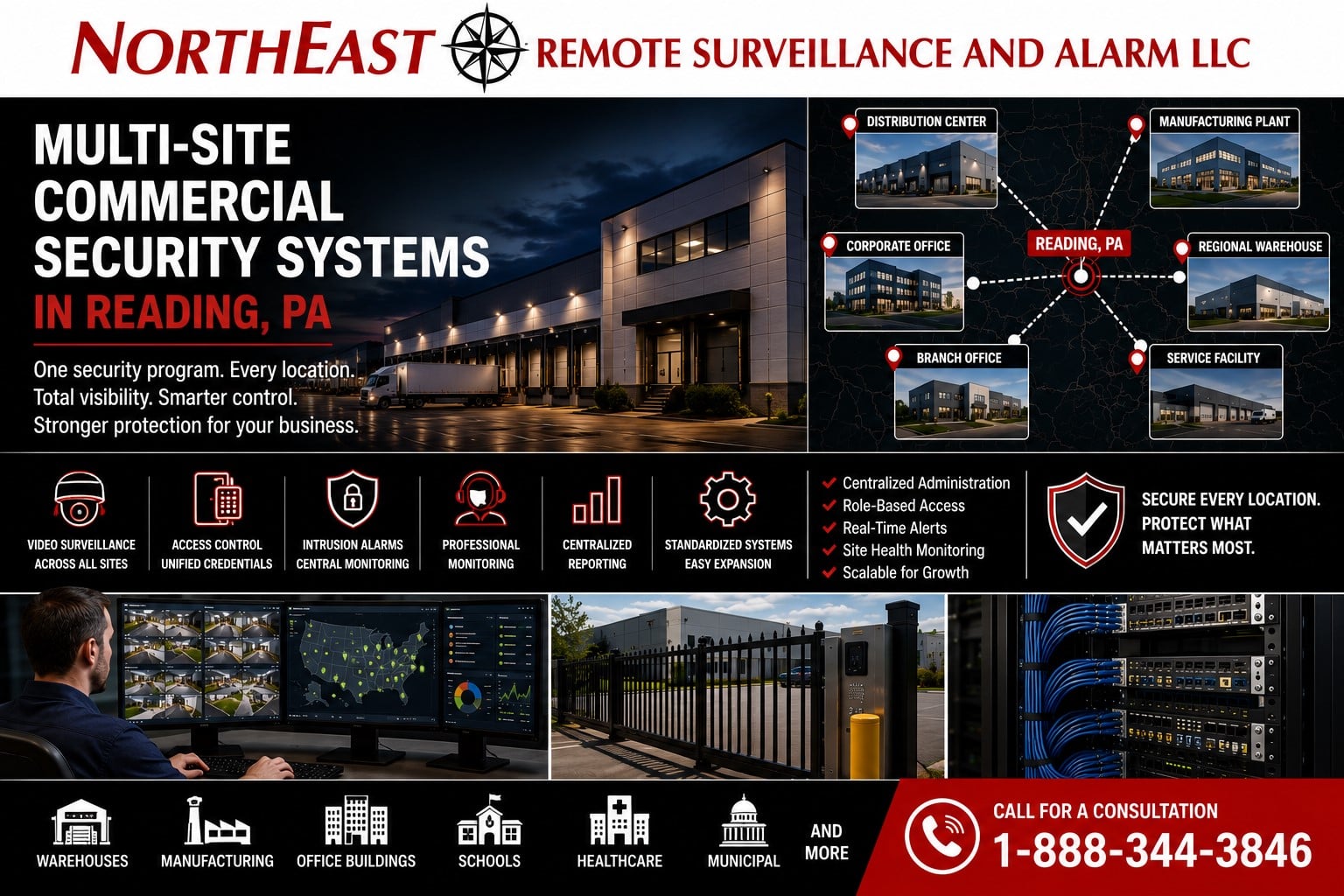
NERSA can assess existing systems and plan a shared operating standard with site-specific responsibilities.
Compare your Reading and Berks County locations first
Begin with each facility’s use, operating hours, system inventory, account ownership, network conditions, contacts, and known failures. An office, distribution building, and manufacturing property may have different coverage and access needs. Record those differences before selecting equipment or promising a shared management platform.
Use Reading commercial security planning for an individual property.
The multi-site security and standardization guide defines the organization-wide framework.
Create a standard that can be applied locally
Agree camera and door naming, administrator roles, permission approvals, alarm contacts, evidence-handling procedures, and service records. Identify which decisions belong to the corporate team and which remain with a Reading site manager. Document exceptions such as a different shift schedule, a retained recorder, or a connection that cannot support the planned remote workflow.
Assess existing components for retention, correction, integration, or replacement. Standardization can preserve useful equipment when compatibility and support allow it; a single manufacturer is not the objective. Confirm customer account ownership and available documentation before planning a takeover.
Plan Work Around Each Operating Site
Agree installation windows, temporary procedures, and rollback criteria with the people responsible for each building.
Separate an urgent correction from a later standardization phase so local staff know what will operate during the transition.
For older or inherited systems, review Reading security upgrades and retrofits before scheduling the rollout.
Coordinate the systems involved
- Reading commercial security camera installation and video surveillance — coverage, recording, viewing permissions, and retrieval.
- Access control — approved doors, users, schedules, and local operation.
- Intrusion alarms — site identification, partitions, contacts, and communication.
- Security monitoring — agreed event handling and escalation.
- Cabling and infrastructure — connectivity and power dependencies.
- Unified security systems — supported connections between technologies.
Reading-Area Multi-Location Project Experience
The Mama’s Pizza multi-location security case study includes Reading and Shillington restaurants.
Its documented scope covers structured cabling, video surveillance, intrusion detection, and mobile and remote viewing of company operations.
It provides a local example of coordinating security across an operating business with several locations.
The design for a new project should follow that organization’s own buildings, users, and requirements.
Use a Pilot Site to Set the Rollout Standard
Before repeating a design across Reading and Berks County locations, choose a representative pilot property. Record the camera views, controlled doors, alarm zones, network constraints, and staff responsibilities that other sites will need to match. Mark site-specific exceptions rather than assuming every building can use the same equipment layout.
- Verify that central administrators and local staff see only the locations and functions assigned to them.
- Check event naming, timestamps, camera playback, credential changes, and the agreed response workflow.
- Document equipment, network handoff, support contacts, training, and ownership of future account changes.
- Use the accepted pilot checklist to review each additional location before rollout is signed off.
If the project concerns several systems within one building, the Reading unified security systems guide helps define that integration.
A multi-site plan also needs consistent administration and service ownership across separate properties.
Keep ongoing management accountable
After rollout, assign ownership for user changes, monitoring contacts, documentation, health reviews, and service requests.
For a fault at an individual location, request commercial security system maintenance and repair in Reading.
Identify the affected building, equipment and symptoms so the service review can focus on that location.
Multi-site security system management addresses that continuing work.
Site-specific fire alarm arrangements remain separately coordinated through Reading fire alarm and monitoring services.
Reading Multi-Site Security: Define a Repeatable Standard
When a Reading company operates a production site, distribution warehouse, office and outside equipment yard, a common security program should standardize naming, account ownership, response expectations and reporting, not automatically force every location to use identical hardware. Inventory each site’s cameras, recorder, access panels, alarm zones, internet reliability, cabling and licensed software. Document site-specific exceptions such as a gate with cellular communication or a detached warehouse requiring fiber backhaul.
Credentials, Video Events and Alarm Responsibilities Across Locations
A companywide policy should identify who authorizes employee access, contractor credentials and visitor exceptions, and who can review incident video. Access permissions may be centrally managed while an entrance continues operating during an internet interruption, if the selected platform supports it. Make sample incident retrieval and credential termination part of acceptance at each property. Document how alarms from different sites are labeled at the supervising station and how after-hours managers are contacted.
Pilot, Rollout and Testing Without Operational Disruption
Choose a pilot facility before imposing a new system standard. Test actual entry schedules, recording retention, network outage behavior, alarm transmission, video export and administrative reporting. Review whether old equipment can remain supported for a phased transition. Schedule cutovers around production, deliveries and warehouse shifts. Record any local exceptions, drawings and ownership so the pilot’s lessons reduce risk during future Reading and Berks County installations.
Keep Regional and Technical Pages in Their Proper Roles
This multi-site guide covers enterprise operational standards, not the main Reading installation search. Use the Reading city commercial security installation guide for a single property’s primary project scope; use dedicated video surveillance, access-control and intrusion-alarm pages for technical installation details. The Berks County umbrella covers broader countywide facilities and corridors.
Request a multi-site security assessment
Bring a location list, known security platforms, approximate camera and door counts, administrator responsibilities, recurring problems, and expansion plans. Northeast Remote Surveillance and Alarm, LLC can discuss discovery, compatibility checks, a phased scope, and ongoing support for your organization.
Request an assessment or call 1-888-344-3846.
Compliance, Codes & Project Standards
NERSA plans commercial and industrial security work with applicable code, documentation, inspection and authority-having-jurisdiction requirements in mind. Requirements vary by system, property and jurisdiction. These resources support project planning; they do not establish legal compliance, certification or AHJ approval.
Related guidance: Regulatory compliance & inspection readiness · NERSA project standards · Documentation, testing & inspection readiness