School and Educational Facility Security Systems in Reading, PA

School security systems in Reading, PA should support the way students, teachers, administrators, visitors, contractors, maintenance personnel, athletic programs, and community groups move through an educational facility each day.

Northeast Remote Surveillance and Alarm, LLC designs, installs, integrates, upgrades, and supports commercial security systems for public schools, private schools, charter schools, vocational and technical schools, administrative buildings, educational campuses, and institutional facilities throughout Reading and Berks County.

Our school security solutions can combine controlled visitor entry, access control, video surveillance, intrusion detection, intercoms, emergency communication, parking-area coverage, remote monitoring, and centralized system management. Each system is planned around the building, campus layout, operating schedule, existing infrastructure, security procedures, and long-term support requirements.

For broader regional capabilities, visit our commercial and industrial security systems in Reading and Berks County page.

Call 1-888-344-3846 to schedule a school or educational facility security assessment in Reading, PA.

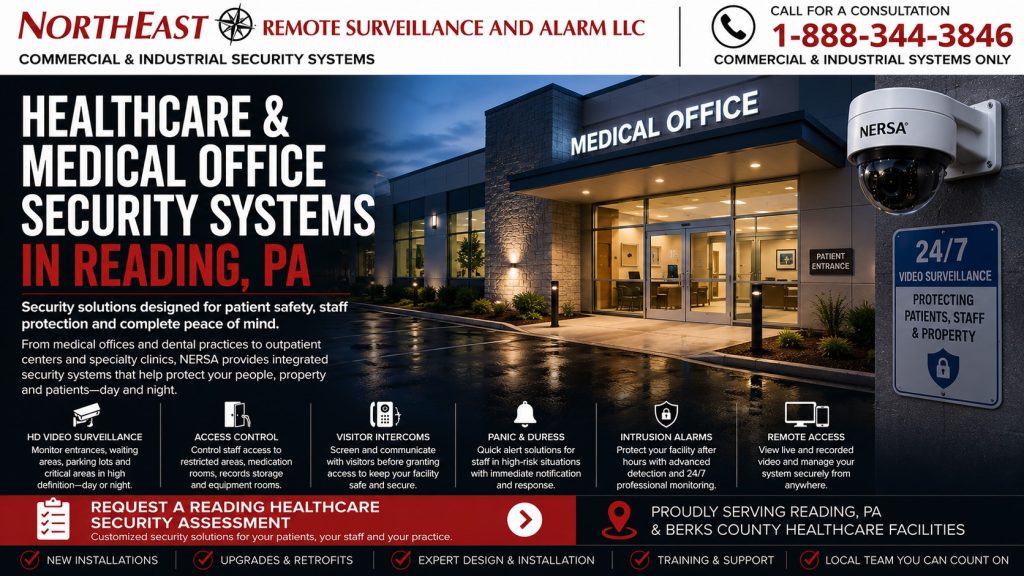
NERSA school and educational facility security systems in Reading, PA, featuring video surveillance, access control, visitor entry, intrusion detection, and remote monitoring at a secure school entrance.

Security Planning Built Around the School’s Daily Operations

An educational facility cannot be secured effectively by placing cameras at random locations or installing electronic locks without considering how the building actually operates.

A school may have a controlled main entrance during normal hours while maintaining separate access procedures for staff, transportation personnel, food-service deliveries, athletic activities, maintenance work, evening programs, and weekend events. Different parts of the building may need different schedules, permissions, alarm partitions, and monitoring procedures.

NERSA evaluates the complete operating environment, including:

  • Main entrances and visitor arrival points
  • Exterior doors and secondary entrances
  • Administrative and reception areas
  • Classrooms, corridors, stairwells, and common areas
  • Cafeterias, auditoriums, gymnasiums, and libraries
  • Mechanical, electrical, information technology, and storage rooms
  • Athletic fields and detached campus buildings
  • Bus loops, parent pickup areas, parking lots, and pedestrian approaches
  • After-hours activities and community use
  • Existing cameras, access control, alarms, intercoms, cabling, and network infrastructure

The objective is to develop a coordinated security system that gives authorized personnel useful information and practical control without unnecessarily disrupting the educational environment.

No electronic security system can prevent every incident. Technology should support trained personnel, established school procedures, emergency planning, building policies, and coordination with appropriate public-safety authorities.

Controlled Main Entrances and Visitor Entry

The main entrance is one of the most important security points in a school.

A properly planned visitor-entry system can allow office personnel to see and communicate with a visitor before deciding whether to provide access. Depending on the building and approved operating procedures, the entrance may incorporate video intercom communication, a controlled vestibule, door-position monitoring, electronic access control, remote door release, and nearby camera coverage.

The system should help staff answer several practical questions:

  • Who is requesting entry?
  • Can the visitor be seen clearly?
  • Can staff communicate with the visitor?
  • Is the correct door being released?
  • Did the door close and secure afterward?
  • Is video available if the event must be reviewed?
  • Are visitor procedures consistent during normal and after-hours operations?

The equipment must be coordinated with the physical door, locking hardware, accessibility requirements, life-safety requirements, and the school’s approved visitor-management procedures.

NERSA does not treat visitor entry as an isolated device installation. We evaluate how the intercom, camera, door hardware, access control, and office workflow function together.

School Access Control and Electronic Door Security

School access control systems help administrators manage who can enter designated doors and when those permissions are valid.

Credentials can be assigned according to an individual’s responsibilities rather than distributing unrestricted mechanical keys. Staff members, administrators, maintenance personnel, contractors, athletic personnel, and other approved users can receive different access schedules and door permissions.

A properly configured system may support:

  • Staff credential access
  • Time-based door schedules
  • Administrative-area restrictions
  • Mechanical and information technology room protection
  • Credential activation and deactivation
  • Door-held-open alerts
  • Door-forced-open alerts
  • Remote status review
  • Building and department permissions
  • Temporary contractor credentials
  • After-hours activity schedules
  • Centralized administration for multiple buildings

Access control should not interfere with required emergency egress. Door hardware, locking methods, fire alarm interfaces, accessibility, and applicable code requirements must be evaluated as part of the design.

NERSA can also assess existing card-access systems that have unreliable readers, unsupported controllers, poor documentation, excessive mechanical-key use, or limited ability to manage multiple facilities.

Video Surveillance for Schools and Educational Campuses

School video surveillance should provide useful identification, situational awareness, and recorded evidence—not simply produce a large number of camera views.

Camera design begins by identifying the operational purpose of each location. A camera intended to identify a person at a controlled entrance requires a different position and field of view than a camera monitoring a hallway, parking lot, bus area, or athletic entrance.

Common school camera locations may include:

  • Main entrances and visitor vestibules
  • Exterior doors
  • Administrative reception areas
  • Corridors and common areas
  • Stairwells
  • Cafeteria entrances
  • Gymnasium and auditorium access points
  • Loading and delivery areas
  • Parking lots
  • Bus loading zones
  • Parent pickup areas
  • Building approaches
  • Detached facilities
  • Athletic facility entrances
  • Equipment and technology storage areas

Camera placement should respect areas where surveillance would be inappropriate and should follow the school’s privacy, retention, access, and technology policies.

NERSA can design new IP video systems, expand existing systems, replace aging recorders, improve weak exterior coverage, and consolidate compatible cameras onto a more manageable video platform.

Clear Video for Investigation and Incident Review

Recorded video is only valuable when authorized personnel can locate and review the correct footage.

System planning should address:

  • Camera image quality
  • Lighting conditions
  • Field of view
  • Identification distance
  • Recording schedules
  • Video retention requirements
  • Storage capacity
  • User permissions
  • Export procedures
  • Time synchronization
  • System health notifications
  • Remote and local viewing policies
  • Protection of administrator accounts

NERSA designs systems so school administrators and authorized security personnel can use the platform without navigating an unnecessarily complicated recording environment.

Where supported by the selected equipment, cameras can also be associated with access events, alarms, or door activity. This can help an authorized user move from an event record to the related video more efficiently.

Intrusion Detection and After-Hours School Protection

Schools frequently remain active beyond the normal instructional day.

Athletic practices, board meetings, adult education, performances, community programs, maintenance work, and weekend events may occupy one section of a facility while the rest of the property should remain protected.

A commercial intrusion alarm can divide the building into operational areas so authorized sections remain accessible without leaving the entire school disarmed.

Depending on the facility, after-hours protection may include:

  • Exterior door contacts
  • Interior motion detection
  • Glass-break detection
  • Roof-hatch monitoring
  • Equipment-room protection
  • Administrative office protection
  • Storage-area protection
  • Separate building partitions
  • Duress or panic devices in approved locations
  • Professional central-station monitoring
  • Video verification where appropriate
  • Opening, closing, and exception reporting

Alarm zoning and user permissions should reflect the school’s actual after-hours schedule. A system that is too difficult to operate may be bypassed, left disarmed, or generate avoidable false alarms.

Intercoms and Two-Way Communication

Clear communication is an important part of controlled entry and coordinated building operations.

Video intercoms can allow office staff to see and speak with visitors at a secured entrance. Audio intercoms, IP speakers, and paging components can also support communication at service entrances, gates, athletic buildings, administrative areas, and other approved locations.

Communication-system planning should consider:

  • Normal visitor entry
  • Delivery and service access
  • Remote entrances
  • Noise levels
  • Camera positioning
  • Staff answering locations
  • Call routing
  • Network reliability
  • Backup procedures
  • Integration with approved door-release functions

NERSA coordinates communication devices with the surrounding access-control, video, and door systems instead of treating each component as an unrelated installation.

Parking Lots, Bus Areas, and Exterior Campus Coverage

School security extends beyond the building entrance.

Parking lots, bus loops, parent pickup areas, service drives, athletic entrances, and pedestrian approaches may require coverage for incident review, vehicle activity, unauthorized access, vandalism, and after-hours use.

Exterior surveillance planning may include:

  • Building-mounted cameras
  • Parking-area overview cameras
  • Vehicle entrance coverage
  • Pedestrian approach coverage
  • Low-light camera technology
  • Appropriate exterior lighting coordination
  • Network and fiber connectivity
  • Wireless links for detached structures
  • Weather-resistant equipment
  • Surge and power protection
  • Secure equipment enclosures

Camera count alone does not determine performance. Mounting height, angle, lighting, distance, network bandwidth, and the expected level of identification must be considered before equipment is selected.

Unified School Security System Integration

Schools often accumulate separate systems over many years. Cameras may operate on one platform, card access on another, intrusion alarms on another, and visitor communication through an unrelated intercom.

Where compatible platforms are available, NERSA can develop a more coordinated security environment in which authorized personnel can review door activity, camera views, alarms, and system status more efficiently.

A unified system may support:

  • Camera views associated with access events
  • Video linked to alarm activity
  • Centralized user administration
  • Multi-building dashboards
  • Door and alarm status review
  • Consistent reporting
  • Role-based permissions
  • Coordinated system health notifications

Integration should be purposeful. Connecting systems is beneficial only when it produces a clearer, more reliable workflow for school personnel.

Learn more about commercial and enterprise unified security systems.

Emergency Lockdown and Door-Control Coordination

Electronic access control may support a school’s approved emergency door-control procedures, but lockdown capability requires more than adding a button to a software screen.

The complete design must consider:

  • Which doors are included
  • Which doors must remain available for emergency egress
  • What happens if network communication is interrupted
  • How staff initiate the approved procedure
  • Which users have authority
  • How the action is communicated
  • How the system is reset
  • How emergency responders gain access
  • How door hardware behaves during fire alarm or power conditions
  • How procedures are documented and tested

NERSA coordinates electronic security components with the school’s administrators, information technology personnel, door-hardware professionals, fire alarm requirements, and other project stakeholders.

We do not make unsupported claims that a particular device or automated feature can eliminate every threat.

Weapons-Detection and Advanced School Security Technology

Some schools evaluate weapons-detection technology, video analytics, intelligent alerts, or other advanced screening tools.

These technologies should be reviewed carefully rather than selected because of a marketing claim. The school should understand the technology’s intended purpose, detection limitations, staffing requirements, alert procedures, privacy implications, network requirements, and ongoing operating costs.

Advanced technology may support a broader security program, but it does not replace controlled access, clear communication, trained personnel, established procedures, or coordinated emergency planning.

For a focused explanation, visit our page covering weapons detection and school security technology.

Security for Different Educational Environments

NERSA supports a range of nonresidential educational properties in Reading and Berks County.

Public and Private K–12 Schools

K–12 facilities commonly require controlled visitor entry, staff access management, hallway and exterior video coverage, intrusion protection, and security for after-hours activities.

Charter and Parochial Schools

Charter and parochial schools may operate in converted, expanded, or multi-use buildings. Security planning must account for the existing door hardware, available pathways, shared spaces, and practical project budget.

Vocational and Technical Schools

Vocational facilities may contain workshops, tools, equipment, laboratories, vehicle areas, and restricted instructional spaces. Access permissions and cameras can be designed around the different operating requirements of each department.

Colleges and Higher-Education Properties

Higher-education environments may have multiple buildings, open campus movement, evening activity, public events, administrative offices, laboratories, and specialized access requirements. These systems may require distributed architecture and centralized administration.

Educational Administrative and Support Buildings

District offices, maintenance buildings, transportation facilities, storage buildings, and technology centers may need commercial access control, intrusion detection, surveillance, and monitoring separate from student-occupied schools.

Existing School Security System Upgrades and Takeovers

A school does not always need to replace every existing device.

NERSA can evaluate the current system to determine what can be retained, what should be upgraded, and which components have reached the end of their useful or supported life.

An upgrade assessment may examine:

  • Existing cameras and recording equipment
  • Access-control panels and readers
  • Door hardware and power supplies
  • Alarm panels and detection devices
  • Intercom stations
  • Cabling and fiber
  • Network switches
  • Wireless connections
  • System documentation
  • Administrator credentials
  • Software support status
  • Available expansion capacity

A phased project may begin with the main entrance, critical exterior doors, failing cameras, or unsupported recording equipment and expand according to the school’s priorities and available budget.

NERSA can also assist with systems originally installed by another contractor when the equipment is serviceable, compatible, and accessible.

Security Network and Cybersecurity Coordination

Modern cameras, access-control panels, intercoms, and security-management platforms frequently operate on an IP network.

School security technology should therefore be coordinated with the organization’s information technology requirements.

Planning may include:

  • Dedicated security network segments
  • Managed network switches
  • Controlled remote access
  • Strong administrator credentials
  • Multi-factor authentication where supported
  • User-role restrictions
  • Firmware and software maintenance
  • Secure password ownership
  • Network bandwidth evaluation
  • Accurate time synchronization
  • System backup procedures
  • Documented device addresses
  • Removal of unused accounts

The school or district should retain control of its administrative credentials, system documentation, retention policies, and authorized-user list.

NERSA works with the client’s information technology personnel to define responsibilities and avoid placing security devices on the network without an approved architecture.

School Security Assessments in Reading and Berks County

A security project should begin with an assessment of the property and its operations—not a predetermined equipment package.

NERSA’s planning process may include:

  1. Discussing the school’s priorities and current concerns
  2. Reviewing normal and after-hours building use
  3. Examining entrances, doors, circulation paths, and exterior areas
  4. Reviewing existing cameras, alarms, access control, intercoms, and infrastructure
  5. Identifying system limitations and immediate deficiencies
  6. Coordinating with administration, facilities, security, and information technology personnel
  7. Developing a practical scope of work
  8. Separating immediate priorities from future improvements
  9. Planning installation around school operations
  10. Providing system training and project documentation

The result is a system designed for the specific facility rather than a generic collection of cameras and electronic locks.

School Security Installation Without Unnecessary Disruption

Educational projects require careful scheduling and coordination.

Installation may need to occur during school breaks, after hours, in phases, or within controlled work areas. Technicians may also need to coordinate with administrators, facilities personnel, information technology departments, general contractors, door-hardware contractors, and other approved project participants.

Project planning can address:

  • Work-hour restrictions
  • Student-occupied areas
  • Background and access requirements
  • Dust and noise control
  • Ceiling and wall restoration
  • Network changes
  • Door shutdowns
  • Testing schedules
  • Staff training
  • Final documentation
  • System turnover

NERSA plans installations to reduce unnecessary interference with instruction and normal facility operations.

Why Educational Facilities Choose NERSA

Northeast Remote Surveillance and Alarm, LLC has provided commercial and institutional security services since 2008.

Schools and educational organizations work with NERSA for:

  • Commercial and institutional security specialization
  • Access control, video, alarm, intercom, and monitoring capabilities
  • New installation and existing-system upgrade experience
  • Door hardware and life-safety coordination
  • Multi-building and multi-site planning
  • Network and low-voltage infrastructure knowledge
  • Phased modernization options
  • Practical system training
  • Long-term service and support
  • Direct regional coverage from an eastern Pennsylvania integrator

NERSA supports smaller private educational facilities, individual school buildings, multi-building campuses, district support properties, and enterprise-scale educational organizations.

School Security Service Area

NERSA provides school and educational facility security services throughout Reading and surrounding Berks County communities, including Wyomissing, West Reading, Shillington, Sinking Spring, Muhlenberg Township, Exeter Township, Fleetwood, Kutztown, Hamburg, Birdsboro, and nearby areas.

Project availability depends on the scope, location, equipment requirements, and required service response.

Frequently Asked Questions About School Security Systems in Reading, PA

What security systems can NERSA install for schools?

NERSA can design and install access control, video surveillance, intrusion alarms, visitor-entry intercoms, remote monitoring, parking-area cameras, emergency communication components, and unified security platforms for schools and educational facilities.

Do you provide armed guards or school security officers?

No. NERSA is an electronic security, fire alarm, monitoring, and low-voltage systems integrator. We design, install, upgrade, integrate, and support security technology. We do not provide armed or unarmed guard personnel.

Can NERSA upgrade an existing school camera system?

Yes. NERSA can evaluate existing cameras, recorders, network equipment, storage, cabling, and viewing software. Depending on compatibility and condition, part of the existing system may be retained while weak or unsupported components are replaced.

Can access control and school cameras work together?

Compatible access-control and video platforms can associate a door event with the corresponding camera view. This can help authorized personnel review forced-door, held-door, credential, and visitor-entry events more efficiently.

Can you secure only the school’s main entrance first?

Yes. A phased project can begin with a controlled main entrance, video intercom, camera coverage, access control, and door monitoring before expanding to other doors or buildings.

Can school access control support an emergency lockdown procedure?

Access control may support approved emergency door-control procedures when the controllers, locks, door hardware, network architecture, power design, and life-safety requirements are properly coordinated. The design must be matched to the school’s adopted procedures and reviewed with the appropriate project stakeholders.

Can different parts of a school remain open after hours?

Yes. Access-control schedules and intrusion-alarm partitions can be designed so approved areas remain available for athletics, meetings, performances, or community programs while other portions of the facility remain restricted and protected.

Do you install systems for small private schools as well as large districts?

Yes. NERSA supports educational facilities ranging from smaller private or charter schools to multi-building campuses, district support facilities, and enterprise-scale organizations. The system is scaled according to the facility and its operational requirements.

Can NERSA take over a system installed by another company?

Often, yes. NERSA must first evaluate the equipment, software, administrator access, licensing, documentation, system condition, and manufacturer support. Unsupported or locked equipment may require partial or complete replacement.

Do you provide school security services outside Reading?

Yes. NERSA supports commercial and institutional properties throughout Berks County, the Lehigh Valley, Greater Philadelphia, Northeastern Pennsylvania, selected Central Pennsylvania markets, and other approved Mid-Atlantic locations.

Schedule a Reading School Security Assessment

A school security project should provide clearer control, better information, dependable system operation, and a practical plan for future improvement.

Northeast Remote Surveillance and Alarm, LLC can evaluate your entrances, doors, cameras, alarms, visitor communication, exterior coverage, existing infrastructure, and after-hours operations before recommending a security solution.

Call 1-888-344-3846 to schedule a school or educational facility security assessment in Reading, PA.

Scroll to Top
1-888-344-3846