
Commercial gate access control manages vehicle and pedestrian entry before traffic reaches protected areas.

Request a Commercial Gate Access Assessment
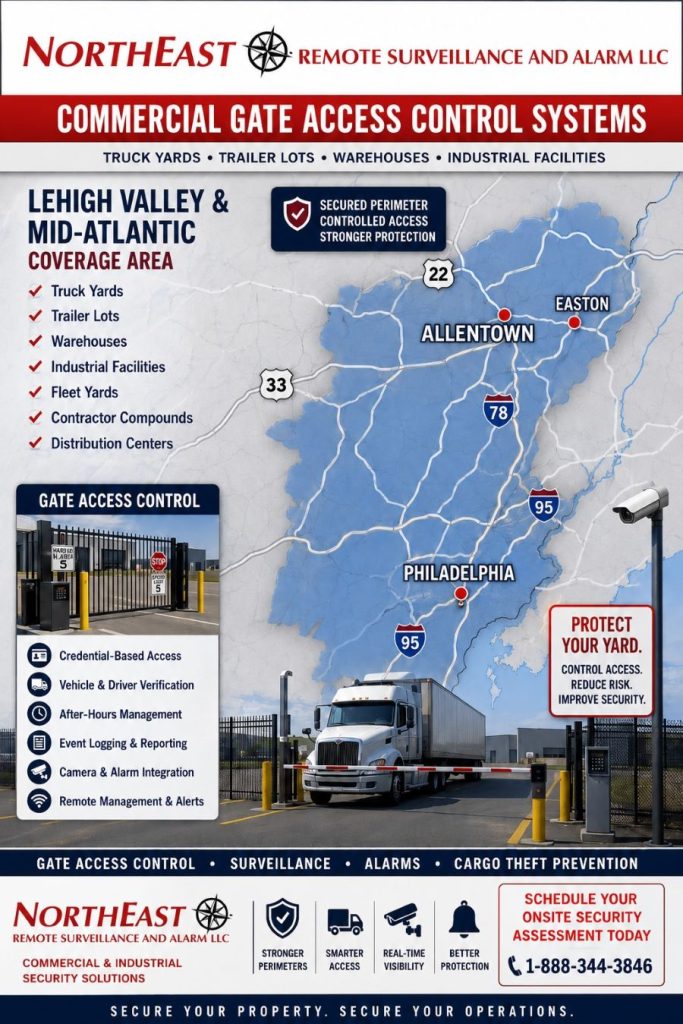
It supports truck yards, warehouses, fleet yards, contractor compounds, manufacturing facilities, industrial parks, and other commercial properties.
Northeast Remote Surveillance and Alarm, LLC (NERSA) designs, installs, upgrades, integrates and supports commercial gate access control systems for qualifying business and professionally managed facilities throughout the Lehigh Valley, Pennsylvania and broader Mid-Atlantic markets.
A properly designed gate access system should manage:
- Who can enter
- Which gate they may use
- When access is permitted
- Which credential or verification method is required
- How temporary access is handled
- How gate activity is recorded
- How events can be reviewed with cameras or other compatible systems
A gate operator only opens and closes the barrier.
A commercial gate access control system manages who is authorized to activate that gate and under what conditions.
For broader door-access planning, visit Commercial & Industrial Access Control Systems.
Commercial and Industrial Systems Only • Truck Gates • Employee Vehicle Gates • Pedestrian Gates • Credentials • Intercoms • Video Integration • Upgrades
Commercial Gate Access Built Around Site Operations
The right gate access system should reflect how people and vehicles actually enter the property.
Planning may need to consider:
- Employees
- Drivers
- Vendors
- Contractors
- Visitors
- Service personnel
- Supervisors
- After-hours users
- Multiple gates
- Truck traffic
- Employee parking
- Pedestrian access
- Restricted yards
Different users may require different permissions.
A truck entrance may require one process while an employee vehicle gate, pedestrian entrance, maintenance gate, or restricted yard gate requires another.
The goal is to provide controlled entry without creating unnecessary operational friction.
Why Commercial Gate Access Control Matters
Many commercial properties have gates but still rely on weak access procedures.
Common problems may include:
- Shared gate codes
- Former employees retaining access
- Vendors using old credentials
- Informal remote release
- Unrecorded visitor entry
- Unclear after-hours permissions
- Tailgating
- No event history
- No connection between gate activity and video
A functioning gate operator does not automatically provide effective access control.
Managed credentials, schedules and event records create stronger accountability.
Credential-Based Gate Access
Commercial gates may use compatible access methods such as:
- Cards
- Fobs
- Mobile credentials
- PINs
- Vehicle credentials
- Call-box authorization
- Remote release
Credential-based access can reduce dependence on one shared code.
Users may be assigned permissions according to:
- Role
- Gate
- Schedule
- Facility
- Temporary assignment
Individual credentials are generally more manageable when the organization needs to add, suspend or remove access.
Access Schedules and Permissions
Commercial facilities often operate beyond normal office hours.
Gate access may need to accommodate:
- Multiple shifts
- Early-morning drivers
- Overnight operations
- Weekend employees
- Maintenance crews
- Temporary contractors
- Holiday schedules
- On-call personnel
The system should support legitimate operations without forcing the property into permanently unrestricted access.
Permissions should be based on actual operational need.
Intercoms and Visitor Verification
The Philadelphia gate and perimeter access guide provides a regional planning path for facilities coordinating visitors, vehicles, and controlled entrances.
For vehicle entrances at local facilities, see commercial gate access control in Scranton.
Drivers, vendors, contractors and visitors may require verification before entry.
Gate access may be coordinated with:
- Audio intercoms
- Video intercoms
- Call boxes
- Remote answering
- Door or gate release
- Visitor workflows
The organization should establish who receives gate calls, who is authorized to release the gate and how after-hours requests are handled.
For dedicated communication planning, visit Commercial & Industrial Intercom Systems.
Gate Event Logging
A commercial gate access system may provide event records associated with:
- Credential use
- Successful entry
- Rejected attempts
- After-hours activity
- Temporary users
- Remote release
- User changes
These records can support operational review and incident investigation.
Event history is most valuable when users, gates and credentials are clearly named and administered.
Cameras and Gate Access Control
Camera coverage can provide visual context around gate events.
Depending on system compatibility, video may help authorized users review:
- Vehicle entry
- Credential use
- Visitor access
- Failed attempts
- After-hours activity
- Tailgating
- Gate incidents
A gate log records the configured access event, such as an authorization or release; it does not by itself prove that a particular person or vehicle passed through.
Video may help show what was happening at the gate at that time.
For broader video planning, visit Commercial & Industrial Video Surveillance Systems.
License Plate Recognition at Commercial Gates
Some vehicle entrances may benefit from dedicated license-plate capture.
Potential applications include:
- Truck entrances
- Employee parking
- Fleet yards
- Distribution properties
- Contractor facilities
- Controlled vehicle lanes
License-plate recognition requires proper planning around lane layout, speed, lighting, camera angle and mounting position.
For dedicated planning, visit License Plate Recognition Camera Systems.
Truck Yard and Trailer Lot Gate Access
Truck yards and trailer areas may require tighter control because they often involve:
- Drivers
- Carriers
- Vendors
- Staged trailers
- Fleet vehicles
- Equipment
- Limited after-hours staffing
Gate access should focus on identifying who needs entry, when that access is permitted and how gate activity is documented.
For broader warehouse and logistics security planning, visit Warehouse & Logistics Security Systems.
Warehouse Gate Access
Warehouse facilities may have separate entrances for:
- Employees
- Trucks
- Vendors
- Contractors
- Visitors
- Maintenance personnel
The gate strategy should coordinate with the facility’s broader access-control plan so perimeter access and building access are not managed as unrelated systems.
For dedicated warehouse-controlled entry planning, visit Warehouse Access Control Systems.
Industrial Facility Gate Access
Manufacturing and industrial properties may use different gates for:
- Employees
- Shipping
- Contractors
- Maintenance
- Restricted yards
- Secondary access
Each gate should be evaluated according to traffic type, risk, required permissions and operating schedule.
The same access rule should not automatically be applied to every entrance.
Employee Vehicle Gates
Employee parking entrances may benefit from individually managed credentials instead of shared codes or unmanaged remotes.
Potential benefits include:
- Faster credential removal
- Schedule control
- User accountability
- Reduced shared-code exposure
- Cleaner administration
The access method should still fit actual traffic volume and operating conditions.
Pedestrian Gates
Pedestrian gates may require different hardware and access logic than vehicle gates.
Planning may involve:
- Credential readers
- Locking hardware
- Door-position monitoring
- Request-to-exit devices
- Emergency egress
- Accessibility
- Weather exposure
Pedestrian access should be treated as a controlled opening rather than simply as a smaller version of a vehicle gate.
Remote Gate Release
Remote release may be useful for selected visitor, driver or service workflows.
The organization should define:
- Who may release the gate
- Which gate may be released
- Whether video verification is required
- How after-hours requests are handled
- Whether the event is recorded
Remote release should not become a substitute for clear access policy.
Gate Access and Unified Security
Some commercial properties may benefit from gate access working alongside compatible cameras, access control, intercoms, intrusion alarms and monitoring.
Integration should improve a specific operational or investigative workflow.
For broader coordinated-security planning, visit Unified Commercial Security Systems.
Security Technologies and Platforms
Commercial gate access may be managed through cloud, on-premise, hybrid or manufacturer-specific platforms depending on the property and operating requirements.
For broader platform planning, visit Security Technologies & Platforms.
Existing Gate Access Systems
Many properties already have:
- Gate operators
- Keypads
- Readers
- Remotes
- Intercoms
- Cameras
- Vehicle loops
- Cabling
- Access-control panels
Existing equipment should be evaluated before replacement is recommended.
Potential concerns may include:
- Shared codes
- Unsupported equipment
- Unknown administrator credentials
- Unreliable readers
- Poor documentation
- Failed communication
- Inadequate event history
- Limited expansion capacity
The appropriate project may involve repair, reprogramming, selective replacement, integration or phased modernization.
For existing-system evaluation, visit Commercial Security System Inspection and Assessment.
For modernization planning, visit Commercial Security System Upgrades, Retrofits and Takeovers.
Gate Access Infrastructure
Commercial gate systems may require:
- Low-voltage cabling
- Fiber
- Wireless links
- Network connectivity
- Power supplies
- Backup power
- Weather-rated enclosures
- Surge protection
- Equipment mounting
- Long-distance communication
Remote gates and large industrial properties may require additional infrastructure planning.
For broader infrastructure planning, visit Commercial & Industrial Infrastructure and Cabling.
Safety and Emergency Access
Gate access systems should be planned with vehicle safety, pedestrian movement, emergency access and site operations in mind.
Planning may require coordination around:
- Gate operator safety devices
- Emergency access
- Fire-department access
- Pedestrian egress
- Vehicle detection
- Property procedures
Security should not create unsafe gate operation or interfere with required emergency access.
For broader compliance-aware planning, visit Regulatory Compliance and Inspection Readiness.
Why Businesses Choose NERSA for Commercial Gate Access
Northeast Remote Surveillance and Alarm, LLC focuses on commercial and industrial security rather than single-family home systems.
NERSA evaluates gate projects around:
- Gate purpose
- Vehicle movement
- User groups
- Credentials
- Access schedules
- Visitor procedures
- After-hours access
- Cameras
- Intercoms
- Existing equipment
- Infrastructure
- Administrator ownership
- Future expansion
The objective is to provide a commercial gate access system that controls entry, supports daily operations and remains manageable after installation.
Verify the Gate Entry Workflow
Before handover, walk through employee, delivery, visitor, denied-entry, and after-hours scenarios with the site team. Confirm reader or call-box reach from the vehicles that use the lane, the answering destination, temporary-access expiration, and the records available for review. Plan how a denied or unanswered visitor can leave without blocking normal traffic.
Coordinate power-loss, communication-loss, emergency-access, and gate-safety testing with the responsible qualified installer and site representatives under the approved design. Record the actual operating behavior and who maintains each component; access-control authorization must not bypass the gate operator’s protective functions. Give the owner current permissions, equipment records, support contacts, and a procedure for reporting faults.
Request a Commercial Gate Access Assessment
A gate-access assessment may review:
- Gate locations
- Gate operators
- Employee traffic
- Truck traffic
- Vendor access
- Contractor access
- Credential requirements
- Access schedules
- Intercom requirements
- Camera coverage
- Existing access equipment
- Network connectivity
- Power
- Emergency access
- Future expansion
If your truck yard, warehouse, fleet yard, contractor facility or industrial property relies on shared codes, outdated remotes, inconsistent access procedures or a gate system that no longer matches site operations, Northeast Remote Surveillance and Alarm, LLC can help.
Request a Commercial Gate Access Assessment.
Frequently Asked Questions About Commercial Gate Access Control Systems
What is commercial gate access control?
Commercial gate access control manages who is authorized to open a controlled vehicle or pedestrian gate, when access is permitted and how the event is recorded.
Is a gate operator the same as access control?
No. The gate operator physically moves the gate. Access control determines who is authorized to activate it.
Can different users have different gate permissions?
Yes. Compatible systems may assign permissions according to user, gate, role and schedule.
Can a property move away from one shared gate code?
Yes. Individually managed credentials can reduce dependence on shared codes and make access easier to revoke or modify.
Can vendors and contractors receive temporary gate access?
Yes. Compatible systems may provide temporary or scheduled permissions for authorized outside users.
Can different gates have different rules?
Yes. Truck gates, employee gates, pedestrian gates and restricted entrances may each require different permissions and schedules.
Can cameras be connected to gate access control?
Yes. Compatible systems may provide video context around selected gate events.
Can LPR be used at a gate?
Yes. Properly designed LPR systems may provide plate documentation at selected controlled vehicle entrances.
Can gate access support after-hours operations?
Yes. Schedules and permissions may allow authorized after-hours access while limiting unnecessary entry.
Can NERSA upgrade an existing gate access system?
Yes. Existing operators, readers, keypads, remotes, cabling, cameras and access-control equipment can be evaluated before unnecessary replacement is recommended.
Does NERSA install single-family home gate access systems?
No. Northeast Remote Surveillance and Alarm, LLC focuses on commercial and industrial systems.
How does a commercial gate-access project begin?
The project begins with an assessment of the gates, traffic, users, access methods, schedules, existing equipment, infrastructure and operating requirements.
Local gate and vehicle-entry guides
Compare the approach lanes, visitor process, and vehicle activity at your location.
- Scranton gate access — Review vehicle entry alongside local site operations.
- Pittston gate access — Plan for truck traffic and controlled vehicle entry.
- Wilkes-Barre gate access — Connect the gate workflow with site security.