Use a Lehigh Valley security assessment to review property operations, existing equipment, coverage gaps, and project priorities before selecting improvements.

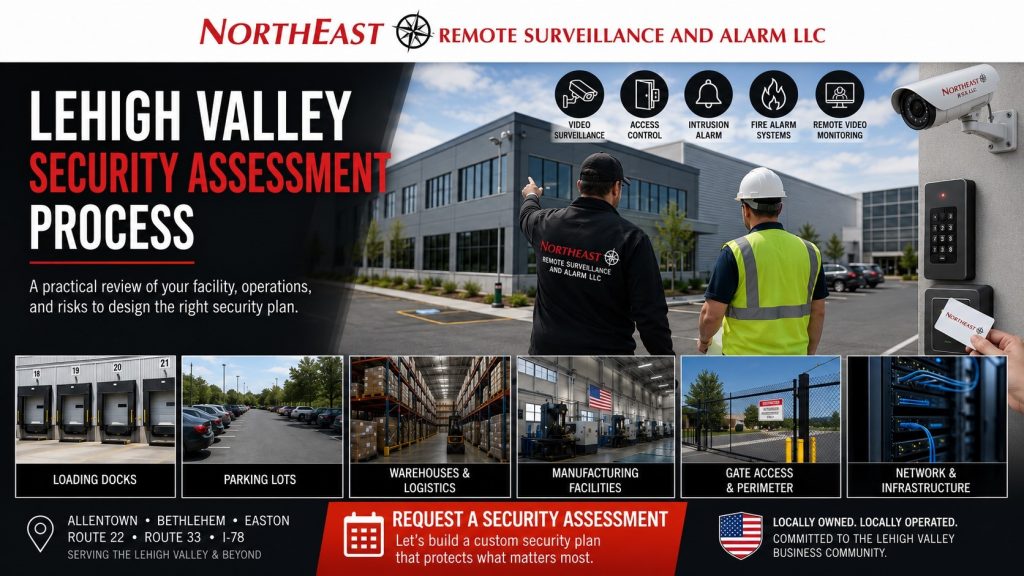
Northeast Remote Surveillance and Alarm, LLC performs security assessments for warehouses, manufacturing facilities, logistics properties, office buildings, healthcare buildings, schools, municipal properties, contractor yards, industrial parks, and multi-site businesses across Allentown, Bethlehem, Easton, Route 22, Route 33, I-78, and the surrounding Lehigh Valley region.
Coordinate the assessment with Lehigh Valley Commercial and Industrial Security Systems planning process to turn facility risks, access points, exterior exposure, and response procedures into a practical security plan.
Commercial Security Assessments for Lehigh Valley Facilities
A strong commercial security system starts with the property, not the equipment. Before recommending cameras, card readers, alarm devices, gate controls, monitoring, or cabling, the assessment should identify how the building operates, where people enter, how vehicles move, where deliveries happen, what areas are exposed after hours, and how incidents are handled.
Northeast Remote Surveillance and Alarm, LLC helps Lehigh Valley businesses evaluate security needs through a practical site-review process. The goal is to understand the facility before designing the system.
A security assessment may include employee entrances, visitor access, parking areas, loading docks, overhead doors, truck courts, trailer spaces, restricted rooms, offices, storage areas, utility rooms, production-support areas, gate lanes, exterior approaches, camera views, alarm coverage, monitoring response, fire alarm coordination, network infrastructure, and future expansion needs.
For companies still deciding what type of system they need, the assessment process is often the best starting point.
Why the Lehigh Valley Security Assessment Process Matters
The Lehigh Valley includes many different commercial and industrial environments. A warehouse near I-78, a manufacturing facility in Bethlehem, a medical office in Allentown, a contractor yard near Easton, and a multi-building industrial park along Route 22 do not have the same security priorities.
A proper assessment helps avoid generic security packages. It helps determine whether the facility needs better video coverage, stronger access control, more reliable intrusion detection, remote monitoring, gate control, fire alarm monitoring, parking lot visibility, low-voltage infrastructure, or a phased upgrade plan.
The assessment also helps prevent common problems, including cameras aimed at the wrong areas, doors added to access control without reviewing door hardware, alarm zones that do not match business operations, exterior areas left uncovered, poor after-hours response procedures, weak network infrastructure, and missing documentation after installation.
What NERSA Reviews During a Lehigh Valley Security Assessment Process
Facility Operations
The first step is understanding how the property is used. This includes operating hours, shift changes, employee access, delivery schedules, visitor flow, contractor access, customer areas, public-facing spaces, and after-hours activity.
A system designed for a 9-to-5 office will not fit a logistics property with overnight truck movement, a warehouse with dock activity, or a manufacturing facility with restricted production-support areas.
Doors, Entrances, and Access Points
Commercial buildings often have more access points than owners realize. Employee entrances, front doors, rear doors, side doors, warehouse personnel doors, dock doors, overhead doors, mechanical rooms, storage rooms, and restricted offices may all need different levels of protection.
During the assessment, NERSA reviews which openings need video coverage, alarm detection, access control, door position monitoring, visitor management, or hardware coordination.
For door-specific planning, use Commercial Access Control Systems and Access Control Door Hardware.
Video Surveillance Coverage
Camera planning should be based on what the business needs to see and document. Important areas may include entrances, parking lots, loading docks, receiving areas, shipping offices, truck courts, fence lines, exterior approaches, employee doors, interior corridors, production-support areas, point-of-sale areas, and restricted spaces.
The assessment reviews camera placement, viewing angles, evidence quality, lighting conditions, recording needs, remote access, AI-supported search, and whether live or remote video monitoring is appropriate.
For system-level camera planning, continue to Commercial and Industrial Video Surveillance Systems.
Intrusion Alarm Coverage
Commercial intrusion alarm planning should match how the building is used when closed, lightly staffed, or partially occupied. Some Lehigh Valley properties need standard door and motion coverage. Others need partitioned alarm areas, warehouse zones, overhead-door contacts, after-hours monitoring, panic or duress devices, exterior detection, or video verification.
The assessment reviews doors, windows, interior spaces, vulnerable areas, warehouse openings, offices, storage rooms, and alarm response procedures.
For alarm-specific planning, use Commercial Alarm Systems.
Loading Docks, Truck Courts, and Yard Areas
Warehouses, logistics facilities, contractor yards, and industrial properties often have major exposure around loading docks, truck courts, trailer areas, outdoor equipment, material storage, fleet parking, and gate lanes.
These areas may need cameras, remote video monitoring, intrusion detection, gate control, license plate recognition, lighting coordination, and clear response procedures.
For dock-specific planning, use Loading Dock Security Systems.
For exterior yard and trailer exposure, continue to Truck Yard and Trailer Security Systems.
Parking Lots and Exterior Approaches
Parking areas are one of the most common weak points at commercial properties. Employee vehicles, visitor parking, delivery traffic, exterior doors, walkways, lighting zones, and building approaches should be reviewed together.
The assessment considers camera coverage, lighting conditions, building approaches, vehicle movement, pedestrian paths, blind spots, and after-hours exposure.
For exterior camera planning, continue to Parking Lot Security Cameras.
Gate Access and Vehicle Control
Some Lehigh Valley businesses need more control over vehicle movement. This is common at contractor yards, truck yards, fenced industrial properties, warehouses, utility sites, distribution facilities, and multi-building commercial properties.
Gate planning may include access control, intercoms, cameras, license plate recognition, visitor procedures, emergency access, vehicle lanes, and after-hours monitoring.
For vehicle entry planning, use Commercial Gate Access Control Systems.
Fire Alarm and Life-Safety Coordination
Security assessments should not ignore fire alarm and life-safety coordination. Access control, door hardware, monitoring equipment, alarm communicators, low-voltage pathways, and building use may affect how a system should be designed and documented.
Security systems do not replace code compliance, fire alarm inspections, emergency procedures, or life-safety requirements. They should be planned with egress, accessibility, fire alarm coordination, documentation, and inspection-sensitive conditions in mind.
For fire alarm planning, use Commercial Fire Alarm Systems.
For broader compliance-aware planning, continue to Code and Compliance for Commercial Security Systems.
Network and Low-Voltage Infrastructure
A security system is only as reliable as the infrastructure behind it. Cameras, access control panels, alarm communicators, intercoms, remote monitoring devices, wireless bridges, fire alarm communicators, and network-connected systems may require cabling, PoE switching, fiber, racks, battery backup, surge protection, cellular communication, or network segmentation.
The assessment reviews whether the building can support the proposed system or whether infrastructure upgrades should be included in the project scope.
For cabling and infrastructure planning, use Commercial Low Voltage and Network Infrastructure Services.
Lehigh Valley Security Assessment Process by Area
Allentown Security Assessment Priorities
Allentown assessments often involve office buildings, healthcare facilities, schools, municipal properties, warehouses, parking areas, multi-tenant buildings, and mixed commercial facilities.
These properties may need stronger visitor control, employee access management, parking lot visibility, camera coverage, intrusion protection, fire alarm coordination, and documentation.
For city-specific planning, continue to Commercial Security Systems in Allentown, PA.
Bethlehem Security Assessment Priorities
Bethlehem assessments often involve manufacturing, industrial, production-support, contractor-access, employee-entry, and restricted-area security planning.
These properties may need controlled employee entrances, production-area visibility, contractor accountability, restricted-room access, industrial parking lot coverage, fire alarm coordination, and operational continuity planning.
For city-specific planning, continue to Commercial and Industrial Security Systems in Bethlehem, PA.
Easton Security Assessment Priorities
Easton assessments often involve warehouses, logistics operations, industrial parks, Route 33 properties, contractor yards, loading docks, truck courts, trailer areas, and exterior storage.
These properties may need dock coverage, trailer-area documentation, gate control, remote video monitoring, after-hours alarm response, yard visibility, and vehicle accountability.
For city-specific planning, continue to Commercial and Industrial Security Systems in Easton, PA.
Lehigh Valley Security Assessment Process by Facility Type
Warehouse and Logistics Facilities
Warehouse assessments focus on dock doors, trailer yards, truck movement, shipping offices, employee entrances, inventory areas, overhead doors, receiving areas, after-hours exposure, and alarm response.
The goal is to improve visibility, reduce blind spots, document activity, protect exterior openings, and support operations without slowing down freight movement.
For warehouse-specific planning, use Lehigh Valley Warehouse Security Systems.
Manufacturing Facilities
Manufacturing assessments focus on employee entrances, contractor access, restricted rooms, production-support spaces, raw materials, finished goods, maintenance areas, industrial parking areas, and emergency response paths.
The goal is to support production, protect sensitive areas, document incidents, and manage access without disrupting daily operations.
For manufacturing-specific planning, use Lehigh Valley Manufacturing Security Systems.
Contractor Yards and Exterior Storage Sites
Contractor yard assessments focus on fences, gates, vehicles, equipment, materials, trailers, exterior lighting, after-hours activity, and remote monitoring needs.
The goal is to improve deterrence, document vehicle movement, protect outdoor assets, and support response when the property is closed.
For exterior yard planning, use Lehigh Valley Contractor Yard Security Systems.
Office, Healthcare, School, and Municipal Properties
Public-facing and institutional properties often require careful review of visitor movement, employee access, parking areas, interior common spaces, emergency response, documentation, and life-safety coordination.
The goal is to improve visibility and accountability while respecting building use, public access, staff workflow, and inspection-sensitive conditions.
For office and commercial building planning, use Lehigh Valley Office Building Security Systems.
What Happens After the Assessment
After the site review, NERSA can help convert findings into a practical security plan. Depending on the facility, that plan may include camera placement, access-controlled doors, alarm zones, monitoring options, gate controls, intercoms, fire alarm communication, cabling, network equipment, documentation, phased upgrades, and service expectations.
The next step is not always a full replacement. Some businesses need a new system. Others need to correct weak points, expand an existing system, improve camera views, add access control, replace outdated alarm equipment, upgrade communications, improve monitoring, or document the system more clearly.
For broader project planning, use Commercial Security Trust and Project Standards.
Common Findings During Lehigh Valley Security Assessments
Many commercial and industrial properties have similar security gaps. These may include uncovered side doors, weak dock visibility, outdated cameras, poor nighttime image quality, unmanaged keys, missing door position monitoring, alarm zones that do not match operations, exposed exterior storage, uncontrolled gate access, weak parking lot coverage, old phone-line alarm communication, undocumented user permissions, or infrastructure that cannot support modern systems.
A security assessment helps identify which issues create the most operational risk and which upgrades should happen first.
The best plans prioritize business impact, response value, system reliability, and long-term maintainability instead of simply adding more devices.
Compliance-Aware Assessment Notes
A Lehigh Valley security assessment should consider building use, emergency egress, accessibility, fire alarm coordination, workplace safety, wiring methods, documentation, inspection-sensitive conditions, and how the system may be reviewed in the future.
NERSA does not position security systems as a replacement for code compliance, fire alarm inspections, employee training, emergency plans, legal requirements, or AHJ direction. Security systems can support documentation, accountability, monitoring response, safer operations, incident review, and better long-term management when they are planned correctly.
For compliance-focused planning, use Code and Compliance for Commercial Security Systems.
Why Choose Northeast Remote Surveillance and Alarm, LLC for your Lehigh Valley Security Assessment
Northeast Remote Surveillance and Alarm, LLC is headquartered in Bethlehem, PA and works exclusively in commercial and industrial security environments. NERSA supports businesses across Allentown, Bethlehem, Easton, Route 22, Route 33, I-78, and the surrounding Lehigh Valley region.
NERSA designs systems around real facility conditions, including employee access, visitor movement, loading areas, vehicle flow, exterior exposure, camera visibility, alarm response, fire alarm coordination, monitoring needs, network infrastructure, documentation, and long-term service support.
As a Greater Lehigh Valley Chamber of Commerce member, NERSA is tied to the local business community and focused on long-term commercial and industrial security support across the region.
Request a Lehigh Valley Security Assessment
If your Lehigh Valley property needs better camera coverage, stronger access control, dependable alarm protection, improved after-hours monitoring, gate control, fire alarm coordination, low-voltage infrastructure support, or a clearer security upgrade plan, Northeast Remote Surveillance and Alarm, LLC can help.
Call 1-888-344-3846 or use Request a Security Assessment to schedule a review of your property, access points, vehicle flow, doors, docks, cameras, alarms, monitoring needs, fire alarm coordination, infrastructure conditions, and long-term security goals.
Frequently Asked Questions About the Lehigh Valley Security Assessment Process
What is a Lehigh Valley security assessment?
A Lehigh Valley security assessment is a commercial or industrial site review that helps identify security risks, weak points, access-control needs, camera coverage issues, alarm concerns, monitoring requirements, infrastructure needs, and future upgrade priorities.
Who should request a commercial security assessment?
A business should request a security assessment when it is building a new system, upgrading outdated equipment, expanding into a larger facility, adding access control, improving camera coverage, dealing with after-hours activity, protecting exterior assets, or trying to standardize security across multiple properties.
What types of facilities does NERSA assess?
Northeast Remote Surveillance and Alarm, LLC assesses warehouses, manufacturing facilities, logistics operations, office buildings, healthcare buildings, schools, municipal properties, contractor yards, industrial parks, multi-tenant commercial buildings, and multi-site business locations across the Lehigh Valley.
Does a security assessment include camera planning?
Yes. Camera planning is often a major part of the assessment. NERSA reviews entrances, parking areas, loading docks, truck courts, exterior approaches, interior spaces, restricted areas, lighting conditions, recording needs, remote access, and evidence-quality expectations.
Does the assessment include access control?
Yes. Access control planning may include employee entrances, restricted rooms, office doors, warehouse doors, gates, credentials, readers, door hardware, request-to-exit devices, door position monitoring, user permissions, and long-term credential management.
Does NERSA review alarm systems during the assessment?
Yes. The assessment may include intrusion alarm coverage, door contacts, motion detection, overhead doors, partitions, panic or duress devices, alarm monitoring, video verification, after-hours response, and communication pathways.
Why is a warehouse assessment different from an office assessment?
A warehouse may include dock doors, trailer yards, truck courts, shipping offices, staged freight, overhead doors, employee entrances, and after-hours exterior exposure. An office usually has different concerns, such as visitor access, employee entry, interior common areas, parking visibility, and intrusion protection.
Can the assessment help prioritize upgrades?
Yes. Many businesses do not need to replace everything at once. A security assessment can help identify the highest-priority risks, near-term improvements, phased upgrades, infrastructure needs, and long-term system goals.
Does a security assessment replace code review or fire alarm inspection?
No. A security assessment does not replace code review, fire alarm inspection, AHJ direction, employee training, emergency planning, or compliance programs. It can support better planning, documentation, monitoring response, access accountability, and coordination with fire alarm and life-safety conditions.
How does NERSA approach the Lehigh Valley Security Assessment Process?
NERSA reviews how the facility operates before recommending equipment. The process considers access points, exterior exposure, vehicle movement, employee flow, visitor access, doors, docks, alarms, cameras, monitoring, fire alarm coordination, infrastructure, documentation, and long-term support.