Commercial-Grade Video Surveillance, Access Control, Intrusion Alarms, Monitoring, Visitor Entry, Parking-Lot Security, and Scalable Protection for Small Businesses Across NEPA
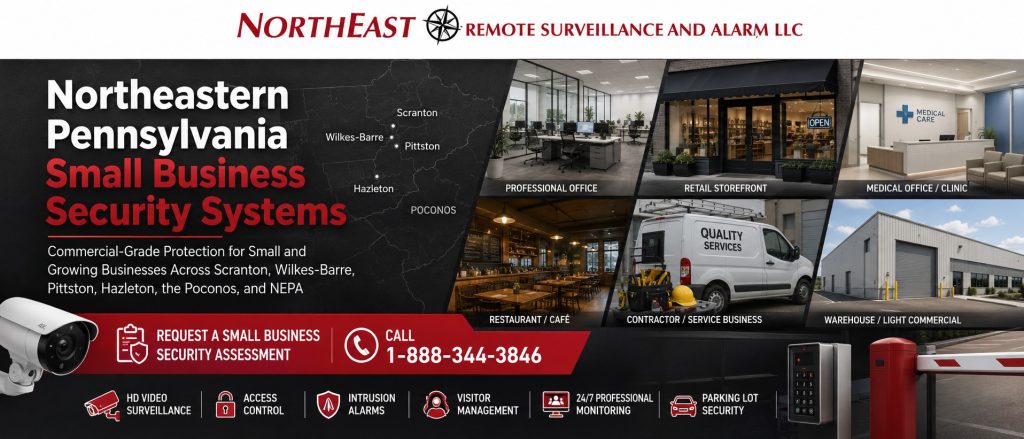
Northeastern Pennsylvania small business security systems should protect employees, customers, property, inventory, equipment, entrances, parking areas, restricted rooms, and daily operations without forcing the business into a residential-style alarm package or an unnecessarily complicated enterprise platform.
Northeast Remote Surveillance and Alarm, LLC designs, installs, integrates, monitors, upgrades, and supports commercial-grade security systems for small businesses throughout Scranton, Wilkes-Barre, Pittston, Hazleton, Lackawanna County, Luzerne County, the Wyoming Valley, the Poconos, and surrounding Northeastern Pennsylvania markets. Projects may include video surveillance, access control, intrusion alarms, professional monitoring, remote video monitoring, intercoms, fire-alarm coordination, gate protection, low-voltage infrastructure, system upgrades, and takeovers. Service availability depends on the property, system type, project scope, inspection requirements, travel, and long-term support needs. (Northeast Remote Surveillance)
Every small business operates differently. A downtown professional office does not have the same visitors, assets, schedules, doors, parking exposure, or after-hours risks as a medical practice, restaurant, contractor shop, auto repair facility, retail store, laundromat, salon, fitness center, small warehouse, or multi-location service company.
NERSA begins with the business, the property, the people, and the operating conditions—not a predetermined equipment package.
This is NERSA’s regional small-business security sub-hub for Northeastern Pennsylvania. Use it to find the appropriate planning resource by business type, security system, geographic market, exterior risk, existing-system condition, or business-growth stage.
For broader small-business planning across the full NERSA footprint, begin with Small Business Security Systems.
For geographic service information, visit NERSA Commercial Security Service Areas.
Warehouses, distribution facilities, industrial parks, manufacturing properties, truck yards, and freight-related businesses should also use the Northeastern Pennsylvania Logistics Hub Security Directory. That directory routes industrial and logistics properties through Scranton, Wilkes-Barre, Pittston, Hazleton, the Wyoming Valley, the Poconos, and the I-80 and I-81 corridors. (Northeast Remote Surveillance)
Request a Northeastern Pennsylvania Small Business Security Assessment
Call 1-888-344-3846
Commercial systems only • Single-location and multi-site businesses • New installations, upgrades, retrofits, takeovers, monitoring, and expansion

Security Planning for Small Businesses Across Northeastern Pennsylvania
Small-business security should not begin with a standard camera count, a residential alarm kit, or a reader mounted beside one arbitrarily selected door.
Planning should begin with an understanding of:
- How customers and visitors enter
- Where employees arrive and leave
- Which doors should remain public
- Which areas require restricted access
- Where inventory, records, tools, medications, keys, cash, or equipment are kept
- How deliveries are received
- Where vehicles are parked
- Which areas remain exposed after closing
- Who opens and closes the property
- Whether the owner manages the business remotely
- How alarms should be handled
- Whether the business expects to add employees, doors, cameras, or locations
A Northeastern Pennsylvania small-business security assessment may review:
- Public entrances
- Employee entrances
- Reception and waiting areas
- Service counters
- Sales floors
- Cash-handling locations
- Offices
- Records rooms
- Information-technology rooms
- Stockrooms
- Medication or controlled storage
- Tool and equipment rooms
- Service bays
- Overhead doors
- Rear and side entrances
- Delivery doors
- Loading areas
- Parking lots
- Employee vehicles
- Customer vehicles
- Contractor yards
- Exterior storage
- Vehicle gates
- Detached buildings
- Opening and closing procedures
- Existing cameras
- Existing alarm equipment
- Existing access control
- Door hardware
- Internet and network capacity
- Alarm communication paths
- Monitoring contacts
- User accounts
- System documentation
- Future expansion plans
- Additional business locations
The objective is not to install the greatest possible number of devices. The objective is to provide useful visibility, appropriate access control, dependable alarm response, manageable administration, and a practical path for growth.
What This Northeastern Pennsylvania Small-Business Hub Covers
This page owns the regional intent:
Northeastern Pennsylvania small business security systems.
It coordinates:
- Regional small-business security planning
- Navigation by business type
- Navigation by NEPA market
- Commercial video surveillance
- Employee access control
- Intrusion alarms
- Professional monitoring
- Remote video monitoring
- Panic and duress systems
- Visitor entry and intercoms
- Parking-lot and exterior security
- Fire-alarm and life-safety coordination
- Low-voltage infrastructure
- Existing-system upgrades
- Monitoring takeovers
- Phased modernization
- Multi-location business growth
This page does not replace:
- The national or non-geographic Small Business Security Systems master sub-hub
- The NERSA Service Areas geographic directory
- The NEPA Logistics Hub Security Directory
- City-specific small-business pages
- Business-type pages
- Video-surveillance service pages
- Access-control service pages
- Intrusion-alarm service pages
- Remote-monitoring service pages
Those resources should remain focused on their own primary intent.
Small-Business Security Is Not One System Package
A smaller business may still face serious security and operational concerns, but that does not mean every property requires a complex enterprise platform.
A professional office may need:
- Entrance cameras
- Controlled staff access
- A monitored intrusion alarm
- Visitor communication
- Parking visibility
A retailer may need:
- Customer entrance coverage
- Transaction-area video
- Stockroom protection
- Panic devices
- Opening-and-closing accountability
A contractor may need:
- Yard cameras
- Vehicle and trailer visibility
- Gate access
- Tool-room control
- After-hours video monitoring
A medical office may need:
- Staff credentials
- Visitor entry
- Records-room protection
- Panic devices
- Privacy-aware video placement
- Alarm and life-safety coordination
A small warehouse may need:
- Overhead-door alarms
- Loading-area cameras
- Employee access control
- Inventory visibility
- Parking coverage
- Remote monitoring
The system should be scaled around the actual business rather than around a predefined product tier.
Northeastern Pennsylvania Small Business Security by Business Type
Retail Store Security Systems
Retail stores, showrooms, specialty shops, convenience businesses, and customer-facing commercial properties may require protection around:
- Public entrances
- Sales floors
- Registers
- Service counters
- Merchandise displays
- Stockrooms
- Employee entrances
- Manager offices
- Rear delivery doors
- Parking areas
- Opening and closing
- Panic or duress events
- After-hours intrusion
Retail camera placement should provide useful views of entrances, transactions, customer movement, inventory areas, and exterior approaches without installing cameras in locations where occupants have a reasonable expectation of privacy.
Access control may protect offices, stockrooms, information-technology rooms, and staff entrances. A professionally monitored alarm may protect doors, windows, interior areas, and restricted storage after the business closes.
Continue to Retail Store Security Systems.
Professional Office Security Systems
Northeastern Pennsylvania professional offices may include:
- Law firms
- Accounting practices
- Financial offices
- Insurance agencies
- Property-management companies
- Engineering firms
- Consulting businesses
- Technology companies
- Administrative offices
- Shared office properties
Office security may involve:
- Controlled visitor entry
- Lobby and reception cameras
- Staff-only doors
- Records storage
- Information-technology rooms
- Executive offices
- Rear entrances
- Parking areas
- Panic devices
- After-hours intrusion protection
- Secure remote administration
The system should preserve an appropriate professional environment while separating visitor areas from employee-only and restricted spaces.
Continue to Office Security Systems.
Medical Office Security Systems
Medical practices, therapy offices, outpatient providers, wellness businesses, and other healthcare-related properties may require security around:
- Patient entrances
- Reception areas
- Staff entrances
- Records rooms
- Medication or supply storage
- Administrative offices
- Information-technology spaces
- Employee parking
- Rear service entrances
- Panic or duress locations
- Intrusion detection
- Fire-alarm coordination
Camera placement should support common-area and exterior security without intruding into examination, treatment, changing, or other private areas.
Continue to Medical Office Security Systems.
Dental Office Security Systems
Dental practices may need protection for:
- Patient and visitor entrances
- Reception areas
- Staff entrances
- Business offices
- Records
- Equipment rooms
- Supply storage
- Medication storage where applicable
- Rear entrances
- Parking areas
- Panic devices
- After-hours alarms
The design should account for patient privacy, staff workflow, equipment value, controlled storage, and the way the office opens and closes.
Continue to Dental Office Security Systems.
Restaurant and Food-Service Security Systems
Restaurants, cafés, bakeries, bars, delis, takeout businesses, and food-service operations may need security around:
- Customer entrances
- Registers
- Pickup counters
- Dining areas
- Bars
- Kitchen transitions
- Employee entrances
- Rear delivery doors
- Food and beverage storage
- Refrigeration areas
- Exterior waste areas
- Parking lots
- Opening and closing
- After-hours access
Alarm partitions may allow cleaning, food preparation, maintenance, deliveries, or management activity in one section while the remainder of the property stays secured.
Continue to Restaurant Security Systems.
Contractor Shop and Service-Fleet Security Systems
Contractors and service companies may operate from properties containing:
- Administrative offices
- Workshops
- Fenced yards
- Work vehicles
- Service vans
- Trailers
- Tools
- Machinery
- Building materials
- Outdoor equipment
- Fuel or utility areas
- Detached storage
Security planning may include:
- Exterior yard cameras
- Vehicle-gate control
- Tool-room access control
- Office and shop alarms
- Trailer monitoring
- Parking and fleet visibility
- Perimeter detection
- Remote video monitoring
- Live audio warnings
- Cellular alarm communication
Exterior cameras should be designed around actual viewing distances, lighting, fence lines, vehicle routes, and required identification detail.
Continue to Contractor Shop Security Systems.
Auto Repair and Automotive Service Security Systems
Auto repair shops, tire businesses, body shops, detailing operations, and other automotive properties may require coverage of:
- Service bays
- Overhead doors
- Customer drop-off
- Key-storage areas
- Parts rooms
- Tool storage
- Payment areas
- Employee entrances
- Customer vehicles
- Overnight vehicle parking
- Exterior storage
- Rear doors
- Vehicle gates
- After-hours activity
A single wide camera may show that an incident occurred without providing the detail needed to identify a person, document vehicle damage, or understand activity near a key-storage area. Focused views may be needed at entrances, lanes, service bays, and other critical points.
Continue to Auto Repair Shop Security Systems.
Laundromat and Unattended Business Security Systems
Laundromats and other businesses with long hours or limited on-site staffing may require:
- Entrance cameras
- Customer-area visibility
- Payment-machine coverage
- Equipment-area protection
- Rear-door alarms
- Panic devices
- Remote camera viewing
- Professional monitoring
- Parking-lot cameras
- After-hours event alerts
The system should support remote awareness and incident review without becoming unnecessarily difficult for the owner or manager to operate.
Continue to Laundromat Security Systems.
Salon, Spa, and Personal-Service Security Systems
Salons, spas, barber shops, beauty studios, and personal-service businesses may benefit from:
- Entrance cameras
- Reception-area visibility
- Cash-area protection
- Staff access control
- Rear-door alarms
- Panic devices
- Inventory-area cameras
- Parking visibility
- Opening-and-closing reports
- Secure remote viewing
Camera placement should protect the business while respecting treatment rooms, changing areas, and other spaces where privacy is expected.
Continue to Salon and Spa Security Systems.
Gym and Fitness-Facility Security Systems
Gyms, training studios, martial-arts facilities, and fitness businesses may require:
- Member-entry control
- Staff credentials
- Lobby cameras
- Check-in visibility
- Common-area video
- Equipment-area awareness
- Parking-lot coverage
- After-hours access management
- Door-held-open alerts
- Intrusion alarms
- User-event reporting
Access permissions can help distinguish members, staff, trainers, cleaners, contractors, and temporary users without relying on one shared entry code.
Continue to Gym and Fitness Studio Security Systems.
Church and Nonprofit Security Systems
Churches, charities, community organizations, and nonprofits may operate with:
- Changing schedules
- Volunteers
- Public events
- Classrooms
- Offices
- Donation areas
- Community rooms
- Detached buildings
- Multiple user groups
Security planning may include:
- Controlled staff and volunteer access
- Visitor entrances
- Classroom corridors
- Administrative offices
- Donation areas
- Parking lots
- Panic devices
- Alarm partitions
- Individual user codes
- Professional monitoring
- Schedule-based permissions
The system should accommodate changing programs without giving every volunteer unrestricted access to the complete property.
Continue to Church and Nonprofit Security Systems.
Small Warehouse and Flex-Commercial Security Systems
Smaller warehouses, office-warehouse properties, storage buildings, and flex-commercial facilities may need:
- Loading-door cameras
- Overhead-door contacts
- Employee access control
- Inventory-area visibility
- Shipping and receiving cameras
- Parking-lot coverage
- Monitored intrusion alarms
- Remote video monitoring
- Expandable network infrastructure
For small light-commercial properties, continue to Small Warehouse Security Systems.
Larger warehouses, distribution centers, manufacturing-connected facilities, truck yards, and logistics operations should use the NEPA Logistics Hub Security Directory. The directory is designed to route industrial properties into specialized dock, yard, gate, warehouse, monitoring, and infrastructure resources. (Northeast Remote Surveillance)
Multi-Location Small Business Security Systems
A growing business may operate several:
- Offices
- Retail stores
- Restaurants
- Medical practices
- Service facilities
- Contractor properties
- Warehouses
- Franchise locations
- Mixed commercial sites
Multi-location planning may establish:
- Centralized camera access
- Shared credential administration
- Location-specific permissions
- Consistent intrusion-alarm monitoring
- Standard camera names
- Common video-retention policies
- Individual user accounts
- System-health alerts
- Repeatable installation standards
- Organized documentation
Centralized management does not mean every employee receives access to every location. Permissions should match the person’s role, approved property, schedule, and responsibilities.
Continue to Multi-Location Small Business Security Systems.
Small Business Security by Northeastern Pennsylvania Market
Scranton and Lackawanna County Small Business Security
Scranton-area small businesses may include downtown offices and storefronts, medical practices, restaurants, retailers, multi-tenant buildings, service companies, automotive businesses, contractor operations, and smaller office-warehouse properties.
Security planning may address:
- Public entrances
- Staff-only doors
- Rear alleys and service entrances
- Shared parking
- Customer-facing cameras
- Records and information-technology rooms
- Cash or inventory exposure
- Alarm communication
- Remote viewing
- Existing-system upgrades
- Multi-tenant permissions
The broader Lackawanna County market may also include businesses in Dunmore, Dickson City, Moosic, Taylor, Old Forge, Clarks Summit, Jessup, and surrounding communities.
Warehouse, distribution, industrial, and freight-related properties in this market should use Greater Scranton Logistics Hub Security Systems. That resource is specifically focused on warehouses, distribution centers, industrial parks, truck terminals, contractor yards, and logistics-connected facilities rather than general small-business security. (Northeast Remote Surveillance)
Wilkes-Barre and the Wyoming Valley Small Business Security
Wilkes-Barre and Wyoming Valley small businesses may operate from:
- Downtown commercial buildings
- Professional offices
- Medical properties
- Retail centers
- Restaurants
- Automotive facilities
- Contractor shops
- Multi-tenant buildings
- Small industrial and flex spaces
Potential security priorities include:
- Public and employee entrances
- Parking areas
- Customer activity
- Controlled offices and stockrooms
- Intrusion detection
- Professional monitoring
- Panic devices
- Visitor communication
- Remote camera access
- Existing-system modernization
The broader market may include Kingston, Edwardsville, Plains Township, Hanover Township, Nanticoke, Mountain Top, and surrounding Luzerne County communities.
Industrial, manufacturing, warehouse, and logistics properties should also use Wilkes-Barre Industrial and Logistics Security Systems, which is the focused NERSA resource for warehouse cameras, controlled entry, intrusion alarms, monitoring, loading docks, gates, infrastructure, and modernization in the Wilkes-Barre market. (Northeast Remote Surveillance)
Pittston and Greater Pittston Small Business Security
Pittston-area small businesses may include:
- Professional offices
- Medical and dental practices
- Restaurants
- Retailers
- Service businesses
- Contractors
- Automotive operations
- Smaller warehouses
- Office-industrial properties
- Multi-location businesses
Security planning may involve:
- Customer and staff entry
- Parking and vehicle visibility
- Restricted-room control
- After-hours intrusion protection
- Delivery areas
- Contractor access
- Alarm communication
- Remote management
- System upgrades
The broader market may include West Pittston, Duryea, Avoca, Jenkins Township, Pittston Township, and nearby Wyoming Valley communities.
Warehouse and logistics properties should use the NEPA Logistics Hub Security Directory, which provides the existing regional path for Pittston and Wyoming Valley warehousing, dock security, truck-yard protection, video monitoring, access control, alarms, infrastructure, and system upgrades. (Northeast Remote Surveillance)
Hazleton and Southern Luzerne County Small Business Security
Hazleton-area small businesses may operate from:
- Downtown commercial properties
- Professional offices
- Medical practices
- Retail stores
- Restaurants
- Contractor facilities
- Automotive businesses
- Flex buildings
- Office-warehouse spaces
- Multi-tenant commercial properties
Security planning may include:
- Public entrances
- Employee doors
- Parking areas
- Rear service entrances
- Stockrooms
- Tool and equipment areas
- Visitor communication
- Intrusion alarms
- Professional monitoring
- Existing-system upgrades
- Multi-location administration
The broader market may include West Hazleton, Hazle Township, Drums, Conyngham, Mountain Top, and surrounding southern Luzerne County communities.
Larger commercial, industrial, warehouse, manufacturing, and logistics properties should also use Commercial and Industrial Security Systems in Hazleton, PA. The established Hazleton resource covers video surveillance, access control, intrusion alarms, fire-alarm systems, remote monitoring, low-voltage infrastructure, system upgrades, and integrated property protection. (Northeast Remote Surveillance)
Poconos Small Business Security
Small businesses throughout the Poconos may include:
- Professional offices
- Medical and wellness practices
- Restaurants
- Retail businesses
- Personal-service businesses
- Contractors
- Automotive properties
- Property-management offices
- Fitness businesses
- Small commercial buildings
- Multi-location service companies
Properties with seasonal scheduling, changing staffing, remote parking, detached buildings, or periods of reduced occupancy may require carefully managed:
- Alarm schedules
- Remote camera access
- Individual user accounts
- Temporary credentials
- Visitor communication
- Parking-lot coverage
- After-hours alerts
- Monitoring instructions
Project support throughout the Poconos should begin with this regional small-business page and NERSA Service Areas. Larger industrial, warehouse, and commercial properties can also use the NEPA Logistics Hub Security Directory, which includes the Poconos within its regional navigation structure. (Northeast Remote Surveillance)
Core Northeastern Pennsylvania Small Business Security Systems
Small Business Video Surveillance
Commercial cameras should be selected around the views the business needs rather than a generic camera quantity.
A small-business camera system may support:
- Entrance identification
- Customer and visitor activity
- Employee entrances
- Cash-handling review
- Inventory protection
- Parking-lot visibility
- Vehicle documentation
- Delivery activity
- Restricted-room entrances
- Exterior property awareness
- After-hours incident review
- Remote administration
- Multi-location viewing
Camera planning should consider:
- Required image detail
- Field of view
- Identification distance
- Mounting height
- Lighting
- Nighttime performance
- Recording reliability
- Storage capacity
- Video retention
- Remote access
- User permissions
- Cybersecurity
- Evidence export
- System-health reporting
- Future expansion
A wide overview camera may show general activity but may not provide enough detail to identify a person, document a transaction, review a vehicle, or understand what occurred at a distant entrance.
Focused views may be required at:
- Public entrances
- Employee doors
- Registers
- Stockrooms
- Key-storage areas
- Vehicle lanes
- Parking-lot approaches
- Rear entrances
- Service bays
- Loading areas
Continue to Small Business Security Camera Systems.
Small Business Access Control
Commercial access control can help a business manage employees, managers, contractors, cleaners, vendors, temporary users, and changing responsibilities without relying entirely on mechanical keys.
Controlled areas may include:
- Employee entrances
- Offices
- Stockrooms
- Records rooms
- Information-technology rooms
- Medication storage
- Tool rooms
- Equipment areas
- Rear entrances
- Service bays
- Warehouse sections
- Shared tenant doors
- Vehicle gates
Permissions may be organized by:
- Employee
- Manager
- Department
- Door
- Schedule
- Location
- Temporary assignment
- Contractor status
- Business responsibility
When an employee leaves, an electronic credential can be disabled without rekeying every affected opening.
The complete door should be evaluated, including:
- Reader
- Controller
- Lock
- Strike
- Panic hardware
- Door contact
- Request-to-exit device
- Power supply
- Closer
- Frame
- Accessible operator
- Emergency egress
- Fire-alarm interaction
A reader installed beside an unreliable door does not create dependable access control.
Continue to Small Business Access Control Systems.
Small Business Intrusion Alarm Systems
A commercial intrusion alarm should reflect how the business opens, closes, and operates.
A system may include:
- Exterior-door contacts
- Window protection
- Interior motion detection
- Glass-break detection
- Overhead-door contacts
- Roof-hatch protection
- Restricted-room protection
- Individual user codes
- Multiple alarm partitions
- Opening-and-closing reports
- Cellular communication
- IP communication
- Dual-path communication
- Professional monitoring
- Video verification
- Panic or duress devices
- Environmental alerts where appropriate
Individual user codes provide greater accountability than one shared code.
Alarm partitions may allow an office, shop, stockroom, warehouse, tenant space, or detached area to operate independently from the remainder of the property.
Continue to Small Business Alarm Systems.
Professional Alarm Monitoring
Professional monitoring may support:
- Intrusion alarms
- Panic signals
- Communication failures
- System trouble
- Environmental events
- Other defined commercial conditions
Monitoring instructions should identify:
- Correct business name
- Property address
- Building or suite
- Alarm-area descriptions
- Primary contacts
- Backup contacts
- Authorized users
- Verification requirements
- Dispatch procedures
- Opening and closing schedules
- Holiday exceptions
- Temporary changes
- Escalation instructions
- Testing requirements
Monitoring information should be reviewed whenever employees, managers, tenants, telephone services, operating schedules, or business responsibilities change.
A reliable alarm system can still produce a weak response when the monitoring center has outdated contacts or unclear zone descriptions.
Remote Video Monitoring and Live Audio Response
Businesses with parking areas, contractor yards, service vehicles, rear entrances, loading areas, detached buildings, exterior equipment, or repeated after-hours exposure may benefit from active remote video monitoring.
Depending on the system and approved response plan, monitored video may support:
- AI-assisted event detection
- Live operator review
- Video verification
- Responsible-party notification
- Live audio warnings
- Documented escalation
- Incident reporting
- System-health supervision
Remote video monitoring is different from simply opening a camera application. It creates a structured workflow around selected events, schedules, operator instructions, and response procedures.
Monitoring rules should be designed around the business’s real operating hours. Legitimate employees, cleaners, contractors, deliveries, snow removal, maintenance, and other approved activity should be incorporated into the plan.
For active exterior and after-hours protection, review Remote Video Monitoring and Live Talk-Down.
Visitor Entry and Video Intercom Systems
Video intercoms can help staff communicate with:
- Visitors
- Patients
- Deliveries
- Vendors
- Contractors
- Employees
- After-hours arrivals
- Drivers at controlled gates
A small-business entry system may include:
- Exterior video stations
- Reception answering
- Desktop answering
- Mobile answering
- Remote door release
- Gate communication
- Recorded call events
- Access-control integration
- Secondary answering positions
The entry process should establish:
- Who answers
- Which opening is released
- What the visitor can access
- What happens outside normal hours
- What happens when reception is unattended
- Whether the event is recorded
- Who may remotely unlock the door
Panic and Duress Systems
Panic or duress devices may be appropriate for:
- Reception desks
- Payment counters
- Medical offices
- Counseling spaces
- Cash-handling areas
- Late-night businesses
- Isolated staff areas
- Manager offices
- Customer-service counters
Planning should define:
- Device locations
- Authorized users
- Signal type
- Monitoring response
- Notification procedures
- Video association
- Testing schedules
- Staff training
- Accidental-activation procedures
A panic device is one part of an emergency-response plan. It does not replace written procedures, employee training, internal communication, or appropriate first-responder coordination.
Parking-Lot and Exterior Security
Small-business exterior security may address:
- Employee parking
- Visitor parking
- Accessible spaces
- Building approaches
- Sidewalks
- Rear entrances
- Delivery areas
- Work vehicles
- Customer vehicles
- Exterior equipment
- Service bays
- Fenced yards
- Vehicle gates
- Detached buildings
Exterior camera planning should account for:
- Nighttime lighting
- Weather exposure
- Vehicle headlights
- Viewing distance
- Mounting height
- Camera stability
- Network connectivity
- Power availability
- Required identification detail
- Plate-capture objectives
- Recording retention
A standard overview camera should not automatically be expected to provide readable license plates. Plate capture may require a dedicated lane, focused camera, controlled angle, appropriate distance, specialized exposure, and separate overview video.
Continue to Small Business Parking Lot Security Cameras.
Fire Alarm and Life-Safety Coordination
Small-business security equipment must not interfere with:
- Emergency egress
- Accessibility
- Fire-alarm release
- Occupant notification
- Sprinkler supervision
- Elevator-related functions
- Required monitoring
- Emergency power
- Inspection requirements
Project coordination may involve:
- Fire-alarm release of controlled doors
- Accessible entrance operation
- Fire-alarm monitoring
- Cellular communicator upgrades
- Sprinkler supervisory signals
- Door-holder release
- Notification equipment
- Emergency power
- Inspection access
- System-interface testing
Fire-alarm and life-safety requirements are code-driven and should be evaluated separately from general intrusion and video-surveillance needs.
Low-Voltage and Network Infrastructure
Modern cameras, access control, intercoms, alarms, and monitoring platforms depend on reliable infrastructure.
Small-business infrastructure may include:
- Category cabling
- Fiber where appropriate
- Power-over-Ethernet switches
- Managed network equipment
- Network segmentation
- Secure remote connectivity
- Wireless building links
- Cellular communication
- Equipment racks
- Lockable enclosures
- Uninterruptible power supplies
- Surge protection
- Cable labeling
- Device naming
- Network documentation
- Future expansion capacity
A security-system problem may actually be caused by:
- Damaged cabling
- Overloaded switches
- Insufficient PoE capacity
- Weak wireless links
- Failing power supplies
- Poor surge protection
- Unstable internet service
- Undocumented network changes
Infrastructure should be treated as part of the security system—not as an afterthought.
For broader infrastructure planning, review Commercial and Industrial Infrastructure and Cabling.
New Installations, Upgrades, Retrofits, and Takeovers
New Small Business Security Installations
A new Northeastern Pennsylvania small-business installation may begin with a focused combination of:
- Entrance cameras
- Interior cameras
- Parking-lot coverage
- A monitored intrusion alarm
- Controlled employee access
- Visitor intercoms
- Panic devices
- Cellular alarm communication
Planning should address:
- Current risks
- Entrances
- Employees
- Customers
- Restricted areas
- Camera objectives
- Alarm zones
- Monitoring procedures
- Network capacity
- Backup power
- Remote access
- Documentation
- Future growth
The design should leave a reasonable path for adding cameras, doors, users, analytics, or additional business locations later.
Existing-System Upgrades
A business may request an upgrade because of:
- Poor camera images
- Weak nighttime performance
- Failed recording
- Insufficient video retention
- Slow footage retrieval
- Shared passwords
- Former employees with access
- Unsupported equipment
- Old telephone-line alarm communication
- Unreliable remote viewing
- Failing door hardware
- Confusing alarm zones
- Outdated monitoring contacts
- Missing administrator credentials
- Incomplete documentation
- Limited expansion capacity
Existing cameras, cabling, readers, door hardware, alarm devices, network equipment, fiber, poles, and pathways may sometimes be retained when they remain compatible, supportable, secure, properly installed, and appropriate for the final design.
Unsupported, proprietary, unreliable, insecure, or undocumented components may require correction or replacement.
For complete modernization planning, review Commercial Security System Upgrades, Retrofits and Takeovers.
Alarm and Monitoring Takeovers
A takeover may involve:
- Existing-equipment inspection
- Administrator-access review
- Alarm-panel programming
- Communicator replacement
- Monitoring-account transition
- User-code cleanup
- Credential cleanup
- Contact-list corrections
- Device testing
- Zone-description cleanup
- Documentation recovery
- Priority repairs
- Ongoing service planning
A takeover cannot be considered complete until:
- Critical devices have been tested
- Administrator control is established
- Monitoring signals are confirmed
- User access is reviewed
- Communication paths are operating
- Contact instructions are documented
Some proprietary systems may require cooperation from the previous provider or manufacturer. Locked equipment, missing licenses, unavailable credentials, obsolete hardware, or nontransferable cloud accounts may require partial replacement.
Phased Small-Business Modernization
A phased plan may begin with:
- Failed cameras or recording
- Alarm communication problems
- Former-user removal
- Critical entrance protection
- Failing controlled doors
- Outdated monitoring contacts
- Parking or exterior blind spots
- Network and backup-power problems
Later phases may add:
- Additional cameras
- More controlled doors
- Parking-lot coverage
- Visitor intercoms
- Remote video monitoring
- Analytics
- Multi-location administration
- System integration
- Standardized documentation
Each phase should move the business toward one defined system architecture rather than create another temporary platform with no planned future.
Small-Business Security for Existing and Multi-Tenant Buildings
Many small businesses operate from leased spaces, shared commercial properties, converted buildings, or facilities that already contain security equipment.
Planning may require coordination among:
- Business owner
- Property owner
- Property manager
- Tenant
- Information-technology provider
- Electrical contractor
- Door-hardware provider
- Fire-alarm provider
- Existing security company
- Monitoring center
A multi-tenant project should clearly define:
- Who owns the cameras
- Who can view shared video
- Who manages entrance credentials
- Which doors belong to each tenant
- Who receives alarm notifications
- How former tenants are removed
- Who approves equipment changes
- How exported video is handled
- Who maintains shared infrastructure
- Which systems remain with the property
Tenant-level permissions should not automatically provide unrestricted access to every camera, door, user, or alarm area in the building.
Small Business Growth and Multi-Location Planning
A small business may begin with one property and later add locations across Scranton, Wilkes-Barre, Pittston, Hazleton, the Poconos, or other Pennsylvania markets.
A scalable plan may establish:
- Approved camera standards
- Credential formats
- Individual user accounts
- Role-based permissions
- Location-specific access
- Standard alarm descriptions
- Common monitoring procedures
- Defined video-retention objectives
- Secure remote access
- Consistent system naming
- Documentation requirements
- New-location assessment procedures
A regional manager may require access to several sites. A local manager may require access to only one. Human resources may need to request credential changes without viewing cameras. Information-technology personnel may manage infrastructure without administering employee access.
The system should support these separate responsibilities.
A small business should not be forced into an enterprise platform before it needs those capabilities. It should also avoid dead-end equipment that cannot support reasonable growth.
Why Northeastern Pennsylvania Small Businesses Choose NERSA
Northeast Remote Surveillance and Alarm, LLC focuses on non-residential properties and supports systems ranging from focused small-business installations to large industrial, institutional, and multi-site environments. NERSA’s published service structure includes video surveillance, access control, intrusion alarms, fire-alarm and life-safety systems, professional monitoring, remote video monitoring, visitor entry, gate security, structured cabling, unified systems, solar or cellular surveillance, upgrades, retrofits, and takeovers. (Northeast Remote Surveillance)
NERSA plans small-business security around:
- The business
- The property
- Employees and customers
- Entrances and doors
- Visitor procedures
- Parking and exterior areas
- Inventory and equipment
- Restricted spaces
- Operating schedules
- Alarm response
- Monitoring instructions
- Existing systems
- Network infrastructure
- User permissions
- Documentation
- Future growth
The recommended project may be a focused camera-and-alarm installation for one office or a coordinated video, access-control, monitoring, infrastructure, and multi-location program for a growing business.
The objective is to provide commercial-grade security that remains practical to operate, understand, service, document, and expand.
Request a Northeastern Pennsylvania Small Business Security Assessment
A small-business security assessment should review the property before cameras, alarm devices, readers, monitoring services, or software platforms are selected.
NERSA can evaluate:
- Public entrances
- Employee entrances
- Customer and visitor movement
- Parking areas
- Rear and side approaches
- Inventory and equipment
- Restricted rooms
- Existing cameras
- Video-retention requirements
- Access-control needs
- Intrusion-alarm coverage
- Panic or duress requirements
- Monitoring procedures
- Intercoms
- Fire-alarm coordination
- Cabling
- Network infrastructure
- Existing users and credentials
- System documentation
- Expansion plans
- Additional business locations
Request a Commercial Security Assessment or call 1-888-344-3846 to discuss security planning for a small or growing business in Scranton, Wilkes-Barre, Pittston, Hazleton, the Poconos, or another supported Northeastern Pennsylvania market.
Commercial systems only • Single-location and multi-site businesses • New installations, upgrades, retrofits, takeovers, monitoring, and expansion
Frequently Asked Questions About Northeastern Pennsylvania Small Business Security Systems
What types of Northeastern Pennsylvania small businesses does NERSA support?
NERSA supports qualifying professional offices, medical and dental practices, retail stores, restaurants, contractor shops, service businesses, auto repair facilities, laundromats, salons, gyms, churches, nonprofits, small warehouses, multi-tenant properties, and growing multi-location businesses.
What Northeastern Pennsylvania markets does this page cover?
This regional hub covers small-business security planning throughout Scranton, Wilkes-Barre, Pittston, Hazleton, Lackawanna County, Luzerne County, the Wyoming Valley, the Poconos, and surrounding NEPA markets. Project availability depends on the property, system, scope, inspection requirements, travel, and long-term service fit. (Northeast Remote Surveillance)
What security systems can a small business install?
A project may include video surveillance, access control, intrusion alarms, professional monitoring, panic devices, video intercoms, parking-lot cameras, gate security, remote video monitoring, fire-alarm coordination, and low-voltage infrastructure.
Does a small business need an enterprise security platform?
Not necessarily. The system should match the property’s size, operating risks, users, administrative requirements, and growth plans. A smaller business should not be forced into an unnecessarily complicated platform.
Can NERSA install only cameras and an alarm?
Yes. A focused project can include only the systems the property currently needs while maintaining commercial-grade equipment, installation, monitoring, remote access, documentation, and expansion capability.
Can a small business view cameras remotely?
Many commercial camera systems support secure remote viewing for authorized users. The system should use individual accounts, strong authentication, appropriate permissions, and properly configured network connections.
Can access control reduce the need for employee keys?
Yes. Cards, fobs, mobile credentials, or other approved credentials can be changed or disabled without rekeying every controlled opening.
Can access permissions be limited by employee and schedule?
Yes. Permissions may be organized by employee, manager, door, department, location, day, time, temporary assignment, or business role.
Can a small-business alarm be professionally monitored?
Yes. Commercial monitoring may support intrusion alarms, panic events, communication failures, system trouble, environmental alerts, and other approved signals.
Can an older telephone-line alarm system be modernized?
Many commercial alarm systems can be moved to cellular, IP, or dual-path communication when the panel and proposed communicator are compatible. The complete signal path should be programmed, tested, and documented after the upgrade.
Can NERSA upgrade cameras or alarms installed by another company?
Yes. NERSA can evaluate existing cameras, recorders, alarm panels, communicators, access-control equipment, intercoms, cabling, networks, users, and documentation to determine what can be retained, corrected, upgraded, taken over, or replaced.
Can former employees be removed from cameras, alarms, and access control?
Yes. User cleanup can address former employees, vendors, contractors, previous tenants, shared codes, duplicate credentials, old mobile users, and unnecessary administrator accounts.
Can cameras integrate with access control or intrusion alarms?
Compatible systems may associate video with door events, invalid credentials, forced doors, intrusion alarms, intercom calls, gate activity, and selected monitoring events. Integration should serve a defined operational purpose.
Can parking-lot cameras capture license plates?
General overview cameras may not reliably capture readable plates. Dedicated plate capture may require a controlled lane, appropriate distance, suitable camera angle, specialized settings, and separate overview video.
Can remote video monitoring be added later?
Yes. Remote monitoring can often be added after the cameras, network, lighting, fields of view, analytics, communication paths, schedules, and response procedures have been evaluated.
Does NERSA support businesses with several NEPA locations?
Yes. Multi-location businesses may use centralized video, shared credential administration, location-specific permissions, consistent alarm monitoring, system-health alerts, and standardized documentation.
Can a security upgrade be completed in phases?
Yes. A phased plan may address failed equipment, alarm communication, user cleanup, critical entrances, parking coverage, and infrastructure first, followed by integration and expansion.
Does NERSA install residential security systems?
No. NERSA focuses on commercial, industrial, institutional, municipal, healthcare, warehouse, manufacturing, logistics, contractor, and multi-site properties. (Northeast Remote Surveillance)
What is the first step in planning a Northeastern Pennsylvania small-business security system?
Begin with a commercial security assessment that reviews the property, people, entrances, vehicles, assets, existing equipment, monitoring, infrastructure, documentation, and future requirements before equipment is selected.