
Plan security for Fogelsville industrial parks around shared entrances, tenant boundaries, detached buildings, warehouse activity, and coordinated system administration.

Fogelsville Industrial Park Security Assessment
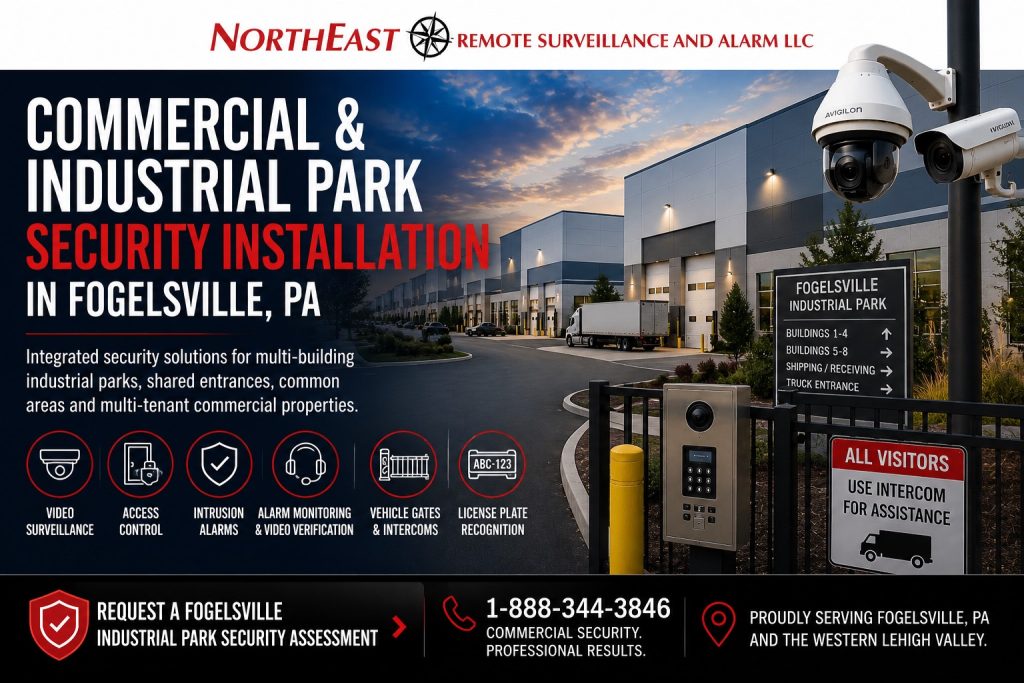
Industrial parks require a different security strategy from a single warehouse, office or manufacturing building because roads, parking areas, loading zones, entrances, gates, networks and responsibilities may be shared across several buildings or tenants.
On this page: Shared and tenant security · Planning process · Assessment
Northeast Remote Surveillance and Alarm, LLC serves industrial parks, warehouse campuses and flex-industrial sites in Fogelsville and western Lehigh County. We design, install, integrate, monitor, upgrade and support security systems for these properties, including buildings with multiple tenants.
For services at an individual property, see Commercial and Industrial Security Installation in Fogelsville, PA.
The guidance below focuses on what changes when tenants share entrances, common areas, or infrastructure.
An industrial park may need shared cameras, gates, license plate recognition and remote video monitoring. Tenants may also need access control, intrusion alarms and visitor communication. Plan shared networks, administration and each party’s responsibilities together.
Define what property management needs to oversee and what each tenant should control. Keep access to cameras, doors, alarms, and records within those agreed boundaries.
Start by agreeing on who owns each system, who can change it, and who responds when something goes wrong.
Project availability depends on the site and scope. We review installed equipment, administrator access, network ownership, software licenses and manufacturer support. Customer IT policies, internet service, firewall coordination, cybersecurity requirements, documentation and ongoing support needs also affect the plan.
Security Planning for Fogelsville Industrial Parks
An industrial park may include several independent businesses operating within one property or development.
The property may contain:
- Shared spaces: access roads, parking, gates, visitor entrances, loading docks, truck courts, and trailer areas.
- Buildings and services: tenant suites, vacant spaces, management offices, utility and maintenance areas, and exterior equipment.
- Separate responsibilities: tenant networks, building-to-building fiber, operating schedules, monitoring accounts, and service providers.
These conditions create two different security responsibilities.
Property ownership or management may be responsible for shared roads, gates, common parking, exterior areas and building shells. Individual tenants may be responsible for their suites, employees, inventory, alarms and internal access permissions.
The security plan should define those boundaries before cameras, credentials, alarm accounts or remote access are configured.
Property-Wide Security and Tenant-Level Security
Industrial-park security should distinguish between systems serving the overall property and systems serving individual occupants.
Property-Wide Security
Property-wide systems may include:
- Main entrance cameras
- Shared-road coverage
- Common parking cameras
- Perimeter cameras
- Vehicle gates
- Gate intercoms
- License plate recognition
- Shared-area lighting
- Remote video monitoring
- Property-management access
- Building-exterior cameras
- Utility-area coverage
These systems may be administered by the property owner or management company.
Tenant-Level Security
Tenant systems may include:
- Employee access control
- Suite intrusion alarms
- Interior cameras
- Warehouse cameras
- Restricted-room access
- Loading-dock cameras
- Tenant monitoring accounts
- Individual user permissions
- Tenant-specific video retention
Each tenant should control only the systems, doors, cameras and records assigned to that organization unless a broader arrangement is specifically authorized.
Industrial Park Video Surveillance
Industrial-park cameras should provide useful coverage across shared areas while respecting tenant boundaries.
Property-wide camera planning may include:
- Vehicle activity at entrances, exits, road intersections, shared parking, and truck courts.
- People approaching buildings, using pedestrian routes, or working around loading areas.
- Exposed locations such as storage areas, utility equipment, fence lines, and dumpster enclosures.
- Vacant buildings and shared maintenance spaces that may receive less routine attention.
A large industrial property often requires several camera objectives.
Overview Cameras
Overview cameras show general activity, traffic flow and movement across wider areas.
Identification Cameras
Identification views provide additional detail at entrances, pedestrian routes or controlled locations.
License Plate Cameras
Dedicated LPR cameras capture vehicle plates at controlled lanes and should not be replaced by general overview cameras.
Tenant Cameras
Tenant cameras may cover suite entrances, warehouse interiors, individual loading docks and restricted spaces without granting unrelated tenants access.
Camera placement, naming and permissions should make it clear which organization owns or administers each view.
For broader regional camera planning, review Lehigh Valley Commercial Video Surveillance Systems.
Shared Entrances and Vehicle Gates
A shared industrial-park gate may serve employees, tenants, visitors, contractors, vendors, truck drivers and emergency responders.
A commercial gate-access system may coordinate:
- Who can enter: employees, tenants, contractors, and visitors using the supported credentials or temporary permissions.
- How visitors get help: an intercom directory, a responsible person to answer, and authorized remote gate release.
- What is recorded: entrance and exit video, plate information where included, gate position, and access events.
- When access changes: schedules, after-hours procedures, and arrangements for emergency access.
The property should determine who may issue credentials, change schedules, review gate events and release the entrance remotely.
One tenant should not automatically be able to create credentials or release gates for another tenant’s employees and visitors.
The gate operator and required safety equipment should be evaluated separately from the access-control and communication systems. Electronic integration cannot correct unsafe mechanical movement, missing entrapment protection or a damaged gate.
For broader vehicle-entry planning, review Lehigh Valley Commercial Gate Access Control Systems.
Tenant Access Control and Credential Separation
Access control can manage employee, contractor and visitor permissions across several buildings while maintaining appropriate separation.
An industrial-park access-control system may support:
- Assign administrators and decide who manages property-wide, tenant, and contractor credentials.
- Define access to shared doors, tenant suites, loading areas, and utility rooms.
- Set building and holiday schedules, including any access needed across several buildings.
- Keep individual activity records and remove permissions when a user no longer needs access.
The system should define whether credentials are administered centrally, individually by each tenant or through a controlled combination.
A tenant administrator may be allowed to manage users for that tenant’s suite without receiving permission to unlock another building, view unrelated records or change property-wide settings.
Access-control design should also include the complete physical opening:
- Reader
- Controller
- Lock hardware
- Door-position switch
- Request-to-exit device
- Power supply
- Door closer
- Emergency egress
- Accessibility
- Fire alarm interfaces
Use Lehigh Valley Commercial Access Control Systems to plan the doors, hardware, and permissions before assigning tenant access.
Visitor Entry for Multi-Tenant Industrial Properties
Visitors may arrive without knowing which entrance, building or tenant they need.
A commercial visitor-entry system may coordinate:
- A tenant directory that routes audio or video calls to the right person.
- Authorized answering and entrance release from supported mobile or desktop devices.
- Entrance-camera views, visitor records, and a clear after-hours answering route.
The system should define:
- How visitors select the correct tenant
- Who answers each call
- Which tenant may release which entrance
- What happens when the tenant does not answer
- Whether property management can assist
- How after-hours calls are handled
- Who maintains the directory
- How tenant changes are administered
Tenant turnover should not require replacing the entire entrance station when the selected platform supports directory and user updates.
For broader visitor-entry planning, review Lehigh Valley Commercial Intercom and Visitor Entry Systems.
Industrial Park License Plate Recognition
License plate recognition may create searchable vehicle records at shared industrial-park entrances.
An LPR system may provide:
- Plate captures, vehicle snapshots, and time records at the entrance or exit lanes.
- Supported plate searches, authorized-vehicle lists, and watch lists.
- Links to tenant, building, or gate events where the chosen system supports them.
Administrative permissions should be carefully controlled.
Property management may need access to shared entrance records, while individual tenants may need access only to events related to their own operations or authorized investigations.
LPR does not identify the driver and should not be treated as conclusive proof of who operated the vehicle.
Dedicated plate cameras should normally be paired with overview cameras showing the vehicle, lane and surrounding activity.
The Lehigh Valley License Plate Recognition Systems guide explains the capture and planning considerations behind a useful plate record.
Intrusion Alarm Systems for Multiple Tenants
Each tenant may require an independent intrusion-alarm system or separately administered partition.
A multi-tenant alarm environment may include:
- Separate accounts, partitions, and user codes for the tenants who need them.
- Detection at exterior and overhead doors, interior spaces, and restricted rooms, with panic or duress devices where included.
- Tenant call lists and response instructions, plus an agreed route for shared-building trouble reports.
- Cellular or IP communication and video verification where supported and included in the scope.
One tenant should not have authority to arm, disarm or cancel alarms for another tenant unless specifically authorized.
Property ownership may maintain separate protection for common areas, vacant suites, utility rooms or building infrastructure.
Alarm-zone descriptions should identify the actual tenant, building and location involved rather than use generic zone numbers.
For broader alarm planning, review Lehigh Valley Commercial Intrusion Alarm Systems.
Alarm Monitoring and Video Verification
Alarm monitoring may need to support several tenants, buildings, partitions and contact lists.
A coordinated environment may include:
- Named buildings, suites, accounts, and contact lists so the responder knows which tenant is affected.
- Relevant camera views, opening and closing information, and instructions for panic or duress events.
- Separate handling of common-area alarms and shared-gate activity, with records of the response.
Video verification may help determine whether an event involves an employee, delivery, cleaning crew, contractor, weather condition or unauthorized person.
Monitoring responsibilities should be documented so the central station, property manager and tenant understand who is contacted and who has authority to modify instructions.
Review Lehigh Valley Commercial Alarm Monitoring and Video Verification when defining how alarms and associated camera views will be handled.
Remote Video Monitoring for Common Areas
Remote video monitoring may provide active after-hours review around exposed shared areas.
Potential monitoring locations may include:
- Entrances, access roads, shared parking, and loading areas.
- Fence lines, trailer positions, exterior equipment, and dumpster areas.
- Vacant suites, utility areas, and places where trespassing has been a recurring problem.
When qualifying activity is detected, trained personnel may review the event and follow documented property instructions.
Depending on the approved service, the response may involve:
- Reviewing additional cameras
- Issuing a live audio warning
- Contacting property management
- Contacting a designated tenant
- Following escalation instructions
- Documenting the event
The response process should identify which organization is responsible for each area.
A tenant should not receive alerts for unrelated activity unless that responsibility has been specifically assigned.
Compare the response you need with the options in Lehigh Valley Remote Video Monitoring and Live Talk-Down before assigning common-area monitoring responsibilities.
AI Video Analytics for Industrial Parks
AI-assisted analytics may help identify relevant activity across larger exterior areas.
Potential functions may include:
- Person and vehicle detection, line crossing, perimeter zones, and loitering alerts.
- Activity around gates, parking, vacant suites, or other areas needing after-hours review.
- Supported recorded-event searches and alerts that feed the agreed monitoring workflow.
Detection zones should avoid public roads, neighboring properties and routine tenant activity whenever practical.
Schedules should account for the fact that tenants may operate different shifts.
An alert schedule appropriate for one building may generate unnecessary events around a tenant operating overnight.
For broader analytics planning, review Lehigh Valley AI Video Analytics Systems.
Centralized and Tenant-Separated Video Management
A shared video platform may provide centralized administration while limiting users to selected buildings and cameras.
Permission structures may separate:
- Property ownership
- Property management
- Individual tenants
- Security personnel
- Service providers
- Corporate administrators
- Remote monitoring personnel
A tenant may receive access to:
- Its suite entrance
- Its loading dock
- Its interior cameras
- Its assigned parking
- Its warehouse area
The tenant should not automatically receive access to:
- Another tenant’s cameras
- Unrelated parking areas
- Property-wide LPR records
- Other tenants’ alarm events
- System-wide administrator settings
Role-based permissions and individual accounts should be used where the selected platform supports them.
Cloud and Hybrid Video for Multi-Building Properties
Cloud and hybrid video platforms may simplify administration across several buildings.
A system may combine:
- Local or edge recording combined with supported cloud management and multi-site navigation.
- Central user management with building-specific permissions and tenant separation.
- Camera-health alerts, supported search and event sharing, and clearly defined recording behavior during an internet outage.
Account ownership should be clearly documented.
The primary account should not depend solely on one tenant, former property manager or provider-controlled email address.
The system should also establish what happens when:
- A tenant leaves
- A new tenant arrives
- Management companies change
- A subscription expires
- Internet service fails
- A camera is reassigned
- A property is sold
Use Lehigh Valley Cloud and Hybrid Video Surveillance Systems to compare recording, remote management, and account responsibilities across buildings.
Unified Industrial Park Security Systems
A unified or integrated platform may coordinate property-wide and tenant-level security without eliminating appropriate separation.
Supported integration may connect:
- Camera views associated with gates, doors, alarms, intercom calls, and plate records.
- Authorized user access across shared and tenant-owned systems.
- Building maps, monitoring workflows, and incident reports where the platforms support those connections.
Examples may include:
- Displaying an entrance camera during an intercom call
- Associating a gate credential with vehicle video
- Displaying tenant loading-dock video during an alarm
- Reviewing common-area and tenant video during an authorized investigation
- Centralizing several buildings while separating user permissions
Integration should make administration and investigation easier without exposing one tenant’s data or controls to another.
The Lehigh Valley Unified Commercial Security Systems guide helps you decide which events and controls need to work together.
Shared Networks and Multi-Building Infrastructure
Industrial parks may require security communication across several buildings and equipment locations.
Infrastructure may include:
- Cable routes: conduit, Cat6 or Cat6A, and suitable fiber between buildings.
- Connections and equipment: PoE switches, wireless bridges, racks, and environmental enclosures.
- Power and continuity: UPS backup, surge protection, and cellular communication where included.
- Administration: network separation, device labels, diagrams, and capacity for planned additions.
Shared fiber or network infrastructure should not automatically place every tenant on the same unrestricted network.
The design may require:
- Separate property-security and tenant network segments, with controlled routing between them.
- Building switches, firewall rules, and only the cloud connections required for the approved use.
- Documented device addresses and clear responsibility for network support.
For broader infrastructure planning, review Lehigh Valley Low-Voltage and Security Infrastructure.
Security Network Segmentation and Cybersecurity
A multi-tenant security environment may connect cameras, recorders, access-control panels, intercoms, alarm communicators, cloud platforms and remote users.
Cybersecurity-aware planning may include:
- Property and tenant network separation
- Security VLANs
- Managed switches
- Controlled routing
- Individual administrator accounts
- Multi-factor authentication where supported
- Secure remote access
- Limited vendor permissions
- Cloud-account ownership
- Removal of former users
- Supported firmware
- Event logging
- Backup and recovery
- Documented responsibilities
One tenant should not be able to reach another tenant’s cameras, door controllers or alarm equipment through a shared network.
Network-connected work should be coordinated with property management and authorized tenant IT personnel when customer-managed infrastructure is involved.
Bring Lehigh Valley Security Network Segmentation and Cybersecurity into the discussion with property management and tenant IT contacts before connecting shared equipment.
Vacant Suites and Tenant Turnover
Vacant industrial suites may present different risks from occupied buildings.
Security planning may include:
- Temporary detection, door monitoring, cameras, and protection for exposed utility areas.
- Environmental or remote video monitoring where the property needs it.
- Credential and account reviews, lock or access changes, and records of the inspection.
When a tenant leaves, property management should review:
- Active credentials
- Alarm users
- Camera users
- Mobile applications
- Cloud accounts
- Intercom directory entries
- Gate permissions
- Monitoring contacts
- Network equipment
- Provider-owned equipment
Tenant turnover should not leave former employees or vendors with active access to the property or connected systems.
Shared Parking and Exterior Areas
Common parking areas may require coverage of:
- Vehicle lanes, entrances, exits, and conflicts between parking and loading activity.
- Pedestrian routes, accessible parking, and approaches to buildings.
- After-hours activity, damage reports, unauthorized parking, and the lighting needed for useful camera views.
Parking cameras should include both broad awareness and useful identification views where appropriate.
License plate recognition may be added at controlled entrances, but it does not replace general parking-lot video.
Property management should define which tenants may view shared-area video and under what circumstances.
Fire Alarm and Life-Safety Coordination
Industrial parks may contain separate fire alarm systems for each building or tenant, shared sprinkler supervision or property-wide life-safety interfaces.
Qualifying planning may involve:
- Building-specific fire alarm systems
- Tenant improvements
- System expansion
- Alarm monitoring
- Communicator upgrades
- Sprinkler supervision
- Waterflow and tamper monitoring
- Shared utility conditions
- Building interfaces
- Documentation
- Testing and inspection coordination
Fire alarm responsibilities should be clearly divided between property ownership, tenants, monitoring providers and service companies.
Security-system integration must not interfere with required fire detection, notification, emergency operation or inspection requirements.
For broader regional life-safety planning, review Lehigh Valley Commercial Fire Alarm Systems.
Existing Industrial Park Security Upgrades
Industrial parks frequently inherit equipment installed at different times by different providers.
Existing systems may include:
- Mixed camera brands, recorders, alarms, gates, and older intercoms.
- Unmanaged switches, unsupported software, and incomplete system records.
- Inconsistent credentials, multiple cloud accounts, and different monitoring providers.
An assessment can help determine what may be:
- Keep serviceable equipment, with repairs or configuration changes where appropriate.
- Reassign, integrate, expand, or standardize supported systems when that meets the agreed need.
- Replace equipment in phases or as a complete system when its condition and support limits justify that choice.
Existing equipment should not be replaced solely because several brands are present. It should also not be retained when it is unsupported, insecure, unreliable or impossible to administer appropriately.
For broader existing-system planning, review Lehigh Valley Commercial Security System Upgrades, Retrofits and Takeovers.
Industrial Park Security Maintenance and Service
Multi-building properties require clear service responsibilities.
A service request may involve:
- Property-owned and tenant-owned cameras, doors, alarms, gates, and intercoms.
- Shared fiber, network switches, and connections between buildings.
- Cloud platforms and monitoring accounts with their own owners and support contacts.
Before service begins, the responsible party should be identified.
The property owner, manager and tenant should understand:
- Who owns the equipment
- Who may authorize service
- Who provides administrator access
- Who pays for shared repairs
- Which systems NERSA supports
- Which equipment belongs to another provider
- Which conditions require tenant approval
- Which work affects shared infrastructure
For broader regional support planning, review Lehigh Valley Commercial Security System Maintenance and Service.
Related Fogelsville and Lehigh Valley Security Resources
For wider facility planning, review Fogelsville commercial and industrial security installation, Lehigh Valley commercial and industrial security systems, and Route 100 industrial corridor security systems.
The NERSA Fogelsville Industrial Park Planning Process
1. Define Property and Tenant Responsibilities
The process begins by identifying which entrances, roads, cameras, gates, networks and systems belong to the property and which belong to individual tenants.
2. Review Buildings and Shared Areas
NERSA reviews entrances, parking areas, roads, loading areas, gates, utility spaces, buildings, tenant suites and existing systems.
3. Review Existing Security and Infrastructure
The review may include:
- Cameras, recording, access control, and intrusion alarms.
- Monitoring, intercoms, vehicle gates, and plate recognition.
- Cabling, fiber, and network switches.
- Cloud accounts, user permissions, and available documentation.
4. Define Property-Wide Objectives
The owner or manager should identify what needs to be seen, controlled, detected, documented and monitored across shared areas.
5. Define Tenant Separation
The plan should determine which users may access each building, camera group, door, alarm account and administrative function.
6. Design the System Architecture
The proposed design may coordinate property-wide systems with tenant-specific systems while maintaining appropriate separation.
7. Configure Users and Responsibilities
The system should define property administrators, tenant administrators, service access, monitoring users and account ownership.
8. Install, Test and Document
Testing may include:
- Live and recorded video, plate capture, and the camera views each tenant is allowed to see.
- Gate credentials, visitor calls, and door access.
- Alarm reporting, monitoring procedures, and authorized remote access.
- Network separation and communication between buildings.
9. Train Property Management and Authorized Tenants
Authorized users should understand how to manage credentials, review events, answer visitor calls, request service and remove former users without affecting unrelated tenants.
Why Fogelsville Industrial Parks Choose NERSA
An industrial park security system requires more than placing cameras at several buildings.
It requires an understanding of shared entrances, tenant separation, vehicle movement, loading areas, common infrastructure, network ownership, monitoring procedures, account administration and long-term service responsibilities.
Northeast Remote Surveillance and Alarm, LLC focuses on commercial, industrial, warehouse, manufacturing, logistics, contractor, multi-tenant and multi-building environments.
NERSA plans industrial-park systems around what property ownership and individual tenants need to see, control, detect, verify, communicate and document.
The objective is to create dependable property-wide security without removing appropriate tenant privacy, administrative boundaries or operational independence.
Request a Fogelsville Industrial Park Security Assessment
A commercial and industrial park security assessment may review:
- Property layout: buildings, tenant suites, entrances, shared roads, parking, loading areas, gates, and vacant spaces.
- Existing systems: cameras, recording, door access, alarms, monitoring, intercoms, and fire-alarm coordination.
- Connections and administration: cabling, fiber, networks, cloud accounts, permissions, and tenant separation.
- Responsibilities and plans: equipment ownership, management contacts, documentation, and future expansion.
Frequently Asked Questions About Fogelsville Industrial Park Security
Who is this industrial-park guide for?
NERSA provides shared security, tenant separation and multi-building administration for industrial parks and commercial campuses in Fogelsville.
How is this different from the general Fogelsville security page?
The general guide covers individual properties. Here, the focus is on shared entrances, common areas, several buildings, and the division of responsibility between tenants and property management.
Where can I find broader Fogelsville security services?
Visit Commercial and Industrial Security Installation in Fogelsville, PA for broader local services, or the Lehigh Valley commercial security resource for regional planning.
Can one camera system cover several buildings?
Yes, when the network, recording platform, fiber, licensing and permissions support multi-building operation.
Can each tenant see only its own cameras?
Supported platforms may restrict users by building, tenant, camera group and administrative role.
Can property management see common-area cameras?
Yes, property management may be granted access to shared roads, parking, gates and other property-owned cameras based on the approved permission structure.
Can tenants have separate access-control permissions?
Yes. Tenant administrators may manage their own users and doors without controlling unrelated tenants when the platform supports role separation.
Can one gate serve several tenants?
Yes. A shared gate may use tenant credentials, intercom directories, temporary access, cameras and LPR with clearly defined administrative responsibility.
Can visitors select a tenant at the gate?
Qualifying intercom systems may provide directory-based calling and tenant-specific routing.
Can each tenant have a separate alarm account?
Yes. Separate accounts, partitions, users, contacts and response instructions may be used based on the system architecture and tenant responsibilities.
Can common areas receive remote video monitoring?
Qualifying cameras and analytics may support active review of shared gates, roads, parking areas, loading zones and exterior property areas.
Can NERSA upgrade a mixed-brand industrial-park system?
NERSA can evaluate existing equipment, ownership, compatibility, networks, administrator access and long-term supportability before recommending integration or replacement.
Can building-to-building fiber support the security system?
Yes, qualifying fiber infrastructure may connect cameras, access-control panels, intercoms and other systems across several buildings.
Should tenants share one security network?
Not necessarily. Shared infrastructure may require VLANs, routing controls and tenant separation to prevent unauthorized system access.
Who should own the cloud security accounts?
Account ownership should be documented based on whether the system belongs to the property or an individual tenant, with appropriate recovery and administrator control.
What happens when a tenant moves out?
Credentials, alarm users, camera access, intercom directory entries, mobile applications, cloud accounts and monitoring contacts should be reviewed and removed or reassigned.
Can NERSA provide fire alarm coordination?
Qualifying fire alarm work may be available, but responsibilities, building systems, monitoring, code requirements and authority requirements must be reviewed.
Does NERSA install single-family home systems?
No. NERSA serves commercial and industrial properties, including industrial parks, warehouse campuses, and multi-tenant facilities.
How much does industrial-park security installation cost?
Cost depends on the number of buildings, tenants, entrances, cameras, controlled doors, gates, networks, monitoring accounts, integrations and existing infrastructure.
How does a property begin an industrial-park security project?
Begin with a Fogelsville Industrial Park Security Assessment so shared areas, tenant responsibilities, systems, networks and administrative requirements can be reviewed before equipment is recommended.
Compliance, Codes & Project Standards
NERSA plans commercial and industrial security work with applicable code, documentation, inspection and authority-having-jurisdiction requirements in mind. Requirements vary by system, property and jurisdiction. These resources support project planning; they do not establish legal compliance, certification or AHJ approval.
Related guidance: Regulatory compliance & inspection readiness · NERSA project standards · Documentation, testing & inspection readiness