
Lehigh Valley fire alarms need a plan that reflects the building, its use, and the people responsible for the system.

Request a commercial fire alarm assessment
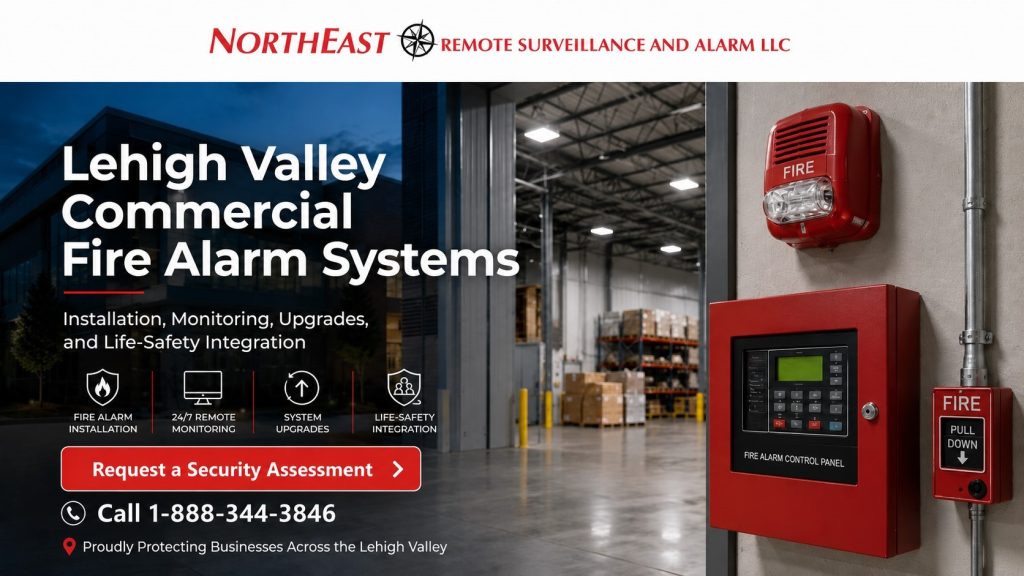
NERSA helps commercial property teams review detection, notification, monitoring, existing equipment, and project documentation before defining installation or upgrade work.
Start With the Building and Existing Records
Bring current drawings, equipment information, inspection records, and known trouble conditions to the assessment. Also identify changes in occupancy, room use, tenant layout, or operating schedules that may affect the project. A device list alone does not explain how the complete system should operate.
Before work begins, identify the people responsible for design, approvals, installation, testing, and ongoing service. Keep the scope and required documentation clear so each team knows what it must provide. When several contractors are involved, agree on the handoff between their work.
Review Monitoring and Connected Functions
Document how signals travel from the property and who receives them. Then confirm that account details, site information, and contact lists reflect the current building. Separate the review of alarm events from trouble and supervisory conditions so staff understand what each means for their response process.
Some projects also involve sprinkler supervision, elevator interfaces, or controlled doors. Coordinate those functions with the responsible project teams and approved documentation. If an existing connection changes, include its operation in the agreed testing plan.
Explore Fire Alarm Services and Planning Guides
Use these guides to review installation, monitoring, connected functions, testing, and the requirements relevant to your fire alarm project.
- Commercial and Industrial Fire Alarm Installation — Review the broader scope of fire alarm installation and life-safety coordination.
- Fire Alarm Monitoring and Supervision — Understand how system signals and communication paths are supervised.
- Commercial Sprinkler System Monitoring — Review how sprinkler-system events fit into monitoring arrangements.
- Fire Alarm Waterflow and Tamper Monitoring — Distinguish waterflow events from valve-supervision conditions.
- Fire Alarm Elevator Recall Integration — Review the coordination involved between fire alarm and elevator systems.
- Commercial Fire Alarm System Engineering Guide — Explore the design considerations behind a commercial fire alarm system.
- Fire Alarm Trouble and Supervisory Signals — Understand the different conditions reported by trouble and supervisory signals.
- Fire Alarm Phone Line Replacement — Plan a communication-path change before retiring an existing phone line.
- Fire Alarm Inspection Readiness — Prepare records, access and responsible contacts for a system review.
- Commercial Fire Alarm Monitoring, Testing and Inspection Readiness — Review ongoing monitoring, testing and inspection planning.
- NFPA 72 and Commercial Fire Alarm Systems — Explore the relationship between NFPA 72 and commercial fire alarm work.
- Commercial and Industrial Access Control Systems — Coordinate controlled openings with the building’s access and life-safety plan.
- Regulatory and Compliance for Commercial Security, Fire Alarm and Life Safety — Find related guidance on project requirements and inspection coordination.
- Lehigh Valley Commercial Intrusion Alarm Systems — Keep intrusion detection and its response procedures distinct from fire alarm work.
Plan Lehigh Valley Fire Alarms by Property and Location
A warehouse, office, and manufacturing property can have different layouts and project responsibilities.
Use the relevant location or facility guide to coordinate other security work while keeping the fire alarm scope clearly defined.
- Commercial Security Systems in Allentown, PA — Find the wider commercial-security resources for Allentown properties.
- Commercial and Industrial Security Systems in Bethlehem, PA — Review commercial and industrial planning for Bethlehem facilities.
- Commercial Fire Alarm Systems in Easton, PA — Find fire alarm planning resources for Easton properties.
- Route 22 Industrial Corridor Security Systems — Review property-security coordination along Route 22.
- Lehigh Valley Route 33 Industrial Corridor Security Systems — Explore commercial and industrial planning along Route 33.
- I-78 Logistics Corridor Security Systems in the Lehigh Valley — Find guidance for logistics properties along the Lehigh Valley’s I-78 corridor.
- Lehigh Valley Warehouse Security Systems — Coordinate fire alarm planning with the wider needs of a warehouse.
- Lehigh Valley Manufacturing Security Systems — Review security planning around manufacturing operations.
- Lehigh Valley Industrial Park Security Systems — Consider coordination across industrial-park properties and shared infrastructure.
Prepare for Testing, Training, and Service
As the project progresses, update equipment records and note approved changes. Before handover, complete the agreed tests and provide the customer with current documentation, service contacts, and training. Staff should know how to report a system issue and whom to contact for support.
For broader coordination, review Lehigh Valley commercial security and the assessment process.
Request a commercial fire alarm assessment with your building records and the issues you need to address.