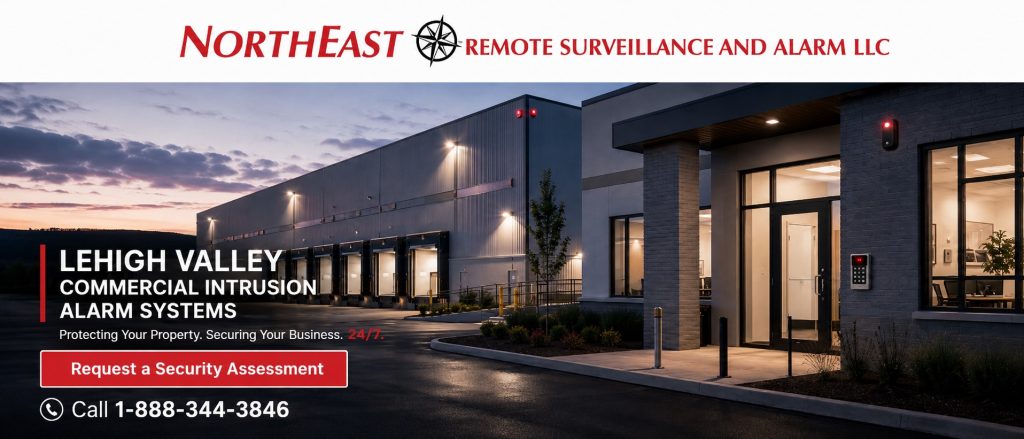
Lehigh Valley commercial intrusion alarm systems should be designed around what happens when a facility is closed, lightly staffed, partially occupied or operating an overnight shift.

Request a Lehigh Valley Intrusion Alarm Assessment
The system should account for employees, contractors, vendors, cleaning crews, drivers and delivery personnel who may enter outside standard business hours.
Northeast Remote Surveillance and Alarm, LLC (NERSA) designs, installs, monitors, upgrades and supports commercial and industrial intrusion alarm systems throughout Allentown, Bethlehem, Easton, Lehigh County, Northampton County, Route 22, Route 33, I-78 and the surrounding Lehigh Valley.
Commercial intrusion systems can protect:
- Exterior doors
- Employee entrances
- Side and rear doors
- Overhead doors
- Loading-dock openings
- Warehouse interiors
- Offices
- Restricted rooms
- Storage areas
- Equipment rooms
- Detached buildings
- Tenant spaces
- Other vulnerable areas
A dependable alarm system should identify the affected opening or area, transmit the signal through a reliable communication path and provide useful information to authorized personnel and the monitoring center.
For broader commercial and industrial security throughout the region, visit Lehigh Valley Commercial and Industrial Security Systems.
For larger facilities, multi-site organizations and enterprise intrusion systems, visit Commercial and Enterprise Intrusion Alarm Systems.
Commercial Intrusion Alarm Planning Across the Lehigh Valley
A commercial alarm system should do more than report that something happened.
It should help authorized personnel understand:
- Which opening or area generated the alarm
- Whether the property was expected to be occupied
- Which section of the building was armed
- Who had authority to enter
- Whether a nearby camera provides additional information
- Who should receive notification
- What response procedure should follow
A warehouse near I-78 may need overhead-door protection and independently controlled warehouse areas.
A Bethlehem manufacturing facility may need separate protection for production-support areas, maintenance rooms, offices and restricted spaces.
An Allentown office or institutional property may require individual user management, panic devices, after-hours procedures and protection for records, IT rooms and administrative areas.
The building, operating schedule and response procedure should determine the system rather than a preassembled alarm package.
For information about how NERSA evaluates facilities before recommending equipment, visit Lehigh Valley Security Assessment Process.
Commercial Intrusion Detection
A properly planned commercial intrusion system combines detection methods based on the building, environment, operating conditions and required response.
Protection may involve:
- Door contacts
- Overhead-door contacts
- Window protection
- Motion detection
- Glass-break detection
- Beam detection
- Panic or duress devices
- Specialized sensors
- Environmental monitoring where appropriate
The objective is to provide useful detection without creating unnecessary nuisance alarms or operating difficulties.
Alarm Zones, Partitions & User Control
A commercial alarm system should clearly identify where an event originated.
Zone descriptions such as Receiving Overhead Door 7, Rear Warehouse Personnel Door or Server Room Motion provide considerably more useful information than generic descriptions such as Zone 4.
Larger facilities may require separate zones or areas for:
- Individual overhead doors
- Employee entrances
- Shipping and receiving
- Warehouse sections
- Offices
- Restricted rooms
- Tenant suites
- Detached buildings
- Maintenance areas
- Interior detection
Partitions can allow different areas to operate independently.
This can be useful for office-and-warehouse combinations, multi-tenant properties, manufacturing facilities, multi-building sites and organizations with different operating schedules.
Individual users and appropriate permissions also improve accountability compared with undocumented shared alarm codes.
Monitoring, Communication & Alarm Response
Professional monitoring should be planned around more than simply transmitting an alarm signal.
A monitored commercial system should establish:
- What event occurred
- Where the event occurred
- Who should be contacted
- What verification is available
- Which events require escalation
- What special instructions apply
- How communication failures are handled
Communication may use IP, cellular or multiple communication paths depending on the selected system and facility requirements.
Backup power and communication continuity should also be considered.
For commercial monitoring services and response workflows, visit Commercial and Industrial Security Monitoring.
Lehigh Valley Commercial Intrusion Alarm Resources
Core Alarm Services
Commercial & Industrial Alarm Installation
For commercial alarm panels, detection devices, zone planning, communications, monitoring and system installation, visit Commercial and Industrial Alarm Installation.
Commercial Security Monitoring
For monitored intrusion signals, alarm communication, notification procedures and response instructions, visit Commercial and Industrial Security Monitoring.
Video Verification for Intrusion Alarms
For alarm events supported by related camera views and visual context, visit Video Verification for Intrusion Alarms.
Access Control & Intrusion Alarm Integration
For coordinated door, credential, alarm and user activity, visit Access Control and Intrusion Alarm Integration.
Commercial Access Control Systems
For controlled doors, credentials, readers, locking hardware and user permissions, visit Commercial and Industrial Access Control Systems.
Commercial Video Surveillance
For cameras that can provide additional context around intrusion events and protected areas, visit Lehigh Valley Commercial Video Surveillance Systems.
Lehigh Valley Intrusion Alarm Systems by City
Allentown
For commercial intrusion alarms serving offices, healthcare properties, warehouses, schools, municipal buildings and other Allentown facilities, visit Commercial Alarm Systems in Allentown, PA.
Bethlehem
For commercial and industrial alarm systems serving manufacturing, institutional, warehouse and office properties in Bethlehem, visit Commercial and Industrial Security Systems in Bethlehem, PA.
Easton
For warehouse, industrial, contractor, logistics and commercial intrusion-alarm applications in Easton, visit Commercial and Industrial Intrusion Alarm Systems in Easton, PA.
Intrusion Alarm Systems Along Lehigh Valley Corridors
Route 22
For commercial and industrial intrusion systems serving properties along the Route 22 corridor, visit Route 22 Intrusion Alarm Systems.
Route 33
For warehouse, industrial, manufacturing, contractor and logistics alarm systems along Route 33, visit Alarm Systems Along the Lehigh Valley Route 33 Industrial Corridor.
I-78
For warehouse, distribution, manufacturing and freight-related intrusion planning along I-78, visit I-78 Lehigh Valley Corridor Security Systems.
Commercial Alarm Systems by Facility Type
Warehouses & Logistics Facilities
For dock doors, overhead openings, employee entrances, warehouse interiors, shipping offices and restricted storage areas, visit Lehigh Valley Warehouse Security Systems.
Manufacturing & Industrial Facilities
For employee entrances, production-support spaces, maintenance rooms, tool rooms, material storage and restricted industrial areas, visit Lehigh Valley Manufacturing Security Systems.
Industrial Parks & Multi-Tenant Properties
For separate alarm areas, tenant permissions, shared entrances and multi-building commercial properties, visit Lehigh Valley Industrial Park Security Systems.
Offices, Healthcare, Schools & Municipal Properties
For administrative areas, records rooms, IT spaces, employee-only areas and other protected institutional spaces, visit the appropriate Lehigh Valley facility-security resource.
Contractor Yards & Exterior Storage Properties
For offices, service buildings, tool rooms, equipment areas and enclosed spaces at contractor and fleet properties, visit Lehigh Valley Contractor Yard Security Systems.
Video Verification for Commercial Alarm Events
A traditional intrusion signal may identify a triggered zone without showing what caused the event.
When compatible cameras are available, video can provide additional context around:
- Rear-door alarms
- Overhead-door alarms
- Interior motion events
- Restricted-room activity
- After-hours entrances
- Panic or duress events
The camera should provide a useful view of the alarm point.
A camera facing the wrong direction, blocked by a trailer or unable to provide adequate nighttime detail may have limited verification value.
Video verification can help authorized personnel better understand an event, but it does not replace proper alarm design, detector placement or response procedures.
For dedicated planning, visit Video Verification for Intrusion Alarms.
Environmental & Critical-Condition Alerts
Some commercial alarm platforms can also monitor selected conditions that affect business operations.
Depending on the facility and equipment, these may include:
- Temperature
- Freezer conditions
- Water
- Sump levels
- Power loss
- Generator status
- Equipment status
- Mechanical-room conditions
Environmental monitoring should include defined thresholds, notification contacts and clear response expectations.
The organization should know what personnel are expected to do when an alert occurs.
Reducing Nuisance Alarms
Nuisance alarms reduce confidence in a security system and consume employee, monitoring and responder time.
Common causes can include:
- Poor detector placement
- Loose or misaligned door contacts
- Incorrect zone descriptions
- Improper partitions
- Incorrect schedules
- Former users
- Employee operating errors
- Cleaning or maintenance activity
- Doors that fail to latch
- Environmental conditions
- Poor communication
- Incomplete response procedures
A nuisance-alarm review should identify why unwanted events occur and correct the underlying problem rather than simply suppressing alarms.
The objective is a system that remains dependable, understandable and consistent with the way the facility actually operates.
Existing Intrusion Alarm Upgrades & Takeovers
Commercial alarm systems should be reviewed when the building, staffing pattern or operating procedure has changed significantly since the original installation.
Warning signs can include:
- Repeated unexplained alarms
- Shared user codes
- Poor zone descriptions
- Missing protection
- Legacy telephone communication
- Limited zone capacity
- Insufficient partitions
- Weak event reporting
- Former employees with active credentials
- Inadequate backup communication
- Poor video verification
- Unsupported equipment
- Undocumented additions
- Expansion into new rooms or buildings
NERSA can evaluate existing contacts, detectors, wiring, keypads, communicators and alarm panels to determine what may reasonably be retained, repaired, reconfigured, expanded or replaced.
The objective is not to replace useful equipment unnecessarily.
The objective is to create a dependable, manageable system that reflects the property as it operates today.
Panic & Duress Protection
Commercial panic and duress devices may be appropriate for selected offices, healthcare properties, public-facing facilities and other environments where employees may require a discreet or immediate method of requesting assistance.
Device placement, notification procedures, employee training, testing and response expectations should be clearly established before installation.
Alarm & Access Control Coordination
Compatible intrusion and access-control systems can sometimes coordinate after-hours access, user activity, door events, alarm partitions and opening or closing procedures.
The goal is to make operation easier to understand without creating unnecessary complexity.
For dedicated combined-system planning, visit Access Control and Intrusion Alarm Integration.
Compliance & Life-Safety Coordination
Commercial intrusion alarms are security systems and do not replace fire alarm systems, emergency procedures, inspections, workplace-safety programs or required life-safety responsibilities.
Intrusion-alarm projects may interact with:
- Alarm communications
- Backup power
- Low-voltage wiring
- Door monitoring
- Access control
- Emergency egress
- Fire alarm interfaces
- Panic procedures
- Monitoring documentation
Security equipment should not interfere with required egress, fire alarm operation or other life-safety functions.
For broader information, visit Regulatory and Compliance for Commercial Security, Fire Alarm and Life Safety.
Why Lehigh Valley Businesses Choose NERSA
Northeast Remote Surveillance and Alarm, LLC is headquartered in Bethlehem, Pennsylvania and focuses on commercial and industrial security environments rather than residential alarm packages.
NERSA plans intrusion systems around actual operating conditions, including:
- Opening and closing procedures
- Employee activity
- After-hours schedules
- Loading operations
- Overhead doors
- Restricted spaces
- User permissions
- Monitoring
- Alarm communications
- Video verification
- Documentation
- Future expansion
NERSA supports commercial and industrial facilities throughout Allentown, Bethlehem, Easton, Route 22, Route 33, I-78 and the surrounding Lehigh Valley.
Lehigh Valley Intrusion Alarm Assessment
A strong commercial alarm project begins with a site review rather than a predetermined device count.
NERSA can review:
- Exterior doors
- Employee entrances
- Overhead and dock doors
- Windows
- Warehouse areas
- Offices
- Restricted spaces
- Existing alarm zones
- Partitions
- User permissions
- Arming schedules
- After-hours staffing
- Cleaning personnel
- Contractor and vendor activity
- Alarm communications
- Backup communication
- Battery condition
- Monitoring instructions
- Camera coverage
- Access-control activity
- Existing equipment
- Documentation
- Future expansion
The objective is to create a commercial intrusion system that identifies meaningful events, provides useful information, supports a defined response and remains manageable as the facility changes.
Frequently Asked Questions About Lehigh Valley Commercial Intrusion Alarm Systems
What is a commercial intrusion alarm system?
A commercial intrusion alarm system detects unauthorized entry or activity at protected doors, warehouse areas, offices, restricted rooms and other defined areas within a non-residential property.
How is a commercial alarm different from a residential alarm?
Commercial systems may require larger zone capacity, multiple partitions, individual user permissions, opening and closing reports, video verification, access-control coordination and more complex monitoring procedures.
Which areas should a warehouse alarm protect?
Common areas include dock doors, overhead doors, employee entrances, shipping and receiving offices, restricted rooms, inventory areas, warehouse interiors and detached structures.
Can one alarm system support several departments or tenants?
Compatible commercial systems can support multiple partitions, user groups, schedules and permissions so independently operated areas can be controlled separately.
Can intrusion alarms integrate with security cameras?
Yes, compatible systems can associate alarm events with nearby camera views to provide additional visual context.
Can intrusion alarms integrate with access control?
Compatible systems may coordinate alarm activity with door events, user credentials, after-hours access and related video.
Can commercial alarms monitor temperature or water?
Depending on the selected platform, systems may monitor temperature, refrigeration, water, power loss and other selected operational conditions.
When should an older commercial alarm system be reviewed?
An older system should be reviewed when it produces nuisance alarms, has outdated communications, poor user control, limited capacity, unsupported equipment or no longer matches the property.
Does NERSA install residential alarm systems?
No, Northeast Remote Surveillance and Alarm, LLC focuses on commercial and industrial security systems for non-residential properties.
Request a Lehigh Valley Intrusion Alarm Assessment
If your Lehigh Valley facility needs stronger protection for exterior doors, overhead openings, warehouse areas, offices, restricted rooms, after-hours activity or other commercial risks, NERSA can evaluate the property and develop an intrusion system around the way the organization actually operates.
Northeast Remote Surveillance and Alarm, LLC
Commercial & Industrial Intrusion Alarm Systems
Allentown • Bethlehem • Easton • Lehigh County • Northampton County
Call 1-888-344-3846
Request a Lehigh Valley Intrusion Alarm Assessment
Midea warehouse managed alarm case study
See the Midea warehouse managed alarm case study in the Lehigh Valley, covering 76 overhead doors and 27 personnel doors—103 doors in total.