Project availability may depend on property location, customer IT policies, installed equipment, administrator access, network ownership, software licensing, manufacturer support, internet service, firewall coordination, cybersecurity requirements, documentation, project scope and long-term support needs.
Breinigsville warehouse and logistics properties require security systems designed around freight movement, loading docks, overhead doors, employee entrances, truck courts, trailer areas, vehicle gates, inventory, restricted spaces and substantial after-hours exterior exposure.
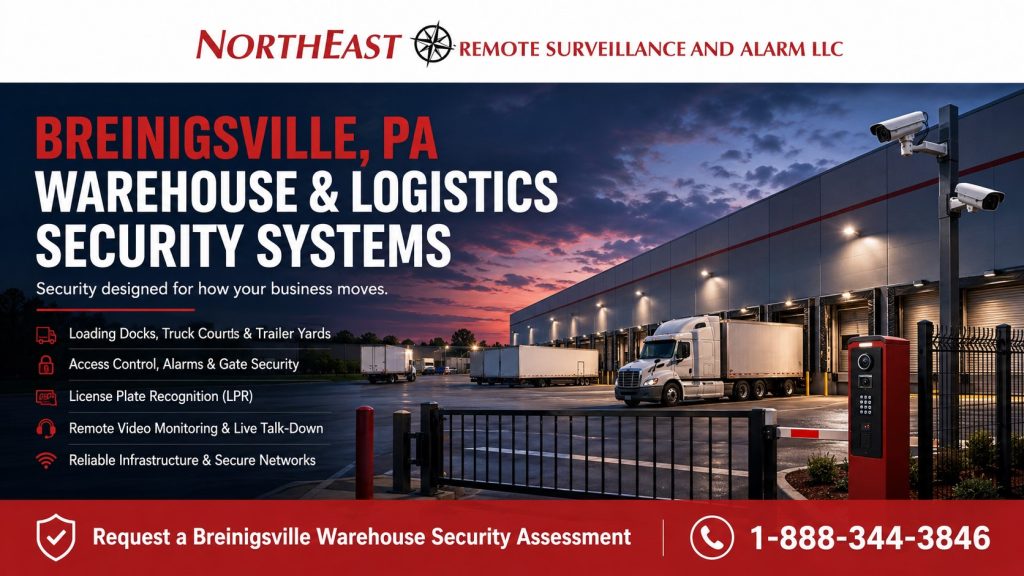
Northeast Remote Surveillance and Alarm, LLC designs, installs, integrates, monitors, upgrades and supports non-residential video surveillance, access control, intrusion alarms, monitoring, fire alarm, intercoms, gate security, license plate recognition and low-voltage infrastructure for qualifying commercial and industrial properties throughout Breinigsville.
This focused local spindle is part of NERSA’s Upper Macungie Commercial and Industrial Security Systems market hub, which organizes western Lehigh Valley planning for Upper Macungie, Route 100, Breinigsville and Fogelsville.
A properly planned warehouse or logistics system may coordinate dock cameras, employee credentials, overhead-door alarms, gate access, vehicle records, alarm verification, remote video monitoring, network infrastructure, retention and documented response procedures.
The objective is not simply to place cameras around the building. The objective is to create dependable visibility, controlled access, useful detection and a practical response environment around the movement of employees, drivers, freight, trailers and vehicles.
Request a Breinigsville Warehouse Security Assessment or call 1-888-344-3846 to discuss the facility, current systems, operating concerns and desired improvements.
Commercial and industrial systems only • Warehouses • Distribution centers • Logistics facilities • Manufacturing properties • Truck courts • Loading docks • Small businesses through enterprise organizations

Project availability may depend on property location, customer IT policies, installed equipment, administrator access, network ownership, software licensing, manufacturer support, internet service, firewall coordination, cybersecurity requirements, documentation, project scope and long-term support needs.
Security Planning for Breinigsville Warehouse and Logistics Properties
Warehouse and logistics security must support active operations rather than interfere with legitimate freight movement.
A Breinigsville property may include:
- Employee and visitor entrances
- Shipping and receiving offices
- Loading docks
- Overhead doors
- Truck approaches
- Truck courts
- Trailer staging
- Drop lots
- Vehicle gates
- Driver intercoms
- Inventory areas
- High-value storage
- Restricted cages
- Maintenance rooms
- Equipment areas
- Employee parking
- Exterior storage
- Several operating shifts
- Multiple buildings
- Regional or corporate administration
Each area creates a different security objective.
A dock camera may need to document freight condition and driver activity. A gate camera may need to show the complete vehicle, while a separate LPR camera captures the plate. An access-controlled employee entrance may need credentials, door-status monitoring and associated video.
The system should be designed around the questions the business may need to answer before, during and after an incident.
Commercial Video Surveillance for Breinigsville Warehouses
Warehouse video surveillance should provide useful evidence across large interiors, loading areas and exterior operational spaces.
Camera planning may include:
- Main entrances
- Employee entrances
- Visitor doors
- Shipping and receiving
- Loading docks
- Overhead doors
- Warehouse aisles
- Inventory zones
- Restricted cages
- Tool and equipment rooms
- Truck courts
- Trailer rows
- Vehicle gates
- Parking areas
- Exterior storage
- Fence lines
- Utility areas
- Building approaches
Each camera should have a defined purpose.
A wide warehouse overview may show general activity without providing enough detail to identify a person or review a specific transaction. A camera covering several dock doors may not provide the same evidence as focused views of individual loading positions.
Camera design should consider:
- Identification versus overview
- Daytime and nighttime lighting
- Backlighting at overhead doors
- Forklift and equipment movement
- High ceilings
- Long interior distances
- Dust and vibration
- Camera obstructions
- Recording reliability
- Video retention
- Time synchronization
- Remote access
- Video export
- Future expansion
For broader regional camera planning, review Lehigh Valley Commercial Video Surveillance Systems.
Loading-Dock Camera Systems
Loading docks are among the most active and dispute-sensitive areas of a warehouse.
A dock-camera plan may document:
- Tractor and trailer arrival
- Dock assignment
- Trailer position
- Seal condition
- Driver interaction
- Freight movement
- Forklift activity
- Staged goods
- Damaged freight
- Overhead-door activity
- Employee access
- After-hours loading
- Dock departure
A single camera may not answer every dock-related question.
Useful coverage may require:
- Exterior trailer view
- Dock-door view
- Interior loading view
- Shipping-office view
- Truck-court overview
- Focused transaction or seal view
Camera placement should avoid unnecessary blind areas created by trailers, dock equipment, stored materials and raised doors.
For deeper dock-specific planning, review Loading Dock Security Systems.
Truck Court, Trailer and Yard Security
Truck courts and trailer areas may remain exposed after the warehouse closes or after most employees leave.
Security planning may include:
- Yard overview cameras
- Trailer-row cameras
- Gate cameras
- Fence-line coverage
- Exterior analytics
- Vehicle records
- Lighting review
- Intrusion detection
- Remote video monitoring
- Live talk-down
- Equipment-area coverage
- After-hours response procedures
Camera views should account for trailers blocking one another and for the changing arrangement of parked equipment.
A fixed camera that works when the yard is empty may lose visibility when rows are full.
For broader planning, review Truck Yard Security Systems.
Employee and Contractor Access Control
Commercial access control can manage who may enter warehouse, office and restricted areas and when access is permitted.
A Breinigsville access-control system may coordinate:
- Employee credentials
- Mobile credentials
- Temporary contractor access
- Warehouse entrances
- Office entrances
- Shipping-office doors
- Restricted inventory areas
- Tool and maintenance rooms
- Server and network rooms
- Warehouse-to-office openings
- Vehicle gates
- Door schedules
- Holiday schedules
- Multi-building permissions
- Audit records
Individual credentials provide greater accountability than shared keys or common codes.
When an employee, contractor or temporary worker no longer needs access, the credential can be disabled without replacing every lock.
Access-control planning should include the entire opening:
- Reader
- Controller
- Lock hardware
- Door-position switch
- Request-to-exit device
- Power supply
- Door closer
- Emergency egress
- Accessibility
- Fire alarm interfaces
A reader and electronic lock cannot correct a door that does not close or latch properly.
For broader regional planning, review Lehigh Valley Commercial Access Control Systems.
Overhead-Door and Warehouse Intrusion Alarms
Overhead doors create large access points and may operate differently from standard pedestrian entrances.
A commercial intrusion-alarm system may protect:
- Overhead doors
- Exterior personnel doors
- Shipping offices
- Warehouse zones
- Inventory areas
- Restricted cages
- Tool rooms
- Maintenance areas
- Office sections
- Roof access
- Windows
- Interior corridors
- Panic and duress locations
A warehouse may require several alarm partitions because shipping, office, maintenance and warehouse operations may follow different schedules.
Alarm planning may include:
- Individual user codes
- Opening and closing records
- Door contacts
- Interior motion detection
- Glass-break detection
- Multiple partitions
- Cellular communication
- IP communication
- Dual-path communication
- Professional monitoring
- Video verification
- Clearly named zones
Zone descriptions should identify real locations, such as “west shipping office rear door” or “dock doors 12 through 18,” rather than generic labels that provide limited information during an event.
For broader regional alarm planning, review Lehigh Valley Commercial Intrusion Alarm Systems.
Commercial Alarm Monitoring and Video Verification
An alarm signal may identify the affected zone without showing what caused the event.
Video verification can associate qualifying alarm activity with nearby cameras.
A coordinated system may provide:
- Alarm-zone information
- Associated live video
- Recorded pre-event video
- Recorded post-event video
- Customer contact information
- Documented response instructions
- Opening and closing records
- Gate activity
- Panic and duress procedures
- Multi-site monitoring
- Incident history
Video may help determine whether activity involves an employee, driver, cleaner, maintenance worker, animal, weather condition, equipment movement or unauthorized person.
Verification does not correct a defective sensor, poor camera position or inaccurate response instructions. The alarm, camera and monitoring environments should be maintained together.
For broader planning, review Lehigh Valley Commercial Alarm Monitoring and Video Verification.
Remote Video Monitoring and Live Talk-Down
Breinigsville logistics facilities may have substantial exterior exposure around docks, truck courts, trailer areas, gates and parking lots.
Remote video monitoring may provide active review of qualifying events detected by cameras or analytics.
Depending on the approved system and property instructions, trained personnel may:
- Review the triggering camera
- Review nearby cameras
- Determine whether visible activity matches the alert
- Issue a live audio warning
- Contact designated personnel
- Follow documented escalation procedures
- Create an event record
Remote monitoring may be appropriate around:
- Loading docks
- Trailer rows
- Vehicle gates
- Fence lines
- Exterior equipment
- Parking areas
- Fuel or utility areas
- Repeated trespassing locations
- Closed shipping entrances
- Vacant sections of the property
The event rules should match the facility’s real schedules, including overnight loading, maintenance, cleaning and driver activity.
For broader active-monitoring planning, review Lehigh Valley Remote Video Monitoring and Live Talk-Down.
Commercial Gate Access Control
Warehouse and logistics gates may be used by employees, truck drivers, visitors, vendors, contractors and emergency responders.
A commercial gate-access system may coordinate:
- Employee credentials
- Mobile credentials
- Long-range vehicle credentials
- Temporary access codes
- Driver intercoms
- Remote gate release
- Entrance cameras
- Exit cameras
- License plate recognition
- Gate-position monitoring
- Vehicle schedules
- Event records
- Emergency access
- Remote video monitoring
The gate operator provides physical movement, while the access-control system determines who may activate it.
Electronic access equipment cannot correct unsafe gate movement, damaged hardware or missing safety devices. Mechanical and electronic conditions should be reviewed as one entrance environment while preserving the responsibilities of qualified gate professionals.
For broader planning, review Lehigh Valley Commercial Gate Access Control Systems.
Driver Intercom and Visitor Entry Systems
Truck drivers, vendors and visitors may arrive through an entrance separate from the main office.
A commercial intercom system may provide:
- Driver communication
- Video verification
- Shipping-office call routing
- Remote gate release
- Remote door release
- Desktop answering
- Mobile answering
- Entrance cameras
- After-hours routing
- Event recording
- Access-control integration
The visitor-entry workflow should establish:
- Who answers each call
- How the driver or visitor is verified
- Which entrance may be released
- Whether a delivery is scheduled
- What instructions are provided
- What happens after hours
- What happens when no authorized person is available
For broader visitor-entry planning, review Lehigh Valley Commercial Intercom and Visitor Entry Systems.
License Plate Recognition for Truck and Vehicle Entrances
License plate recognition can create searchable records at controlled truck lanes, employee entrances, visitor gates and service drives.
An LPR system may provide:
- Entrance plate capture
- Exit plate capture
- Date and time records
- Full or partial plate search
- Authorized vehicle lists
- Watch lists
- Gate-event associations
- Vehicle snapshots
- Multi-site search
- Incident documentation
Truck-lane LPR requires planning around:
- Tractor plate location
- Trailer plate location
- Vehicle height
- Lane width
- Camera distance
- Stopping position
- Vehicle speed
- Lighting
- Headlights
- Entrance and exit direction
A general overview camera may document the truck without producing a dependable plate image.
LPR should normally be paired with overview video so the organization can review the vehicle, trailer, driver interaction and surrounding activity.
For broader regional planning, review Lehigh Valley License Plate Recognition Systems.
AI Video Analytics for Warehouse and Logistics Operations
AI-assisted video analytics may help authorized personnel detect, classify and search selected person and vehicle activity.
Potential applications include:
- Person detection
- Vehicle detection
- Line crossing
- Intrusion zones
- Loitering
- Activity near closed docks
- Movement near staged freight
- Vehicle approach alerts
- Gate activity
- Fence-line detection
- Recorded-event search
- Alarm verification
- Remote-monitoring events
Analytics should reflect the warehouse’s actual activity.
A facility with overnight drivers, cleaning crews or multiple shifts should not use alert schedules that assume the property is vacant.
Loading areas may also include frequent legitimate movement that requires carefully defined detection zones.
For broader regional analytics planning, review Lehigh Valley AI Video Analytics Systems.
Cloud and Hybrid Video Surveillance
Breinigsville logistics operators may require centralized video access across several buildings or properties while retaining dependable local recording.
A cloud or hybrid system may combine:
- Onsite recording
- Cloud management
- Secure remote access
- AI-assisted event search
- Camera-health notifications
- Multi-site administration
- Edge recording
- Selected cloud-event storage
- Local recording during connectivity interruptions
- User permissions
- Incident sharing
The customer should understand:
- Where video is stored
- How long it is retained
- Which subscriptions apply
- Who owns the account
- Who may access each facility
- What happens during an internet outage
- Whether existing cameras can be retained
- How the system may be expanded
For broader planning, review Lehigh Valley Cloud and Hybrid Video Surveillance Systems.
Unified Warehouse and Logistics Security Systems
Warehouse security technologies may be installed at different times and managed through different applications.
A unified or integrated system may coordinate:
- Video surveillance
- Employee access control
- Intrusion alarms
- Driver intercoms
- Vehicle gates
- License plate recognition
- Alarm monitoring
- Remote video monitoring
- User permissions
- Event reporting
- Multi-site administration
Examples may include:
- Displaying dock video when an overhead-door alarm occurs
- Associating an employee credential with entrance video
- Connecting a gate release with vehicle and plate records
- Presenting camera views during alarm verification
- Centralizing several distribution properties in one management environment
Integration should be used where it improves administration, investigation or response—not merely because a connection is technically available.
For broader integration planning, review Lehigh Valley Unified Commercial Security Systems.
Commercial Fire Alarm Systems
Warehouse and logistics fire alarm systems require code-aware planning based on occupancy, building construction, storage arrangements and installed life-safety systems.
Qualifying work may involve:
- Fire alarm installation
- System expansion
- Alarm monitoring
- Communicator replacement
- Initiating devices
- Notification appliances
- Sprinkler supervision
- Waterflow monitoring
- Valve-tamper monitoring
- Duct or HVAC interfaces
- Elevator interfaces
- Trouble and supervisory signals
- Documentation
- Testing and inspection coordination
Warehouse changes, tenant improvements, storage modifications and building expansion may affect fire alarm requirements.
An assessment does not replace required engineering, permitting, inspection or approval by the authority having jurisdiction.
For broader regional planning, review Lehigh Valley Commercial Fire Alarm Systems.
Low-Voltage and Security Infrastructure
Large warehouse systems depend on dependable pathways, cabling, switching, fiber and power.
Infrastructure planning may include:
- Cat6 and Cat6A cabling
- Fiber between equipment rooms
- PoE switching
- Wireless bridges
- Equipment racks
- Patch panels
- Power supplies
- UPS protection
- Surge protection
- Cellular communication
- Environmental enclosures
- Device labeling
- IP addressing
- Network documentation
- Expansion capacity
Long warehouse distances may require fiber, intermediate equipment locations or carefully planned network architecture.
A new camera connected to damaged cabling may remain unreliable. A recorder connected through an overloaded switch may fail to capture video consistently.
For broader regional planning, review Lehigh Valley Low-Voltage and Security Infrastructure.
Security Network Segmentation and Cybersecurity
Modern warehouse security may connect cameras, recorders, access-control panels, intercoms, gate systems, alarm communicators, cloud platforms and remote users.
Network planning may include:
- Dedicated security networks
- Security VLANs
- Managed switches
- Fiber backbones
- Controlled routing
- Firewall coordination
- Secure remote access
- Individual user accounts
- Multi-factor authentication where supported
- Supported firmware
- Cloud-account ownership
- Removal of former users
- Device documentation
- Backup and recovery planning
Security equipment should not be connected to production, warehouse-management or corporate networks without customer authorization and an approved architecture.
For broader planning, review Lehigh Valley Security Network Segmentation and Cybersecurity.
Cargo and Inventory Protection
Cargo loss may occur around shipping, receiving, staged freight, trailers, warehouse interiors, employee access and vehicle gates.
A layered cargo-security plan may coordinate:
- Dock cameras
- Trailer documentation
- Gate access
- LPR
- Employee credentials
- Restricted inventory access
- Overhead-door alarms
- Video verification
- Remote monitoring
- Shipping-office security
- Incident export
- Documented response procedures
No single camera or alarm eliminates cargo exposure.
The system should support the facility’s freight-handling procedures and provide useful information when an exception, dispute or loss occurs.
For deeper planning, review Cargo Theft Prevention Systems.
Multi-Site Warehouse and Distribution Operations
Organizations with several warehouses or distribution properties may benefit from standardized administration.
A multi-site program may coordinate:
- Camera naming
- Door names
- User roles
- Credential permissions
- Alarm partitions
- Monitoring contacts
- Video-retention standards
- Remote-access procedures
- Cloud-account ownership
- Gate administration
- LPR lists
- Service records
- System documentation
- New-site deployment
Centralized management should not provide every user with unrestricted access to every facility.
Permissions should reflect the employee’s location, department and responsibilities.
Existing Warehouse Security System Upgrades
Breinigsville facilities may inherit cameras, recorders, access control, intrusion alarms, intercoms, gate systems, cloud accounts and monitoring arrangements without complete documentation or administrator access.
An assessment can determine what may be:
- Retained
- Repaired
- Reconfigured
- Integrated
- Expanded
- Taken over
- Upgraded
- Replaced in phases
- Completely replaced
Existing cabling, cameras, door hardware, alarm devices and network equipment may remain useful when they are customer-owned, operational, supportable and compatible.
Unsupported or insecure equipment should not be preserved merely because it still powers on.
For broader planning, review Lehigh Valley Commercial Security System Upgrades, Retrofits and Takeovers.
Security System Maintenance and Service
Warehouse security systems may require troubleshooting and maintenance as equipment ages and operating conditions change.
Service may involve:
- Offline cameras
- Missing recorded video
- Failed hard drives
- Damaged exterior cameras
- Access-controlled door trouble
- Gate communication problems
- Recurring alarm conditions
- Communicator failures
- User and credential changes
- Battery or power problems
- Network interruptions
- Wireless-link issues
- Missing documentation
- Unsupported equipment
The visible symptom may be caused by the endpoint device, cabling, network, power, configuration or another supporting component.
For broader regional support planning, review Lehigh Valley Commercial Security System Maintenance and Service.
Route 100 and Western Lehigh Valley Planning
Breinigsville is part of NERSA’s western Lehigh Valley structure.
Businesses whose operations are meaningfully connected to Route 100 through freight movement, employee traffic, industrial-campus access or deliveries can also review Route 100 Industrial Corridor Security Systems in the Lehigh Valley.
The Route 100 page owns corridor-wide planning, while this Breinigsville page remains focused on warehouse, logistics, distribution and industrial properties physically located in the Breinigsville market.
The NERSA Breinigsville Security Planning Process
1. Review Warehouse and Logistics Operations
NERSA begins with operating hours, shifts, employees, visitors, drivers, freight movement, loading procedures, parking, gates and after-hours activity.
2. Review Existing Systems and Infrastructure
The review may include cameras, recording, access control, intrusion alarms, monitoring, fire alarm communication, intercoms, gates, cabling, fiber, networks, power, users and documentation.
3. Define the Security Objectives
The organization should identify what it needs to:
- See
- Record
- Control
- Detect
- Verify
- Communicate
- Document
- Monitor
- Manage across locations
4. Develop the System Architecture
The proposed design may coordinate cameras, access control, alarms, gate security, LPR, monitoring, fire alarm and supporting infrastructure.
5. Establish User and Response Procedures
The plan should identify:
- Who receives credentials
- Who answers driver calls
- Who reviews video
- Who receives alarms
- Who may release gates
- Who manages monitoring contacts
- What happens after hours
- How incidents are documented
6. Install, Configure and Test
Testing may include:
- Live and recorded video
- Video retention
- Video export
- Employee credentials
- Controlled-door operation
- Alarm reporting
- Monitoring communication
- Intercom calls
- Gate release
- LPR capture
- Analytics
- Remote access
- User permissions
- Network performance
7. Train and Document
Authorized personnel should understand how to operate the system, add and remove users, review events, export video, answer visitor calls, respond to alerts and request service.
System names, administrator responsibilities, account ownership and key procedures should be documented appropriately.
Why Breinigsville Warehouse and Logistics Businesses Choose NERSA
A dependable warehouse security system requires more than installing cameras at several doors.
It requires an understanding of truck movement, loading operations, employee access, inventory, gates, alarms, networks, monitoring, retention and response procedures.
Northeast Remote Surveillance and Alarm, LLC focuses on non-residential commercial, industrial, warehouse, manufacturing, logistics, contractor and multi-site environments.
NERSA plans systems around what the facility needs to see, control, detect, verify, communicate and document.
The objective is to create a practical and supportable security environment that protects operations without creating unnecessary delays for employees, drivers, deliveries or freight movement.
Request a Breinigsville Warehouse Security Assessment
A Breinigsville warehouse and logistics security assessment may review:
- Operating hours and shifts
- Employee and visitor entrances
- Truck and delivery activity
- Shipping and receiving
- Loading docks
- Overhead doors
- Truck courts
- Trailer areas
- Vehicle gates
- Parking areas
- Inventory and restricted spaces
- Existing cameras
- Video recording and retention
- Access control
- Intrusion alarms
- Alarm monitoring
- Fire alarm coordination
- Intercoms
- Remote video monitoring
- AI analytics
- LPR
- Cabling and fiber
- Security networks
- Administrator access
- Documentation
- Multi-site requirements
- Future expansion
Request a Breinigsville Warehouse Security Assessment or call 1-888-344-3846 to discuss the facility, current systems, operating concerns and project goals.
Frequently Asked Questions About Breinigsville Warehouse Security Systems
What types of Breinigsville properties does NERSA support?
NERSA supports warehouses, distribution centers, logistics facilities, manufacturing properties, truck operations, office-warehouse buildings, industrial properties and multi-site organizations.
Where does this page fit within the NERSA structure?
This Breinigsville spindle sits beneath the Upper Macungie market hub and focuses on warehouse, distribution and logistics security within the Breinigsville market.
When should a property use the Route 100 page?
Use the Route 100 page when corridor-wide freight movement, employee traffic, industrial-campus access or deliveries are more important than Breinigsville local intent.
What security systems may a warehouse need?
A warehouse may require cameras, access control, intrusion alarms, monitoring, fire alarm, gate access, intercoms, LPR, remote video monitoring, AI analytics, cabling, fiber and security networks.
Can NERSA install loading-dock cameras?
Yes. Dock-camera planning may include trailer views, overhead doors, shipping and receiving, freight movement, driver interaction and truck-court coverage.
Can NERSA protect overhead doors?
Qualifying intrusion-alarm systems may protect overhead doors with suitable contacts, zone programming, monitoring and associated video.
Can employee entrances use access control?
Yes. Employee credentials may be managed by user, schedule, door, building, department or location when the selected system supports those permissions.
Can NERSA provide gate access for truck entrances?
Qualifying systems may coordinate driver intercoms, credentials, remote release, cameras, LPR, schedules and gate-event records.
Can NERSA capture tractor-trailer license plates?
Yes, when lane geometry, plate location, camera position, vehicle speed and lighting support dependable plate capture.
Can NERSA provide remote monitoring for trailer yards?
Qualifying exterior cameras and analytics may support active event review, live audio warnings, customer notification and documented escalation procedures.
Can NERSA provide video verification?
Qualifying alarm and camera systems may associate alarm events with live or recorded video for authorized review.
Can an existing warehouse camera system be upgraded?
Possibly. NERSA can evaluate cameras, recorders, cabling, networks, software, storage, lighting and administrator access to determine what may be retained or upgraded.
Does every inherited system need to be replaced?
No. Existing equipment may sometimes be retained when it is customer-owned, operational, supported, secure, compatible and suitable for the intended purpose.
Can several warehouses use one security platform?
Yes, when the selected platform, licensing, networks and permissions support centralized multi-site administration.
Can NERSA coordinate with a company’s IT department?
Yes. Network-connected security systems should be coordinated with authorized customer IT personnel when customer-managed infrastructure is involved.
Can NERSA provide fire alarm systems for warehouses?
Qualifying commercial fire alarm work may include installation, expansion, monitoring, communicator upgrades, sprinkler supervision and related coordination, subject to applicable requirements.
Does NERSA install residential systems in Breinigsville?
This resource is intended for commercial, industrial, warehouse, manufacturing, logistics and multi-site properties rather than residential alarm packages.
How much does a Breinigsville warehouse security system cost?
Cost depends on the building, camera count, controlled doors, alarm zones, gates, LPR, monitoring, cabling, networks, retention, licensing, existing equipment and installation conditions.
How does a Breinigsville warehouse begin a security project?
Begin with a Breinigsville Warehouse Security Assessment so the operations, docks, entrances, vehicle movement, systems, infrastructure and project requirements can be reviewed before equipment is recommended.