
Industrial park security serves small-business tenants, growing companies, and enterprise operations.

Request an Industrial Park Security Assessment
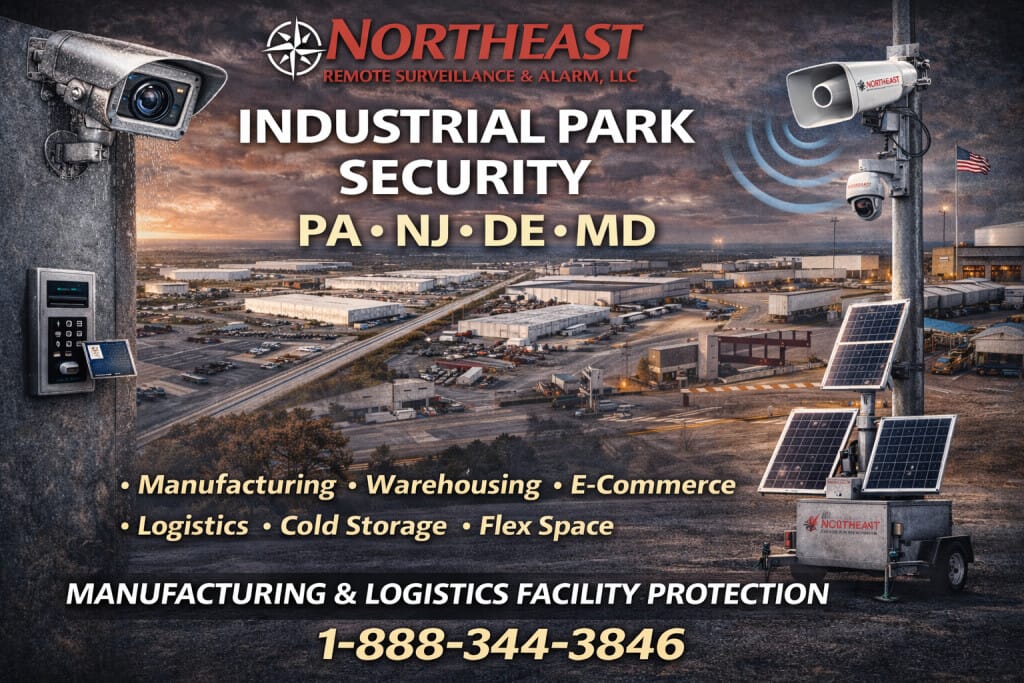
Coordinate tenant entrances, shared roads, loading areas, detached buildings, and property management responsibilities around the scope you control.
Use Small Business Security Systems for a tenant’s own premises and Enterprise Security Systems Integration for shared systems, multiple buildings, and organization-wide responsibilities.
Start by agreeing which areas belong to the tenant and which are managed by the property team.
Industrial parks, warehouse campuses, distribution centers, manufacturing properties, flex-industrial buildings, contractor yards, truck courts and logistics facilities may include shared roads, multiple tenants, loading docks, trailer areas, employee entrances, restricted spaces, exterior yards, parking areas, gate points and after-hours exposure.
Northeast Remote Surveillance and Alarm, LLC (NERSA) designs, installs, monitors, upgrades, integrates and supports security systems for industrial properties that need stronger visibility, tighter access control, cleaner event review, better vehicle documentation and dependable protection across large or multi-building environments.
The objective is not to install disconnected cameras, alarms, readers or gates.
The objective is to create a practical, manageable and scalable security environment built around the way the industrial property actually operates.
For broader planning by facility type, visit Industries We Serve.
For commercial and industrial systems by service type, visit Commercial & Industrial Security Services.
For regional and city planning, visit NERSA Service Areas.
Commercial and Industrial Systems Only • Industrial Parks • Business Parks • Warehouse Campuses • Multi-Tenant Industrial Properties • New Installations • Upgrades • Takeovers • Monitoring
Industrial Park Security Built Around Real Site Conditions
Industrial parks are not secured like small offices, storefronts or single-tenant commercial buildings.
They may involve:
- Large perimeters
- Shared drives
- Truck entrances
- Employee parking
- Visitor traffic
- Tenant separation
- Loading areas
- Trailer staging
- Utility spaces
- Exterior storage
- Fenced yards
- Side and rear building approaches
- Multiple operating schedules
- Areas active after normal business hours
A strong security design begins by understanding how the property actually operates.
Planning should consider how trucks enter, where employees park, how tenants are separated, where freight is staged, which buildings remain active after hours and where visibility decreases when staff is not present.
Why Industrial Parks Need Layered Security
Industrial parks often require several security systems working together.
Cameras may improve visibility but do not control entry.
Access control may manage authorized users but does not provide complete exterior awareness.
Intrusion alarms can detect selected after-hours conditions but may provide more useful information when cameras or monitoring procedures add context.
Depending on the property, industrial park security may involve:
- Video surveillance
- Access control
- Gate access control
- License plate recognition
- Intrusion alarms
- Professional security monitoring
- Remote video monitoring
- Live talk-down
- Intercom and visitor entry
- Trailer-yard visibility
- Parking-lot coverage
- Fire alarm and life-safety coordination
- Structured cabling and fiber
- Network infrastructure
- System documentation
- Multi-building administration
The appropriate combination should reflect the property rather than a predetermined equipment package.
Video Surveillance for Industrial Parks
Industrial parks often require camera coverage around loading docks, yard lanes, shared roads, truck courts, parking areas, entrances, building exteriors, tenant spaces, fence lines and exterior storage.
Camera planning should identify what each view needs to accomplish.
An overview camera, vehicle-identification camera, loading-dock view and employee-entrance camera perform different jobs.
The goal is to produce useful information for incident review, property management and operational awareness rather than simply increasing camera count.
For detailed camera-system planning, visit Commercial & Industrial Video Surveillance Systems.
Access Control for Multi-Tenant Industrial Sites
Industrial parks may need access control across employee entrances, tenant spaces, shared openings, office-to-warehouse transitions, IT rooms, tool rooms, utility spaces, gated yards and controlled storage areas.
Access control can help define:
- Who may enter
- Which doors or gates each person may use
- When access is permitted
- Which areas remain restricted
- How activity is documented
Multi-tenant properties may also need clear separation between property-management administrators and tenant-controlled credentials or doors.
For broader access-control planning, visit Commercial & Industrial Access Control Systems.
Intrusion Detection and After-Hours Protection
Industrial parks can become more difficult to protect when buildings are lightly staffed, partially occupied or operating on different schedules.
Intrusion protection may involve exterior doors, overhead openings, tenant suites, offices, warehouses, storage areas, equipment rooms and restricted spaces.
Alarm planning should reflect the actual operation of the property, including multiple shifts, cleaning personnel, contractors, delivery activity and different tenant schedules.
For broader planning, visit Commercial & Industrial Intrusion Alarm Systems.
Remote Video Monitoring and Live Talk-Down
Some industrial parks need more than passive recording.
Remote video monitoring can provide active review around selected exterior areas where trespassing, vehicle activity, theft risk or after-hours movement may be difficult for on-site staff to manage.
Applications may include:
- Yard activity
- Parking areas
- Loading docks
- Gate approaches
- Fence lines
- Exterior storage
- Trailer rows
- Low-staffed building sections
The monitoring plan should establish which cameras, schedules, event conditions and response procedures are included.
For detailed planning, visit Remote Video Monitoring and Live Talk-Down.
Warehouse and Logistics Operations Inside Industrial Parks
Many industrial parks include warehouses, distribution centers, fulfillment operations and freight-related properties.
These facilities may require security around:
- Shipping and receiving
- Dock doors
- Trailer parking
- Truck courts
- Employee entrances
- Warehouse offices
- Inventory areas
- Driver check-in
- After-hours activity
For warehouse-specific planning, visit Warehouse & Logistics Security Systems.
Manufacturing Operations Inside Industrial Parks
Manufacturing facilities inside industrial parks may require additional planning around production areas, employee access, contractor activity, tool rooms, parts storage, shipping, restricted areas and multi-shift operations.
For dedicated manufacturing planning, visit Manufacturing Plant Security Systems.
Gate Access, Vehicle Flow and Site Entry
Industrial parks often receive employees, contractors, vendors, visitors, service providers, delivery vehicles and tractor trailers through the same broader property.
Vehicle-entry planning may need to account for:
- Gate cameras
- Credential or keypad entry
- Intercom communication
- Truck entrances
- Employee parking
- Contractor access
- Delivery lanes
- Gate schedules
- Vehicle documentation
- Emergency access
The goal is to improve control and documentation without creating unnecessary congestion for legitimate business activity.
For dedicated gate planning, visit Commercial Gate Access Control Systems.
For plate capture, visit License Plate Recognition Camera Systems.
Parking Lots, Trailer Yards and Exterior Storage
Industrial-park security risk often extends well beyond individual buildings.
Parking areas, trailer yards, outdoor storage, equipment yards, service lanes and rear building elevations can become blind spots if they are not included in the security plan.
Exterior planning may involve:
- Fixed cameras
- Vehicle-identification views
- Lighting coordination
- Fence-line visibility
- Gate coverage
- Yard cameras
- Parking coverage
- Remote monitoring
- After-hours response procedures
For truck and trailer properties, visit Truck Yard Security Systems.
Fire Alarm and Life-Safety Coordination
Industrial park security planning can interact with fire alarm systems, emergency egress, electrified door hardware, tenant improvements and inspection-sensitive building conditions.
Security systems should be designed so they support required building operation rather than interfering with life-safety functions.
For commercial fire alarm planning, visit Commercial Fire Alarm and Life-Safety Systems.
For broader code-aware planning, visit Regulatory Compliance and Inspection Readiness.
Low-Voltage Infrastructure for Industrial Parks
Security systems operating across multiple buildings or large exterior distances depend on reliable supporting infrastructure.
Projects may require:
- Structured cabling
- Fiber
- Wireless bridges
- PoE switching
- Equipment racks
- Network cabinets
- Backup power
- Network segmentation
- Exterior pathways
- Remote-building connectivity
- Documentation and labeling
Weak infrastructure can create camera outages, unreliable remote access, access-control problems and difficulty expanding the system.
For detailed planning, visit Commercial & Industrial Infrastructure and Cabling.
Property Management and Tenant Responsibilities
Multi-tenant industrial properties may require clear separation between shared-property responsibilities and tenant-controlled systems.
Property management may control common roads, exterior cameras, vehicle gates, parking areas, utility spaces or shared infrastructure.
Individual tenants may separately control:
- Suite or employee entrances
- Interior cameras
- Warehouse areas
- Restricted rooms
- Local alarm systems
- Credentials
- Local monitoring contacts
System ownership, administrator permissions, service responsibilities, camera access and credential management should be established before turnover.
Common Industrial Park Security Problems
Common industrial-park weaknesses may include:
- Loading docks with poor camera coverage
- Truck entrances without useful vehicle documentation
- Trailer rows with limited visibility
- Employee entrances without access records
- Tenant areas relying on unmanaged keys
- Parking areas with weak camera positioning
- Rear doors without alarm coverage
- Fence lines without useful visibility
- Restricted rooms without controlled entry
- Outdoor storage without after-hours review
- Disconnected camera, alarm and access systems
- Aging network infrastructure
- Missing documentation
- Former tenants retaining access
The first step should be identifying the specific operating weakness and matching it with the appropriate security layer.
Existing Industrial Park Security Systems
Industrial parks may inherit several generations of cameras, access control, alarm systems, monitoring services and network infrastructure.
An existing system does not automatically require complete replacement.
NERSA can evaluate installed equipment, administrator access, credentials, communication paths, infrastructure and documentation to determine what may reasonably be retained, repaired, reprogrammed, integrated, expanded or replaced.
Begin with Commercial Security System Inspection and Assessment.
For modernization and takeover planning, visit Commercial Security System Upgrades, Retrofits and Takeovers.
Industrial Park Security Planning Process
NERSA begins by reviewing the property rather than selecting equipment from a standard package.
Planning may include:
- Site layout
- Buildings and tenants
- Shared roads
- Truck and vehicle movement
- Parking
- Loading docks
- Trailer areas
- Gates
- Restricted spaces
- Exterior exposure
- Existing security systems
- Network and low-voltage infrastructure
- Monitoring requirements
- Tenant separation
- Documentation
- Future expansion
The completed system should improve visibility, access control, documentation and response without creating unnecessary operational complexity.
For broader project-delivery expectations, visit NERSA Project Delivery Standards.
Industrial Markets NERSA Supports
Pennsylvania is NERSA’s primary service footprint.
NERSA supports qualifying commercial and industrial properties throughout the Lehigh Valley, Greater Reading and Berks County, Greater Philadelphia, Northeastern Pennsylvania and selected Central Pennsylvania markets.
Selected projects may also be supported in nearby Mid-Atlantic markets according to location, project scope and long-term service requirements.
For complete geographic coverage, visit NERSA Service Areas.
Why Industrial Properties Choose NERSA
Northeast Remote Surveillance and Alarm, LLC focuses on commercial and industrial security rather than single-family home alarm packages.
NERSA plans around the complete property, including buildings, tenants, employees, visitors, trucks, loading areas, parking, exterior yards, restricted spaces, gates, camera evidence, alarm response, infrastructure and future expansion.
The objective is not to create a collection of disconnected systems.
The objective is to provide a dependable, manageable and scalable security environment designed around the way the industrial property actually operates.
Request an Industrial Park Security Assessment
An industrial park security assessment can review:
- Property layout
- Buildings and tenants
- Shared entrances
- Truck movement
- Loading docks
- Trailer areas
- Parking
- Gates
- Exterior yards
- Restricted areas
- Existing cameras
- Access control
- Intrusion alarms
- Monitoring
- Infrastructure
- Fire and life-safety coordination
- Administration
- Documentation
- Future development
Request an Industrial Park Security Assessment.
Commercial and Industrial Systems Only • Industrial Parks • Business Parks • Warehouse Campuses • Multi-Tenant Industrial Properties • New Installations • Upgrades • Takeovers • Monitoring
Frequently Asked Questions About Industrial Park Security Systems
What is an industrial park security system?
An industrial park security system is a coordinated commercial-security environment designed around multiple buildings, tenants, shared roads, parking, loading areas, controlled entrances, exterior spaces and after-hours activity.
How is industrial park security different from warehouse security?
Warehouse security focuses on the warehouse operation itself, while industrial park security also addresses shared roads, multiple tenants, gates, parking areas, exterior yards and property-wide administration.
What security systems may industrial parks require?
Depending on the property, systems may include video surveillance, access control, intrusion alarms, fire alarm systems, remote video monitoring, gates, intercoms, license plate recognition and supporting network infrastructure.
Do industrial parks need access control?
Many do. Access control may be appropriate for employee entrances, tenant doors, restricted rooms, warehouse transitions, gates and other controlled areas.
Can cameras help protect trailer yards and truck courts?
Yes. Camera systems can help document truck movement, trailer activity, gate events, parking, exterior storage and after-hours activity when they are designed around appropriate views and lighting.
Can industrial park cameras be monitored remotely?
Yes. Qualifying properties may use remote video monitoring for selected exterior cameras, schedules and defined event conditions.
Can security systems be separated by tenant?
Yes. Supported systems can provide different permissions, credentials, doors, cameras and administrator roles for property management and individual tenants.
Can an existing industrial park security system be upgraded?
Yes. Existing cameras, access control, alarms, monitoring, infrastructure and administration can be evaluated before unnecessary replacement is recommended.
Does NERSA support industrial parks outside Pennsylvania?
Pennsylvania is NERSA’s primary service footprint, with selected commercial and industrial projects supported in nearby Mid-Atlantic markets.
How does an industrial park security project begin?
The project begins with a property-specific assessment of buildings, tenants, roads, entrances, docks, parking, yards, gates, existing systems, infrastructure and future plans.