
The industries we serve range from small businesses and growing companies to enterprise operations.

Request a commercial security assessment
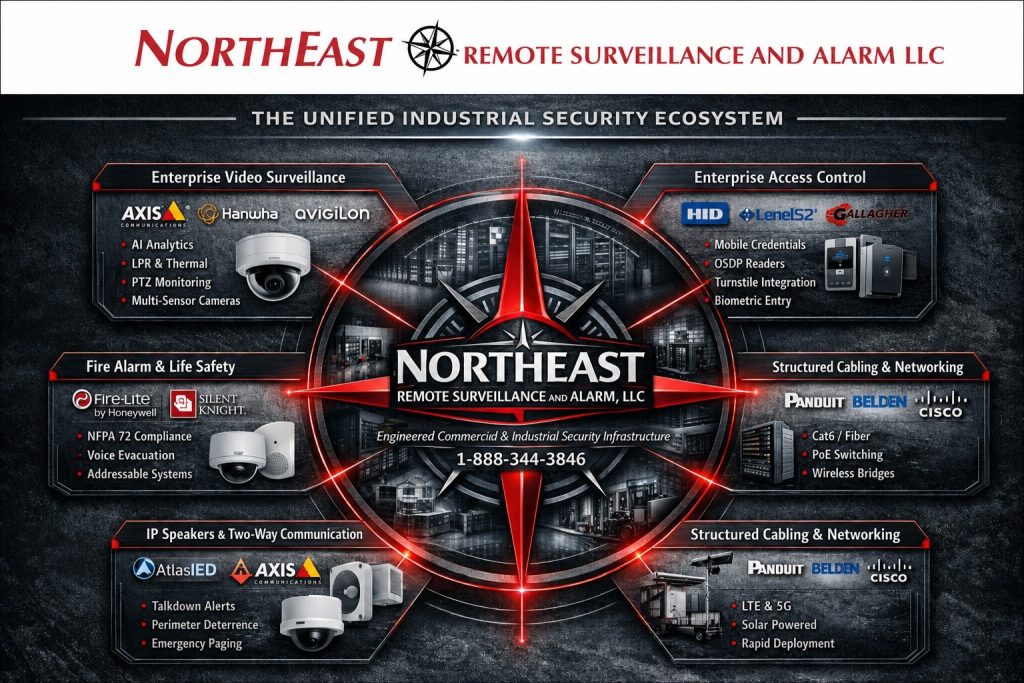
Find commercial and industrial security guidance for shops, offices, healthcare practices, warehouses, manufacturing facilities, campuses, and other business and professionally managed properties.
For a smaller property, start with Small Business Security Systems.
For coordination across departments, buildings, or locations, explore Enterprise Security Systems Integration.
The industry guides below keep the planning specific to how your property operates.
Security Planning for the Industries We Serve
Choose the industry guide that best matches how people, goods, and visitors move through your property. If your business combines several functions, begin with the area driving the project. A manufacturer with a separate trailer yard may need both the manufacturing and truck yard guides; an office inside a distribution center may need different access rules from the warehouse around it.
The industry directory organizes those operating questions. The services directory organizes the technologies used to address them. Move between the two once the concern is defined: visibility and incident review, controlled entry, detection, communication, or a monitored response.
Identify shared responsibilities early
For leased or multi-tenant properties, distinguish the business’s own entrances and equipment from common areas managed by a landlord or property team. For multiple locations, identify which decisions should be consistent and which depend on local operations. Document who may approve camera views, manage credentials, retrieve evidence, and change response instructions.
A useful assessment combines that responsibility map with existing equipment records and a short list of operational priorities. The result should explain the proposed scope and its dependencies, including what will be retained, what requires improvement, and how the completed work will be checked.
Quick Industry Directory
- Construction Sites and Active Jobsites — temporary cameras, mobile surveillance trailers, solar/cellular coverage, live monitoring, equipment protection, changing access points, and transition to permanent systems.
- Contractor Yards and Fleet Properties — gates, outdoor storage, vehicles, tools, perimeter coverage, and after-hours monitoring.
- Corporate Offices and Multi-Tenant Buildings — entrances, credentials, visitors, parking, common areas, and tenant separation.
- Food Processing and Cold Storage — controlled areas, docks, temperature-sensitive operations, monitoring, and life-safety coordination.
- Healthcare and Medical Facilities — staff access, patient areas, pharmacies, records, entrances, parking, and emergency procedures.
- Schools and Educational Facilities — Plan visitor entry, staff permissions, campus circulation, and after-hours access.
- Industrial and Business Parks — shared roads, multiple buildings, tenant areas, gates, utilities, and centralized administration.
- Manufacturing and Industrial Facilities — production, restricted rooms, employee access, materials, equipment, yards, and infrastructure.
- Enterprise Organizations and Multi-Site Businesses — standardized platforms, permissions, monitoring, reporting, documentation, and phased deployment.
- Municipal, Government, and Institutional Properties — public entrances, staff areas, records, facilities, parking, and operational continuity.
- Retail, Hospitality, and Customer-Facing Businesses — customer areas, cash handling, employee access, deliveries, alarms, and video review.
- Small and Growing Businesses — practical systems that can expand as staffing, hours, locations, and risks change.
- Truck Yards and Logistics Terminals — vehicle gates, trailers, cargo areas, driver activity, lighting, and remote monitoring.
- Warehouses and Distribution Centers — docks, staging, aisles, entrances, truck courts, inventory, and parking.
Security Capabilities
- Video surveillance for live viewing, recording, investigation, and exterior coverage
- Access control for doors, credentials, schedules, permissions, and visitors
- Intrusion alarms for perimeter, interior, panic, and monitored events
- Fire alarm and life-safety systems for detection, notification, monitoring, and upgrades
- Commercial alarm monitoring and remote video monitoring
- Gate access, intercoms, parking coverage, and vehicle documentation
- Unified security systems connecting compatible cameras, alarms, access control, and gates
- Security infrastructure and cabling including copper, fiber, PoE, wireless links, racks, and power
View the complete commercial and industrial security services directory.
New Systems, Upgrades, and Takeovers
NERSA supports new installations, additions, retrofits, platform migrations, and takeovers of existing systems. Installed equipment is evaluated before replacement so serviceable cameras, readers, panels, wiring, networks, locks, and power equipment can be retained when appropriate.
Learn about commercial security upgrades and takeovers or the security assessment process.
Service Area
Pennsylvania is NERSA’s primary service area, with selected projects supported in New Jersey, Delaware, Maryland, and surrounding Mid-Atlantic markets.
Frequently Asked Questions
Does NERSA install security systems for single-family homes?
No. NERSA does not provide security installations for individual homes or single-family residences. We serve businesses, industrial facilities, and professionally managed apartment communities, including shared entrances, common areas, and grounds.
Can NERSA support more than one location?
Yes. Compatible systems can be standardized across multiple buildings or sites with defined permissions, documentation, monitoring, and administration.
Can existing security equipment be reused?
Sometimes. NERSA evaluates condition, compatibility, ownership, support, performance, and future requirements before recommending what to retain or replace.
How should a project begin?
Start with the facility, its operations, current systems, concerns, responsible staff, and future plans. That information defines the assessment and appropriate next step.
Request an Industry-Specific Assessment
Request a commercial security assessment.
Customer Projects
Explore NERSA’s commercial and industrial security case studies to see documented project scopes for apartment communities, production and recycling facilities, warehouses, and businesses.