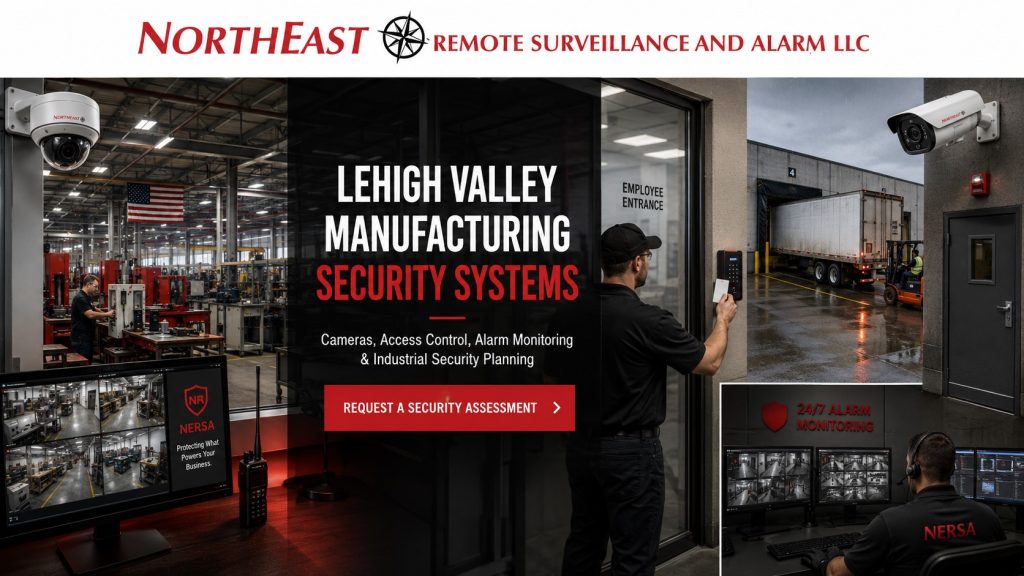
Lehigh Valley manufacturing security systems should be planned around production flow, employee movement, restricted areas, loading activity, utility spaces, parking exposure and after-hours risk.

Request a Lehigh Valley Manufacturing Security Assessment
Northeast Remote Surveillance and Alarm, LLC (NERSA) designs, installs, integrates, monitors, upgrades and supports commercial and industrial security systems for manufacturing facilities throughout Allentown, Bethlehem, Easton, Route 22, Route 33, I-78, LVIP and surrounding Lehigh Valley industrial markets.
Manufacturing properties can include:
- Employee entrances
- Production floors
- Fabrication areas
- Tool rooms
- Maintenance spaces
- Electrical rooms
- Utility rooms
- Shipping offices
- Loading docks
- Raw-material storage
- Finished-goods areas
- Parking lots
- Truck courts
- Contractor entrances
- Exterior yards
- Restricted process areas
Manufacturing facilities do not operate like standard offices or small retail properties.
Employees may work across multiple shifts. Contractors and vendors may require temporary access. Materials may move continuously between receiving, production and shipping. Maintenance teams may need access to restricted equipment areas. Production may continue while offices or storage areas are closed.
NERSA plans security around how the plant actually works.
The objective is not simply to install cameras, readers and alarm devices.
The objective is to provide useful visibility, controlled access, dependable detection, practical incident documentation and a security environment that supports long-term facility operations.
For broader commercial and industrial security throughout the region, visit Lehigh Valley Commercial and Industrial Security Systems.
For broader manufacturing-security capabilities, visit Manufacturing Plant Security Systems.
Manufacturing Security Built Around Real Plant Operations
A manufacturing security plan should begin with the facility rather than a predetermined equipment package.
A Lehigh Valley manufacturing assessment may consider:
- Facility layout
- Production schedules
- Employee shifts
- Public entrances
- Employee entrances
- Contractor access
- Vendor movement
- Production areas
- Restricted processes
- Tool rooms
- Parts rooms
- Maintenance spaces
- Utility rooms
- Electrical rooms
- Shipping and receiving
- Loading docks
- Raw materials
- Finished goods
- Parking
- Truck movement
- Exterior storage
- Gates
- Existing cameras
- Access control
- Intrusion alarms
- Monitoring
- Network infrastructure
- Power
- Documentation
- Future expansion
The security system should support manufacturing operations rather than interfere with them.
A production floor may require broad visibility while a tool room or controlled process area may require tighter entry restrictions.
A shipping dock may require detailed transaction coverage while a parking area may require broader vehicle and pedestrian visibility.
A maintenance department may need access after normal office hours while other parts of the building remain restricted.
The design should reflect these differences.
Common Manufacturing Security Concerns
Manufacturing properties often have several overlapping security concerns.
Common problems include:
- Uncontrolled employee entrances
- Unmanaged contractor access
- Poor loading-dock visibility
- Unauthorized entry into production areas
- Weak protection for restricted rooms
- Tool or parts shrink
- Exterior doors left open
- Poor documentation of incidents
- Parking-area exposure
- After-hours yard activity
- Outdated alarm systems
- Camera blind spots
- Weak nighttime video
- Limited network capacity
- Missing documentation
- Security systems that no longer match the building
The correct first step is determining whether the problem requires repair, repositioning, expansion, additional controlled access, improved monitoring, better infrastructure or modernization.
Lehigh Valley Manufacturing Security Resources
Manufacturing Video Surveillance
For production-area cameras, employee entrances, loading docks, shipping areas, parking, exterior approaches and recorded incident review, visit Manufacturing Facility Security Systems Along the Lehigh Valley Route 33 Industrial Corridor.
Manufacturing Access Control
For employee entrances, production areas, maintenance rooms, tool rooms, utility spaces, restricted areas and credential management, visit Lehigh Valley Commercial Access Control Systems.
Manufacturing Intrusion Alarms
For exterior doors, overhead openings, restricted rooms, warehouse-connected areas and monitored after-hours protection, visit Lehigh Valley Commercial Intrusion Alarm Systems.
Loading Dock Security
For loading positions, shipping and receiving, freight movement, overhead doors, driver activity and dock-area incident documentation, visit Loading Dock Security Systems.
Remote Video Monitoring
For professional review of selected exterior, loading, yard and after-hours camera events, visit Remote Video Monitoring and Live Talk-Down.
Gate & Vehicle Access
For employee, contractor, vendor and delivery access at controlled manufacturing-property gates, visit Commercial Gate Access Control Systems.
License Plate Recognition
For dedicated vehicle documentation at truck lanes, employee parking entrances, contractor gates and controlled approaches, visit License Plate Recognition Camera Systems.
Low-Voltage & Network Infrastructure
For cabling, fiber, PoE switching, wireless building links, network equipment and supporting security infrastructure, visit Commercial and Industrial Infrastructure and Cabling.
Compliance & Life-Safety Coordination
For manufacturing-security projects involving controlled openings, fire alarm interfaces, emergency egress, accessibility and inspection-sensitive conditions, visit Regulatory and Compliance for Commercial Security, Fire Alarm and Life Safety.
Manufacturing Security by Lehigh Valley Market
Allentown
For manufacturing and industrial properties in Allentown, visit Manufacturing Security Systems in Allentown, PA.
Bethlehem
For manufacturing, industrial and production properties in Bethlehem, visit Manufacturing & Industrial Security Systems in Bethlehem, PA.
Easton
For manufacturing, industrial and Route 33-connected properties in Easton, visit Manufacturing Facility Security Systems in Easton, PA.
Manufacturing Security Along Lehigh Valley Corridors
Route 22
For manufacturing and industrial facilities connected to Route 22, visit Route 22 Industrial Corridor Security Systems in the Lehigh Valley.
Route 33
For manufacturing facilities connected to the Route 33 industrial corridor, visit Manufacturing Facility Security Systems Along the Lehigh Valley Route 33 Industrial Corridor.
I-78
For manufacturing, warehouse and industrial properties connected to I-78, visit I-78 Lehigh Valley Corridor Security Systems.
Video Surveillance for Manufacturing Facilities
Manufacturing video should be designed around useful operational and incident evidence.
Important areas may include:
- Employee entrances
- Production entrances
- Shipping areas
- Receiving areas
- Loading docks
- Tool rooms
- Storage areas
- Parking
- Exterior approaches
- Vehicle routes
Camera placement should account for lighting, distance, mounting height, obstructions, production equipment, vibration and changing operating conditions.
The goal is not simply to create a live view.
The goal is to provide video that authorized personnel can retrieve and use when an incident requires review.
Employee Access & Restricted Areas
Manufacturing facilities often have areas that should not be accessible to every employee or visitor.
These can include:
- Production-support rooms
- Tool cribs
- Parts rooms
- Maintenance areas
- Electrical rooms
- Utility rooms
- Server rooms
- Records rooms
- Quality-control areas
- Management spaces
- Restricted processes
Access permissions should reflect job responsibility.
Employees, contractors, vendors and temporary personnel may require different access to different areas and at different times.
The system should make it practical to add, change or remove permissions as staffing changes.
Loading Docks, Shipping & Receiving
Loading areas can be among the busiest portions of a manufacturing property.
They can involve:
- Trucks
- Drivers
- Vendors
- Employees
- Forklifts
- Raw materials
- Finished goods
- Staged freight
- Shipping documentation
- Overhead doors
Security planning should provide useful visibility without disrupting normal freight operations.
Camera coverage, controlled doors, alarm protection and vehicle documentation can each play a different role.
For dedicated dock planning, visit Loading Dock Security Systems.
After-Hours Manufacturing Security
Manufacturing facilities may continue operating after normal office hours.
Some departments may run overnight while other areas are closed.
Cleaning crews, maintenance teams, contractors and delivery personnel may enter during off-hours.
A commercial intrusion system should therefore reflect actual schedules rather than assuming the entire facility opens and closes at the same time.
After-hours security may include:
- Exterior-door monitoring
- Overhead-door protection
- Interior detection
- Restricted-area alarms
- User-specific permissions
- Separate partitions
- Alarm monitoring
- Video verification
- Exterior camera coverage
The objective is to provide meaningful detection while reducing unnecessary alarms caused by normal operations.
Parking, Yards & Exterior Property
Manufacturing security does not end at the building wall.
Parking lots, truck courts, exterior equipment, material storage, fenced yards and detached structures can create significant exposure.
Exterior security planning should account for:
- Distance
- Lighting
- Vehicle movement
- Fence lines
- Employee parking
- Contractor parking
- Delivery traffic
- Equipment
- Outdoor materials
- Available power
- Network connectivity
These areas may require different cameras and monitoring strategies than indoor production spaces.
Security Infrastructure for Manufacturing Facilities
Large production and industrial properties may require significant low-voltage and network infrastructure.
That can include:
- Structured cabling
- Fiber
- PoE switching
- Wireless links
- Equipment racks
- Network cabinets
- UPS systems
- Backup power
- Surge protection
- Outdoor pathways
- Network segmentation
- Equipment labeling
- Documentation
Older industrial buildings can contain legacy cabling and equipment installed during several different projects.
Existing infrastructure should be evaluated before adding large numbers of new cameras, readers or other network-connected devices.
Existing Manufacturing Security Systems
An older manufacturing system does not automatically require complete replacement.
NERSA can evaluate:
- Cameras
- Recorders
- Readers
- Controllers
- Door hardware
- Alarm panels
- Sensors
- Communicators
- Cabling
- Fiber
- Networks
- Power supplies
- User accounts
- Monitoring
- Documentation
Existing equipment may sometimes remain useful when it is compatible, secure, serviceable and suitable for the completed system.
The objective is to preserve useful infrastructure where practical while correcting systems that no longer support the operation of the facility.
Best-Fit Manufacturing & Industrial Properties
NERSA supports qualifying:
- Production facilities
- Fabrication shops
- Processing plants
- Packaging facilities
- Industrial buildings
- Manufacturing warehouses
- Multi-tenant industrial properties
- LVIP facilities
- Route 22 industrial properties
- Route 33 manufacturing sites
- I-78 corridor facilities
- Contractor and supply operations
- Mixed office, warehouse and production facilities
Commercial and industrial properties only.
Compliance & Life-Safety Coordination
Manufacturing security systems may interact with emergency egress, fire alarm systems, door hardware, accessibility, low-voltage wiring and other building conditions.
Security equipment should not block required exits or interfere with approved life-safety functions.
Project responsibilities depend on the building, work scope, approved documents and applicable authorities.
For broader compliance-aware planning, visit Regulatory and Compliance for Commercial Security, Fire Alarm and Life Safety.
Request a Lehigh Valley Manufacturing Security Assessment
If your Lehigh Valley manufacturing property needs better camera coverage, stronger employee entrance control, improved loading-dock visibility, tighter restricted-area access, better intrusion detection or modernization of an existing system, NERSA can evaluate the facility around the way it actually operates.
A manufacturing security assessment may review:
- Production areas
- Employee entrances
- Contractor access
- Maintenance rooms
- Tool rooms
- Restricted areas
- Shipping
- Receiving
- Loading docks
- Parking
- Truck movement
- Exterior property
- Existing cameras
- Access control
- Intrusion alarms
- Monitoring
- Gates
- Infrastructure
- Documentation
- Future expansion
The objective is to create a dependable manufacturing security environment that supports daily production while providing useful visibility, controlled access and practical incident review.
Frequently Asked Questions About Lehigh Valley Manufacturing Security Systems
Who installs manufacturing security systems in the Lehigh Valley?
Northeast Remote Surveillance and Alarm, LLC designs, installs, monitors, upgrades and supports commercial and industrial security systems for manufacturing facilities throughout Allentown, Bethlehem, Easton and surrounding Lehigh Valley industrial markets.
What should a manufacturing security system include?
Depending on the facility, systems may include video surveillance, access control, intrusion alarms, loading-dock cameras, parking surveillance, gate security, monitoring, intercoms and supporting infrastructure.
Do manufacturing facilities need access control?
Many do. Access control can help manage employee entrances, production spaces, tool rooms, maintenance areas, utility rooms and other restricted spaces.
Are cameras enough for a manufacturing facility?
Not always. Many facilities also require controlled entry, intrusion detection, monitoring, gate security and dependable network infrastructure.
Can manufacturing security systems support multiple employee shifts?
Yes. Access permissions, alarm partitions and monitoring procedures can be designed around different operating schedules and departments.
Can existing manufacturing security equipment be reused?
Sometimes. Existing cameras, cabling, access-control equipment and alarm devices should be evaluated for condition, compatibility, supportability and suitability for the completed system.
Can NERSA work with older manufacturing buildings?
Yes. NERSA can evaluate legacy wiring, older cameras, alarms, door hardware, network limitations and existing infrastructure before recommending an upgrade path.
Does NERSA install residential security systems?
No. Northeast Remote Surveillance and Alarm, LLC focuses on commercial and industrial properties.
Contact Northeast Remote Surveillance and Alarm
For manufacturing, production, fabrication, processing or industrial security systems throughout the Lehigh Valley, call 1-888-344-3846.