Philadelphia security camera installation should be planned around what the business needs to see, document, investigate and review—not around a predetermined camera count or generic equipment package.
Request a Philadelphia Security Camera Assessment
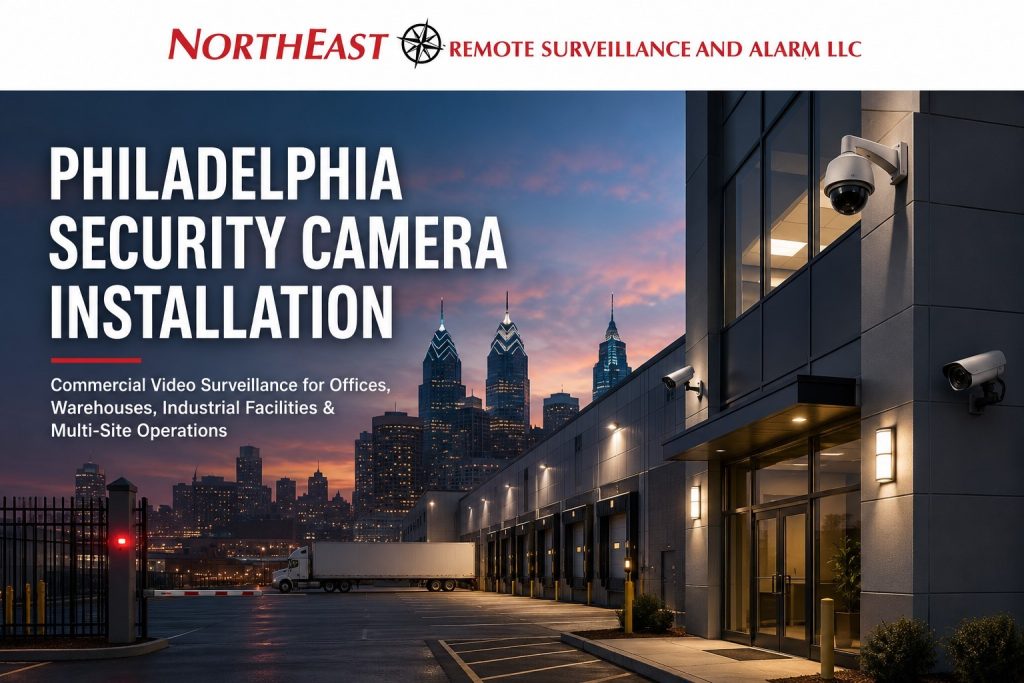
Northeast Remote Surveillance and Alarm, LLC (NERSA) designs, installs, upgrades, integrates and supports commercial video surveillance systems for qualifying business and professionally managed properties throughout Philadelphia.
NERSA supports camera projects for:
- Offices
- Warehouses
- Logistics facilities
- Manufacturing plants
- Healthcare properties
- Schools
- Municipal buildings
- Contractor yards
- Multi-tenant properties
- Parking areas
- Commercial campuses
- Multi-site organizations
A properly designed camera system should provide useful footage where the business actually needs visibility.
For broader Philadelphia security planning, visit Commercial Security Installation Philadelphia.
For manufacturer-neutral video planning, visit Commercial & Industrial Video Surveillance Systems.
Commercial and Industrial Systems Only • Philadelphia • Video Surveillance • Parking Lots • Loading Docks • Warehouses • New Installations • Upgrades
For a project centered on existing equipment, use our Philadelphia security retrofit and upgrade guide to plan reuse, takeover requirements and phased changes.
Commercial Video Surveillance Built Around Philadelphia Facilities
Philadelphia properties can differ significantly in layout, age, lighting, exterior exposure, operating hours and existing infrastructure.
Camera planning may need to consider:
- Main entrances
- Employee entrances
- Visitor areas
- Parking lots
- Loading docks
- Shipping and receiving
- Warehouse interiors
- Production areas
- Vehicle entrances
- Exterior approaches
- Restricted rooms
- Multi-tenant common areas
- After-hours activity
The right system should be based on the information the customer needs from each view.
A camera intended to identify a person at an entrance has a different job than a wide parking-lot overview or a dedicated vehicle camera.
Camera Coverage for Philadelphia Businesses
A commercial camera system may include coverage of:
- Building entrances
- Reception areas
- Parking lots
- Loading areas
- Warehouses
- Offices
- Production areas
- Perimeters
- Rear entrances
- Delivery areas
- Employee entrances
- Vehicle lanes
The objective is not simply to eliminate blind spots.
The objective is to create useful video that can support incident review, investigations and operational awareness.
Philadelphia Warehouse and Logistics Cameras
Warehouse and logistics facilities may require video around:
- Loading docks
- Shipping and receiving
- Employee entrances
- Warehouse aisles
- Trailer areas
- Truck entrances
- Parking
- Inventory areas
- Exterior approaches
Camera placement should follow the movement of employees, drivers, freight and vehicles through the property.
For broader warehouse security planning, visit Warehouse & Logistics Security Systems.
For regional industrial and logistics planning, visit Greater Philadelphia industrial park directory.
Philadelphia Manufacturing Video Surveillance
Manufacturing facilities may require camera coverage around:
- Production areas
- Employee entrances
- Shipping departments
- Tool and parts rooms
- Restricted areas
- Contractor activity
- Parking
- Exterior approaches
Industrial environments may also require consideration of lighting, dust, vibration, ceiling height, machinery and cable pathways.
For broader manufacturing security planning, visit Manufacturing Plant Security Systems.
Loading Dock Cameras
Loading docks are important video areas because employees, drivers, trailers, freight and vendors frequently converge in the same operating space.
Useful views may include:
- Dock doors
- Trailer positions
- Shipping offices
- Receiving areas
- Driver check-in points
- Dock aprons
- Adjacent personnel doors
The goal is to capture usable evidence of activity rather than simply provide a wide view of the building.
Parking Lot and Exterior Cameras
Philadelphia commercial properties may require exterior coverage around:
- Employee parking
- Visitor parking
- Building entrances
- Rear approaches
- Service areas
- Walkways
- Vehicle entrances
- Exterior storage
- Gates
Exterior camera planning should account for:
- Lighting
- Mounting height
- Distance
- Field of view
- Weather
- Nighttime image quality
- Vehicle headlights
- Physical obstructions
License Plate Recognition
Some properties require dedicated vehicle documentation rather than ordinary parking-lot video.
Potential applications include:
- Vehicle entrances
- Exit lanes
- Truck gates
- Employee parking
- Visitor entrances
- Logistics properties
License-plate capture requires purpose-built planning around lane geometry, angle, speed and lighting.
For dedicated planning, visit License Plate Recognition Camera Systems.
AI Video Analytics
Compatible video systems may use analytics to help identify selected events or reduce manual review.
Potential functions may include:
- Person detection
- Vehicle detection
- Line crossing
- Loitering
- Perimeter activity
- After-hours activity
- Other supported analytics
AI does not replace proper camera placement, lighting or investigation procedures.
For dedicated planning, visit AI Video Surveillance Systems.
Video Retention and Incident Review
A commercial camera system should make recorded video practical to locate and use.
Planning may need to consider:
- Recording architecture
- Retention period
- Camera naming
- User permissions
- Remote viewing
- Export procedures
- Incident review
- Evidence handling
Retention should reflect the property’s operational and investigation needs rather than being selected without a defined purpose.
For broader video architecture planning, visit Commercial & Industrial Video Surveillance Systems.
Remote Video Monitoring
Some Philadelphia properties may require professional review of selected camera events rather than passive recording alone.
Remote monitoring may be appropriate for:
- Loading docks
- Exterior yards
- Parking areas
- Gates
- Rear approaches
- After-hours exterior areas
For dedicated event verification and approved live audio intervention, visit Remote Video Monitoring and Live Talk-Down.
Video and Access Control
Compatible cameras can provide additional context around controlled-door activity.
Potential events may include:
- Credential use
- Forced doors
- Held-open doors
- Visitor entry
- Employee entrances
- After-hours access
For Philadelphia-controlled entry planning, visit Access Control Installation in Philadelphia.
Video and Intrusion Alarms
Compatible camera and intrusion systems may allow video review around selected alarm events.
Video can add context, but it should not replace properly designed intrusion detection.
For broader alarm planning, visit Commercial & Industrial Intrusion Alarm Systems.
Unified Video Security
Some facilities may benefit from video surveillance working with access control, intrusion alarms, intercoms, monitoring and other compatible security systems.
Integration should solve a practical operational or investigation problem rather than add unnecessary complexity.
For Philadelphia-specific planning, visit Unified Security Systems Philadelphia.
For deeper system integration, visit Philadelphia Security Integration.
Existing Camera Systems
Many Philadelphia properties already have cameras, recorders, cabling or network infrastructure installed by previous owners, tenants or providers.
Existing equipment should be evaluated before complete replacement is recommended.
Potential concerns may include:
- Poor camera placement
- Weak image quality
- Inadequate nighttime performance
- Short retention
- Unreliable recording
- Unsupported recorders
- Unknown passwords
- Weak remote access
- Poor documentation
- Inadequate network capacity
The appropriate project may involve repair, repositioning, selective camera replacement, recorder modernization or phased migration.
For existing-system evaluation, visit Commercial Security System Inspection and Assessment.
For modernization planning, visit Commercial Security System Upgrades, Retrofits and Takeovers.
Video Surveillance Infrastructure
Commercial cameras depend on reliable cabling, networking and power.
Projects may require:
- Structured cabling
- PoE switching
- Fiber
- Equipment racks
- UPS backup
- Network segmentation
- Wireless building links
- Secure remote connectivity
- Device labeling
For broader infrastructure planning, visit Commercial & Industrial Infrastructure and Cabling.
Cybersecurity and Video Administration
Commercial video systems may connect to networks, cloud platforms, mobile applications and remote-management tools.
System administration should consider:
- Named user accounts
- Role-based permissions
- Multi-factor authentication where supported
- Network segmentation
- Firmware management
- Secure remote access
- Removal of former users
- Administrator ownership
For broader cybersecurity planning, visit Cybersecurity and Data Protection Standards.
Why Philadelphia Businesses Choose NERSA
Northeast Remote Surveillance and Alarm, LLC focuses on commercial and industrial security rather than consumer camera packages.
NERSA plans Philadelphia camera systems around:
- Required camera views
- Image quality
- Lighting
- Entrances
- Parking
- Loading areas
- Exterior exposure
- Retention
- Network infrastructure
- User permissions
- Existing systems
- Future expansion
The objective is to provide a commercial video-surveillance system that delivers useful evidence, practical administration and dependable long-term operation.
Philadelphia Apartment Camera Project: Philip Murray House II
For building-wide planning, explore our Philadelphia apartment building security guide, covering cameras, shared entrances, visitor entry, and the supporting infrastructure.
In 2021, NERSA was contracted to install six cameras on every floor at PMH II, with additional coverage in elevators, public areas and parking lots. The installation uses interior vandal-resistant domes, exterior color-at-night bullet cameras, Cat 6 wiring, PoE switches and outdoor point-to-point wireless connectivity.
Read the Philip Murray House II Philadelphia security camera case study.
Frequently Asked Questions About Philadelphia Security Camera Installation
Does NERSA install commercial security cameras in Philadelphia?
Yes. NERSA supports qualifying Philadelphia offices, warehouses, logistics facilities, manufacturing properties, healthcare facilities, schools, municipal properties and other commercial environments.
Where should commercial cameras be installed?
Common locations include entrances, parking areas, loading docks, employee doors, warehouses, production spaces, delivery areas, vehicle entrances and exterior approaches.
Does NERSA install warehouse cameras in Philadelphia?
Yes. Warehouse camera systems may cover loading docks, shipping and receiving, employee entrances, truck areas, trailer areas, inventory and exterior approaches.
Does NERSA install parking-lot cameras?
Yes. Commercial parking coverage may include employee lots, visitor lots, vehicle entrances, walkways and building approaches.
Does NERSA install LPR cameras in Philadelphia?
Yes. License plate recognition may be appropriate for selected vehicle entrances, exits, truck gates and parking areas.
Can cameras work with access control?
Yes. Compatible systems may provide video context around selected door events.
Can cameras work with intrusion alarms?
Yes. Compatible systems may allow video review around selected alarm events.
Does NERSA provide remote video monitoring?
Yes. Qualifying camera systems may support remote video monitoring and approved live talk-down.
Can an older camera system be upgraded?
Yes. Existing cameras, recorders, cabling, networking and administrator access can be evaluated before unnecessary replacement is recommended.
Does NERSA install single-family home cameras?
No. Northeast Remote Surveillance and Alarm, LLC focuses on commercial and industrial systems.
How does a Philadelphia camera project begin?
The project begins with a property-specific assessment of required views, lighting, existing equipment, retention, network infrastructure and how the business expects to use recorded video.
Compliance, Codes & Project Standards
NERSA plans commercial and industrial security work with applicable code, documentation, inspection and authority-having-jurisdiction requirements in mind. Requirements vary by system, property and jurisdiction. These resources support project planning; they do not establish legal compliance, certification or AHJ approval.
Related guidance: Regulatory compliance & inspection readiness · Video surveillance compliance · NERSA project standards
Request Philadelphia Security Camera Installation
A Philadelphia camera assessment may review:
- Facility layout
- Entrances
- Parking
- Loading docks
- Employee areas
- Warehouse interiors
- Production areas
- Vehicle entrances
- Existing cameras
- Existing recording systems
- Lighting
- Retention requirements
- Network infrastructure
- Remote viewing
- Monitoring options
- Future expansion
If your Philadelphia property has outdated cameras, poor video quality, blind spots, weak exterior coverage, limited retention or a system that no longer matches the operation, Northeast Remote Surveillance and Alarm, LLC can help.