
Philadelphia security integration should help commercial and industrial facilities connect compatible cameras, access control, intrusion alarms, intercoms, monitoring, gates and supporting infrastructure into cleaner, more useful security workflows.

Request a Philadelphia Security Integration Assessment
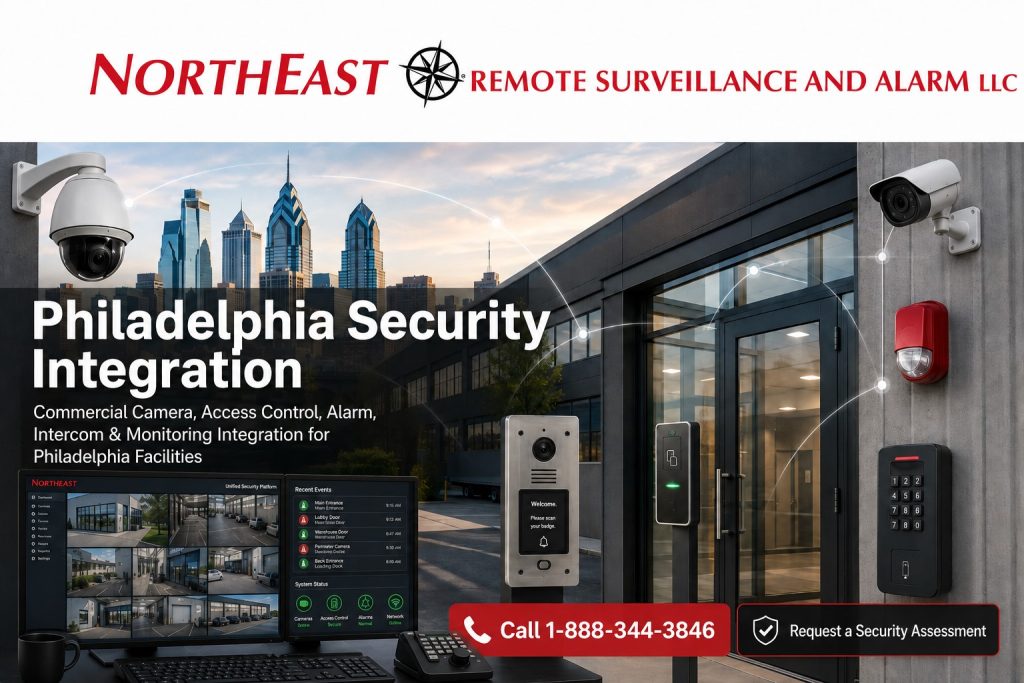
Northeast Remote Surveillance and Alarm, LLC (NERSA) designs, integrates, upgrades and supports commercial security systems for qualifying business and professionally managed properties throughout Philadelphia.
NERSA supports integration projects for:
- Offices
- Warehouses
- Logistics facilities
- Manufacturing plants
- Healthcare properties
- Schools
- Municipal buildings
- Contractor facilities
- Industrial properties
- Multi-tenant buildings
- Commercial campuses
- Multi-site organizations
Many Philadelphia properties already have security systems installed at different times, by different providers or for different operational needs.
Cameras may not connect to door events. Alarms may trigger without useful video context. Intercoms may operate separately from access control. Monitoring may not have the camera views or response procedures needed to evaluate an event effectively.
The objective of security integration is to reduce disconnected workflows and make compatible systems easier to operate, investigate and support.
For coordinated platform planning, visit Unified Security Systems Philadelphia.
Commercial and Industrial Systems Only • Philadelphia • Security Integration • Existing Systems • Platform Migration • Phased Upgrades • Multi-Site
For a project centered on existing equipment, use our Philadelphia security retrofit and upgrade guide to plan reuse, takeover requirements and phased changes.
For broader Philadelphia security planning, visit Commercial Security Installation Philadelphia.
Security Integration Built Around Existing Operations
A successful integration project should begin with the systems and workflows already in place.
NERSA may evaluate:
- Existing cameras
- Recording systems
- Access control
- Intrusion alarms
- Intercoms
- Monitoring
- Vehicle gates
- Network infrastructure
- User permissions
- Administrator ownership
- Documentation
- Existing integrations
- Future expansion requirements
The first question should not be, “What should we replace?”
The first question should be, “What works now, what does not work, and what does the organization need these systems to do together?”
What Philadelphia Security Integration May Include
Depending on compatibility and project requirements, integration may involve:
- Video and access-control coordination
- Alarm and video verification
- Intercom and door-release workflows
- Gate and vehicle-event integration
- Monitoring workflows
- Centralized event review
- User and permission coordination
- Multi-site administration
- Platform migration
- Network improvements
- Phased modernization
Not every project requires every security system to be integrated.
Integration should provide a practical operational, investigative or administrative benefit.
Video and Access Control Integration
Access control identifies credential and door activity.
Video can provide visual context around the same entrance.
Compatible integration may help authorized users review:
- Credential use
- Rejected access
- Forced doors
- Held-open doors
- Visitor entry
- Vendor activity
- After-hours access
- Restricted-room events
For Philadelphia camera planning, visit Philadelphia Security Camera Installation.
For controlled-entry planning, visit Access Control Installation in Philadelphia.
Alarm and Video Verification
Intrusion alarms can indicate that a protected opening or area has been violated.
Compatible video may provide additional context around that alarm event.
Potential workflows may include:
- Door-event video
- Motion-event review
- Dock alarm verification
- Perimeter-event review
- After-hours video
- Selected monitoring workflows
Video should support—not replace—properly designed intrusion detection.
For broader intrusion planning, visit Commercial & Industrial Intrusion Alarm Systems.
For broader monitoring procedures, visit Commercial and Industrial Security Monitoring.
Intercom and Controlled Entry Integration
Commercial intercoms may be coordinated with cameras, access control and door or gate release.
Applications may include:
- Main visitor entrances
- Tenant entry
- Loading docks
- Service entrances
- Vehicle gates
- After-hours entry points
The organization should clearly establish who receives calls, who may release the opening and what happens when the normal recipient is unavailable.
For dedicated planning, visit Commercial & Industrial Intercom Systems.
Gate and Vehicle Integration
Vehicle entrances may involve several coordinated systems, including:
- Credentials
- Intercoms
- Cameras
- License-plate recognition
- Gate position
- Remote release
- Event reporting
For dedicated gate planning, visit Commercial Gate Access Control Systems.
For plate-capture planning, visit License Plate Recognition Camera Systems.
Remote Monitoring Integration
Some Philadelphia properties may need selected camera, alarm or access events incorporated into a defined monitoring workflow.
Monitoring may help determine:
- What triggered the event
- Where it occurred
- Whether video context is available
- Who should be notified
- Whether escalation is appropriate
- How the event should be documented
For broader monitoring planning, visit Commercial and Industrial Security Monitoring.
For active monitored video and approved live audio response, visit Remote Video Monitoring and Live Talk-Down.
Existing Security System Integration
One of the most important integration scenarios is a property that already has several functioning systems that do not work well together.
Existing environments may contain:
- Multiple camera brands
- Different access-control platforms
- Separate intrusion systems
- Independent intercoms
- Older network infrastructure
- Cloud and on-premise systems
- Different administrator accounts
A practical integration plan may involve:
- Reusing compatible equipment
- Correcting system configuration
- Improving network infrastructure
- Replacing unsupported components
- Migrating selected systems
- Standardizing administration
- Phasing improvements over time
Complete replacement should not be recommended solely because the existing environment is mixed.
Integration Versus Unified Security
Security integration and unified security are related, but they are not identical.
Security integration focuses on connecting systems or workflows that may come from different technologies or platforms.
Unified security generally refers to an environment where multiple supported security functions are managed more directly through one platform or closely coordinated architecture.
The correct approach may be:
- Integration between existing systems
- Migration to a unified platform
- A hybrid environment
- Phased modernization
- Selective replacement
For unified-platform planning, visit Unified Security Systems Philadelphia.
Security Technologies and Platforms
Platform compatibility determines what can realistically be integrated.
Some environments may use:
- Cloud-managed platforms
- On-premise systems
- Hybrid architectures
- Manufacturer-specific ecosystems
- Enterprise security platforms
- Existing legacy systems
For broader manufacturer and platform planning, visit Security Technologies & Platforms.
Verkada Security Integration
For organizations evaluating a cloud-managed environment that can coordinate supported video surveillance, access control, alarms, intercoms and additional physical-security functions through a common management platform, visit Verkada Commercial Security Systems.
Verkada is one possible platform approach.
NERSA evaluates platform selection according to facility requirements, existing equipment, network readiness, licensing, administration and long-term operating needs.
Integration for Warehouses and Logistics Properties
Warehouse and logistics facilities may need coordinated security around:
- Loading docks
- Employee entrances
- Shipping offices
- Truck gates
- Trailer areas
- Parking
- Intrusion zones
- After-hours events
For broader warehouse planning, visit Warehouse & Logistics Security Systems.
For Greater Philadelphia industrial and logistics planning, visit Greater Philadelphia industrial park directory.
Integration for Manufacturing Facilities
Manufacturing properties may require coordinated review of:
- Employee entrances
- Production areas
- Contractor activity
- Restricted rooms
- Tool and parts storage
- Shipping
- Parking
- Alarm activity
For broader manufacturing-security planning, visit Manufacturing Plant Security Systems.
Integration for Office and Multi-Tenant Properties
Office and multi-tenant properties may need coordinated security around:
- Shared entrances
- Tenant permissions
- Visitor entry
- Lobby cameras
- Parking
- Restricted rooms
- After-hours activity
For broader office-security planning, visit Office Building Security Systems.
Multi-Site Security Integration
Organizations operating several properties may need more consistent security administration.
Multi-site integration may support:
- Centralized video review
- Shared user management
- Location-specific access permissions
- Common alarm procedures
- Standard event naming
- Remote administration
- Consistent documentation
For broader multi-site planning, visit Multi-Site Commercial Security Systems.
Network and Infrastructure for Integrated Security
Security integration depends heavily on reliable infrastructure.
Projects may require:
- Structured cabling
- PoE switching
- Fiber
- VLANs
- Network segmentation
- Equipment racks
- UPS backup
- Secure remote connectivity
- Device labeling
- IP documentation
Weak infrastructure can prevent otherwise compatible systems from operating reliably together.
For broader planning, visit Commercial & Industrial Infrastructure and Cabling.
For dedicated network-security planning, visit Network Security for Security Systems.
Cybersecurity and Administrator Ownership
Integrated security environments may centralize access to cameras, doors, alarms and facility activity.
Planning should include:
- Named administrator accounts
- Role-based permissions
- Multi-factor authentication where supported
- Secure remote access
- Network segmentation
- Vendor-access controls
- User removal
- Cloud-account ownership
- Documentation
For broader planning, visit Cybersecurity and Data Protection Standards.
Life-Safety and Compliance Coordination
Security integration must not interfere with required emergency egress, fire-alarm operation, accessibility or other regulated building functions.
Controlled openings and system interfaces should be evaluated carefully.
For broader code-aware planning, visit Regulatory Compliance and Inspection Readiness.
Documentation and System Handoff
An integration project should leave the customer with understandable system information.
Documentation may include:
- Camera names
- Controlled-door lists
- Alarm-zone information
- Intercom locations
- Administrator ownership
- Network notes
- Monitoring procedures
- Known integrations
- System limitations
- Service information
For broader turnover planning, visit Commercial Security Documentation and Handoff.
Philadelphia Security Integration Assessment
An integration assessment may review:
- Existing cameras
- Existing access control
- Intrusion alarms
- Intercom systems
- Monitoring
- Vehicle gates
- Network infrastructure
- Administrator ownership
- User permissions
- Existing integrations
- Documentation
- Compatibility
- Expansion requirements
The goal is to identify the most practical path toward a cleaner security environment without unnecessary replacement or complexity.
Why Philadelphia Businesses Choose NERSA
Northeast Remote Surveillance and Alarm, LLC focuses on commercial and industrial security rather than single-family home alarm packages.
NERSA evaluates integration projects around:
- Existing systems
- Facility operations
- Compatibility
- User workflows
- Camera requirements
- Door activity
- Alarm response
- Visitor entry
- Monitoring
- Network infrastructure
- Administrator ownership
- Documentation
- Future expansion
The objective is to provide a security environment where compatible systems exchange useful information and remain practical to operate, investigate and support.
Request Philadelphia Security Integration
NERSA can help Philadelphia facilities bring security systems together. We review disconnected cameras, outdated access control, separate alarms and inconsistent monitoring procedures. The review also addresses poor records and platforms that are difficult to manage.
Request a Philadelphia Security Integration Assessment.
Frequently Asked Questions About Philadelphia Security Integration
What is security integration?
Security integration is the process of coordinating compatible cameras, access control, intrusion alarms, intercoms, monitoring, gates and related security workflows so useful information can move between systems.
Is security integration the same as unified security?
Not exactly. Integration can connect separate systems, while unified security generally refers to managing multiple supported functions through one platform or tightly coordinated environment.
Can cameras and access control be integrated?
Yes. Compatible systems may associate video with selected credential and door events.
Can intrusion alarms be integrated with video?
Yes. Compatible systems may provide video context around selected alarm events.
Can intercoms work with access control?
Yes. Compatible intercoms may coordinate communication and approved door or gate release with access-control workflows.
Can NERSA integrate existing security systems?
Sometimes. Existing equipment should be evaluated for compatibility, condition, supportability, administrator access and available integration options.
Does integration require replacing every system?
No. A project may involve existing-system reuse, selective replacement, configuration changes, platform migration or phased modernization.
Can integration support multiple Philadelphia properties?
Yes. Compatible systems may support centralized administration and consistent workflows across several locations.
Does security integration require network planning?
Often, yes. Modern integrated systems may depend on structured cabling, switching, segmentation, reliable connectivity and secure remote access.
Can NERSA integrate Verkada systems?
Yes. Verkada is one supported platform option for qualifying projects requiring coordinated cloud-managed video, access control, alarms, intercoms and related functions.
Does security integration replace life-safety requirements?
No. Security systems should be coordinated so they do not interfere with required emergency operation or other applicable building requirements.
How does a Philadelphia integration project begin?
The project begins with an assessment of existing systems, compatibility, workflows, infrastructure, administrator ownership, operational problems and desired integration outcomes.
Compliance, Codes & Project Standards
NERSA plans commercial and industrial security work with applicable code, documentation, inspection and authority-having-jurisdiction requirements in mind. Requirements vary by system, property and jurisdiction. These resources support project planning; they do not establish legal compliance, certification or AHJ approval.
Related guidance: NERSA project standards · Documentation, testing & inspection readiness