
Protect commercial and industrial properties with intrusion alarms designed around actual openings, operating schedules, monitored events, and response procedures.
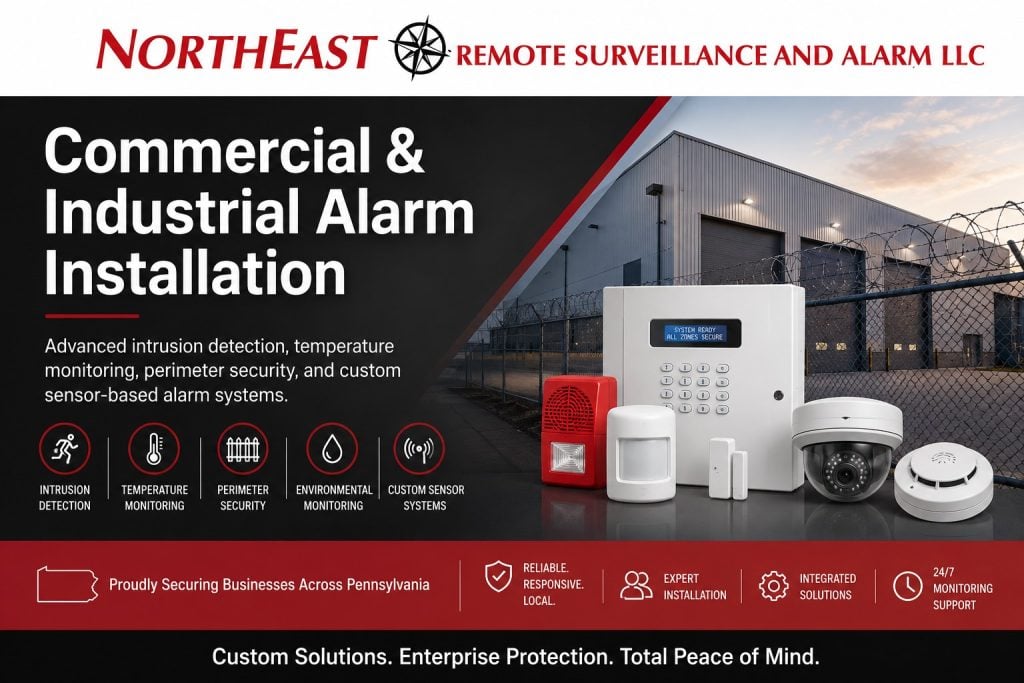
Commercial Alarm Planning for Real Facilities
Northeast Remote Surveillance and Alarm, LLC designs, installs, monitors, upgrades, takes over, and supports nonresidential intrusion alarm systems for warehouses, manufacturers, distribution centers, offices, healthcare properties, schools, municipalities, contractor yards, industrial sites, commercial campuses, and multi-location organizations.
A useful system should detect a meaningful condition, identify the affected opening or area, transmit an understandable signal, notify the appropriate people, and remain practical to manage as the facility changes. Begin with the property and its operations—not a predetermined panel or sensor package.
What a Commercial Alarm System Can Protect
- Personnel doors, overhead doors, windows, hatches, gates, and other perimeter openings
- Offices, production areas, inventory, tool rooms, records, and restricted interior spaces
- Separate buildings, departments, tenants, or operating areas with different schedules
- Approved panic or duress locations with documented signal and response procedures
- Compatible temperature, water, power, or equipment-status conditions with defined thresholds and contacts
- System trouble, low-battery, tamper, and communication conditions supported by the selected equipment
Sensor selection should match the environment. Machinery, air movement, dust, temperature changes, tall ceilings, vehicle traffic, and animals can affect detection and false-alarm risk.
Make Alarm Events Understandable
Zone descriptions should identify the actual door, room, area, or condition. Partitions may allow approved buildings, departments, tenants, or schedules to be armed independently. Individual user codes improve accountability, while schedules and exception reporting can help identify unexpected openings, closings, or after-hours activity.
Names should remain consistent across the panel, monitoring account, application, reports, and customer documentation. Shared codes should be avoided when individual identification is practical.
Plan Monitoring, Communications, and Verification
Qualifying systems may use cellular, internet, approved radio, or dual-path communications depending on the equipment, coverage, customer network, backup power, monitoring arrangement, and project requirements. The proposal should identify the included path instead of implying that every system has the same redundancy.
Professional commercial alarm monitoring should use current call lists and site-specific instructions for intrusion, panic, trouble, or supported facility-condition signals.
Compatible video verification may associate an alarm with a nearby camera view, but it is not continuous live observation unless a separate remote video monitoring service is included.
Monitoring cannot guarantee prevention, signal delivery, dispatch, or response time. Performance depends on installed equipment, power, communications, programming, account instructions, telecommunications, and responding authorities.
Alarm Planning by Facility Type
- Warehouses and distribution centers: employee entrances, shipping offices, dock openings, inventory, and separate operating areas
- Manufacturing facilities: production, tools, materials, maintenance spaces, contractors, and multiple shifts
- Offices and multi-tenant properties: common entrances, suites, records, management areas, and after-hours users
- Healthcare, schools, municipalities, and institutions: perimeter protection, restricted rooms, staff entrances, and approved duress locations
- Contractor yards, fleets, and exterior properties: buildings, gates, storage, equipment, and scheduled after-hours access
Upgrade or Take Over an Existing Alarm
Existing panels, contacts, motion detectors, keypads, sirens, wiring, communicators, and monitoring arrangements should be evaluated before replacement. Reuse depends on condition, ownership, compatibility, programming access, testing, communication requirements, documentation, manufacturer support, cybersecurity, and the objectives of the completed system.
Review alarm upgrades, retrofits, and takeovers when the property needs a communicator change, monitoring transition, added partitions, improved reporting, new users, additional devices, or phased modernization.
Project Process and Customer Ownership
- Review the property, operating schedules, openings, restricted spaces, existing equipment, communications, and response procedures.
- Define each proposed sensor, alarm zone, partition, user role, monitored condition, and expected response.
- Document equipment, general locations, communications, monitoring, applications, customer responsibilities, exclusions, testing, and training.
- Install, program, label, test, commission, and provide role-appropriate instruction.
Authorized customers should retain administrator access, individual user management, current monitoring contacts, zone records, operating instructions, and appropriate project documentation.
Frequently Asked Questions
Does every commercial property need the same alarm system?
No. Openings, schedules, users, environmental conditions, communications, monitoring needs, and response procedures differ by property.
Can existing alarm equipment be reused?
Often. It should first be tested for condition, compatibility, ownership, programming access, communications, documentation, manufacturer support, and future requirements.
Can an alarm monitor temperature or water?
Compatible systems may monitor selected facility conditions when thresholds, delays, recipients, escalation, testing, and maintenance responsibilities are clearly defined.
Is an intrusion alarm the same as a fire alarm?
No.
Commercial fire alarm systems are a separate regulated life-safety scope with distinct design, notification, monitoring, testing, documentation, permitting, and inspection requirements.
Commercial & Industrial Security Services
Request a Commercial Alarm Assessment
Tell us how the property operates, which openings or areas need protection, what is not working, and how events should be handled.