Warehouses, manufacturing plants, distribution centers, freight operations, cold-storage facilities, truck yards, industrial parks, and multi-building properties throughout Berks County need security systems planned around how employees, visitors, drivers, vehicles, inventory, equipment, and restricted areas actually move through the site.
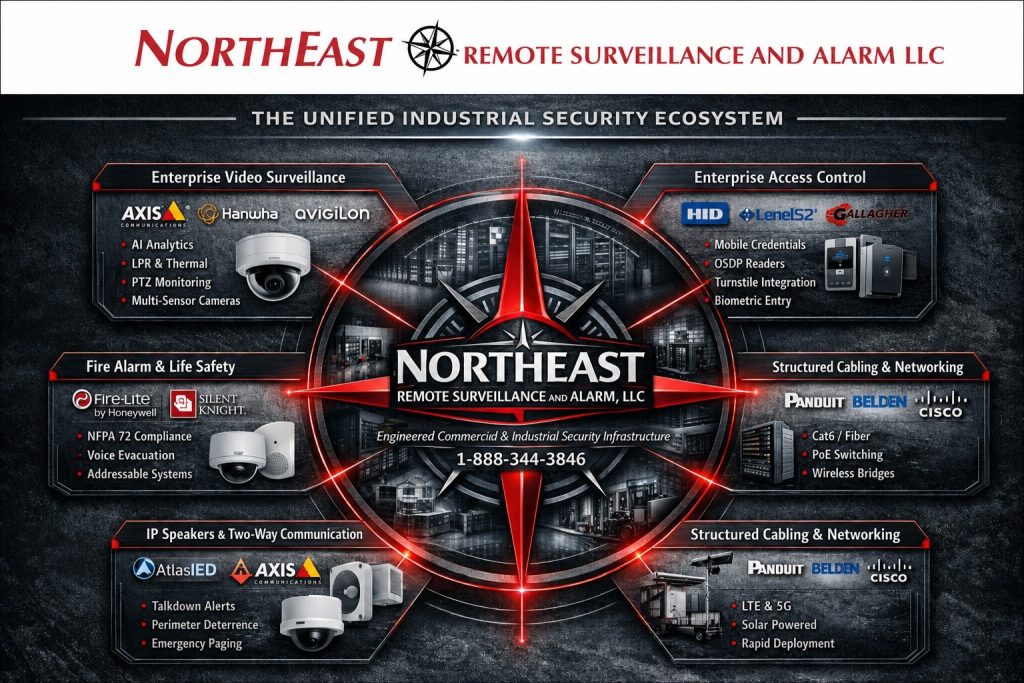
Northeast Remote Surveillance and Alarm, LLC designs, installs, upgrades, integrates, monitors, and supports commercial and industrial video surveillance, access control, intrusion detection, remote video monitoring, gate systems, license plate recognition, fire alarm and life-safety systems, and the structured cabling and fiber infrastructure behind them.
NERSA focuses on commercial, industrial, municipal, institutional, healthcare, logistics, and enterprise environments. We do not install residential security systems.
For broader regional planning involving offices, healthcare facilities, schools, municipal properties, retail businesses, and other commercial buildings, begin with Greater Reading Commercial & Industrial Security Systems.
Request a Physical Plant Security Assessment or call 1-888-344-3846.

Industrial Security Planning for Berks County Facilities
Industrial security should begin with the operation rather than with a predetermined camera count, alarm package, or list of products.
A warehouse operating around the clock has different exposure than a manufacturing plant that closes overnight. A high-volume distribution center has different gate, dock, yard, and evidence requirements than a smaller industrial property. A cold-storage building may also require equipment and installation methods appropriate for temperature changes, condensation, sanitation procedures, and controlled environments.
A properly planned security system should account for:
- Employee shifts and credential schedules
- Visitor, contractor, vendor, and driver entry
- Shipping, receiving, loading docks, and overhead doors
- Truck entrances, trailer staging, and fleet parking
- Production areas, tool cribs, storage rooms, and utility spaces
- Exterior equipment, inventory, dumpsters, and material-storage areas
- Parking lots, side yards, fence lines, and building approaches
- Alarm response and after-hours monitoring procedures
- Video-retention and incident-investigation requirements
- Cabling, network capacity, fiber connectivity, and future expansion
- Existing cameras, panels, locks, readers, and infrastructure that may be reusable
NERSA evaluates these conditions before recommending equipment so the finished system supports security without unnecessarily interfering with production, shipping, receiving, employee movement, or daily facility operations.
Berks County’s Manufacturing and Freight Network
The term Berks County Industrial and Logistics Corridor describes the connected network of warehouses, manufacturing plants, distribution operations, truck-served properties, industrial parks, freight facilities, and multi-building sites operating throughout the county. It is not presented as the official name of one government-designated district.
Industrial and logistics properties are distributed throughout Greater Reading and along major freight routes that include I-78, I-176, US 222, US 422, PA 61, and connecting industrial roads.
Facilities closer to Reading may include established warehouses, older manufacturing properties, redeveloped industrial buildings, and mixed commercial-industrial areas. Northern Berks County includes truck-served properties, warehouse developments, trailer areas, and facilities connected to the I-78 logistics corridor. Other industrial operations are located around Wyomissing, Muhlenberg Township, Exeter Township, Cumru Township, Spring Township, Kutztown, Hamburg, Bethel, Tilden Township, and surrounding communities.
Security planning must reflect the exact building, property boundaries, operating schedule, employee population, truck movement, surrounding land use, network infrastructure, and after-hours exposure at each location.
Industrial Facilities NERSA Supports
Warehouse and Fulfillment Operations
Warehouse security requires coordinated visibility across employee entrances, offices, storage aisles, high-value inventory, loading docks, overhead doors, shipping areas, parking lots, truck courts, and exterior approaches.
Camera coverage should help management follow relevant activity between the property entrance, dock area, staging zone, warehouse floor, and storage location. Access control and intrusion detection should address employee entrances, office-to-warehouse openings, restricted cages, utility rooms, overhead doors, and after-hours perimeter protection.
For facility-wide warehouse planning, visit Warehouse Security Systems in Reading, PA.
Manufacturing Plants
Manufacturing security should protect more than the exterior building perimeter. A plant may need controlled access and useful video coverage around production areas, tool cribs, maintenance rooms, laboratories, quality-control areas, raw-material storage, finished-goods storage, server rooms, utilities, and other restricted spaces.
Access permissions may be organized by department, shift, qualification, contractor status, building, or management responsibility. Video surveillance may support incident review, workplace investigations, inventory accountability, production-area documentation, and verification of activity around valuable equipment.
For plant-specific planning, visit Berks County Manufacturing Security Systems.
Distribution Centers, 3PL Facilities, and Freight Operations
Distribution centers, third-party logistics operations, cross-dock facilities, freight terminals, and high-volume fulfillment properties must document continuous movement involving drivers, employees, trailers, vehicles, freight, and vendors.
Security planning may need to address:
- Driver and carrier arrival
- Gate and guard-station activity
- Trailer placement and removal
- Dock assignments
- Cross-dock transfers
- Shipping and receiving events
- Staging and exception areas
- Inventory discrepancies
- Freight and vehicle claims
- After-hours yard exposure
For high-throughput logistics and freight environments, visit Berks County Distribution Center Security Systems.
Facilities concerned with staged freight, trailer exposure, unauthorized pickup, or shipment theft should also review Cargo Theft Prevention Systems for Warehouses and Distribution Centers.
Cold Storage and Food-Processing Facilities
Cold-storage warehouses, food-processing plants, refrigerated distribution buildings, packaging operations, and controlled-temperature spaces require equipment and installation practices selected for the actual environment.
Camera housings, lenses, mounting methods, cable types, door hardware, device placement, and transitions between conditioned and unconditioned spaces can all affect long-term performance. Security installation may also need to be coordinated with production schedules, sanitation procedures, restricted processing areas, shipping operations, and facility maintenance requirements.
For temperature-controlled and food-related operations, visit Berks County Cold Storage and Food Processing Security Systems.
Industrial Parks and Multi-Building Properties
Industrial parks and multi-building properties may require centralized security across detached buildings, tenant spaces, internal roads, shared entrances, common parking areas, remote gates, utility structures, and exterior storage zones.
A scalable design may use fiber backbones, point-to-point wireless links, distributed network switches, centralized video management, coordinated access control, and shared monitoring procedures. User permissions can still be separated by tenant, department, building, or management responsibility.
Use the Greater Reading Area Industrial Park Directory to find broader planning resources for regional industrial parks.
For detached buildings and campus-wide connectivity, visit Berks County Multi-Building Industrial Security Systems.
Organizations operating several separate facilities can also review Reading Multi-Site Security System Standardization for consistent equipment, naming, user permissions, monitoring, documentation, and management across locations.
High-Risk Areas Around Industrial and Logistics Sites
Loading Docks, Shipping, and Receiving
Loading docks are transition points where employees, drivers, freight, trailers, forklifts, vendors, and exterior activity converge.
Useful dock coverage may require coordinated views of trailer approaches, dock positions, overhead doors, interior shipping areas, staging zones, pedestrian entrances, freight transfer, and surrounding yard movement.
One wide camera looking toward an entire dock wall may provide general awareness but still fail to document the details needed for an investigation. Camera positions should be selected around the events management may need to review, including trailer arrival, door opening, product movement, damage claims, employee interaction, and vehicle departure.
For dock-focused protection, visit Berks County Loading Dock Security Systems.
Truck Yards, Trailer Staging, and Fleet Areas
Truck yards and trailer areas create different challenges from ordinary building-mounted camera coverage. Long distances, parked trailers, changing obstructions, uneven lighting, weather, fence lines, and irregular after-hours movement can reduce the usefulness of a standard camera layout.
A truck-yard plan may combine overview cameras, targeted identification views, gate cameras, license plate capture, perimeter detection, lighting coordination, analytic alerts, remote video monitoring, and defined response procedures.
The objective is to help management determine who entered, which vehicle arrived, where a trailer was placed, when equipment moved, and what happened before or after an incident.
For exterior freight, trailer, and fleet protection, visit Berks County Truck Yard and Trailer Security Systems.
Gates and Controlled Vehicle Entrances
Industrial gates may be used by employees, truck drivers, vendors, contractors, service companies, emergency responders, and visitors. The entry process must control access without creating unnecessary delays or unsafe vehicle movement.
A gate system may include credential readers, long-range vehicle credentials, keypads, intercoms, remote release, video verification, vehicle detection, gate-position monitoring, scheduled permissions, and after-hours call routing.
For gate readers, keypads, intercoms, credentials, and vehicle-entry workflows, visit Reading Commercial Gate Access Control Systems.
License plate recognition requires a dedicated view designed around lane position, vehicle speed, lighting, camera angle, mounting location, and plate size. A general overview camera should not automatically be expected to produce reliable plate records. For plate-capture planning, visit Reading License Plate Recognition Camera Systems.
Parking Lots, Perimeters, and Exterior Storage
Employee parking, visitor areas, fleet parking, side yards, rear approaches, dumpsters, material storage, service entrances, generators, transformers, and isolated building elevations may remain exposed after normal operating hours.
Exterior camera planning should account for lighting, distance, obstructions, weather, mounting stability, pedestrian movement, vehicle direction, and the exact location where an incident is likely to occur.
For parking-area and building-approach coverage, visit Reading Commercial Parking Lot Security Cameras.
Properties experiencing trespassing, theft, vandalism, dumping, loitering, or recurring after-hours vehicle activity may benefit from Remote Video Monitoring and Live Talk-Down rather than relying only on recorded footage.
Integrated Security Systems for Industrial Operations
Commercial and Industrial Video Surveillance
A useful video surveillance system should provide footage that can be located, reviewed, exported, and understood—not merely live images on a monitor.
Camera selection should reflect the required purpose, such as general awareness, person identification, vehicle identification, loading-dock documentation, plate capture, process review, perimeter detection, low-light visibility, or detailed investigation.
Recording capacity should be calculated around camera count, resolution, frame rate, compression, activity level, retention requirements, redundancy, and expected expansion.
For camera design and recording-system planning, visit Commercial and Industrial Video Surveillance Systems.
Commercial Access Control
Access control allows management to determine who can enter each secured door, gate, room, building, or restricted area and when that permission is valid.
Industrial systems may use cards, fobs, keypads, mobile credentials, biometric readers, or vehicle credentials. The correct choice depends on traffic volume, user population, security level, environment, network availability, and administrative requirements.
Door hardware, electric strikes, magnetic locks, electrified panic hardware, request-to-exit devices, power supplies, fire alarm interfaces, and emergency egress must be considered as part of the complete opening.
For door, reader, credential, and permission planning, visit Commercial and Industrial Access Control Systems.
Intrusion Detection and Alarm Monitoring
Industrial intrusion systems should be divided around how the facility is occupied and armed. A site may need separate protection for offices, warehouse areas, production floors, docks, overhead doors, tool cribs, utility rooms, detached buildings, exterior storage, gates, and fence lines.
Partitions and schedules may allow one portion of the property to remain occupied while another area is protected.
For perimeter and after-hours detection, visit Commercial and Enterprise Intrusion Alarm Systems.
For alarm communication, supervisory signals, dispatch procedures, and account management, visit Commercial and Industrial Security Monitoring.
Commercial Fire Alarm and Life-Safety Systems
Commercial fire alarm systems should be planned around building use, occupancy, applicable codes, detection requirements, occupant notification, sprinkler supervision, monitoring, documentation, and local Authority Having Jurisdiction requirements.
Industrial facilities may also require coordination involving waterflow and valve-tamper supervision, duct detection, HVAC shutdown, elevator recall, fire doors, suppression systems, emergency communication, cellular or IP communicators, building additions, and occupancy changes.
For life-safety planning, visit Commercial and Industrial Fire Alarm Systems.
Structured Cabling, Fiber, and Network Infrastructure
Cameras, access-control panels, intercoms, monitoring systems, wireless bridges, and connected buildings depend on reliable communications infrastructure.
An industrial infrastructure plan may include CAT6 or CAT6A cabling, fiber backbones, building-to-building connections, point-to-point wireless bridges, PoE switching, network racks, equipment enclosures, backup power, surge protection, labeling, testing, and future expansion capacity.
For cabling and connectivity planning, visit Commercial and Industrial Infrastructure and Cabling.
Commercial Security System Integration
Video surveillance, access control, intrusion alarms, intercoms, gates, monitoring, and analytics can often support one another when the selected equipment and platforms are compatible.
Integration may connect door activity with camera views, gate events with vehicle records, alarm signals with video verification, credential events with recorded footage, and several buildings with one management interface.
Not every existing product, proprietary platform, cloud service, or legacy device can be connected reliably. Compatibility should be verified before installation.
For coordinated system planning, visit Commercial and Industrial Security System Integration.
Security System Upgrades, Retrofits, and Takeovers
Many industrial properties already have cameras, recorders, access-control panels, readers, alarm devices, door hardware, cabling, monitoring accounts, fiber, switches, or network infrastructure.
Existing equipment should be evaluated before everything is removed. Dependable cabling, compatible devices, properly installed door hardware, fiber, enclosures, power supplies, and equipment locations may be reusable. Obsolete, unsupported, unreliable, insecure, or poorly documented components may need replacement.
A takeover or retrofit review should address:
- Equipment makes and models
- Device condition and compatibility
- Firmware and software support
- Licensing and administrative ownership
- Password and cloud-account control
- Video-retention capacity
- Door hardware and reader wiring
- Network configuration
- Monitoring and communicator status
- System maps, labels, and documentation
- Expansion limitations
For complete modernization planning, visit Commercial Security System Upgrades, Retrofits and Takeovers.
Facilities with an existing monitored-camera system can review Reading Remote Video Monitoring Upgrades. Properties experiencing equipment failures or recurring service problems can use Reading Commercial Security System Maintenance and Repair.
How NERSA Plans an Industrial Security Project
Operational Discovery
NERSA begins by learning how the facility operates, including working hours, employee shifts, truck flow, visitor procedures, shipping activity, restricted areas, recurring incidents, IT requirements, management concerns, and planned expansion.
Facility management, operations, maintenance, security, and IT personnel may each identify different requirements that should be considered before the system is designed.
Existing-System Assessment
Installed cameras, recorders, readers, controllers, locks, alarms, cabling, network equipment, fiber, wireless links, power supplies, and monitoring connections are reviewed to determine what is dependable, compatible, reusable, or limiting the current system.
Facility teams preparing for this review can use the Berks County Industrial Security Assessment Checklist.
Risk, Coverage, and Response Planning
The property is divided into operational zones such as entrances, loading docks, yards, parking areas, warehouses, production spaces, restricted rooms, offices, gates, and detached buildings.
Each zone is assigned a defined purpose. That purpose may be general awareness, identification, access control, intrusion detection, vehicle documentation, live intervention, incident investigation, or life-safety support.
Infrastructure and Expansion Design
The design should account for cable pathways, switch capacity, network bandwidth, equipment locations, storage, power, building-to-building connectivity, administrative control, system security, and future device additions.
A system that meets only today’s minimum requirements but cannot expand may create avoidable replacement costs later.
Installation, Commissioning, and Training
Industrial installation may need to be coordinated around active production, shipping deadlines, employee shifts, sanitation requirements, lift access, escorts, shutdown periods, and other contractors.
After installation, cameras, controlled doors, alarm devices, communications, integrations, user permissions, and notification procedures should be tested under realistic operating conditions. Management should receive the information needed to retrieve video, manage users, respond to events, and request future service or expansion.
For a broader explanation of the first planning step, review NERSA’s Security Assessment Process.
Security Planning for One Building or Multiple Locations
A smaller warehouse, contractor facility, light-manufacturing building, or commercial shop may need a focused combination of cameras, controlled entrances, alarm zones, and monitoring procedures. The system should still be commercial-grade, documented, serviceable, and capable of appropriate expansion.
A larger plant, distribution center, industrial campus, or enterprise organization may require several buildings, fiber connectivity, distributed network equipment, centralized permissions, longer video retention, standardized naming, coordinated monitoring, and multi-site administration.
NERSA plans security systems for both smaller commercial facilities and larger industrial or enterprise environments. The design is based on the property and operating requirements rather than forcing every client into the same equipment package.
Areas Served Across Berks County
NERSA serves commercial and industrial properties throughout Reading, West Reading, Wyomissing, Muhlenberg Township, Exeter Township, Cumru Township, Spring Township, Sinking Spring, Shillington, Birdsboro, Fleetwood, Kutztown, Hamburg, Bethel, Tilden Township, and surrounding Berks County municipalities.
Projects may involve an individual industrial building, warehouse, manufacturing plant, distribution center, truck-served property, industrial park, or multi-building campus.
Mentioning these communities does not imply that NERSA maintains a physical office in each municipality. Service is provided through NERSA’s established regional operation.
Why Industrial Facilities Choose NERSA
Since 2008, Northeast Remote Surveillance and Alarm, LLC has focused on commercial and industrial system design, installation, upgrades, integration, monitoring, and long-term support.
NERSA’s approach emphasizes:
- Commercial and industrial work rather than residential packages
- System design based on facility operations and actual risk areas
- Coordination between cameras, access control, alarms, monitoring, gates, and infrastructure
- Evaluation of existing equipment before recommending replacement
- Scalable planning for one building, several buildings, or multiple locations
- Proper cabling, network planning, labeling, testing, and documentation
- Clear communication with facility, operations, IT, and management personnel
- Long-term serviceability rather than a short-term equipment sale
For documented examples from NERSA’s broader commercial and industrial work, review Commercial and Industrial Security Case Studies.
Request a Berks County Physical Plant Security Assessment
If your warehouse, manufacturing plant, distribution center, cold-storage facility, truck yard, industrial park, or multi-building property needs a new security system, expansion, upgrade, takeover, or independent assessment, NERSA can evaluate the facility and recommend an appropriate path forward.
The assessment can address cameras, controlled doors, intrusion zones, fire alarm requirements, monitoring, loading docks, truck yards, gates, license plate recognition, intercoms, cabling, fiber, network connectivity, existing equipment, and future expansion.
Request a Physical Plant Security Assessment or call 1-888-344-3846.
Frequently Asked Questions About Berks County Industrial and Logistics Security Systems
What does the Berks County Industrial and Logistics Corridor mean?
It describes the connected network of manufacturing plants, warehouses, distribution operations, truck-served properties, industrial parks, and related facilities operating throughout Greater Reading and Berks County. It is used to organize industrial security planning and is not presented as one officially designated business district.
What types of industrial properties does NERSA secure?
NERSA supports warehouses, manufacturing plants, distribution centers, freight operations, cold-storage facilities, food-processing properties, contractor and fleet yards, industrial parks, and multi-building commercial or industrial sites.
Does NERSA install residential security systems?
No. Northeast Remote Surveillance and Alarm, LLC focuses on commercial, industrial, municipal, institutional, healthcare, logistics, and enterprise environments.
How is an industrial security system designed?
The process begins with a facility and operational assessment. NERSA reviews entrances, employee movement, truck traffic, docks, yards, restricted spaces, parking areas, existing equipment, network infrastructure, after-hours exposure, incident-review requirements, and management priorities before recommending a design.
Can an existing camera, alarm, or access-control system be reused?
Sometimes. Existing cabling, cameras, readers, locks, panels, power supplies, fiber, and other infrastructure should be evaluated for condition, compatibility, reliability, support, ownership, licensing, and system security before reuse is recommended.
What should loading-dock camera coverage include?
Coverage may need to show trailer approaches, dock positions, exterior doors, interior shipping areas, freight transfer, staging locations, overhead-door activity, pedestrian entrances, and surrounding yard movement. The exact views should reflect the incidents or claims management may need to investigate.
How can truck yards and trailer areas be protected?
Truck yards may use overview cameras, dedicated gate views, license plate recognition, perimeter detection, access control, analytic alerts, remote video monitoring, live talk-down, and lighting coordination. The design should account for distance, parked trailers, vehicle movement, changing obstructions, and low-light conditions.
Can video surveillance, access control, and intrusion alarms work together?
Yes, when the selected systems and existing equipment are compatible. Integration may associate video with door activity, support alarm verification, connect gate events with vehicle records, and simplify incident investigation.
Can remote video monitoring operate only during nights and weekends?
Yes. Monitoring schedules and event rules can be configured around operating hours, holidays, low-staff periods, selected cameras, defined activity zones, and approved response procedures.
Can NERSA connect security systems across multiple buildings?
Yes. Multi-building systems may use fiber, network extensions, point-to-point wireless links, distributed switches, centralized video management, coordinated access-control permissions, and shared monitoring procedures.
Can NERSA work around active production and shipping operations?
Yes. Installation can be planned around production schedules, employee shifts, shipping deadlines, sanitation requirements, restricted areas, lift access, shutdown periods, and other contractors. Larger projects may be completed in phases.
Does NERSA provide fire alarm and structured-cabling services?
NERSA provides commercial fire alarm and life-safety planning, installation, coordination, monitoring, upgrades, and related infrastructure services. NERSA also installs structured cabling, fiber, network pathways, racks, PoE switching, wireless bridges, and other infrastructure needed by commercial security systems.
Can NERSA support both a small industrial building and a large enterprise facility?
Yes. A smaller property may need several cameras, controlled entrances, alarm zones, and monitoring, while a larger operation may require multiple buildings, extensive fiber, centralized permissions, integrated systems, long-term retention, and multi-site administration.
How does a Berks County industrial security project begin?
Begin with a physical plant security assessment. NERSA can review the property, existing systems, operational risks, infrastructure, monitoring procedures, and expansion requirements before developing a recommended security plan.