Cameras, Access Control, Alarms, Monitoring, Door Hardware, Fire Communicators and Low-Voltage Infrastructure
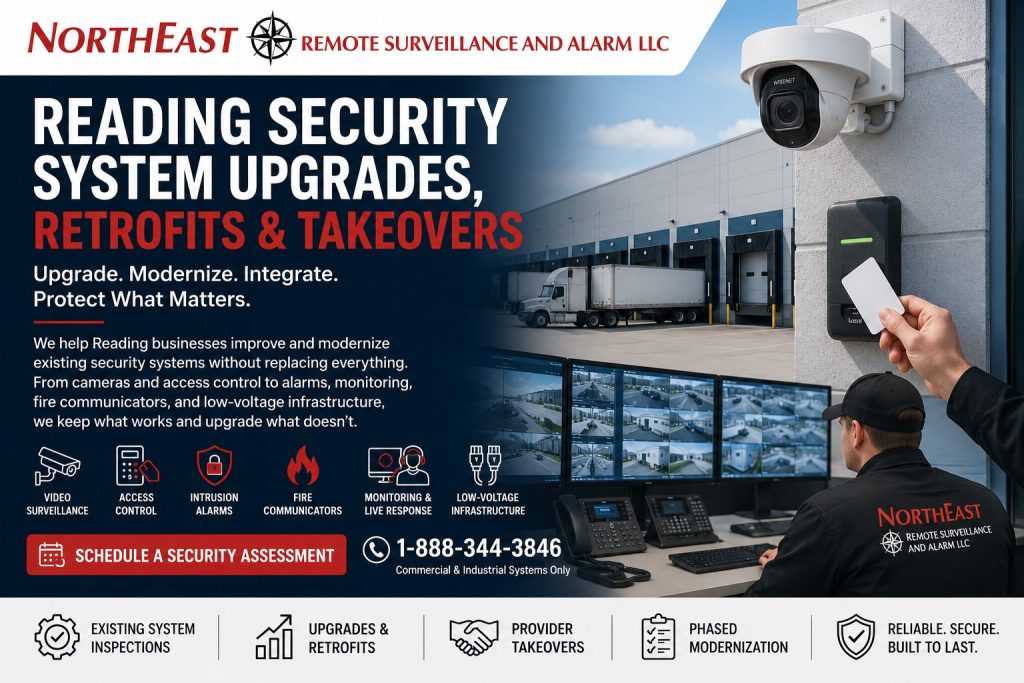
Reading commercial security system upgrades, retrofits, and takeovers help businesses improve aging, inherited, unreliable, unsupported, disconnected, or poorly documented systems without automatically replacing every usable camera, cable, sensor, reader, lock, controller, power supply, or network component.
Northeast Remote Surveillance and Alarm, LLC evaluates existing video surveillance, access control, intrusion alarms, monitoring paths, fire alarm communication equipment, commercial door hardware, cabling, networks, power supplies, remote-access accounts, user permissions, and system documentation for commercial and industrial facilities throughout Reading and the surrounding Berks County market.
A project may involve correcting an isolated failure, taking over equipment installed by another provider, reusing suitable infrastructure, upgrading selected components, expanding coverage, recovering administrative control, combining disconnected platforms, or replacing a system that can no longer be supported responsibly.
For broader new-system and citywide security planning, visit Commercial Security System Installation in Reading, PA.
Request a Reading Commercial Security System Assessment
Call 1-888-344-3846 or request a commercial security assessment.
Commercial and industrial systems only • Existing-system inspections • Upgrades • Retrofits • Provider takeovers • Phased modernization • Small business through enterprise

Improve the Existing System Without Automatically Replacing Everything
An older commercial security system does not necessarily need to be removed in one phase.
Many Reading businesses already have useful infrastructure in place. Existing Cat5e or Cat6 cabling, conduit, coaxial cable, fiber, door contacts, card readers, electric locks, alarm wiring, camera mounting locations, equipment racks, power supplies, network switches, wireless bridges, and other components may still have operational value.
The problem may be limited to:
- Outdated or failed cameras
- Poorly aimed camera views
- An unsupported DVR, NVR, server, or management platform
- Insufficient video retention
- Difficult playback or unreliable evidence export
- Recurring remote-access failures
- Shared passwords or unmanaged administrator accounts
- Former employees retaining active credentials
- Access-control panels that cannot support expansion
- Worn, misaligned, or unsuitable commercial door hardware
- An intrusion alarm that no longer matches the building
- Inaccurate alarm-zone names or partitions
- Obsolete alarm communication paths
- Disconnected or poorly maintained monitoring
- Undersized PoE switching
- Weak or failing power supplies
- Missing administrator credentials
- Unlabeled wiring
- Incomplete system documentation
- Separate platforms that are difficult to manage together
NERSA begins by determining what is installed, what is operating correctly, what can be supported, what can be reused, and what is creating unnecessary risk.
The recommendation may involve repair, reprogramming, repositioning, expansion, retrofit, provider takeover, integration, administrative recovery, phased modernization, or complete replacement.
The objective is to preserve equipment and infrastructure that remain dependable, compatible, secure, and supportable while correcting the components that are creating operational, administrative, or security problems.
Reading Security Upgrade and Retrofit Services
NERSA has developed focused Reading resources for businesses that already have systems in place and need a more specific modernization path.
Reading Security Camera System Upgrades and Retrofits
Reading Security Camera System Upgrades and Retrofits covers camera replacement, analog-to-IP migration, DVR-to-NVR modernization, expanded coverage, improved recording retention, nighttime image quality, evidence export, remote access, and phased video-system improvements.
Reading Access Control Upgrades and Door Hardware Retrofits
Reading Access Control Upgrades and Door Hardware Retrofits addresses controller replacement, reader and credential upgrades, database cleanup, door expansion, power supplies, electric locking hardware, request-to-exit devices, door monitoring, and coordinated commercial opening improvements.
Reading Commercial Alarm System Upgrades and Takeovers
Reading Commercial Alarm System Upgrades and Takeovers focuses on panel takeovers, zone corrections, keypad replacement, user cleanup, partition changes, communicator upgrades, monitoring transfers, alarm verification, and modernization of inherited commercial intrusion systems.
Reading Fire Alarm Communicator Upgrades
Reading Fire Alarm Communicator Upgrades explains approved telephone-line replacement, cellular and IP communication options, alarm, supervisory, and trouble reporting, account updates, and required coordination with applicable codes, listings, permits, inspections, and authorities having jurisdiction.
Reading Low-Voltage Security Infrastructure Upgrades
Reading Low-Voltage Security Infrastructure Upgrades covers cabling, fiber, PoE switching, network cabinets, wireless bridges, UPS equipment, power, pathways, labeling, documentation, and infrastructure improvements that support reliable cameras, access control, alarms, and monitoring.
Reading Commercial Security System Maintenance and Repair
Reading Commercial Security System Maintenance and Repair addresses failed devices, intermittent trouble, recording problems, communication faults, damaged wiring, unreliable readers, weak power supplies, preventive review, troubleshooting, and defined repairs that do not require a complete redesign.
Reading Security Monitoring Upgrades
Reading Security Monitoring Upgrades covers monitoring-provider changes, communication-path improvements, updated call lists, clearer dispatch instructions, signal testing, account-authority cleanup, opening and closing reports, and better coordination between alarms, video, and authorized responders.
Reading Security-System Documentation and Administrator Recovery
Reading Security-System Documentation and Administrator Recovery helps businesses recover authorized system control, rebuild equipment records, organize administrator accounts, document camera names, doors, alarm zones, networks, licenses, monitoring information, and reduce dependence on former employees or unavailable contractors.
Reading Multi-Site Security-System Standardization
Reading Multi-Site Security-System Standardization helps organizations establish consistent equipment, credential, monitoring, naming, documentation, permission, service, and operating standards across multiple Reading-area or regional facilities.
Reading Remote Video Monitoring Upgrades
Reading Remote Video Monitoring Upgrades addresses camera positioning, analytics, event transmission, monitored video verification, live talk-down readiness, speaker placement, escalation procedures, site contacts, lighting, network reliability, and after-hours response planning.
Reading Commercial Door Access System Retrofits
Reading Commercial Door Access System Retrofits focuses on modernizing complete controlled openings, including readers, controllers, electrified locks, exit devices, door contacts, request-to-exit equipment, power supplies, closers, credential technology, emergency operation, and required life-safety coordination.
Upgrade, Retrofit, Takeover, Repair, or Replacement?
These terms describe different project paths and should not be treated as interchangeable.
Repair
A repair corrects an isolated failure without materially redesigning the system.
This may be appropriate for one failed camera, a damaged reader, an unreliable power supply, a communication trouble condition, a defective alarm device, or another clearly defined problem.
Upgrade
An upgrade improves selected equipment, software, coverage, administration, security, or system capabilities while retaining the useful core of the existing system.
This may be appropriate when the platform remains supportable but needs better cameras, increased storage, stronger permissions, additional doors, newer credentials, better communication, or improved functionality.
Retrofit
A retrofit modernizes a system while reusing suitable existing cabling, pathways, devices, door hardware, power, or other infrastructure.
This may be appropriate when substantial improvements are needed but parts of the installation remain dependable and compatible.
Provider Takeover
A provider takeover occurs when NERSA assumes authorized service, administration, monitoring, upgrade, or long-term support responsibility for a system installed or previously maintained by another company.
A responsible takeover requires more than changing a phone number on the account. The equipment, programming access, users, signals, communication path, licenses, documentation, and supportability must be evaluated.
Expansion
An expansion adds cameras, controlled doors, alarm points, users, buildings, storage, monitoring capabilities, intercoms, or integrations to an existing platform.
This may be appropriate when the existing system operates correctly but the property, workforce, operating hours, or risk has grown.
Phased Modernization
Phased modernization completes the highest-priority corrections first and schedules later improvements around budget, production, occupancy, deliveries, available downtime, and operational needs.
The plan should identify what is being completed now, what is being retained temporarily, and what will eventually require replacement.
Full Replacement
Full replacement removes, abandons, or migrates away from an existing platform and installs a new system.
This may be necessary when the existing system is unsupported, proprietary, locked, insecure, damaged, unreliable, improperly installed, unavailable for service, or incapable of meeting present requirements.
A single Reading project may combine several paths. NERSA may take over an alarm system, retrofit usable wiring, replace the communicator, repair several devices, recover administrator control, and schedule a future camera-platform migration.
When a Reading Business Should Request an Upgrade Assessment
A commercial security assessment should be considered when:
- Cameras record but do not provide usable identification
- Nighttime images are dark, blurred, washed out, or dominated by glare
- Important entrances, loading docks, parking areas, yards, gates, or restricted spaces have blind spots
- Recorded video is difficult to locate, play, or export
- The DVR, NVR, server, or video-management system is obsolete
- Remote viewing frequently fails
- Shared passwords create accountability or cybersecurity concerns
- Former employees, tenants, contractors, or vendors may retain access
- Access levels and schedules are poorly organized
- The business depends heavily on physical keys
- Door hardware is worn, inconsistent, or inappropriate for the opening
- Controlled doors do not close or latch reliably
- The intrusion alarm no longer matches the facility layout
- Alarm zones have unclear or inaccurate descriptions
- False alarms or communication troubles recur
- The system still relies on legacy telephone lines
- Monitoring contacts or response instructions are outdated
- Separate cameras, alarms, access control, and intercoms cannot be managed efficiently
- Cabling, networks, racks, switching, or power are restricting expansion
- The original installer is unavailable or no longer supports the equipment
- Administrator credentials or programming records are missing
- The property has changed ownership, tenancy, layout, occupancy, or use
- Management does not know what equipment is installed
- No one can determine which components should be retained or replaced
- The business has acquired multiple locations with inconsistent systems
Do not begin by choosing replacement equipment. Begin by determining what is installed, what still works, who controls it, what can be reused, and what the completed system needs to accomplish.
Start With a Commercial Security System Inspection
A takeover or retrofit should not be based on assumptions.
Depending on the project, NERSA’s inspection and assessment may review:
- Cameras and camera views
- Camera image quality during daytime and nighttime conditions
- DVRs, NVRs, servers, and video-management systems
- Recording status and available retention
- Playback and video-export workflows
- Mobile and desktop remote access
- User accounts and permissions
- Access-control panels and expansion capacity
- Readers, credentials, and credential technology
- Door schedules and access levels
- Electric strikes, electrified locks, exit devices, and door closers
- Request-to-exit devices and door-position contacts
- Access-control power supplies and backup batteries
- Intrusion alarm panels and keypads
- Door contacts, motion detectors, glass-break detectors, and overhead-door protection
- Alarm zones, partitions, user codes, and arming procedures
- Alarm communication and monitoring paths
- Fire alarm communication equipment included within the approved scope
- Intercom and controlled-entry equipment
- Cat5e, Cat6, coaxial cable, alarm wiring, reader wiring, conduit, and fiber
- PoE switches, network cabinets, wireless bridges, and UPS equipment
- Device naming and cable labeling
- Authorized administrator access
- Available drawings, licenses, passwords, and system records
- Manufacturer support and replacement-equipment availability
- Remote-access and cybersecurity concerns
- Future expansion requirements
- Multi-site consistency
The completed findings should distinguish among immediate corrections, reusable equipment, recommended upgrades, optional improvements, known limitations, and longer-term replacement planning.
What Can Be Reused?
Equipment should be retained because it remains suitable—not merely because it is already installed.
Existing Camera Cabling
Camera cabling may be retained when it tests reliably, is properly terminated, follows suitable pathways, and is compatible with the proposed system.
It may require replacement when it is damaged, undocumented, improperly installed, exposed to interference, unreliable, inaccessible, or inadequate for the new design.
Modernization may involve reusing qualified network cable, using approved conversion equipment temporarily, or installing new Cat6, fiber, or other appropriate infrastructure.
Security Cameras
Existing cameras may remain when image quality, condition, compatibility, cybersecurity, manufacturer support, and long-term usefulness remain acceptable.
They may require repositioning, replacement, or migration when views are poor, nighttime performance is inadequate, failures recur, firmware is unsupported, or the cameras cannot work with the intended platform.
Recorders and Video-Management Platforms
A recorder or video-management platform may be retained when it is supported, secure, reliable, properly licensed, and capable of handling the required cameras and retention.
Replacement may be necessary when it is locked, unsupported, difficult to search, unreliable, insecure, or unable to expand.
Access-Control Panels
Existing access-control panels may remain when they are supported, programmable, secure, properly licensed, and capable of serving the required doors, users, schedules, and integrations.
Replacement may be necessary when the system is proprietary, locked, unsupported, unreliable, or unable to expand.
Readers and Credentials
Readers and credentials may remain when they are compatible, dependable, appropriately secure, and suitable for current operating policies.
Modernization may involve encrypted credentials, mobile credentials, new readers, improved communication protocols, or a phased credential transition.
Commercial Door Hardware
Door hardware may be retained when the door closes, latches, locks, releases, and operates correctly under normal and emergency conditions.
Worn, misaligned, unsafe, incompatible, damaged, or unsuitable hardware should be corrected rather than hidden behind new access-control electronics.
Alarm Devices
Existing door contacts, motion detectors, glass-break detectors, panic devices, and other alarm components may remain when they are reliable, testable, correctly located, and appropriate for the current layout.
Devices should be replaced or redesigned when they are damaged, obsolete, improperly located, unreliable, or no longer matched to the protected area.
Alarm Panels and Communicators
An existing panel may be taken over when authorized programming access is available and the platform remains supportable.
A panel or communicator may require replacement when it is locked, unsupported, unreliable, tied to an obsolete communication method, or unable to report the required signals correctly.
Network Equipment
Network switches and related equipment may remain when they are stable, secure, documented, appropriately managed, and adequately sized.
Modernization may require managed PoE switching, increased power capacity, network segmentation, fiber, UPS support, cabinet cleanup, or replacement of unsupported hardware.
Documentation
Existing documentation should be retained when it is accurate and current.
Missing or incomplete information may require rebuilding camera lists, door schedules, alarm-zone records, network information, administrator records, monitoring contacts, equipment locations, and future-phase recommendations.
NERSA does not promise that every existing component can be reused. Condition, compatibility, ownership, authorized access, manufacturer support, licensing, cybersecurity, applicable codes, and long-term serviceability determine what can remain.
Commercial Security Camera Upgrades in Reading
Camera upgrades are often needed when video exists but does not answer the customer’s questions.
A Reading camera modernization project may include:
- Replacing failed or low-resolution cameras
- Re-aiming useful existing cameras
- Adding identification views at entrances and transaction points
- Improving loading-dock, parking-lot, yard, gate, and perimeter coverage
- Replacing an obsolete DVR, NVR, or video server
- Migrating from analog cameras to IP video
- Creating a temporary hybrid system
- Increasing recording storage and retention
- Improving low-light and nighttime performance
- Adding panoramic, multi-sensor, PTZ, thermal, or vehicle-focused views where appropriate
- Improving playback and evidence export
- Renaming cameras by building and location
- Cleaning up mobile and desktop users
- Establishing appropriate administrator and viewing permissions
- Adding AI-supported event search
- Integrating video with access control or intrusion alarms
- Preparing selected cameras for remote video monitoring
For a detailed local modernization path, visit Reading Security Camera System Upgrades and Retrofits.
For broader system design, visit Commercial and Industrial Video Surveillance Systems.
Analog-to-IP and DVR-to-NVR Migration
Older analog wiring can sometimes be reused during a phased camera upgrade.
The cable type, distance, condition, power arrangement, terminations, grounding, interference, and proposed conversion method must be evaluated before reuse is recommended.
A hybrid design may allow a Reading business to modernize the highest-priority cameras and recording equipment first while retaining selected analog cameras temporarily.
The plan should identify which equipment is temporary, which components are being retained for the long term, and when the remaining analog equipment is expected to become unsupported or operationally inadequate.
Video Retention, Playback, and Remote Access
Recorder sizing should not be based only on the number of available camera inputs.
The design should consider:
- Required days of storage
- Camera resolution
- Frame rate
- Compression settings
- Continuous or event-based recording
- Existing and future camera count
- Available bandwidth
- Local and remote viewing needs
- User permissions
- Evidence-export requirements
- Cybersecurity
- Multi-site administration
- Local, cloud-managed, or hybrid architecture
The customer should be able to locate video, understand the retention period, export evidence, manage authorized users, and determine who controls remote access.
Reading Access Control and Door Hardware Upgrades
An access-control upgrade may be needed when the existing system cannot support current employees, doors, schedules, credentials, reporting, cybersecurity, or future expansion.
Upgrade work may include:
- Replacing unsupported controllers
- Updating access-control software
- Recovering authorized administrator access
- Migrating user databases
- Adding controlled doors
- Replacing unreliable readers
- Changing credential technology
- Adding mobile credentials
- Removing former employees and vendors
- Rebuilding access levels and schedules
- Separating permissions by department, shift, tenant, or building
- Improving forced-door and held-open reporting
- Associating video with important access events
- Replacing failing power supplies
- Correcting request-to-exit devices
- Correcting door-position monitoring
- Retrofitting electric strikes, electrified locks, or electrified trim
- Correcting door alignment, closing, and latching
- Standardizing access control across several buildings
The reader is only one part of the controlled opening.
The door, frame, lock, closer, exit hardware, controller, power supply, request-to-exit equipment, door-position contact, credential, accessibility, fire-alarm interface, and emergency operation must be reviewed as a coordinated assembly.
Changes involving controlled egress, panic hardware, fire-rated openings, magnetic locks, delayed egress, stairwell doors, automatic operators, or fire-alarm release may require design, permits, listed equipment, testing, inspection, and AHJ coordination.
Access-control electronics should not be used to compensate for a defective door or an unsuitable locking arrangement.
Commercial Intrusion Alarm Upgrades and Takeovers
A commercial alarm may continue operating even though it no longer matches the building or business.
Reading alarm upgrade work may include:
- Taking over a serviceable existing panel
- Replacing an unsupported panel
- Updating keypads
- Adding or replacing door contacts
- Improving overhead-door protection
- Replacing unreliable motion detectors
- Correcting zones that no longer match the building
- Creating partitions for offices, warehouses, tenants, or departments
- Cleaning up user codes
- Removing former employees
- Improving arming and disarming procedures
- Updating zone descriptions
- Replacing batteries and power supplies
- Adding panic or duress devices
- Adding selected environmental alerts
- Improving alarm verification
- Coordinating alarms with cameras
- Replacing outdated communication equipment
- Changing monitoring providers
- Updating monitoring contacts and response procedures
A provider takeover should include more than transferring the account.
The panel, devices, zones, users, partitions, communication path, signal descriptions, authorized contacts, and dispatch instructions should be reviewed so the system can be supported properly.
For detailed local information, visit Reading Commercial Alarm System Upgrades and Takeovers.
For broader intrusion planning, visit Commercial and Industrial Alarm Installation.
Alarm Monitoring and Communication Upgrades
Existing alarm systems may depend on outdated communication methods, stale contact information, or unclear response instructions.
A monitoring upgrade may involve:
- Replacing legacy telephone-line communication
- Adding an appropriate cellular or IP path
- Reviewing panel and communicator compatibility
- Testing alarm, supervisory, trouble, and restoration reporting
- Confirming zone descriptions
- Updating call lists
- Removing former employees and contacts
- Confirming authorized account representatives
- Reviewing dispatch instructions
- Organizing opening and closing reports
- Correcting recurring communication trouble
- Coordinating selected alarm events with video verification
- Documenting who receives alerts and what action is expected
The business should understand where signals are transmitted, who is contacted, what information the monitoring center receives, and what response procedures are on file.
Visit Reading Security Monitoring Upgrades for the complete local monitoring resource.
Fire Alarm Communicator and Life-Safety Coordination
Fire alarm work must remain separate from ordinary intrusion alarm work.
Depending on the approved project scope, modernization may involve:
- Replacing an obsolete fire alarm communicator
- Replacing legacy telephone-line communication
- Adding an approved cellular, IP, or dual-path communication method
- Correcting monitoring account information
- Reviewing alarm, supervisory, trouble, and restoration reporting
- Coordinating sprinkler waterflow and valve-tamper supervision
- Reviewing approved door-release interfaces
- Coordinating elevator, HVAC, smoke-control, or other building-system interfaces
- Updating system documentation
- Supporting permit, testing, inspection, and AHJ coordination
A communicator upgrade does not automatically correct defects elsewhere in the fire alarm system.
Panel condition, initiating devices, notification appliances, circuit supervision, power, batteries, documentation, occupancy, adopted codes, equipment listings, and AHJ requirements may affect the final project scope.
No fire alarm system should be modified solely as an ordinary security-device upgrade without appropriate project-specific review.
Visit Reading Fire Alarm Communicator Upgrades for focused information.
Low-Voltage Cabling and Infrastructure Upgrades
Security devices depend on the wiring, network, power, and pathways behind them.
A Reading low-voltage retrofit may include:
- Testing existing Cat5e, Cat6, coaxial, alarm, and reader wiring
- Reusing serviceable cable
- Replacing damaged or unreliable cabling
- Correcting terminations
- Adding Cat6 or Cat6A
- Installing fiber between buildings or network rooms
- Improving conduit and pathways
- Adding managed PoE switches
- Correcting inadequate PoE capacity
- Reorganizing equipment racks
- Replacing damaged or overcrowded cabinets
- Adding UPS support
- Reviewing access-control power supplies
- Improving grounding or surge-protection arrangements where applicable
- Replacing unreliable wireless bridges
- Labeling cables and equipment
- Documenting switch ports and device locations
- Planning capacity for future phases
A new camera installed on failing cable remains unreliable. An upgraded recorder connected to an undersized network may still lose video. A modern access-control platform connected to weak power or damaged door wiring may continue generating trouble.
Infrastructure should be evaluated before the final equipment schedule is approved.
Visit Reading Low-Voltage Security Infrastructure Upgrades for detailed local planning.
Remote Video Monitoring Modernization
Remote video monitoring requires more than forwarding motion alerts from existing cameras.
A monitoring-readiness review may consider:
- Camera positioning
- Image quality
- Nighttime lighting
- Detection zones
- Analytics configuration
- Network reliability
- Event transmission
- Site schedules
- Authorized contacts
- Escalation instructions
- Speaker placement
- Live talk-down procedures
- Gate and perimeter coverage
- Alarm and access-control event coordination
- False-event reduction
- Documentation and testing
A camera that cannot reliably show the activity or transmit the event is not ready for meaningful remote monitoring.
Visit Reading Remote Video Monitoring Upgrades for focused planning.
Unified and Multi-Site Security Modernization
Businesses that have expanded over time may operate several disconnected camera, alarm, access-control, intercom, and monitoring systems.
Modernization may help standardize:
- Camera naming
- Remote viewing
- Administrator roles
- User permissions
- Access-control credentials
- Door schedules
- Alarm partitions
- Monitoring procedures
- Event reporting
- Network architecture
- Equipment documentation
- Service responsibilities
- Multi-location operating standards
A unified platform may be appropriate when integration improves administration, incident review, alarm verification, visitor entry, reporting, or employee management.
Integration should solve a defined operational problem rather than add unnecessary complexity.
For organizations with several properties, modernization can be phased location by location while maintaining consistent equipment, credential, monitoring, documentation, and support standards.
Visit Reading Multi-Site Security-System Standardization for multi-location planning.
Recovering System Documentation and Administrative Control
An inherited system may appear functional while no one at the company has dependable administrative control.
Common problems include:
- Unknown administrator passwords
- Accounts belonging to former employees
- Cloud services registered to a previous contractor
- Shared credentials
- Unclear software ownership
- Missing licenses
- Unknown monitoring-authority information
- Unlabeled cameras, doors, zones, cables, or network ports
- Missing equipment lists
- Incomplete programming records
- No documented service history
- No clear process for adding or removing users
Administrative recovery must remain authorized. NERSA will not bypass ownership, licensing, manufacturer, cloud-account, or cybersecurity controls without appropriate authorization.
When recovery is possible, the project may include rebuilding authorized user structures, recovering or replacing administration methods, documenting installed equipment, cleaning up accounts, and establishing a supportable handoff.
Visit Reading Security-System Documentation and Administrator Recovery for focused guidance.
Reading Facilities That Benefit From Security Upgrades
Upgrade, retrofit, repair, and takeover services may be appropriate for:
- Warehouses
- Distribution centers
- Manufacturing plants
- Loading-dock operations
- Trucking terminals and fleet facilities
- Offices
- Business parks
- Multi-tenant commercial buildings
- Healthcare and professional properties
- Schools and educational facilities
- Municipal properties
- Institutional buildings
- Contractor shops and equipment yards
- Industrial flex buildings
- Parking facilities
- Retail and customer-facing businesses
- Properties with several buildings
- Organizations operating multiple locations
A smaller Reading business may need several cameras repositioned, one controlled door corrected, an alarm communicator replaced, or administrator access restored.
A warehouse, manufacturing facility, campus, or multi-site organization may require a phased migration involving hundreds of devices, multiple buildings, several platforms, network infrastructure, centralized administration, and documented operating standards.
A Practical Phased Modernization Process
1. Inventory the Existing System
Identify equipment, model numbers, locations, software, users, credentials, communication paths, licenses, cabling, power supplies, network equipment, cloud accounts, and available documentation.
2. Identify Immediate Risks
Prioritize failed recording, unsecured administrator access, inactive monitoring, communication failures, defective door hardware, former users, critical blind spots, unsupported equipment, damaged cabling, and other urgent conditions.
3. Test Compatibility and Reusability
Evaluate cameras, cabling, readers, locks, alarm devices, panels, switches, power supplies, racks, fiber, software, and licenses before promising reuse.
4. Complete Priority Corrections
Repair or replace equipment affecting immediate security, reliability, communication, administrative control, or required life-safety coordination.
5. Modernize the Core Platform
Upgrade the recorder, access controller, alarm panel, communicator, management software, network equipment, or other central components required to support future phases.
6. Expand and Integrate
Add cameras, controlled doors, alarm points, remote monitoring, intercoms, buildings, and approved integrations after the core platform and infrastructure are ready.
7. Document and Train
Update device names, camera lists, door schedules, alarm zones, users, administrator accounts, monitoring contacts, equipment locations, limitations, and future recommendations.
A phased plan should state what is being completed now, what is being retained temporarily, what will eventually require replacement, and what later work depends on the earlier phases.
What May Prevent a Provider Takeover?
NERSA may not be able to support every existing platform without modifications.
Takeover limitations may include:
- Proprietary or locked equipment
- Missing authorized administrator credentials
- Unsupported software
- Expired or unavailable licenses
- Equipment available only through the original provider
- Failed or damaged control equipment
- Unreliable or inaccessible wiring
- Unknown ownership of cloud accounts
- Shared credentials that cannot be secured
- Missing programming records
- Manufacturer restrictions
- Fire alarm equipment requiring specialized authorization
- Door hardware that is unsafe or unsuitable
- Serious cybersecurity concerns
- Systems that cannot be supported responsibly
When a direct takeover is not practical, NERSA can explain whether a limited repair, partial retrofit, phased migration, or complete replacement provides the more supportable path.
What Does a Reading Security-System Upgrade Cost?
Upgrade cost depends on what is installed, what remains usable, and what the completed system must accomplish.
Important factors include:
- Number and type of systems
- Equipment condition
- Camera, door, and alarm-point counts
- Required video retention
- Existing wiring and pathways
- Network and PoE capacity
- Door and frame condition
- Required commercial door hardware
- Ceiling height and lift access
- Building construction
- Software and licensing
- Monitoring requirements
- Communication-path changes
- Quality of existing documentation
- Need for after-hours work
- Number of buildings or locations
- Required project phasing
- Permit, engineering, testing, or inspection requirements
- Amount of equipment that can be retained
A focused repair or communicator upgrade may have a limited scope. A multi-building modernization involving video, access control, intrusion alarms, monitoring, cabling, fiber, documentation, and centralized administration requires a more extensive design.
The correct price cannot be determined responsibly until the existing system and site conditions are reviewed.
What the Customer Should Receive After Modernization
The completed project should leave the system more understandable, manageable, and supportable.
Depending on the scope, customer handoff may include:
- Updated camera names and locations
- Recording and retention information
- Authorized remote-viewing users
- Access-control door lists
- Credential and administrator structures
- Access levels and schedules
- Alarm-zone descriptions
- Alarm partitions and user procedures
- Monitoring contacts and account information
- Communicator details
- Equipment and panel locations
- Network and switch information
- Power-supply and UPS locations
- Device and cable labels
- User and administrator training
- Known limitations
- Recommended future phases
- Service and support information
Documentation is not merely paperwork.
It helps management control the system, reduces dependence on one employee or contractor, supports future troubleshooting, and makes later expansion more efficient.
Why Reading Businesses Choose NERSA
Commercial and Industrial Experience Since 2008
Northeast Remote Surveillance and Alarm, LLC has served non-residential properties since 2008.
NERSA supports new installations, inspections, maintenance, repairs, expansions, provider takeovers, phased retrofits, monitoring changes, system integration, door hardware, and low-voltage infrastructure.
Assessment Before Replacement
NERSA does not automatically recommend removing every existing component.
Equipment and infrastructure are evaluated for condition, compatibility, security, ownership, manufacturer support, and long-term usefulness.
Complete-System Review
Cameras, access control, intrusion alarms, monitoring, commercial door hardware, fire alarm communication, cabling, networks, power, administrators, users, and documentation are reviewed as parts of the same operating environment.
Commercial-Only Positioning
NERSA focuses on commercial and industrial systems rather than dividing its service model between residential packages and complex non-residential facilities.
Small Commercial Systems Through Enterprise Operations
NERSA supports smaller offices, shops, professional properties, and commercial buildings as well as warehouses, manufacturing plants, campuses, multi-building sites, and multi-location organizations.
Operationally Practical Phasing
Upgrade work can be organized around production, deliveries, employee access, building occupancy, available downtime, budget, and planned expansion.
Documentation and Administrative Control
A commercial security system should not depend on shared passwords, unknown cloud accounts, former employees, or undocumented equipment.
The customer should understand who controls the system, how users are managed, how signals are handled, and how the installation will be supported.
Reading and Nearby Commercial Areas Served
NERSA supports commercial and industrial properties in:
- Reading
- West Reading
- Wyomissing
- Shillington
- Laureldale
- Temple
- Muhlenberg Township
- Exeter Township
- Spring Township
- Cumru Township
- Sinking Spring
- Nearby Reading commercial and industrial areas
For Hamburg, Kutztown, Boyertown, Fleetwood, Birdsboro, Morgantown, and other outlying Berks County markets, begin with the broader commercial and industrial security systems in Reading and Berks County resource.
Frequently Asked Questions About Reading Security-System Upgrades
What is the difference between an upgrade and a retrofit?
An upgrade improves selected equipment, administration, coverage, or capabilities. A retrofit modernizes an existing system while reusing suitable infrastructure where practical. Many projects include both.
What is a commercial security-system takeover?
A takeover occurs when NERSA assumes authorized service, administration, monitoring, upgrade, or support responsibility for a system installed or previously maintained by another provider.
Does every older security system need complete replacement?
No. Cameras, cabling, door hardware, readers, alarm devices, power supplies, racks, switches, conduit, fiber, and other components may be reusable when they remain dependable, compatible, secure, supported, and appropriate for the completed system.
Can NERSA take over a proprietary or locked system?
Sometimes, but not always. The result depends on authorized access, equipment ownership, software licensing, manufacturer restrictions, cloud-account control, system condition, and available support. A locked or unsupported system may require partial or complete migration.
Can existing camera cabling be reused?
Sometimes. Cable type, condition, distance, terminations, pathways, interference, compatibility, and long-term reliability must be evaluated before reuse is approved.
Can an analog camera system be upgraded in phases?
Yes. Some facilities can use a hybrid or phased approach in which priority cameras and recording equipment are modernized first. Existing wiring and equipment must be tested, and the long-term migration plan should be documented.
Can access control be upgraded without replacing every reader and lock?
Possibly. Existing readers, locks, wiring, power supplies, and controllers may remain when compatible and supportable. Door condition, credential security, egress, fire rating, accessibility, and emergency operation still require review.
Can NERSA take over an existing business alarm system?
Yes, when the panel, devices, authorized programming access, communication method, and monitoring requirements can be supported. The takeover should include a review of zones, users, partitions, contacts, signal reporting, and account information.
Can old alarm telephone lines be replaced?
Many commercial intrusion and fire alarm communication systems can be migrated to an appropriate cellular, IP, or dual-path solution. The approved method depends on the panel, communicator, equipment listing, monitoring requirements, applicable rules, and AHJ expectations.
Can an upgrade improve remote viewing?
Yes. Remote access may improve through recorder replacement, network correction, account cleanup, stronger permissions, updated software, secure configuration, clearer camera naming, and replacement of unsupported equipment.
Can NERSA recover missing administrator access?
NERSA can evaluate authorized recovery options. Recovery depends on equipment ownership, manufacturer procedures, licensing, cloud-account control, system condition, and available documentation. Some systems must be reset, migrated, or replaced when authorized recovery is not possible.
Can upgrades be completed without shutting down the entire facility?
Many projects can be phased around normal operations. Actual downtime depends on the system, platform migration, door work, network changes, communication changes, testing, and inspection requirements.
Does NERSA support a small Reading business as well as a large industrial facility?
Yes. A project may involve several cameras, one controlled door, an alarm communicator, or a documentation problem, or it may involve a warehouse, manufacturing plant, campus, multi-building property, or multi-site enterprise platform.
Will NERSA reuse all existing equipment?
No reuse promise should be made before testing. NERSA recommends retaining equipment only when it is compatible, dependable, secure, supportable, properly authorized, and appropriate for the completed design.
Does NERSA provide maintenance and repair without requiring a complete replacement?
Yes, when the existing platform can be supported responsibly and the problem can be corrected through defined troubleshooting, repair, replacement of failed components, programming, or preventive service.
How should a Reading business begin an upgrade or takeover?
Begin with a commercial security system inspection and assessment. The review should identify what is installed, what still works, who controls it, what can be reused, what requires immediate attention, and which improvements belong in later phases.
Request a Reading Security-System Upgrade Assessment
An aging or inherited commercial security system should not be replaced blindly, and recurring problems should not be addressed through disconnected device swaps.
Northeast Remote Surveillance and Alarm, LLC can evaluate existing cameras, recording equipment, access control, commercial door hardware, intrusion alarms, monitoring paths, fire alarm communication equipment, intercoms, cabling, fiber, networks, power, users, administrator accounts, and system documentation.
The completed assessment can help determine whether the correct path is repair, maintenance, expansion, retrofit, provider takeover, administrative recovery, phased modernization, integration, or replacement.
Call 1-888-344-3846 or request a commercial security system inspection and assessment.
Commercial and industrial systems only • Existing-system inspections • Upgrades • Retrofits • Provider takeovers • Phased modernization • Small business through enterprise