
Municipal and Institutional Security Systems in Reading, PA

Municipal and institutional security systems in Reading, PA must support public access while protecting employees, records, equipment, vehicles, infrastructure, restricted rooms, and after-hours operations.

Northeast Remote Surveillance and Alarm, LLC designs, installs, integrates, upgrades, and supports electronic security systems for municipal buildings, township offices, borough facilities, public authorities, administrative properties, libraries, community buildings, public works facilities, utility sites, maintenance garages, institutional campuses, and other nonresidential public-service properties throughout Reading and Berks County.

Our systems can combine commercial video surveillance, electronic access control, intrusion detection, panic and duress devices, visitor-entry intercoms, gate access, remote monitoring, centralized administration, and compatible security-system integration.

For broader planning across the region, visit our commercial and industrial security systems in Reading and Berks County page.

Call 1-888-344-3846 to schedule a municipal or institutional security assessment in Reading, PA.
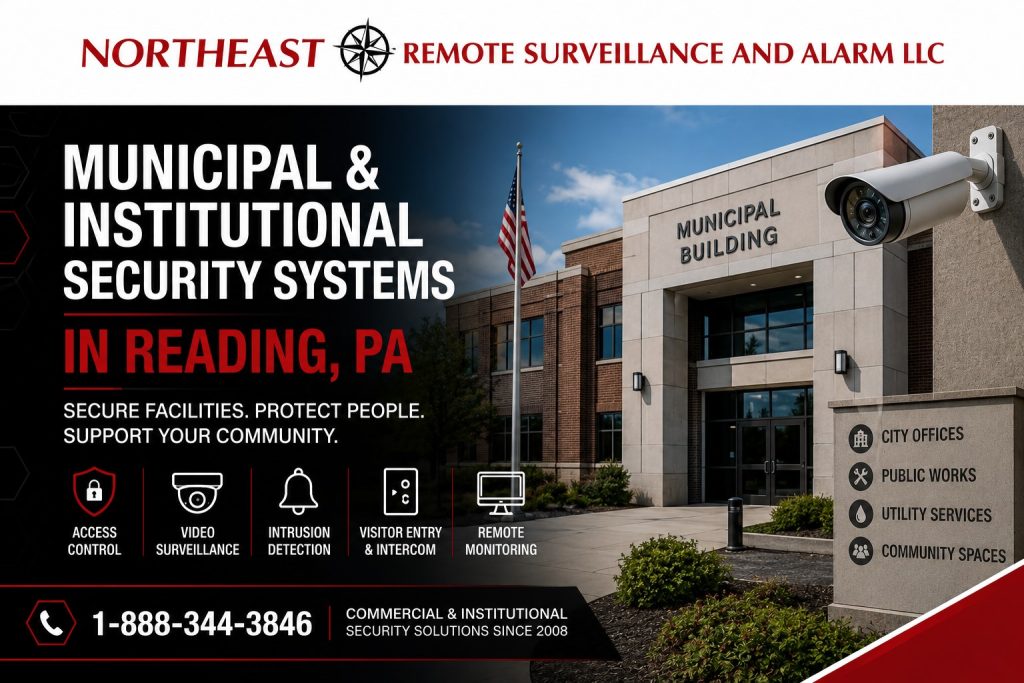
NERSA municipal and institutional security systems in Reading, PA, featuring access control, video surveillance, intrusion detection, visitor entry, and remote monitoring.

Security Designed Around Public-Service Operations

Municipal and institutional properties present a different security challenge from private commercial buildings.

Many facilities must remain accessible to residents, vendors, contractors, elected officials, employees, inspectors, delivery personnel, and other authorized visitors. At the same time, administrative offices, records rooms, information technology spaces, evidence or property areas, utility controls, vehicle yards, maintenance areas, and employee-only entrances may require tighter restrictions.

A properly planned system separates the public-facing portions of the property from controlled operational areas without making normal public service unnecessarily difficult.

NERSA evaluates how the facility operates, including:

  • Public entrances and reception areas
  • Service counters and waiting rooms
  • Employee entrances
  • Administrative offices
  • Meeting and hearing rooms
  • Records and document-storage areas
  • Information technology and communications rooms
  • Mechanical and electrical spaces
  • Public works garages and maintenance buildings
  • Utility and infrastructure locations
  • Fleet parking and vehicle yards
  • Parks and recreation support buildings
  • Detached buildings and storage facilities
  • Evening meetings and community activities
  • Contractor and vendor access
  • Emergency and after-hours operations

The system is then designed around the actual building, users, schedules, policies, existing equipment, and long-term operational requirements.

Municipal Buildings and Institutional Properties We Support

NERSA provides commercial-grade electronic security planning for a range of public and institutional facilities.

These may include:

  • City, borough, and township offices
  • Municipal administrative buildings
  • Public authority facilities
  • Public works departments
  • Water and wastewater support facilities
  • Municipal maintenance garages
  • Fleet and transportation yards
  • Libraries
  • Community and recreation centers
  • Public meeting facilities
  • Parks department buildings
  • Records and archive facilities
  • Courthouses and administrative legal facilities
  • Emergency-services support properties
  • Multi-building government campuses
  • Institutional administrative buildings
  • Public parking and service properties

Schools, healthcare facilities, correctional environments, police operations, and emergency-response facilities may have additional operational or regulatory requirements. Those projects should be evaluated according to their specific use rather than treated as ordinary municipal offices.

Public Entrances and Restricted Areas

One of the most important municipal security decisions is determining where unrestricted public movement should end.

A resident may need access to a lobby, service counter, public meeting room, permit office, library, or community area. That does not necessarily mean the person should be able to enter employee offices, records rooms, utility spaces, maintenance areas, or internal corridors.

NERSA can help define practical security boundaries using combinations of:

  • Public entrance routing
  • Reception-area camera coverage
  • Electronic access-controlled doors
  • Video or audio intercoms
  • Door-position monitoring
  • Visitor communication
  • Restricted elevator or stair access
  • Staff-only corridor controls
  • Scheduled door operation
  • Alarm and event notifications

The objective is not to turn a public building into an inaccessible facility. It is to provide understandable transitions between public, supervised, employee-only, and highly restricted areas.

Electronic Access Control for Municipal Facilities

Electronic access control allows authorized administrators to manage who may enter selected doors, buildings, gates, and restricted areas.

Credentials can be assigned according to the person’s role, department, work location, schedule, or temporary assignment. When an employee leaves, a credential can be disabled without rekeying every affected door.

Municipal access control may support:

  • Employee credential management
  • Department-based permissions
  • Time and day schedules
  • Public and employee entrance separation
  • Contractor and vendor credentials
  • Temporary access permissions
  • Door-held-open notifications
  • Door-forced-open notifications
  • After-hours access reporting
  • Restricted records-room access
  • Information technology room protection
  • Utility and mechanical-room control
  • Multi-building administration
  • Event-history review
  • Remote management where approved

Access control does not replace proper doors, frames, hinges, closers, locks, and other physical hardware. Each controlled opening must be evaluated as a complete assembly.

Electronic locking must also be coordinated with required egress, accessibility, fire alarm operation, emergency procedures, and the authority responsible for approving the project.

Video Surveillance for Public Buildings

Municipal video surveillance should be designed around defined operational objectives.

A camera at a public entrance may need to provide a clear view of an arriving person. A parking-lot camera may be intended to document vehicle movement. A camera at a service counter may need to show the general interaction without recording sensitive information displayed on a computer screen or document.

Potential camera locations include:

  • Public entrances
  • Employee entrances
  • Reception and waiting areas
  • Service counters
  • Public corridors
  • Meeting-room approaches
  • Exterior doors
  • Parking areas
  • Building approaches
  • Loading and delivery points
  • Vehicle yards
  • Maintenance garages
  • Fueling areas
  • Equipment storage locations
  • Utility compounds
  • Detached buildings
  • Gate entrances
  • Waste and recycling areas

Every camera should have a defined purpose. Camera quantity alone does not determine whether a system will produce useful results.

Mounting height, lighting, distance, lens selection, image detail, retention, network capacity, storage, user permissions, and the expected investigation need must be considered during design.

Usable Video for Incident Review

Recorded video is valuable only when authorized personnel can find, review, and export the correct event.

NERSA plans municipal video systems around practical administration, including:

  • Logical camera names
  • Building and location groups
  • Accurate date and time
  • Appropriate recording schedules
  • Storage-capacity planning
  • Retention requirements
  • User roles and permissions
  • Search and playback procedures
  • Secure video export
  • System-health notifications
  • Camera-offline alerts
  • Recorder and server capacity
  • Remote viewing policies
  • Administrator credential ownership

A system should not require municipal personnel to search through dozens of poorly labeled camera views to determine which camera covers a particular doorway or parking area.

Clear naming, system mapping, user training, and final documentation are essential parts of the installation.

Visitor Entry and Intercom Systems

Municipal buildings often need to communicate with visitors at locked doors, service entrances, gates, utility properties, or after-hours entrances.

A visitor-entry system can allow authorized staff to:

  • Receive a call from the entrance
  • Speak with the visitor
  • View the visitor where video is provided
  • Determine the purpose of the visit
  • Contact the appropriate department
  • Release an approved door remotely
  • Maintain the door as locked when entry is not authorized
  • Review associated video when necessary

Intercoms may be installed at primary entrances, delivery doors, employee entrances, vehicle gates, parking facilities, utility sites, or detached buildings.

Door release should be designed carefully. Staff should understand which door is being released, whether it has closed afterward, and what procedure applies when the answering employee cannot identify the visitor.

Intrusion Detection and After-Hours Protection

Municipal properties may contain valuable equipment, records, information systems, vehicles, tools, fuel, utility controls, and restricted materials.

A commercial intrusion alarm can protect the building or selected operational areas when they are unoccupied.

Depending on the facility, protection may include:

  • Exterior door contacts
  • Interior motion detection
  • Glass-break detection
  • Roof-hatch monitoring
  • Overhead-door protection
  • Records-room protection
  • Information technology room protection
  • Maintenance and storage-area detection
  • Separate building partitions
  • Equipment-cage protection
  • Gate or perimeter detection
  • Professional central-station monitoring
  • Opening and closing reports
  • Exception notifications
  • Video verification where appropriate

Municipal facilities often operate outside ordinary business hours. Public meetings, snow response, utility emergencies, maintenance work, elections, recreation programs, and other events may require one section of the property to remain active while other areas remain armed.

The alarm system should be partitioned and scheduled around those real operating conditions.

Panic and Duress Devices for Public-Facing Areas

Employees working with the public may encounter confrontational, threatening, or medically urgent situations.

Panic or duress devices can provide a discreet method of initiating an approved response from selected locations. Potential applications may include reception desks, payment counters, administrative offices, meeting areas, interview rooms, and isolated workstations.

A duress system must be supported by an established response procedure.

Planning should determine:

  • Where devices are appropriate
  • Whether activation is silent or audible
  • Who receives the signal
  • Whether the event is professionally monitored
  • What information is transmitted
  • Which cameras cover the area
  • How staff are trained
  • How devices are tested
  • How accidental activation is handled
  • How the event is documented

NERSA supplies and integrates the electronic portion of the solution. The municipality or institution remains responsible for developing its emergency procedures, employee training, and coordination with the appropriate responding authorities.

Security for Public Works and Municipal Garages

Public works properties frequently have different security needs from administrative buildings.

These sites may contain:

  • Municipal vehicles
  • Snow-removal equipment
  • Tools and machinery
  • Fuel storage
  • Road materials
  • Maintenance shops
  • Spare parts
  • Outdoor storage
  • Contractor access
  • Large overhead doors
  • Fenced yards
  • Remote buildings
  • Early-morning and overnight operations

Security planning may combine yard cameras, gate access, employee credentials, building alarms, overhead-door monitoring, equipment-area coverage, and remote video access.

Camera placement should consider large distances, nighttime lighting, weather, vehicle headlights, equipment movement, and areas that cannot be viewed from the main building.

Water, Wastewater, and Utility-Support Facilities

Utility and infrastructure facilities may contain pumps, controls, communications equipment, chemicals, mechanical systems, storage areas, and remote operational buildings.

The security system may need to control access to the perimeter, building, control room, electrical room, mechanical spaces, and other restricted areas.

Potential components include:

  • Gate access control
  • Perimeter cameras
  • Building access control
  • Intrusion detection
  • Door and hatch monitoring
  • Intercom communication
  • Remote system-health alerts
  • Cellular or network communication
  • Video verification
  • Multi-site administration
  • Secure equipment enclosures
  • Power and surge protection

Electronic security devices should be coordinated with the facility’s operational technology, information technology, safety, environmental, and emergency-response requirements.

NERSA does not alter process controls or utility operating systems unless that work is expressly included, engineered, and approved by the responsible project stakeholders.

Parking Lots, Vehicle Yards, and Gate Access

Municipal security extends beyond the walls of the building.

Public parking, employee parking, fleet areas, service drives, gated yards, and equipment compounds may require video coverage and controlled access.

Exterior planning may include:

  • Parking-lot overview cameras
  • Vehicle entrance cameras
  • Gate intercoms
  • Credential readers
  • Keypads
  • License-plate capture where appropriate
  • Building-approach coverage
  • Pedestrian-path cameras
  • Fence-line observation
  • Remote gate release
  • Gate-position monitoring
  • Low-light imaging
  • Fiber or wireless connectivity
  • Weather-resistant enclosures
  • Surge and power protection

License-plate recognition should be selected only when the location, camera angle, lighting, vehicle speed, and operational purpose support reliable capture. It should not be substituted for proper overview surveillance.

Multi-Building and Multi-Department Security Management

A municipality may operate an administrative building, public works facility, library, recreation center, utility property, maintenance garage, and other sites under separate systems.

When every building uses different software, credentials, naming conventions, and service procedures, administration becomes difficult.

A coordinated platform can help standardize:

  • Employee credentials
  • Department permissions
  • Door schedules
  • Camera naming
  • Alarm response
  • User roles
  • Video retention
  • System-health reporting
  • Incident-review procedures
  • Administrator access
  • Multi-site dashboards
  • Employee onboarding and termination

Compatible systems can also associate video with door activity, alarm events, visitor calls, or other security information.

Learn more about commercial and enterprise unified security systems.

Integration should solve an operational problem. Combining systems has little value when it creates unnecessary complexity or locks the organization into a platform that cannot be maintained effectively.

Existing Municipal Security System Upgrades

Many municipal and institutional facilities already have some combination of cameras, access control, alarms, intercoms, cabling, and monitoring.

The existing equipment may still have value even when the overall system is difficult to use.

NERSA can evaluate:

  • Existing IP and analog cameras
  • Video recorders and servers
  • Camera licenses
  • Access-control panels
  • Card readers and credentials
  • Electrified door hardware
  • Alarm panels and sensors
  • Intercom stations
  • Network switches
  • Fiber connections
  • Wireless bridges
  • Power supplies
  • Battery backup
  • Cellular communicators
  • Software versions
  • System documentation
  • Administrative passwords
  • Manufacturer support status

The assessment separates equipment that can reasonably remain from components that are failing, unsupported, insecure, poorly positioned, or unable to meet current requirements.

Phased Modernization and Budget Planning

A complete system replacement may not be practical within one budget cycle.

A phased municipal security project may begin with:

  1. Critical public and employee entrances
  2. Failing recording equipment
  3. Unsupported access-control panels
  4. High-priority restricted rooms
  5. Public-facing employee work areas
  6. Parking lots and exterior approaches
  7. Public works or utility properties
  8. Centralized multi-building management
  9. Remaining cameras, doors, and alarm zones
  10. Long-term maintenance and lifecycle planning

The first phase should create a usable foundation for later expansion. Equipment should not be selected solely because it is inexpensive if it cannot support the municipality’s expected growth, retention, integration, cybersecurity, or service requirements.

Security Network and Cybersecurity Coordination

Modern cameras, access-control controllers, intercoms, recorders, servers, and management platforms frequently operate on an IP network.

Physical-security technology should therefore be coordinated with the organization’s information technology policies.

Planning may address:

  • Dedicated security network segments
  • Managed network switches
  • Secure remote access
  • Strong administrator credentials
  • Multi-factor authentication where supported
  • Role-based permissions
  • Firmware and software maintenance
  • Removal of default passwords
  • Device and address documentation
  • Accurate time synchronization
  • Backup and recovery procedures
  • Vendor-access controls
  • Encryption where supported
  • Logging and account review
  • Ownership of system credentials

The municipality should retain control of its administrator accounts, configuration records, software licensing, credential database, and final system documentation.

NERSA works with the client’s information technology personnel to define network responsibilities before devices are connected.

Privacy, Retention, and Authorized System Use

Municipal and institutional video systems may record employees, visitors, public meetings, vehicles, and activity around public facilities.

Technology should be supported by clear policies covering:

  • Who may view live video
  • Who may review recorded video
  • Who may export footage
  • How long video is retained
  • How exported evidence is secured
  • How access-control records are used
  • How administrator activity is reviewed
  • How public-record requests are handled
  • Which areas should not be recorded
  • Whether audio recording is permitted
  • How passwords and credentials are protected

NERSA can configure the system according to the approved technical requirements, but the municipality or institution should establish its legal, privacy, labor, records-retention, and disclosure policies with its own authorized advisers.

Procurement and Project Documentation

Municipal security projects may involve purchasing personnel, administrators, facilities staff, information technology departments, engineers, architects, door-hardware contractors, general contractors, and public officials.

A usable scope of work should clearly identify:

  • Included buildings and areas
  • Camera purposes and locations
  • Controlled doors and gates
  • Credential requirements
  • Alarm zones
  • Intercom stations
  • Recording and retention expectations
  • Network responsibilities
  • Cabling pathways
  • Existing equipment to remain
  • Equipment proposed for replacement
  • Alternates and future phases
  • Training requirements
  • Warranty responsibilities
  • Closeout documentation
  • Testing and acceptance procedures

NERSA can provide defined project scopes, equipment schedules, system descriptions, alternates, training, and closeout information appropriate to the project.

We do not claim participation in a purchasing program, cooperative contract, or manufacturer authorization unless it has been confirmed for the specific proposal.

System Testing, Training, and Turnover

A municipal security installation is not complete simply because the devices have been mounted.

Project turnover should verify that:

  • Cameras produce the intended views
  • Doors lock and release correctly
  • Door-status signals are accurate
  • Credentials follow approved permissions
  • Alarm zones report correctly
  • Intercom calls reach the intended staff
  • Monitoring signals are received
  • Dates and times are synchronized
  • Authorized users can locate video
  • Administrators can add and remove users
  • System-health alerts are configured
  • Required documentation is delivered

NERSA provides practical training based on the responsibilities of the people using the system.

A front-desk employee may need visitor-entry and camera-review training. A facilities administrator may need door, credential, and alarm-management training. Information technology personnel may need network and administrator documentation.

Municipal Security Assessment Process

A municipal or institutional security project should begin with the facility—not a generic equipment package.

NERSA’s planning process may include:

  1. Discussing the organization’s concerns and project objectives
  2. Reviewing public, employee, contractor, and vehicle movement
  3. Identifying public, supervised, restricted, and critical areas
  4. Reviewing normal, evening, emergency, and seasonal schedules
  5. Examining doors, gates, windows, parking areas, and exterior approaches
  6. Assessing existing cameras, access control, alarms, intercoms, and cabling
  7. Coordinating with facilities, administration, purchasing, and information technology
  8. Identifying immediate deficiencies and long-term priorities
  9. Developing a practical project scope
  10. Establishing testing, training, and documentation requirements

The result is a security plan designed around the property’s real operations and available resources.

Why Municipal and Institutional Clients Choose NERSA

Northeast Remote Surveillance and Alarm, LLC focuses on commercial, industrial, municipal, institutional, and other nonresidential systems.

Our capabilities include:

  • Commercial video surveillance
  • Electronic access control
  • Intrusion detection
  • Panic and duress devices
  • Visitor-entry intercoms
  • Gate access
  • Remote monitoring
  • Unified security integration
  • Structured cabling and fiber
  • Network coordination
  • Existing-system upgrades
  • Phased modernization
  • Multi-building administration
  • Long-term system support

NERSA supports projects ranging from a smaller municipal office or community facility to a multi-building authority, institutional campus, public works operation, or enterprise-scale public organization.

Reading and Berks County Service Area

NERSA provides municipal and institutional security services throughout Reading and nearby Berks County communities, including West Reading, Wyomissing, Shillington, Sinking Spring, Muhlenberg Township, Exeter Township, Fleetwood, Kutztown, Hamburg, Birdsboro, and surrounding areas.

Project availability depends on the facility, scope, equipment requirements, procurement process, schedule, and required service response.

Frequently Asked Questions

What municipal security systems does NERSA install in Reading?

NERSA installs commercial video surveillance, electronic access control, intrusion alarms, panic and duress devices, visitor intercoms, gate-access systems, remote monitoring, structured cabling, and compatible unified security platforms.

Do you provide residential security systems?

No. NERSA focuses on commercial, industrial, municipal, institutional, government, and other nonresidential properties.

Can a municipal building remain open to the public while internal areas are restricted?

Yes. The system can separate public entrances, service counters, meeting rooms, employee areas, administrative offices, records rooms, and other restricted spaces using controlled doors, intercoms, cameras, and operating procedures.

Can NERSA upgrade cameras installed by another company?

Often, yes. NERSA must evaluate the cameras, recorder, software, licenses, network, passwords, cabling, storage, and manufacturer support before determining which components can remain.

Can access control manage several municipal buildings?

Yes. Compatible systems can manage credentials, permissions, schedules, door events, and administrative users across multiple buildings from a centralized platform.

Can different departments have different access permissions?

Yes. Credentials can be assigned according to department, role, building, door, schedule, or temporary assignment.

Can the system provide panic or duress notification?

Yes. Panic and duress devices can be installed in approved public-facing or employee areas. The devices should be supported by documented response, testing, training, and monitoring procedures.

Can cameras and access control be integrated?

Compatible platforms can associate a door event with nearby video, helping authorized personnel review credential activity, forced-door events, and held-open conditions.

Can a municipal security project be completed in phases?

Yes. The project can prioritize critical entrances, failing equipment, restricted areas, public-facing workspaces, parking areas, or high-risk facilities before expanding to additional buildings.

Does NERSA work with municipal information technology departments?

Yes. NERSA can coordinate network addressing, switch requirements, security-network segmentation, remote-access rules, administrator credentials, time synchronization, and system documentation with authorized information technology personnel.

Do you secure public works and utility properties?

Yes. NERSA can design security systems for public works garages, fleet yards, maintenance buildings, storage properties, utility-support facilities, gated compounds, and remote operational buildings.

Do you support both smaller municipalities and larger institutions?

Yes. Systems can be designed for a small borough office, individual authority building, community facility, multi-building municipal operation, or enterprise-scale institutional environment.

Schedule a Municipal Security Assessment in Reading, PA

Municipal and institutional security systems should provide clearer access control, usable video, dependable after-hours protection, better incident documentation, and a practical path for future improvements.

Northeast Remote Surveillance and Alarm, LLC can evaluate your public entrances, restricted areas, cameras, doors, alarms, intercoms, parking areas, vehicle yards, network infrastructure, and existing equipment before recommending a solution.

Request a municipal or institutional security assessment or call 1-888-344-3846.

Scroll to Top
1-888-344-3846