Commercial Security Planning by Property Type, Operating Model and Operational Need
Northeast Remote Surveillance and Alarm, LLC designs, installs, integrates, monitors, upgrades, and supports commercial security and life-safety systems for businesses, industrial facilities, institutions, municipalities, healthcare organizations, schools, warehouses, manufacturers, logistics operations, commercial properties, and multi-location organizations.
Every property operates differently.
A manufacturing plant with production equipment, multiple shifts, controlled processes, loading docks, raw materials, finished goods, and contractor activity has different security requirements than a medical office, corporate workplace, restaurant, truck yard, school, industrial park, retail store, or municipal building.
NERSA plans around the property’s actual operation, including:
- Employees, visitors, vendors, drivers, and contractors
- Public entrances, employee entrances, and delivery doors
- Controlled doors, restricted rooms, and shared spaces
- Loading docks, parking lots, gates, and exterior approaches
- Trucks, trailers, fleets, equipment, inventory, and deliveries
- Operating hours, shift changes, and after-hours activity
- Camera views, image quality, recording, and retention
- Access permissions and system administration
- Intrusion detection and alarm-response procedures
- Fire alarm and life-safety coordination
- Monitoring and communication paths
- Cabling, fiber, networks, power, and low-voltage infrastructure
- Existing equipment, documentation, serviceability, and expansion
The objective is not to install a collection of disconnected cameras, alarms, readers, intercoms, and monitoring accounts. It is to create a dependable security environment that improves visibility, controls access, documents important activity, supports an appropriate response, and remains manageable after installation.
Use this page to find security planning based on:
- The type of property you operate
- The people, vehicles, and materials moving through it
- The areas creating the greatest exposure
- Whether the organization has one facility or multiple locations
- Whether the project involves a new installation or an existing system
For planning organized by security system, visit Commercial and Industrial Security Services.
For planning organized by state, region, corridor, or city, visit NERSA Service Areas.
Request a Commercial Security Assessment or call 1-888-344-3846.
Commercial and industrial properties only • Small business through enterprise • New installations • Upgrades • Retrofits • Takeovers • Monitoring
NERSA’s live companywide resources confirm its commercial-only positioning, broad system capabilities, assessment process, and Pennsylvania-centered service structure.
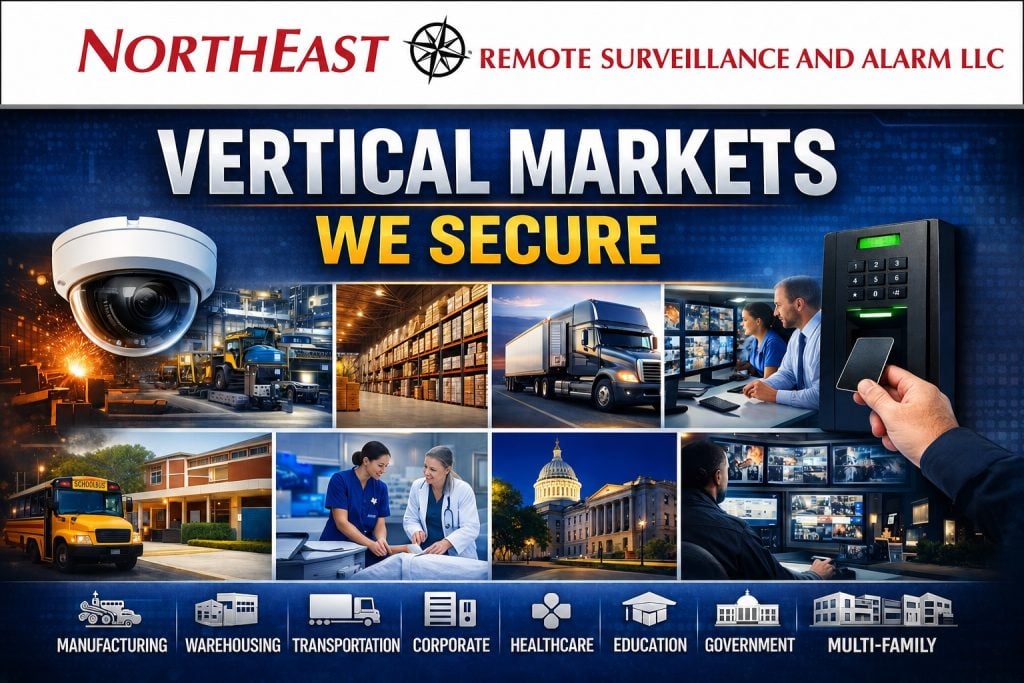
Industrial, Manufacturing, Warehouse and Logistics Properties
Manufacturing and Industrial Facilities
Manufacturing and industrial facilities must protect employees, contractors, production areas, equipment, tools, materials, utilities, restricted processes, shipping operations, and exterior property without unnecessarily disrupting production.
Planning may address:
- Employee and contractor entrances
- Production-floor visibility
- Tool rooms and maintenance areas
- Raw-material and finished-goods storage
- Laboratories and controlled production spaces
- Shipping and receiving
- Loading docks and overhead doors
- Exterior yards and parking areas
- Multiple shifts and after-hours activity
- Industrial cabling, fiber, networks, and power
- Integration with alarms, access control, monitoring, and life-safety systems
A manufacturing security system may combine video surveillance, access control, intrusion detection, professional monitoring, perimeter protection, loading-dock coverage, fire alarm coordination, and industrial network infrastructure.
Explore Manufacturing Plant Security Systems for plant-specific planning.
Warehouses, Distribution Centers and Logistics Facilities
Warehouses and logistics properties involve continuous movement among employees, drivers, vendors, contractors, forklifts, freight, trucks, trailers, and delivery vehicles.
Security planning may focus on:
- Loading docks
- Shipping and receiving areas
- Truck entrances and exit lanes
- Trailer yards and drop lots
- Employee and driver entry
- Office-to-warehouse transitions
- Inventory and restricted storage
- Overhead doors
- Vehicle gates
- Exterior yards and perimeter areas
- After-hours monitoring
- Cargo and shipment accountability
A properly planned system should help management understand what occurred at a dock, gate, employee entrance, trailer row, warehouse aisle, shipping office, or exterior approach without relying on several disconnected platforms.
Explore Warehouse and Logistics Security Systems for broader warehouse, distribution, freight, dock, yard, and logistics planning.
Food Processing, Cold Storage and Temperature-Controlled Facilities
Food processing and cold-storage facilities may combine manufacturing, warehousing, logistics, employee access, vendor activity, restricted operations, refrigeration, shipping, receiving, and environmental concerns within one property.
Planning may address:
- Employee and contractor entrances
- Production-support spaces
- Ingredient and material storage
- Refrigerated and controlled areas
- Finished-product storage
- Shipping and receiving
- Loading docks
- Vendor and delivery activity
- Restricted rooms
- Environmental alarm coordination
- After-hours access
- Backup communication paths
Electronic security does not replace food-safety procedures, inspections, temperature-control programs, audits, or regulatory responsibilities. It can support controlled access, incident documentation, operational accountability, and review of activity around production, storage, and distribution areas.
Until NERSA publishes a dedicated companywide food-processing and cold-storage resource, production facilities should begin with Manufacturing Plant Security Systems, while refrigerated distribution properties should begin with Warehouse and Logistics Security Systems.
Industrial Parks, Business Parks and Multi-Building Properties
Industrial parks, flex-industrial developments, commercial campuses, and multi-building properties create security concerns beyond one building or tenant.
These properties may include:
- Shared roads and vehicle entrances
- Common parking areas
- Multiple loading zones
- Exterior storage
- Vehicle gates
- Utility and maintenance areas
- Vacant suites or buildings
- Detached structures
- Tenants with different schedules and permissions
- Shared infrastructure and private tenant systems
Security planning should define which systems and areas are controlled by property management and which remain under individual tenant control.
A coordinated design may include property-wide video surveillance, shared gate management, tenant-specific credentials, common-area monitoring, license plate recognition, building-to-building connectivity, multi-building alarm reporting, and centralized administration.
Explore Industrial Park Security Systems for facility-wide planning.
Use the Industrial Park Security Systems Directory to locate industrial parks, logistics corridors, business parks, and regional planning resources.
Offices, Healthcare, Education and Public Facilities
Corporate Offices and Multi-Tenant Buildings
Office security should protect employees, visitors, tenants, records, technology, parking areas, and restricted rooms without making the workplace unnecessarily difficult to use.
Planning may include:
- Controlled employee entrances
- Visitor communication and video intercoms
- Lobby and common-area cameras
- Tenant suite access
- Server-room and records-room protection
- Parking-lot surveillance
- After-hours intrusion detection
- Temporary contractor credentials
- Panic or duress protection
- Centralized or cloud-managed administration
Multi-tenant systems should clearly separate property-management authority, common-area control, and tenant-level permissions.
Explore Office Building Security Systems for Commercial Properties for corporate offices, professional workplaces, commercial suites, administrative buildings, and multi-tenant properties.
Healthcare and Medical Facilities
Healthcare properties combine public access, patient movement, staff-only areas, administrative offices, records, medication or supply rooms, laboratories, parking areas, and privacy-sensitive conditions.
Security planning may include:
- Controlled staff entrances
- Separation between public and employee areas
- Restricted-room access
- Records and administrative-area protection
- Visitor communication
- Panic and duress devices
- Privacy-aware camera placement
- Parking-lot and exterior-door surveillance
- After-hours intrusion protection
- Multi-location user administration
Camera placement should support legitimate security and incident review without creating inappropriate views into treatment rooms, restrooms, changing spaces, or other privacy-sensitive areas.
Explore Healthcare Security Systems for Medical Environments for medical offices, clinics, urgent-care facilities, outpatient properties, healthcare administrative sites, and related medical environments.
Schools and Educational Facilities
Schools, training centers, private educational facilities, administrative buildings, and campuses require careful planning around students, staff, visitors, exterior doors, parking areas, after-hours events, and emergency procedures.
Planning may include:
- Controlled primary entrances
- Staff credentials
- Visitor communication and intercoms
- Exterior-door monitoring
- Corridor and common-area visibility
- Parking-lot coverage
- Intrusion alarms
- Panic or emergency notification
- Paging and emergency communication
- After-hours building schedules
- Coordination with emergency plans and approved procedures
School security should support normal daily activity and emergency planning without interfering with accessibility, required egress, approved life-safety functions, or ordinary student and staff movement.
Review Weapons Detection and School Security Technology Solutions for one focused layer of educational-facility planning. A dedicated companywide school and educational-facility page should be added to provide the complete entrance, access-control, video, alarm, communication, parking, and emergency-planning structure.
Municipal, Government and Institutional Properties
Municipal and institutional properties often combine public access with employee-only departments, service counters, meeting rooms, administrative offices, records areas, parking lots, public works operations, and after-hours building use.
Planning may involve:
- Public entrance cameras
- Employee access control
- Visitor communication
- Service-counter visibility
- Records-room protection
- Panic and duress devices
- Department-specific permissions
- Parking-area surveillance
- Public works and equipment-yard coverage
- After-hours intrusion alarms
- Access to council, meeting, courtroom, or administrative spaces
- Separation of public areas from controlled departments
A municipal security system should support legitimate public access while protecting employees, records, equipment, controlled departments, and essential operations.
Until a companywide municipal and institutional resource is published, use NERSA Service Areas to locate the most appropriate regional or city resource. Current search visibility shows local municipal pages, supporting the need for one clearly established companywide destination above them.
Small Businesses and Customer-Facing Commercial Properties
Commercial-Grade Security for Small and Growing Businesses
Small businesses need professional security without being pushed into a residential package or an unnecessarily complex enterprise platform.
A smaller commercial property may begin with:
- Several properly positioned cameras
- A professionally monitored intrusion alarm
- One controlled employee entrance
- A video intercom
- Panic or duress protection
- Focused parking-area coverage
- Fire alarm monitoring or communication upgrades
- Infrastructure that allows future expansion
A modest initial project should still be planned around suitable equipment, user permissions, recording capacity, controller capacity, communication paths, documentation, and long-term support.
Explore Small Business Security Systems for the complete small-commercial structure.
Retail Stores
Retail security may involve entrances, checkout areas, customer incidents, stockrooms, receiving doors, employee access, parking areas, remote viewing, video export, intrusion detection, and panic protection.
The objective is to support customer and employee safety, incident review, inventory accountability, and after-hours protection without unnecessarily interfering with the shopping experience.
Explore Retail Store Security Systems.
Restaurants and Food-Service Businesses
Restaurants must account for customer entrances, dining areas, counters, payment locations, kitchens, employee doors, deliveries, storage, offices, parking, and closing procedures.
Planning may combine video surveillance, intrusion detection, panic protection, employee access, fire and life-safety coordination, and secure remote viewing.
Explore Restaurant Security Systems.
Professional Offices and Practices
Professional offices may require controlled staff entrances, visitor communication, lobby cameras, records-room protection, server-room access, after-hours alarms, panic protection, and parking-lot visibility.
A smaller office does not need the same administration structure as a corporate campus, but it should still use commercial-grade systems that can be documented, maintained, and expanded.
Explore Office Security Systems.
Dental Offices and Smaller Medical Practices
Dental and medical practices combine public reception areas with treatment spaces, records, administrative offices, equipment, supplies, staff entrances, and privacy-sensitive conditions.
Security planning should distinguish legitimate security coverage from spaces where cameras would be inappropriate.
Explore Dental Office Security Systems for dental-specific planning and Healthcare Security Systems for Medical Environments for broader medical-facility planning.
Contractor Shops and Service Businesses
Contractor shops and trade businesses may need to protect offices, employee entrances, tools, materials, equipment, service vehicles, parts, storage rooms, and adjacent exterior areas.
A project may begin with building cameras and an intrusion alarm, then expand into controlled entrances, fleet coverage, yard cameras, gate management, or remote monitoring.
Explore Contractor Shop Security Systems.
Hospitality and Other Customer-Facing Businesses
Hotels, gyms, salons, entertainment properties, and other customer-facing businesses may have public entrances, employee-only areas, payment locations, offices, parking exposure, service doors, deliveries, and after-hours risks.
These businesses should begin with Small Business Security Systems when the operation is locally managed or limited to a small number of properties.
Organizations operating several customer-facing locations should use Multi-Site Commercial Security Systems.
Exterior, Vehicle, Freight and High-Risk Operational Areas
Some security needs are defined less by the organization’s industry and more by a particular part of the property. These cross-industry resources help facilities address exterior areas, vehicle movement, freight, equipment, gates, docks, and remote locations.
Contractor Yards, Fleet Properties and Equipment Sites
Contractor yards, service-fleet lots, equipment properties, construction staging areas, and outdoor storage sites may contain valuable vehicles, tools, trailers, machinery, fuel, materials, and inventory across large exterior spaces.
Planning may involve:
- Perimeter cameras
- Gate access control
- Vehicle-entry documentation
- License plate recognition
- Equipment and material coverage
- Trailer monitoring
- Fence-line visibility
- Exterior intrusion detection
- Remote video monitoring
- Live audio warnings
- Wireless, solar, or cellular infrastructure
The design must account for lighting, weather, distance, fencing, vehicle movement, available power, internet connectivity, changing storage patterns, and after-hours exposure.
Until a companywide contractor-yard and fleet page is established, use Contractor Shop Security Systems, Truck Yard Security Systems, and Parking Lot Security Cameras based on the property’s primary operation.
Truck Yards, Trailer Lots and Freight Terminals
Truck yards, trailer compounds, fleet facilities, freight terminals, and vehicle-staging properties require security around yard entrances, truck courts, trailer rows, fence lines, parking areas, gates, offices, and after-hours vehicle movement.
A truck-yard security system may combine:
- Yard and trailer cameras
- Gate access control
- License plate recognition
- Perimeter monitoring
- Video intercoms
- Intrusion detection
- Remote viewing
- Active monitored-video response
The system should help operators determine who entered, which vehicle or trailer moved, when activity occurred, and what video, access, or alarm record is available afterward.
Explore Truck Yard Security Systems.
For camera-focused coverage of staged trailers and vehicle parking, review Trailer Yard and Truck Parking Lot Security Cameras.
Loading Docks, Shipping and Receiving Areas
Loading docks bring employees, drivers, vendors, freight, overhead doors, trailers, forklifts, paperwork, and vehicle movement together in a limited area.
Planning may address:
- Dock-door identification
- Trailer arrival and departure
- Driver interaction
- Shipping-office entrances
- Freight movement
- Overhead-door status
- Employee access
- Interior-to-exterior transitions
- Image quality for shipment review
- After-hours dock activity
Explore Loading Dock Security Systems for dock cameras, controlled entry, alarms, shipment documentation, and monitoring.
Cargo Theft and Shipment Accountability
Cargo-theft planning may involve inventory areas, outbound staging, loading docks, trailer rows, truck entrances, vehicle identification, access permissions, alarm response, and documented handling procedures.
Technology alone cannot prevent every loss. A coordinated system can improve visibility, access accountability, incident review, gate records, shipment verification, and response to unusual activity.
Explore Cargo Theft Prevention Systems.
Parking Lots and Exterior Approaches
Parking areas are often the first and last parts of a property used by employees, customers, visitors, contractors, and delivery personnel.
Exterior planning may address:
- Vehicle movement
- Pedestrian routes
- Employee parking
- Visitor parking
- Building approaches
- Accessible entrances
- Exterior doors
- Lighting conditions
- Camera identification requirements
- Video retention
- After-hours monitoring
Explore Parking Lot Security Cameras for commercial and industrial exterior-surveillance planning.
Gates, Vehicle Entry and License Plate Documentation
Vehicle entrances may require more than a camera aimed toward the driveway.
Planning may include:
- Gate operators and safety devices
- Vehicle credentials
- Visitor communication
- Delivery access
- Intercoms
- Access-control schedules
- License plate capture
- Overview video
- Gate-position monitoring
- Emergency access
- Manual operating procedures
- Network and communication paths
Explore Commercial Gate Access Control Systems for controlled vehicle entry.
Review License Plate Recognition Camera Systems when the property needs reliable plate documentation under actual entry-lane conditions.
Remote, Temporary and Infrastructure-Limited Locations
Some properties require surveillance where permanent power, reliable internet, conduit, or direct cabling is unavailable, delayed, unreliable, or economically impractical.
These locations may include:
- Remote storage areas
- Construction staging sites
- Detached yards
- Temporary entrances
- Expansion areas
- Utility locations
- Unoccupied buildings
- Equipment sites
- Distant property boundaries
Explore Solar-Powered and Cellular Video Surveillance for locations where conventional infrastructure is limited.
For active review and response to after-hours activity, explore Remote Video Monitoring and Live Talk-Down.
Security Planning by Business Size and Operating Model
Small and Growing Businesses
Small organizations may need only a focused initial system, but that system should still be planned for appropriate administration, monitoring, documentation, service, and future expansion.
Explore Small Business Security Systems.
Multi-Site and Enterprise Organizations
Organizations operating multiple branches, offices, warehouses, clinics, yards, campuses, or regional facilities need consistency without forcing every location into an identical physical design.
Multi-site planning may include:
- Centralized video access
- Shared credentials
- Location-specific permissions
- Regional and local administrators
- Standard intrusion-alarm procedures
- Common monitoring instructions
- Consistent device naming
- System-health reporting
- Network and cybersecurity standards
- Coordinated documentation and service
Centralized administration should not provide every user with unrestricted access. Permissions should reflect each person’s role, assigned facility, department, region, and operational responsibility.
Explore Multi-Site Commercial Security Systems for enterprise and multi-location planning.
Property Managers and Multi-Tenant Buildings
Property managers may control shared entrances, parking lots, lobbies, common areas, gates, and base-building systems while individual tenants manage their own suites, credentials, alarms, or internal cameras.
Planning should establish:
- Property-management authority
- Tenant-level permissions
- Shared versus private equipment
- Credential responsibilities
- Video-access boundaries
- Move-in and move-out procedures
- Common-area monitoring
- Service and documentation responsibilities
Use Office Building Security Systems for Commercial Properties for office and commercial-suite environments.
Use Industrial Park Security Systems for industrial, flex, warehouse, and multi-building environments.
Commercial Campuses and Multi-Building Operations
A campus may contain several buildings on one connected property, while a multi-site organization may operate facilities across several cities or states.
Campus planning may emphasize:
- Shared roads and parking
- Common entrances
- Building-to-building connectivity
- Centralized monitoring
- Local building permissions
- Shared gates
- Site-wide video
- Multi-building alarm reporting
Use Industrial Park Security Systems when the buildings share one physical property.
Use Multi-Site Commercial Security Systems when the organization manages geographically separate locations.
Choose the Correct NERSA Planning Resource
This page is organized around industries, facility types, operating models, and property risks. Use the following resources when the main question concerns a different part of the project.
Planning by Security System
Use Commercial and Industrial Security Services when the primary need is:
- Video surveillance
- Access control
- Intrusion detection
- Fire alarm and life-safety systems
- Professional monitoring
- Remote video monitoring
- Intercoms and controlled entry
- Gates and vehicle security
- Low-voltage infrastructure
- Unified system integration
Planning by Location
Use NERSA Service Areas to find the correct Pennsylvania, regional, corridor, county, or city resource.
For broader companywide coverage, visit Commercial and Industrial Security Systems in Pennsylvania and the Mid-Atlantic.
Managed Security Systems & Security System Health Monitoring
For centralized oversight, proactive maintenance, and ongoing performance support across your commercial security technologies, explore our Managed Security Systems and System Health Monitoring services.
Existing Systems, Upgrades and Provider Changes
Use Commercial Security System Upgrades, Retrofits and Takeovers when the facility has:
- Aging cameras or recording equipment
- Unsupported access-control hardware
- Former employees with active credentials
- Outdated alarm communication
- Unreliable remote access
- Damaged door hardware
- Failing cabling or network equipment
- Missing administrator credentials
- Incomplete documentation
- Several disconnected systems
This resource should own modernization, equipment reuse, phased replacement, service-provider changes, and upgrade-versus-replacement planning.
Codes, Standards and Compliance-Aware Planning
Use Regulatory and Compliance for Commercial Security, Fire Alarm and Life Safety when the project may interact with:
- Emergency egress
- Accessibility
- Fire alarm operation
- Electrified door hardware
- Fire-rated openings
- Workplace safety
- Low-voltage wiring
- Equipment sourcing
- Privacy
- Cybersecurity
- Documentation
- Inspection-sensitive conditions
Security equipment does not make a property compliant by itself. Requirements may involve the property owner, security integrator, fire alarm professionals, door-hardware specialists, information-technology personnel, design professionals, inspectors, authorities having jurisdiction, and other responsible parties.
Research, Comparisons and Buyer Education
Use the Commercial and Industrial Security Knowledge Center for educational resources, technology comparisons, planning guides, system selection, maintenance considerations, and common buyer questions.
The Knowledge Center should own informational and comparison-based searches rather than allowing those topics to expand this page into a general article library.
Industrial Parks and Logistics Corridors
Use the Industrial Park Security Systems Directory for industrial-park, business-park, logistics-corridor, and regional property resources.
The directory should own location-based industrial-park discovery, while this page explains industrial parks as a facility type.
Completed Projects and Real-World Applications
Review Commercial and Industrial Security Case Studies for examples involving cameras, access control, industrial properties, parking areas, warehouses, offices, upgrades, and multi-site standardization.
Visit NERSA Installation Videos and Field Demonstrations for field demonstrations and installation-focused material.
Project Expectations, Documentation and Accountability
Review Commercial Security Trust and Project Standards for NERSA’s approach to planning, scope definition, documentation, workmanship, turnover, customer responsibilities, system administration, and long-term support.
New Installations, Existing Systems and Phased Projects
Not every project starts with an empty building, and not every older system requires complete replacement in one phase.
NERSA can help evaluate:
- What equipment is currently installed
- Whether existing components remain supportable
- What can be reused
- What requires repair
- What presents a reliability or security concern
- Whether documentation and administrator credentials are available
- Which improvements should be completed first
- Whether the project can be divided into manageable phases
- How future expansion should be supported
A focused project may involve one entrance, several cameras, an alarm communicator, a gate, or a specific exterior area. A larger project may involve an entire facility, campus, portfolio, or phased regional standardization program.
Use the Security Assessment Process to understand how NERSA reviews a project.
Use the Physical Plant Security Assessment when the review must address the broader facility, infrastructure, life-safety coordination, and operating environment.
Request a Commercial Security Assessment when the organization is ready to discuss the property and establish the next step.
Why Commercial Organizations Choose NERSA
Since 2008, Northeast Remote Surveillance and Alarm, LLC has focused on security and life-safety systems for non-residential properties.
NERSA plans around:
- The facility and its actual operation
- Employees, visitors, vendors, drivers, and contractors
- Entrances, doors, docks, gates, and restricted spaces
- Vehicle, delivery, and freight movement
- Camera visibility and evidence requirements
- Access permissions and user administration
- Alarm detection and response
- Monitoring procedures
- Fire alarm and life-safety coordination
- Network and low-voltage infrastructure
- Existing equipment and system condition
- Documentation and serviceability
- Future growth and expansion
NERSA does not install residential alarm packages.
The objective is not to sell every organization the same equipment package. It is to provide a dependable, scalable, manageable, and supportable system designed around the property’s actual operation.
Learn more through About Northeast Remote Surveillance and Alarm, LLC.
Request an Industry-Specific Commercial Security Assessment
A commercial security assessment may review:
- Facility use and operating schedules
- Employees, visitors, vendors, drivers, and contractors
- Entrances, doors, docks, gates, and restricted spaces
- Parking areas and vehicle movement
- Existing cameras and recording systems
- Access-control equipment and permissions
- Intrusion-alarm devices and communication paths
- Fire alarm and life-safety coordination
- Monitoring and response procedures
- Cabling, switching, fiber, and network infrastructure
- Equipment condition
- Available documentation
- Upgrade priorities
- Future expansion
NERSA can help determine which industry, facility, security-system, upgrade, compliance, assessment, and geographic resources apply to the property.
Request a Commercial Security Assessment or call 1-888-344-3846.
Commercial and industrial systems only • New installations • Upgrades • Retrofits • Takeovers • Monitoring • Small business through enterprise
Frequently Asked Questions About the Industries and Facilities NERSA Serves
What industries does Northeast Remote Surveillance and Alarm, LLC serve?
NERSA supports manufacturing plants, warehouses, distribution centers, logistics facilities, industrial parks, offices, healthcare properties, schools, municipal and institutional buildings, retail stores, restaurants, contractor properties, truck yards, commercial campuses, multi-tenant properties, small businesses, and multi-site organizations.
Does NERSA install residential security systems?
No. Northeast Remote Surveillance and Alarm, LLC focuses on commercial, industrial, institutional, municipal, healthcare, educational, warehouse, manufacturing, logistics, office, contractor, exterior-site, and multi-location properties.
Should I begin with an industry page or a security-service page?
Begin with an industry or facility page when the primary question is how security should be planned for a particular type of property.
Begin with Commercial and Industrial Security Services when the primary need is a specific system such as video surveillance, access control, intrusion detection, fire alarm, monitoring, intercoms, gates, or infrastructure.
Can NERSA support both small businesses and large enterprises?
Yes. A smaller commercial property may begin with several cameras, a monitored alarm, one controlled entrance, an intercom, panic protection, or another focused requirement.
Large facilities and multi-site organizations may require centralized administration, shared credentials, location-specific permissions, coordinated monitoring, standardized documentation, system-health reporting, and regional support.
What if my exact industry is not listed?
Begin with the facility type or operating condition that most closely matches the property.
For example, a temperature-controlled distribution operation may begin with warehouse and logistics planning, while a production-oriented food facility may begin with manufacturing planning. NERSA can identify the most applicable resources during the assessment process.
Can NERSA upgrade or take over an existing security system?
Yes. NERSA can assess cameras, recording systems, access control, intrusion alarms, monitoring paths, networks, cabling, credentials, door hardware, and available documentation.
The assessment can help determine what should be retained, repaired, reprogrammed, integrated, upgraded, or replaced.
Can video surveillance, access control, alarms, intercoms, and monitoring work together?
Yes, when compatible systems and project requirements support integration.
A coordinated system may associate door activity, alarm events, camera views, gate records, visitor communication, monitoring procedures, and incident documentation within a more manageable environment.
Can one property belong to more than one category?
Yes. A food-distribution operation may involve food processing, cold storage, warehousing, loading docks, truck yards, and multi-site administration.
The property’s primary operation should determine the main planning path, while supporting resources address specific areas and risks.
Does NERSA work with multi-tenant and multi-building properties?
Yes. These properties require clear separation of common-area control, property-management authority, tenant permissions, shared infrastructure, private systems, and service responsibilities.
What areas does NERSA serve?
NERSA primarily serves commercial and industrial properties throughout Pennsylvania and supports selected projects in surrounding Mid-Atlantic markets.
Visit NERSA Service Areas for the complete geographic structure.
How should an organization begin a commercial security project?
Begin with a commercial security assessment.
Call 1-888-344-3846 or request an assessment to discuss the property, existing systems, operating conditions, known concerns, infrastructure, project requirements, and future plans.