Commercial and Industrial Security Systems for Production Plants, Fabrication Facilities, Processing Buildings, Industrial Sites, and Manufacturing Operations
Manufacturing facility security systems should be designed around production flow, employee access, contractor movement, restricted rooms, loading areas, raw materials, finished goods, parking areas, utility spaces, alarms, cameras, monitoring, and after-hours activity. This page helps manufacturing plants, fabrication facilities, processing operations, industrial buildings, and production-support properties move into the correct NERSA resource for cameras, access control, alarms, monitoring, fire alarm coordination, infrastructure, documentation, and long-term support. For broader facility-type routing across manufacturing, warehousing, logistics, healthcare, education, municipal, office, and industrial environments, use the Industries We Serve page.
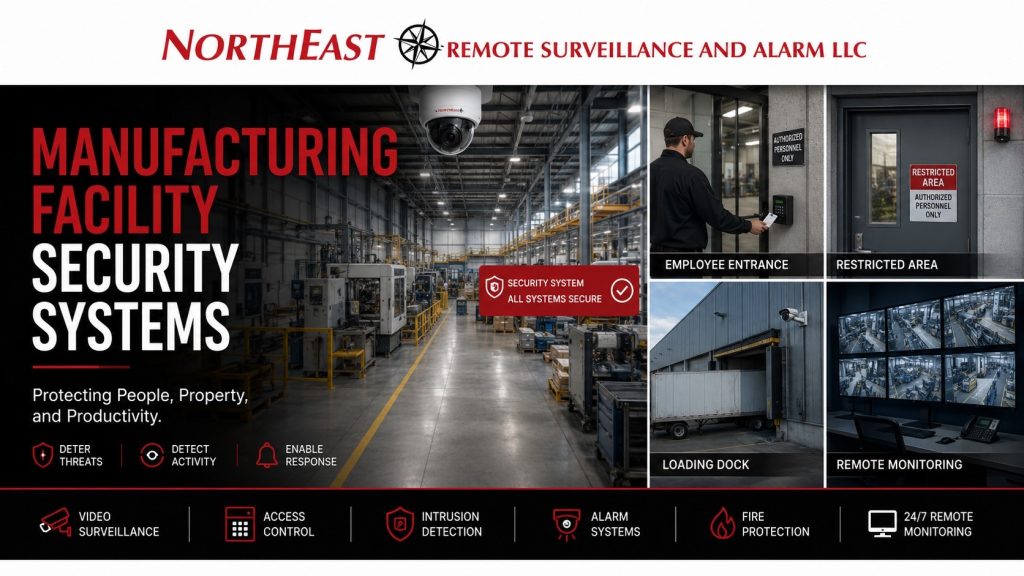
Planning for Manufacturing Facility Security Systems
A manufacturing facility is not a standard commercial building. Production areas, tool rooms, maintenance spaces, raw material storage, finished goods, shipping departments, receiving areas, employee entrances, contractor access points, and utility spaces all create different security needs.
Northeast Remote Surveillance and Alarm, LLC designs manufacturing security systems around how the plant actually operates. The goal is to improve visibility, control access, document activity, reduce blind spots, support after-hours protection, and help management review incidents without disrupting production.
A properly designed manufacturing security system should support production continuity, employee accountability, restricted-area control, incident review, life-safety coordination, and long-term serviceability.
Core Manufacturing Facility Security Systems Resources
Use these NERSA resources to move from this manufacturing facility page into the correct security layer.
Manufacturing Plant Security Systems supports production plants, industrial buildings, fabrication spaces, processing facilities, tool rooms, employee entrances, restricted areas, and manufacturing-specific security planning.
Video Surveillance for Manufacturing Facilities focuses on production-area cameras, process visibility, loading-area review, equipment-adjacent coverage, employee movement, and incident documentation inside manufacturing environments.
Industrial Security Camera Systems supports manufacturing, warehousing, logistics, and industrial facilities that need engineered camera design for large operational environments.
Industrial Video Surveillance Systems supports larger industrial properties that need camera coverage around production areas, yards, loading areas, restricted spaces, equipment zones, and multi-building operations.
Commercial and Industrial Video Surveillance Systems is the broader video surveillance service page for commercial and industrial properties that need cameras, recording, remote access, storage, and incident review.
Commercial and Industrial Access Control Systems supports controlled doors, credentials, readers, controllers, schedules, permissions, audit history, and multi-building access.
Commercial and Industrial Alarm Installation supports intrusion protection for exterior doors, overhead doors, offices, restricted rooms, production-support spaces, storage areas, and after-hours vulnerable openings.
Remote Video Monitoring and Live Talk-Down supports after-hours awareness around parking lots, loading areas, contractor yards, side doors, rear approaches, gates, and exterior risk areas.
Commercial and Industrial Fire Alarm Installation supports fire alarm planning, monitoring, notification coverage, documentation, inspection awareness, and life-safety coordination.
Commercial and Industrial Infrastructure and Cabling supports structured cabling, fiber, network pathways, PoE switching, wireless bridges, racks, UPS planning, and low-voltage security infrastructure.
Manufacturing Facility Security Risk Areas
Manufacturing facilities often need several security layers working together. Cameras, access control, alarms, monitoring, fire alarm coordination, and infrastructure should not be treated as separate systems when the plant depends on all of them to operate reliably.
Common manufacturing security risk areas include:
- Production floors
- Assembly lines
- Processing areas
- Employee entrances
- Contractor entrances
- Visitor entrances
- Shipping and receiving areas
- Loading docks
- Tool rooms
- Parts rooms
- IT rooms
- Utility rooms
- Maintenance spaces
- Raw material storage
- Finished goods areas
- Quality-control rooms
- Parking lots
- Exterior doors
- Side and rear approaches
- After-hours access points
Each area should be evaluated based on how people, products, tools, equipment, vehicles, and vendors actually move through the facility.
Manufacturing Facility Video Surveillance
Manufacturing video surveillance should provide usable views of the areas where people, equipment, materials, and product movement create risk. Cameras should be placed for review value, not just general visibility.
Manufacturing camera coverage may include:
- Production floors
- Machine-adjacent areas
- Assembly lines
- Raw material areas
- Finished goods areas
- Tool rooms
- Maintenance spaces
- Shipping and receiving areas
- Loading docks
- Employee entrances
- Contractor entrances
- Parking areas
- Exterior building approaches
A camera that shows a wide area but does not provide useful review detail may not help when management needs to understand what happened. Camera placement, mounting height, lighting, field of view, recording quality, and retention should all be planned around the actual review need.
For manufacturing-specific camera planning, use Video Surveillance for Manufacturing Facilities.
Access Control for Manufacturing Plants
Manufacturing facilities often need tighter control over who can enter specific areas. Not every employee, contractor, visitor, or vendor should have access to production areas, shipping offices, receiving offices, maintenance rooms, IT rooms, tool rooms, storage areas, or management spaces.
Access control may support:
- Employee entrances
- Office-to-plant doors
- Contractor entrances
- Production support areas
- Tool rooms
- Parts rooms
- IT rooms
- Utility spaces
- Shipping offices
- Receiving offices
- Quality-control areas
- Restricted storage
- After-hours access rules
A well-planned access control system can help reduce key problems, document entry activity, manage permissions, and support review when something goes wrong.
For broader controlled-entry planning, use Commercial and Industrial Access Control Systems.
Intrusion Alarms and After-Hours Protection
Manufacturing facilities may be vulnerable after the building is closed, lightly staffed, or operating with limited overnight supervision. Intrusion alarms should be designed around the actual building layout, schedules, access points, and high-risk areas.
Manufacturing alarm planning may include:
- Employee entrance contacts
- Exterior door contacts
- Overhead door monitoring
- Office intrusion protection
- Production-area motion detection
- Tool room protection
- Parts room protection
- Utility room protection
- Secondary structure protection
- Alarm partitions by area or schedule
- Monitoring and response procedures
For alarm planning, use Commercial and Industrial Alarm Installation.
For larger facilities with partitions, schedules, video verification, and enterprise-level requirements, use Commercial and Enterprise Intrusion Alarm Systems.
Loading Areas, Shipping, and Receiving
Manufacturing security often depends on clear visibility around shipping and receiving areas. These spaces connect production, inventory, drivers, vendors, forklifts, staged materials, finished goods, and exterior doors.
Security planning may include:
- Dock camera coverage
- Shipping office visibility
- Receiving office visibility
- Trailer activity review
- Forklift movement review
- Driver interaction review
- Staged product documentation
- Overhead door monitoring
- Access control between office and plant spaces
- Alarm coverage for after-hours openings
For dock-specific planning, use Loading Dock Security Systems.
If the property includes truck courts, exterior staging, trailer rows, or yard activity, use Truck Yard Security Systems.
Remote Monitoring and Live Talk-Down
Some manufacturing facilities need more than recorded video. Parking lots, side doors, rear approaches, exterior storage, contractor yards, loading areas, and after-hours building edges may benefit from event review and active deterrence.
Remote video monitoring may support:
- After-hours activity review
- Exterior approach alerts
- Yard activity verification
- Parking lot event review
- Dock-area monitoring
- Gate or side-lot activity
- Live audio deterrence where appropriate
- Escalation procedures for real events
For monitored video and active deterrence planning, use Remote Video Monitoring and Live Talk-Down.
Fire Alarm and Life-Safety Coordination
Manufacturing facilities may include production equipment, electrical rooms, process areas, storage spaces, fire-rated openings, emergency exits, alarm notification needs, and inspection-sensitive conditions.
Security, access control, alarms, door hardware, fire alarm systems, and emergency egress should be coordinated carefully so security improvements do not create life-safety or inspection problems.
For fire alarm and life-safety planning, use Commercial and Industrial Fire Alarm Installation.
For broader compliance-aware planning, use Regulatory and Compliance for Commercial Security, Fire Alarm and Life Safety.
Low-Voltage Infrastructure and Network Planning
Manufacturing security systems depend on the infrastructure behind the devices. Cameras, access control panels, alarm communicators, intercoms, monitoring equipment, and fire alarm support systems may require structured cabling, fiber, PoE switching, wireless links, equipment racks, backup power, and clear documentation.
Poor infrastructure can lead to unreliable cameras, access control failures, alarm communication problems, network instability, and long-term service issues.
For structured cabling, fiber, wireless bridges, racks, PoE switching, UPS planning, and system infrastructure, use Commercial and Industrial Infrastructure and Cabling.
For VLANs, network segmentation, remote access, VPN planning, and security-system network design, use Network Security for Security Systems.
Cybersecurity and Equipment Sourcing
Modern manufacturing security systems often include IP cameras, cloud dashboards, remote access, access control panels, alarm communicators, mobile credentials, and connected monitoring tools. These systems should be planned with cybersecurity and user permissions in mind.
Good planning may include:
- Role-based user access
- Secure remote access
- Network segmentation
- Strong password practices
- Device documentation
- Camera health monitoring
- Firmware management
- Controlled video export procedures
- Approved equipment sourcing where required
For cybersecurity-aware physical security planning, use Cybersecurity and Data Protection Standards.
For approved-camera and equipment sourcing awareness, use NDAA Compliance for Commercial Security Systems.
OSHA-Aware Incident Documentation
Manufacturing security systems can support workplace safety programs by improving visibility into production-adjacent areas, forklift routes, loading docks, parking areas, and other operational zones where incidents may occur.
Video surveillance does not make a facility OSHA compliant by itself. OSHA compliance depends on employer policies, hazard controls, training, supervision, documentation, and the standards that apply to the specific workplace. Security cameras can support those efforts by helping teams review what happened before, during, and after an incident.
For workplace-safety visibility and incident documentation planning, use OSHA and Electronic Security Systems.
Manufacturing Facility Types NERSA Supports
Northeast Remote Surveillance and Alarm, LLC designs security systems for many types of manufacturing and industrial facilities.
Common facility types include:
- Production plants
- Fabrication facilities
- Processing buildings
- Assembly operations
- Packaging facilities
- Food production facilities
- Industrial equipment facilities
- Machine shops
- Manufacturing-connected warehouses
- Multi-building industrial sites
- Contractor-support industrial properties
- Tool and parts storage operations
- Mixed office-manufacturing buildings
- Manufacturing facilities with shipping and receiving operations
Each facility should be evaluated around its actual layout, process flow, employee movement, contractor access, material storage, restricted areas, equipment exposure, and after-hours conditions.
Regional Manufacturing Security Planning
Manufacturing security needs vary by region, building type, and corridor. A production facility in the Lehigh Valley may have different exposure than a Reading-area processing plant, a Greater Philadelphia industrial facility, or a Northeastern Pennsylvania manufacturing-connected warehouse.
Commercial and Industrial Security Systems in Pennsylvania and the Mid-Atlantic supports broad regional planning for commercial and industrial properties across Pennsylvania and selected Mid-Atlantic markets.
Lehigh Valley Commercial and Industrial Security Systems supports Lehigh Valley manufacturing, warehouse, logistics, office, municipal, healthcare, school, and industrial properties.
Manufacturing and Industrial Security Systems in Bethlehem, PA supports Bethlehem-area manufacturing, industrial, warehouse, institutional, healthcare, office, and multi-site commercial properties.
Greater Reading Area Commercial and Industrial Security Installation supports Reading and Berks County manufacturing, logistics, warehouse, office, and industrial security planning.
Greater Philadelphia Commercial and Industrial Security Installation supports Philadelphia-area industrial, manufacturing, logistics, warehouse, office, institutional, and multi-site security planning.
Greater Scranton Logistics Hub Security Systems supports Northeastern Pennsylvania manufacturing-connected warehouses, industrial properties, logistics hubs, distribution facilities, and truck yard operations.
Project Standards and Long-Term Support
Manufacturing security systems should be planned, installed, documented, and supported as operational infrastructure. The system should be understandable to the people who use it and serviceable for the team that maintains it.
For larger facilities that need a technical review of site conditions, risk areas, life-safety coordination, low-voltage infrastructure, and future growth, use Physical Plant Security Assessment.
For project planning, communication, installation coordination, testing, training, documentation, and handoff expectations, use NERSA Project Delivery Standards.
For camera schedules, access control door lists, alarm zones, network notes, user guidance, system records, and turnover steps, use Commercial Security Documentation and Handoff.
For troubleshooting, system adjustments, user changes, documentation updates, and ongoing service expectations, use NERSA Service and Support Standards.
What This Page Does Not Cover
This page is focused on manufacturing facility security systems.
It is not the main Industries We Serve page. It is not the manufacturing plant security systems page. It is not the industrial security camera page. It is not the manufacturing video surveillance page. It is not the access control page. It is not the alarm page. It is not the fire alarm page. It is not a city-specific manufacturing page or corridor-specific manufacturing page.
This page supports those resources by helping manufacturing facilities move into the correct security layer based on the actual need, including cameras, access control, alarms, loading areas, remote monitoring, infrastructure, compliance, documentation, and project standards.
Request a Manufacturing Facility Security Assessment
If your manufacturing facility needs better visibility, stronger access control, dependable alarm protection, improved after-hours monitoring, fire alarm coordination, infrastructure support, or cleaner incident documentation, Northeast Remote Surveillance and Alarm, LLC can help.
A proper manufacturing security assessment should review production areas, employee entrances, contractor movement, receiving points, shipping areas, parking lots, restricted rooms, utility spaces, loading areas, existing systems, alarm points, camera views, network conditions, compliance-sensitive openings, and long-term security goals.
Request a Security Assessment or call 1-888-344-3846 to discuss manufacturing facility security systems.
Frequently Asked Questions About Manufacturing Facility Security Systems
What is a manufacturing facility security system?
A manufacturing facility security system combines video surveillance, access control, intrusion alarms, monitoring, fire alarm coordination, infrastructure, and documentation to protect production areas, employee entrances, restricted rooms, loading areas, parking lots, and after-hours activity.
Why do manufacturing facilities need a different security design?
Manufacturing facilities have production flow, equipment areas, raw materials, finished goods, contractors, employee shifts, restricted rooms, and loading activity that require a different approach than a standard office or retail property.
What areas should manufacturing cameras cover?
Common areas include production floors, employee entrances, loading areas, shipping and receiving areas, raw material storage, finished goods areas, tool rooms, maintenance areas, parking lots, exterior doors, and restricted spaces.
Do manufacturing facilities need access control?
Many do. Access control can help manage employee entrances, office-to-plant transitions, tool rooms, IT rooms, utility spaces, shipping offices, receiving areas, quality-control rooms, and other restricted areas.
Are alarms important for manufacturing facilities?
Yes. Intrusion alarms can help protect exterior doors, overhead doors, offices, restricted rooms, storage areas, and vulnerable openings when the facility is closed or lightly staffed.
Can cameras help with workplace safety review?
Yes. Cameras can help management review incidents around production areas, loading docks, forklift routes, parking lots, and equipment-adjacent spaces. They support incident review but do not replace safety programs, training, or OSHA compliance requirements.
Can manufacturing security systems support remote monitoring?
Yes. Remote video monitoring can help improve after-hours awareness around exterior doors, loading areas, parking lots, contractor yards, utility spaces, and exterior approaches.
How should manufacturing security systems be documented?
Documentation should include camera locations, access-controlled doors, alarm zones, network notes, user guidance, monitoring procedures, system records, and service expectations.
Can NERSA support multi-building manufacturing properties?
Yes. NERSA can help multi-building manufacturing and industrial sites plan cameras, access control, alarms, monitoring, infrastructure, user permissions, documentation, and long-term service support.
How do I start a manufacturing security project?
Request a Security Assessment or call 1-888-344-3846. Northeast Remote Surveillance and Alarm, LLC can review the facility layout, production areas, access points, camera needs, alarm needs, infrastructure, monitoring options, compliance-sensitive openings, and long-term security goals.