
Loading dock security systems in Reading, PA coordinate video, controlled entry, and monitoring around deliveries, dock openings, and freight movement.

Request a loading dock security assessment
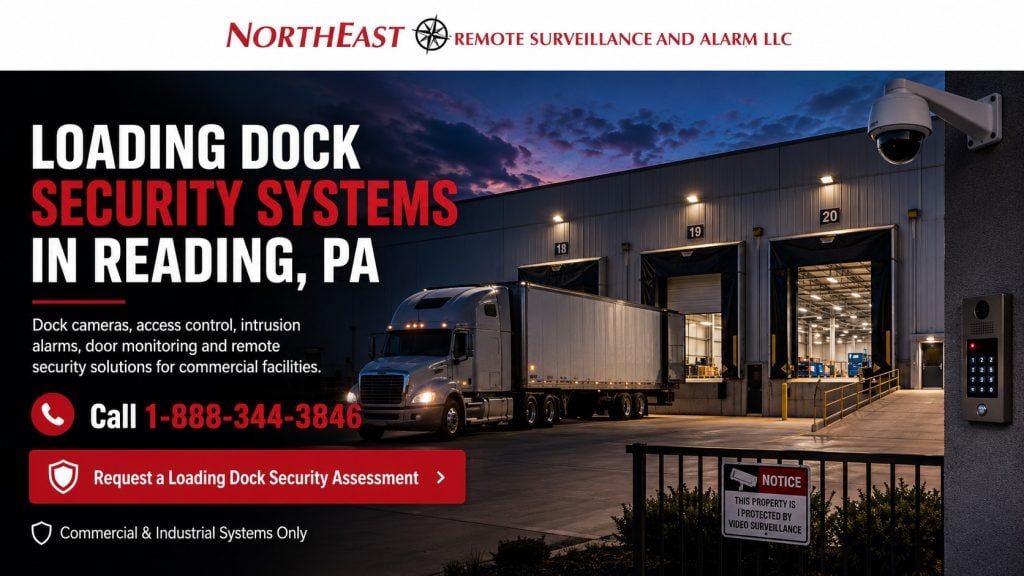
Plan the boundary between freight and building access
For a Reading loading dock, start with the route taken by the truck, driver, freight, and receiving staff. Identify where the project needs general visibility, a detailed transfer view, or controlled personnel entry. These requirements often overlap at a dock but should be defined individually.
Use the camera guide to establish recorded coverage, the door guidance for employee or visitor access, and monitoring resources for events outside normal operating hours. The wider warehouse and yard guides provide context on either side of the loading position.
Test under representative loading conditions
A dock changes when a trailer arrives or a large door opens. Review lighting, obstructions, mounting positions, and the location of stored freight during normal activity. Explain any late work or delivery exceptions that affect alarm operation or event review.
Prepare a dock layout, operating schedule, existing equipment list, and examples of incidents that need better evidence. Agree how staff will find the relevant recording and who maintains permissions or response contacts. Check a representative transaction at handover and record the coverage assumptions for future operational changes.
Loading Dock Services
Choose the service that addresses dock camera views, personnel or vehicle entry, communication, detection, monitoring, or infrastructure.
Video Surveillance — Plan views of dock doors, trailer positions, and freight activity.
Access Control — Control authorized entry through dock-side personnel doors.
Intercom and Controlled Entry — Coordinate driver check-in and visitor communication.
Gate Access Control — Manage controlled vehicle approaches to the dock.
License Plate Recognition — Capture searchable vehicle records at planned lanes.
Intrusion Alarms — Monitor selected dock openings and restricted areas.
Security Monitoring — Coordinate monitored dock events and response procedures.
Remote Video Monitoring — Support after-hours video verification and operator intervention.
Cabling and Infrastructure — Plan reliable connections for dock security equipment.
Related Facility Planning
Use these guides to connect the loading area with the surrounding yard, distribution, manufacturing, or warehouse operation.
Truck and Trailer Yards — Coordinate dock security with surrounding vehicle areas.
Distribution Centers — Review security across the complete logistics operation.
Manufacturing Facilities — Connect loading activity with wider plant security.
Warehouses — Coordinate dock operations with warehouse security.
Existing-System Improvements
Review these upgrade guides when existing dock equipment or camera coverage needs improvement.
Security Upgrades and Retrofits — Plan improvements across existing dock security systems.
Camera Upgrades — Improve existing dock views and recording.
Reading Security Planning
Use the Reading commercial security guide to coordinate work across the whole property.
Reading Commercial Security Systems — Return to the main Reading guide for full-property planning.
Request a loading dock security assessment to review your facility.
Compliance, Codes & Project Standards
NERSA plans commercial and industrial security work with applicable code, documentation, inspection and authority-having-jurisdiction requirements in mind. Requirements vary by system, property and jurisdiction. These resources support project planning; they do not establish legal compliance, certification or AHJ approval.
Related guidance: Regulatory compliance & inspection readiness · NERSA project standards · Documentation, testing & inspection readiness