
Municipal and institutional security systems in Reading, PA coordinate controlled entry, video, alarms, and monitoring around public-service operations and restricted work areas.

Request a municipal or institutional security assessment
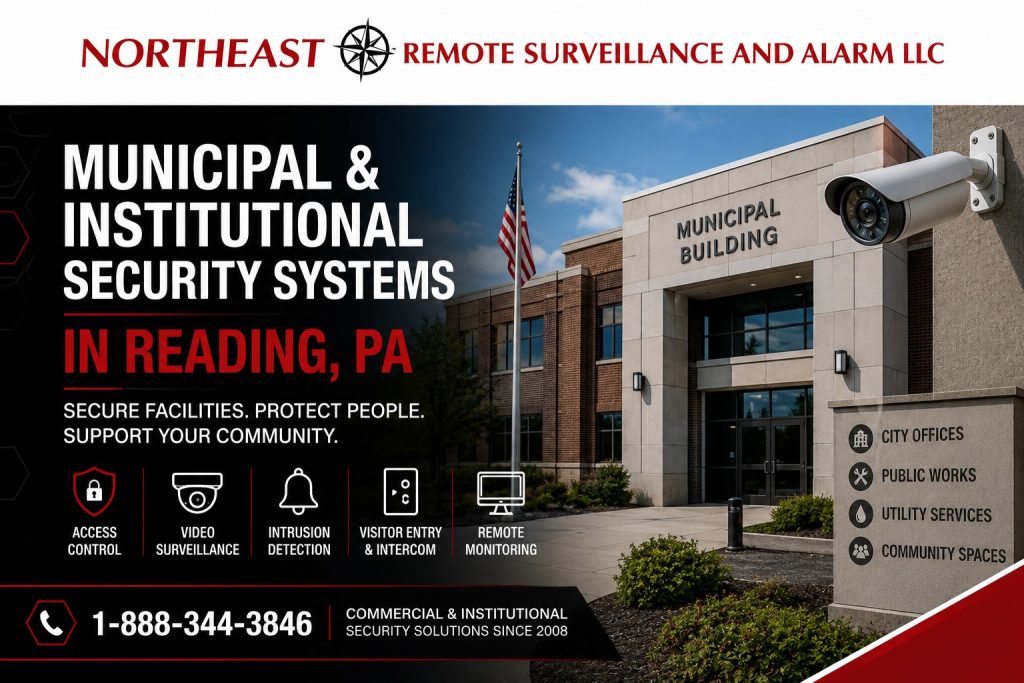
Plan around the boundary between public and staff space
For a Reading municipal or institutional property, begin with the public route from arrival to the service destination. Mark where staff-only, records, storage, or equipment areas begin. Identify the building or department responsible for approving changes in each area.
Use controlled-entry guidance for permissions, intercom guidance for visitor communication, and camera guidance for agreed incident-review needs. Alarms and monitoring require their own event and response instructions. A collection of security devices should support the facility’s operating procedures rather than leave each department to infer how it works.
Include shared use and schedule changes
Describe public meetings, after-hours operations, contractors, and any shared tenancy. Assign responsibility for temporary permissions and changes to opening hours. Review proposed camera locations and authorized viewing with the appropriate facility representatives.
Bring a current layout, installed equipment details, and the practical problem to be resolved. Handover should check public arrival, staff entry, permissions, and agreed event handling. Keep location names and support records consistent across departments so a later service request identifies the correct area and system.
Public Buildings and Controlled Entry
Use these services to coordinate public arrival, staff-only doors, visitor communication, camera review, and alarm response.
Access Control — Separate approved public access from restricted staff areas.
Door Access and Electrified Hardware — Review controlled openings and their operating requirements.
Intercom and Controlled Entry — Coordinate visitor communication at controlled entrances.
Video Surveillance — Plan authorized incident review around public-building activity.
Intrusion Alarms — Monitor selected unauthorized entry conditions.
Security Monitoring — Coordinate monitored events and departmental response procedures.
Parking and Vehicle Areas
Review these guides for parking approaches, restricted vehicle entry, plate records, and outdoor fleet storage.
Parking Lot Cameras — Review vehicle activity and pedestrian approaches.
Gate Access Control — Manage authorized entry to restricted vehicle areas.
License Plate Recognition — Capture searchable vehicle records at planned lanes.
Truck and Trailer Yard Security — Explore security planning for outdoor vehicle storage.
Connected Systems and Modernization
Use these resources to plan compatible integration, shared administration, supporting infrastructure, and phased system improvements.
Unified Security Systems — Explore compatible system integration across public facilities.
Multi-Site Security — Coordinate administration across buildings and departments.
Cabling and Infrastructure — Plan dependable connections for security equipment.
Security Upgrades and Retrofits — Plan phased improvements to existing systems.
Reading Security Planning
Explore Reading security services to coordinate the municipal or institutional project with the wider property plan.
Reading Commercial Security Systems — Return to the main Reading guide for coordinated property planning.
Request a municipal or institutional security assessment to review your Reading facility.
Compliance, Codes & Project Standards
NERSA plans commercial and industrial security work with applicable code, documentation, inspection and authority-having-jurisdiction requirements in mind. Requirements vary by system, property and jurisdiction. These resources support project planning; they do not establish legal compliance, certification or AHJ approval.
Related guidance: Regulatory compliance & inspection readiness · Public-sector & institutional compliance · NERSA project standards