
Use this Central Pennsylvania security service-area guide to confirm the communities and markets where NERSA supports qualifying commercial and industrial projects, including Harrisburg, York, Hershey, Lancaster, Gettysburg, Carlisle, Mechanicsburg, Camp Hill, Middletown, Lebanon and surrounding Central Pennsylvania communities.

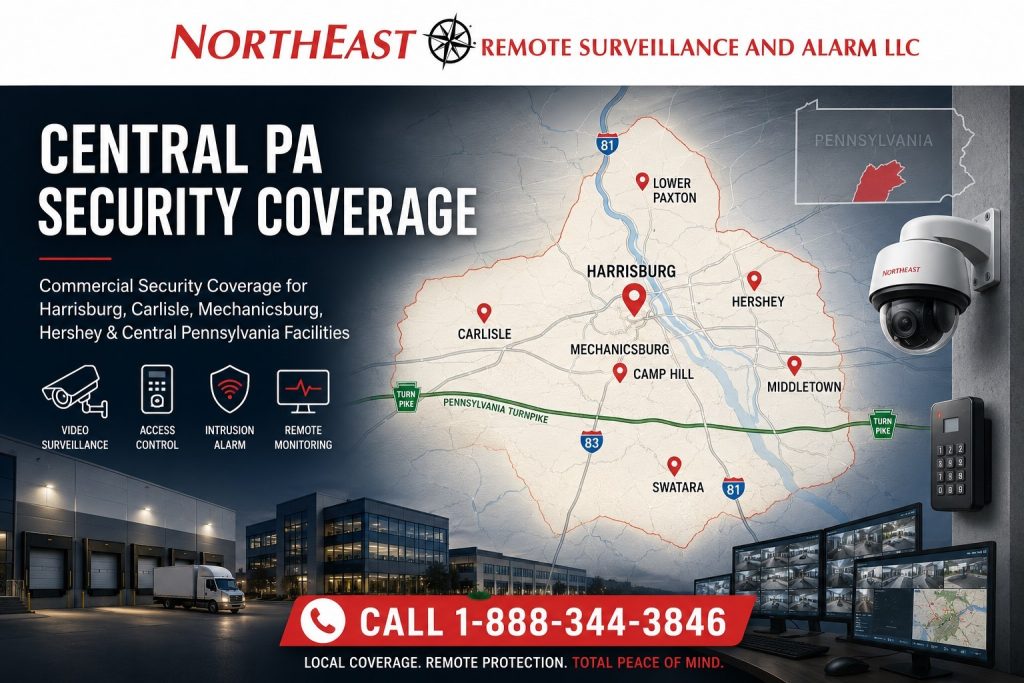
This regional guide is part of NERSA’s Pennsylvania commercial security coverage.
Use it to organize a Central PA project, then follow the Harrisburg or service guide that matches the work.
For the region-wide service architecture, use Commercial Security Installation & Systems in Central Pennsylvania.
This page remains the geographic coverage directory for Harrisburg, York, Lancaster, Hershey, Carlisle, Mechanicsburg, Camp Hill, Middletown, Lebanon, Gettysburg and surrounding markets.
Start With the Location and the Facility Need
This Central Pennsylvania guide connects regional project planning with the technology and facility guides relevant to the work. Identify the site location and the actual problem: missing evidence, uncontrolled entry, an alarm issue, or inconsistent operation across buildings.
For a logistics or industrial property, map the route between vehicle arrival, exterior activity, and building access. For offices or public-facing properties, start with staff and visitor movement. The location alone does not determine a suitable system or the boundary of the work.
Make the project ready for a site review
Identify the buildings, entrances, operating hours, and existing equipment included in the scope. Clarify shared-property responsibilities and who owns the network or accounts supporting the current installation. For multiple sites, distinguish common administration needs from local differences.
Provide available plans and examples of the concern. Agree the intended outcome and how it will be checked, such as usable playback or correct door permissions. Confirm project availability and coordination for the specific location through the assessment process, then keep the resulting scope and support records together.
Local Security Planning
Plan security for offices, warehouses, industrial facilities and other commercial properties in the Harrisburg area.
Review Harrisburg Commercial Security Installation.
Central Pennsylvania Coverage by Market and Service Need
Plan camera coverage for production areas, loading docks, parking and exterior yards.
Review Industrial Video Surveillance.
Manage controlled doors, credentials, permissions and entry schedules.
Review Access Control Systems.
Coordinate alarm zoning, communication and administration across large or multiple facilities.
Review Enterprise Intrusion Alarm Systems.
Review detection, signaling, documentation and installation requirements.
Review Fire Alarm and Life Safety Systems.
Evaluate monitored camera events and after-hours response procedures.
Review Remote Video Monitoring and Live Talk-Down.
Compare service options for your facility.
Review All Commercial and Industrial Security Services.
Project Planning and Support
See how site conditions and operating needs guide recommendations.
Review Security Assessment Process.
Review complex facilities and infrastructure requirements.
Review Enterprise Physical Security Evaluation.
Review planning, coordination and installation practices.
Review Project Delivery Standards.
Prepare system records, user guidance and turnover information.
Review Documentation and Handoff.
Understand ongoing troubleshooting and system support.
Review Service and Support Standards.
Review account access, remote connections and data handling.
Review Cybersecurity and Data Protection Standards.
Regional Coverage
Explore additional Pennsylvania service areas.
Review Pennsylvania Commercial Security Coverage.
Explore the wider regional service area.
Review Pennsylvania and Mid-Atlantic Security Coverage.
Define the Location and the Project Boundary
NERSA supports qualified commercial and industrial projects across the Central Pennsylvania communities listed in this guide. Provide the actual property address, building use, and work requested so project availability, installation coordination, and long-term support can be reviewed for that location. A regional service description does not settle the scope or scheduling of an individual project.
Harrisburg and nearby business properties
For a Harrisburg-area installation, start with the Harrisburg commercial security installation guide.
It explains camera tasks, controlled openings, intrusion alarms, existing-system upgrades, proposal comparison, and handover.
Use the city guide when the immediate decision concerns the systems at a particular property rather than administration across several locations.
For offices, shops, professional practices, leased spaces, or a business starting with a limited scope, the Harrisburg and Central PA small-business security guide helps prioritize practical improvements.
Begin with the operating concern and available staff, then select the equipment and service level that the organization can manage.
Carlisle, Mechanicsburg, Camp Hill, and surrounding properties
Describe the building, normal arrivals, delivery routines, and after-hours activity during the initial assessment request. A warehouse with outside storage may need a different combination of recorded evidence, controlled entry, and event response from an office with a public reception area. The example should come from the site’s actual operation rather than an assumed package for the town.
For a camera installation, identify the event that must be reviewed and when it occurs. For access control, identify the doors, authorized groups, and existing hardware. For alarm work, explain the present system and the person responsible for contacts and testing. These details make the request actionable before a site visit and help the team select the correct service resources.
Other Central Pennsylvania locations
Requests involving York, Hershey, Lancaster, Gettysburg, Middletown, Lebanon, and surrounding communities should include the same property-level information. If the project spans several places, list each address and the local contact. Distinguish work needed now from future phases so the assessment can address delivery and support responsibilities realistically.
The service guides below provide a starting point for planning security across Central Pennsylvania. Where a property’s operating needs are specialized, use the appropriate warehouse, manufacturing, or system guide to develop the scope. Confirm the actual location and requirements through the assessment process before treating general coverage as a committed installation plan.
Retain Useful Equipment and Plan the Transition
For an existing commercial property, collect available equipment records and identify the owner of accounts, subscriptions, and administrative permissions. Include cameras, recorders, readers, controllers, locks, alarm components, communication services, and supporting infrastructure. Missing information should be recorded as an assessment item rather than replaced with an assumption about compatibility.
Ask the review to distinguish equipment suitable for continued use, equipment needing repair, and items proposed for replacement.
Record the reason for each recommendation and the test that will establish whether a retained function meets the agreed need.
The upgrade and takeover guide provides the broader framework for that decision.
Plan the cutover around active operations. Identify which entrances, recording areas, or monitored functions may be affected, who authorizes the change, and who manages temporary arrangements. For phased work, define a usable outcome and acceptance check for each phase. Include staff communication and account administration in the transition rather than treating them as separate concerns after installation.
Coordinate Several Central Pennsylvania Locations
A multi-location project needs both common standards and local decisions. An organization may want consistent camera names, credential administration, alarm contacts, and equipment records while retaining different site schedules. Identify which tasks belong to local staff and which require central approval. A shared platform is useful only when the supported functions match those responsibilities.
Start with a site inventory that records building use, existing systems, network arrangements, known faults, and intended changes. Separate the central management requirement from installation work at each building. One location may need a controller upgrade; another may need door hardware, a cable route, or better camera placement. A single equipment template can obscure those differences.
Use a representative first phase when practical.
Demonstrate administration and daily tasks with the people who will own them, then document what should remain consistent across later sites.
Keep legitimate differences visible.
For the larger coordination questions, review the multi-site commercial security guide.
Compare project and operating costs together
Ask the proposal to separate equipment, installation, infrastructure, programming, testing, training, and recurring services. Identify customer-provided work and exclusions at each location. Costs can change with door condition, cable paths, exterior mounting, access restrictions, and the need to keep an occupied facility operating. Those factors should be reviewed alongside the equipment count.
Include a handover standard that works for future staff. Record device locations, account responsibilities, the approved operating procedures, and support contacts. Have authorized users demonstrate the agreed tasks and retain unresolved items with a responsible owner. This creates a clearer basis for ongoing service than a collection of unrelated invoices and product manuals.
Review the regional plan when a location opens, closes, changes tenants, or changes its operating hours. Identify the person responsible for updating site contacts and administration. Keep those changes with the equipment and handover records so the next service visit starts from the current arrangement.
Central Pennsylvania Security Questions
Which page should I use for a Harrisburg camera or access-control installation?
Start with the Harrisburg installation guide linked above. It connects camera, door-access, alarm, and upgrade decisions at an individual property. Use this regional guide when the project involves other Central PA locations or coordination across several sites.
Can a small business start with a limited scope?
Yes. Identify the immediate operating problems and define a useful first phase. Review future capacity without adding features that staff do not need or cannot maintain. The small-business guide addresses leased-space coordination, permissions, recording, and practical expansion.
Can NERSA assess an inherited system?
Yes. Provide available records, ownership information, known faults, and the intended operating result. Equipment reuse depends on condition, compatibility, support, and testing. An assessment should explain those findings before recommending a takeover or replacement.
What should be ready before a regional assessment?
Prepare site addresses, operating hours, building contacts, known problems, and any plans or equipment records available. Identify approval requirements and restrictions on installation access. For multiple locations, describe both the common management goals and the differences at each property.
Plan Your Central Pennsylvania Project
Request a Security Assessment to review your facility, existing equipment and priorities.
Compliance, Codes & Project Standards
NERSA plans commercial and industrial security work with applicable code, documentation, inspection and authority-having-jurisdiction requirements in mind. Requirements vary by system, property and jurisdiction. These resources support project planning; they do not establish legal compliance, certification or AHJ approval.
Related guidance: Regulatory compliance & inspection readiness · NERSA project standards · Documentation, testing & inspection readiness