
Central Pennsylvania businesses need security planning that connects cameras, access control, intrusion detection, monitoring and the infrastructure that carries every signal.

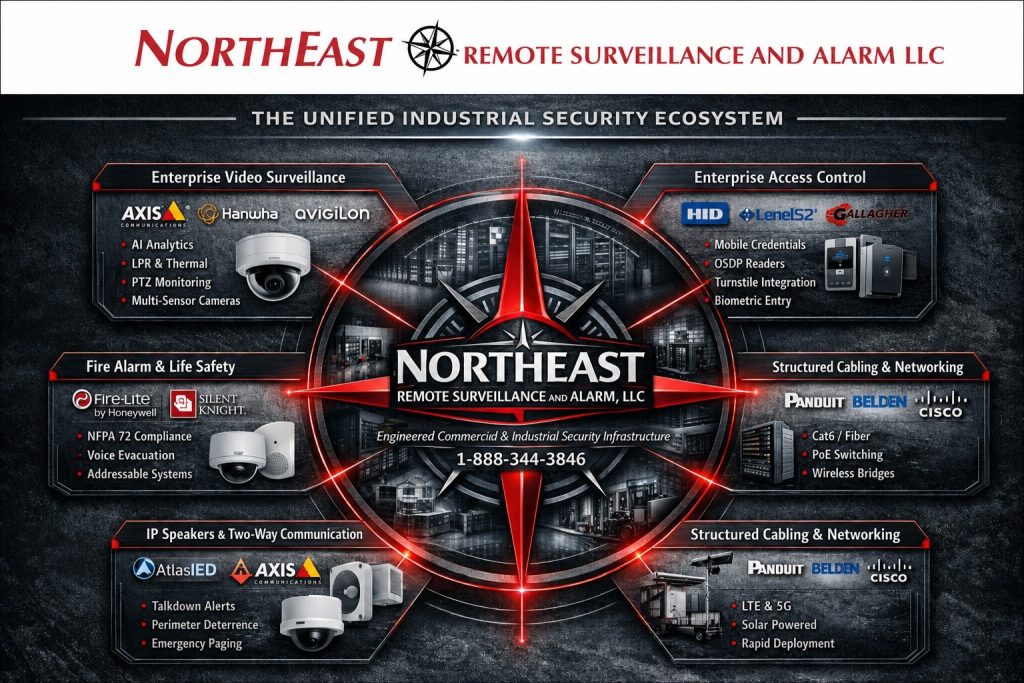
This regional guide organizes commercial security planning for Harrisburg, York, Lancaster, Lebanon, Hershey, Carlisle, Mechanicsburg, Camp Hill, Middletown, Gettysburg and surrounding Central Pennsylvania markets so owners, facilities teams, IT leaders and loss-prevention staff can map a system to the property, operating hours and risk profile.
Central Pennsylvania coverage and planning
Regional projects often cross city and county lines. Planning may include Harrisburg and the I-81/I-83 corridor, Lancaster, York, Lebanon, Hershey, Carlisle, Mechanicsburg and logistics routes serving the Pennsylvania Turnpike and surrounding Central Pennsylvania markets. Each site still needs a property-level review of entrances, loading areas, parking, employee circulation, network paths, power and response procedures. The goal is a consistent security standard across locations without forcing every building into the same equipment list.
Integrated commercial security services
- Video surveillance: camera placement, coverage design, recording retention, remote viewing, analytics and evidence export for offices, warehouses, plants, schools and mixed-use properties. See the commercial video surveillance systems guide.
- Access control: doors, credentials, schedules, visitor workflows, intercoms and integrations that help management understand who can enter each area and when.
- Intrusion alarms and monitoring: perimeter, interior and after-hours detection coordinated with arming rules, verification and response procedures.
- Low-voltage infrastructure: structured cabling, fiber, network cabinets, PoE, wireless coverage and pathway planning that support security and other building systems. Review the commercial infrastructure and cabling resource.
- Upgrades and takeovers: practical paths for replacing recorders, cameras, panels or credentials while preserving usable wiring and minimizing disruption. See security upgrades, retrofits and takeovers.
Harrisburg and Lancaster security planning
For small businesses and distributed facilities, the Central Pennsylvania small business security guide explains right-sized planning, remote management and expansion.
The Harrisburg commercial security installation guide focuses on the Capital Region, while the Lancaster commercial security systems guide organizes local camera, access-control, alarm and infrastructure planning for Lancaster-area properties.
Use cases across the corridor
Warehouses and distribution sites may need loading-dock views, trailer and yard coverage, door status, visitor control and reliable wireless or fiber links. Manufacturing and industrial properties often combine perimeter detection, process-area cameras, restricted rooms and documented service access. Offices, healthcare facilities and municipal buildings typically need controlled entry, visitor workflows, privacy-aware camera placement and clear incident review. Multi-location operators benefit from common naming, retention and permission standards while allowing each site to address its own hazards.
How a regional project is scoped
- Document the property, users, operating schedule, incident history and compliance requirements.
- Map doors, cameras, alarm zones, network paths, power and communications rooms.
- Define recording, credential, monitoring and escalation rules before selecting equipment.
- Sequence installation, testing, staff orientation and handover documentation.
- Set a review cycle for maintenance, firmware, retention, permissions and future expansion.
Questions to resolve before equipment selection
Which areas require identification rather than general awareness? How long must video or event records be retained? Which doors need schedules, visitor handling or two-factor controls? Can existing cabling, switches and panels be reused safely? Who receives alarms after hours, and how is an event verified? Answering these questions keeps a Central Pennsylvania deployment useful to operations, IT and loss prevention instead of treating security as a collection of disconnected devices.
Use the commercial and industrial security services overview to compare system components, then request a documented security assessment for the properties and locations that need attention.
Security services across Central Pennsylvania
Explore local security planning and the services that match your facility or project phase.
Harrisburg Commercial Security Services
For a Harrisburg property, use the city guide to plan your project or explore the service that matches your needs:
- Harrisburg commercial video surveillance for camera placement, recording, parking, docks and incident review.
- Harrisburg commercial access control for readers, credentials, door hardware, employee entry and system upgrades.
- Harrisburg commercial intrusion alarm systems for perimeter and interior detection, monitoring, panic/duress and existing-system takeovers.
For the geographic list of Central Pennsylvania communities and project boundaries, use Central PA Security Coverage and use Carlisle Commercial Security Systems for Carlisle-specific planning.
Harrisburg and Capital Region
Harrisburg commercial security installation covers local coordination, commissioning and handover.
The Central Pennsylvania small business security systems guide supports smaller offices, retail, professional and multi-site properties.
Lancaster County
The Lancaster commercial security systems guide covers local planning for cameras, access control, alarms, infrastructure and system upgrades.
York, Lebanon and surrounding Central Pennsylvania markets
For properties elsewhere in Central Pennsylvania, use the Central PA security coverage directory to confirm the geographic fit, then pair it with the service guide that matches the project.
Security services and planning guides
- Commercial video surveillance systems for camera purpose, lenses, recording, storage, retention, analytics and evidence handling.
- Commercial and industrial security services for coordinated cameras, access control, intrusion alarms, fire-alarm coordination, intercoms and monitoring.
- Commercial, industrial and infrastructure cabling for Cat6/Cat6A, fiber, PoE, racks, wireless links and pathway planning.
- Security system upgrades, retrofits and takeovers for existing equipment, account ownership, phased replacement and modernization.
- Cloud, on-premises and hybrid video surveillance for platform selection based on bandwidth, retention, administration and operating requirements.
- Multi-site security system management for common standards, permissions, health reporting and lifecycle planning across locations.
Planning for your property
Choose the application that matches the property: warehouse and logistics visibility, manufacturing and industrial operations, office and healthcare entrances, municipal facilities, parking and vehicle routes, loading docks, contractor yards, visitor entry or restricted areas.