Commercial Security for Warehouses, Distribution Centers, Manufacturing Facilities and Industrial Properties
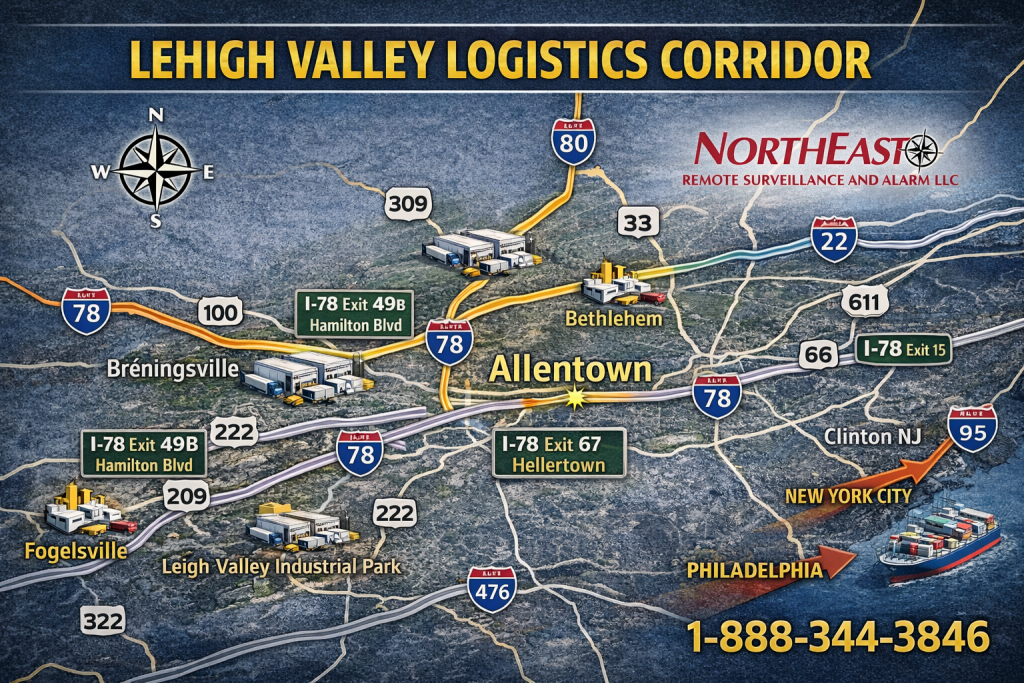
The I-78 Lehigh Valley corridor supports a concentrated mix of warehouses, distribution centers, manufacturing facilities, industrial parks, contractor properties, truck yards, cold-storage operations, commercial campuses, and multi-building logistics properties.
Facilities connected to I-78 often operate differently from ordinary office buildings or customer-facing businesses. They may receive employees, contractors, drivers, vendors, freight, fleet vehicles, and tractor-trailers across multiple shifts and through several entrances.
A single property may include:
- Employee and visitor parking
- Truck entrances and exit lanes
- Loading docks and shipping offices
- Trailer rows and drop lots
- Warehouse and production areas
- Controlled employee entrances
- Inventory and restricted storage
- Exterior equipment and materials
- Vehicle gates and service roads
- Detached buildings
- Large perimeter areas
- Sections operating after normal business hours
Northeast Remote Surveillance and Alarm, LLC designs, installs, integrates, monitors, upgrades, and supports commercial and industrial security systems for properties throughout the I-78 Lehigh Valley corridor.
Systems may include:
- Commercial video surveillance
- Access control
- Intrusion alarms
- Commercial fire alarm and life-safety systems
- Professional security monitoring
- Remote video monitoring and live talk-down
- Gate access control
- License plate recognition
- Video intercoms and controlled entry
- Loading-dock and truck-yard security
- Cabling, fiber, wireless links, and network infrastructure
- Unified multi-building security administration
- Existing-system upgrades, retrofits, and takeovers
NERSA plans around the way the property actually operates. That includes where trucks enter, where trailers stage, how employees reach the building, which doors require control, where freight changes hands, how after-hours activity is handled, and who is responsible for administering the system.
For complete regional planning across Allentown, Bethlehem, Easton, Lehigh County, Northampton County, and surrounding commercial markets, visit Lehigh Valley Commercial and Industrial Security Systems.
For industrial parks, warehouse districts, business parks, and logistics properties throughout the region, use the Lehigh Valley Industrial Park and Logistics Directory.
Request an I-78 Corridor Security Assessment or call 1-888-344-3846.
Commercial and industrial systems only • Individual facilities through multi-site organizations • New installations • Upgrades • Retrofits • Takeovers • Monitoring
Security Planning Built Around I-78 Corridor Operations
An I-78 warehouse, distribution center, manufacturing plant, or truck-oriented property should not be planned around a generic equipment package.
The security plan should reflect:
- Facility size and operating schedule
- Employee, visitor, vendor, contractor, and driver movement
- Truck circulation and trailer staging
- Shipping and receiving procedures
- Inventory and production risks
- Public, employee, delivery, and service entrances
- Vehicle gates and access schedules
- Restricted rooms and controlled departments
- Parking and exterior-property exposure
- Camera identification and evidence requirements
- Alarm detection and response procedures
- Monitoring schedules and escalation instructions
- Fire alarm and life-safety coordination
- Cabling, fiber, network, and power availability
- Existing equipment and system condition
- Documentation and administrative ownership
- Future buildings, tenants, gates, and expansion
The objective is not to install the greatest number of cameras, readers, alarm points, or analytics.
The objective is to provide useful visibility, controlled access, dependable detection, documented activity, appropriate response, and a system the organization can manage after installation.
Focused I-78 Corridor Security Resources
The following resources sit directly beneath this I-78 corridor page. Each should address one clearly separated operational need and link back to this page once.
Do not create additional I-78 versions of every general NERSA service. The seven resources below cover the strongest corridor-specific freight, vehicle, dock, gate, and after-hours conditions without duplicating the complete Lehigh Valley video, access-control, alarm, fire-alarm, or infrastructure pages.
I-78 Warehouse Security Systems
Warehouses and distribution centers along I-78 require security around inventory movement, employee entrances, shipping offices, warehouse aisles, overhead doors, loading areas, parking, exterior approaches, and after-hours operations.
Planning may include:
- Interior and exterior video surveillance
- Employee access control
- Shipping-office protection
- Overhead-door monitoring
- Intrusion detection
- Inventory and restricted-storage coverage
- Parking-lot cameras
- Dock and yard visibility
- Professional monitoring
- Multi-site administration
- Cabling and network infrastructure
The system should help management determine what occurred, where it occurred, when it happened, and which video, access, or alarm records are available.
Explore I-78 Warehouse Security Systems.
For broader companywide warehouse planning, visit Warehouse and Logistics Security Systems.
I-78 Truck Yard Security Systems
Truck courts, trailer rows, drop lots, fleet areas, vehicle-staging properties, and exterior yard lanes often create the greatest exposure after hours.
Planning may address:
- Truck and trailer entrances
- Gate queues
- Yard lanes
- Trailer rows
- Fleet parking
- Fence lines
- Exterior equipment
- Detached storage areas
- After-hours movement
- Vehicle identification
- Remote monitoring
- Live speaker warnings
A truck-yard design may require general overview cameras, focused gate views, trailer-lane cameras, perimeter detection, lighting coordination, gate records, and active event review.
Explore I-78 Truck Yard Security Systems.
For broader truck-yard planning, visit Truck Yard Security Systems.
I-78 Loading Dock Security Systems
Loading docks combine employees, drivers, vendors, trailers, freight, forklifts, paperwork, overhead doors, shipping offices, and vehicle movement within a concentrated operating area.
Security planning may include:
- Dock-door identification
- Trailer arrival and departure views
- Shipping and receiving cameras
- Driver-interaction coverage
- Freight-staging visibility
- Overhead-door contacts
- Dock-adjacent employee access
- Intrusion detection
- Lighting
- Event search and evidence export
- After-hours monitoring
The system should support incident review, shipment documentation, damage investigations, delivery disputes, access accountability, and review of unusual after-hours activity.
Explore I-78 Loading Dock Security Systems.
For companywide planning, visit Loading Dock Security Systems.
I-78 Cargo Theft Prevention Systems
Cargo-theft prevention requires more than one camera aimed at a warehouse or trailer lot.
A coordinated plan may address:
- Truck and trailer entrances
- Loading docks
- Outbound staging
- Inventory areas
- Trailer rows
- Vehicle identification
- Employee and contractor access
- Door and gate events
- Intrusion alarms
- Video verification
- Monitoring procedures
- Shipment records
- Incident documentation
Electronic security cannot eliminate every cargo-loss risk. It can improve visibility, access accountability, gate documentation, shipment review, alarm verification, and the organization’s ability to reconstruct an event.
Explore I-78 Cargo Theft Prevention Systems.
For broader freight-loss planning, visit Cargo Theft Prevention Systems.
I-78 License Plate Recognition Systems
License plate recognition can support vehicle documentation at selected I-78 warehouse, industrial, logistics, contractor, and truck-access locations.
Possible applications include:
- Main vehicle entrances
- Employee parking entrances
- Visitor approaches
- Service roads
- Truck gates
- Fleet lots
- Trailer-yard entrances
- Delivery lanes
- Controlled parking areas
Reliable plate capture depends on the lane, vehicle direction, speed, camera angle, mounting height, distance, lighting, image settings, and the amount of variability within the scene.
A general overview camera should not be expected to provide the same result as a camera designed and positioned specifically for plate capture.
Explore I-78 License Plate Recognition Systems.
For broader LPR planning, visit License Plate Recognition Camera Systems.
I-78 Gate Access Control Systems
Vehicle gates along I-78 may need to manage employees, visitors, vendors, contractors, fleet vehicles, deliveries, tractor-trailers, and emergency access.
A commercial gate system may include:
- Cards, fobs, or mobile credentials
- Vehicle transmitters
- Keypads
- Video intercoms
- Remote release
- Entrance and exit cameras
- License plate recognition
- Gate-position monitoring
- Access schedules
- Safety devices
- Emergency operating procedures
- Cellular or network communication
The design should account for how vehicles approach, stop, queue, turn, enter, and leave the property. Gate access should improve control without creating avoidable congestion or unsafe vehicle movement.
Explore I-78 Gate Access Control Systems.
For complete gate-system planning, visit Commercial Gate Access Control Systems.
I-78 Remote Video Monitoring
Warehouses, truck yards, industrial parks, loading areas, contractor properties, and logistics facilities may have exterior sections that remain lightly staffed or unoccupied after hours.
Remote video monitoring may support:
- Analytic event detection
- Live event review
- Video verification
- Speaker warnings
- Responsible-party notification
- Approved escalation procedures
- Event documentation
- Review of repeated activity patterns
Common monitored areas include:
- Gates
- Loading docks
- Truck courts
- Trailer rows
- Exterior storage
- Equipment yards
- Fence lines
- Rear approaches
- Parking lots
- Vacant buildings
- Low-staffed areas
Not every camera requires active monitoring. The monitored scope should be based on defined cameras, operating schedules, expected activity, detection rules, and response instructions.
Explore I-78 Remote Video Monitoring.
For broader monitored-video planning, visit Remote Video Monitoring and Live Talk-Down.
I-78 Corridor Security Planning by Location
Western Lehigh County, Weisenberg and Upper Macungie
The western Lehigh County portion of I-78 includes freight-oriented commercial properties, warehouse developments, manufacturing facilities, industrial buildings, contractor operations, and distribution activity connected to Route 100 and nearby industrial roads.
Security planning in this portion of the corridor may involve:
- Large warehouse footprints
- Multiple loading-dock elevations
- Employee and truck entrances
- Trailer parking
- Exterior equipment
- Shift changes
- High vehicle volume
- Building expansion
- Long camera and network distances
- After-hours shipping and receiving
Facilities west of the primary Lehigh Valley market should remain within this I-78 resource when their operation is tied to the Lehigh Valley corridor.
Properties farther west can continue to Berks County Industrial and Logistics Corridor Security Systems.
Fogelsville and Breinigsville Logistics Properties
Fogelsville and Breinigsville contain warehouse, distribution, manufacturing, industrial, and truck-oriented commercial operations connected to I-78, Route 100, and surrounding freight routes.
Typical planning concerns include:
- Truck entrances
- Employee parking
- Loading docks
- Trailer rows
- Shipping offices
- Contractor access
- Restricted inventory areas
- Exterior storage
- Shift changes
- Large building perimeters
- Multi-building network connectivity
These markets should eventually receive their own focused warehouse and distribution-center pages only when each page contains original operating content, photographs, proof, and clearly separated intent.
Until then, use this I-78 corridor resource and Warehouse and Logistics Security Systems for complete planning.
Allentown, Salisbury and Upper Saucon
Commercial and industrial properties near the central I-78 Lehigh Valley market may include warehouses, offices, manufacturing operations, healthcare buildings, commercial campuses, contractor properties, and mixed-use industrial facilities.
Projects in this part of the corridor may need to address:
- Employee and visitor entry
- Parking areas
- Restricted departments
- Warehouse-to-office transitions
- Loading areas
- Building exteriors
- Multiple operating schedules
- Shared roads
- Network and power infrastructure
- Expansion across adjoining properties
Use Commercial Security Systems Near I-78 in Allentown, PA when the property is tied specifically to the Allentown portion of the corridor.
For broader citywide planning, visit Commercial Security Systems in Allentown, PA.
Bethlehem, Lower Saucon and LVIP-Connected Properties
Bethlehem-area industrial and commercial properties may combine manufacturing, warehousing, offices, healthcare, institutional uses, logistics operations, parking areas, and multi-building infrastructure.
Security planning may involve:
- Employee and contractor entrances
- Controlled production areas
- Shipping and receiving
- Parking-lot visibility
- Loading docks
- Tenant permissions
- Exterior storage
- Multi-building communications
- Professional monitoring
- Fire alarm coordination
- Existing-system modernization
Use Commercial and Industrial Security Systems in Bethlehem, PA for complete citywide planning.
For multi-building industrial properties and LVIP-connected sites, visit Lehigh Valley Industrial Park Security Systems.
Williams Township, Route 33 and Easton-Area Connections
The eastern portion of the I-78 corridor connects with Route 33 and Easton-area commercial and industrial markets.
Properties in this portion of the region may include:
- Warehouses
- Manufacturing sites
- Distribution facilities
- Industrial parks
- Contractor yards
- Truck-oriented properties
- Commercial campuses
- Multi-tenant industrial buildings
Planning may involve regional truck traffic, loading operations, gates, employee parking, vehicle identification, exterior yards, and after-hours activity.
Use Lehigh Valley Route 33 Industrial Corridor Security Systems when Route 33 is the property’s primary industrial or freight connection.
For broader city planning, visit Commercial and Industrial Security Systems in Easton, PA.
Western Transition Into Berks County
Properties west of the Lehigh County line should not be forced into the Greater Reading city page solely because they are located west of the main Lehigh Valley market.
Use Berks County Industrial and Logistics Corridor Security Systems for broader Berks County manufacturing, warehouse, distribution, and industrial planning.
Facilities near Hamburg can also review Hamburg Logistics Center and Commerce Park.
Commercial and Industrial Properties Along I-78
Warehouses and Distribution Centers
Warehouse security should account for the complete flow of people, freight, vehicles, and inventory.
Planning may involve:
- Employee entry
- Driver and vendor access
- Shipping offices
- Warehouse interiors
- Inventory areas
- Overhead doors
- Loading docks
- Trailer yards
- Parking areas
- Gates
- After-hours monitoring
- Video storage and evidence export
Use the dedicated I-78 Warehouse Security Systems resource for corridor-focused planning.
For the complete companywide structure, visit Warehouse and Logistics Security Systems.
Manufacturing and Production Facilities
Manufacturing properties may require protection for employees, production areas, tools, equipment, raw materials, finished goods, maintenance rooms, restricted processes, utilities, shipping, and exterior property.
A coordinated system may include:
- Production-floor cameras
- Controlled employee entrances
- Contractor access
- Restricted-room permissions
- Tool and maintenance-room protection
- Loading-dock surveillance
- Intrusion alarms
- Fire alarm and life-safety coordination
- Industrial network infrastructure
- Multi-shift administration
Visit Manufacturing Plant Security Systems for manufacturing-specific planning.
Industrial Parks and Multi-Building Properties
Industrial parks and commercial campuses must account for both shared areas and separately controlled buildings or tenant spaces.
Property management may control:
- Shared entrances
- Common parking areas
- Exterior cameras
- Vehicle gates
- Utility areas
- Vacant buildings
- Shared network or fiber infrastructure
Individual tenants may control:
- Suite entrances
- Interior cameras
- Employee credentials
- Warehouse or production areas
- Tenant alarm systems
- Restricted rooms
- Local monitoring contacts
Use Lehigh Valley Industrial Park Security Systems for complete regional multi-building planning.
Use the Industrial Park Security Systems Directory to find industrial-park and logistics resources outside the immediate I-78 market.
Contractor Yards, Fleet Properties and Exterior Sites
Contractor and fleet properties may contain vehicles, machinery, tools, trailers, fuel, materials, inventory, storage containers, and outdoor equipment.
Security planning may require:
- Gate control
- Perimeter cameras
- Vehicle documentation
- License plate recognition
- Equipment coverage
- Exterior intrusion detection
- Remote monitoring
- Speaker warnings
- Solar or cellular surveillance
- Wireless building links
The design must account for weather, lighting, distance, fencing, available power, internet connectivity, changing storage patterns, and normal after-hours activity.
Multi-Site and Enterprise Organizations
Organizations operating several warehouses, manufacturing plants, offices, truck yards, branches, or regional facilities may need consistency without forcing every property into an identical physical design.
Multi-site planning may include:
- Centralized video access
- Shared credentials
- Location-specific permissions
- Regional and local administrators
- Standard alarm procedures
- Common monitoring instructions
- Consistent device naming
- System-health reporting
- Network and cybersecurity standards
- Coordinated documentation
- Long-term service planning
Visit Multi-Site Commercial Security Systems for enterprise and multi-location planning.
Core Security Systems for I-78 Corridor Properties
Commercial Video Surveillance
Video surveillance may support loading docks, truck entrances, trailer rows, parking areas, employee entrances, warehouse interiors, production areas, building approaches, gates, and exterior property.
Camera planning should consider:
- The purpose of each view
- Identification versus general overview
- Camera distance and lens selection
- Mounting height
- Lighting and nighttime performance
- Vehicle speed and direction
- Recording and retention
- User permissions
- Evidence export
- Network capacity
- Future expansion
Visit Commercial and Industrial Video Surveillance Systems for complete video-system planning.
Access Control
Commercial access control can help manage employees, visitors, vendors, contractors, tenants, maintenance personnel, drivers, and temporary users.
A complete controlled opening may involve:
- Credentials
- Readers
- Controllers
- Management software
- Electric strikes or electrified locks
- Panic hardware or electrified trim
- Door contacts
- Request-to-exit devices
- Power supplies
- Emergency release functions
- Fire alarm coordination
- User permissions and schedules
Use Commercial and Industrial Security Services for the complete access-control planning path.
Commercial Intrusion Alarms
Industrial and logistics properties may need detection around:
- Exterior doors
- Overhead doors
- Warehouse areas
- Offices
- Utility rooms
- Storage spaces
- Detached buildings
- Restricted departments
- Perimeter areas
- After-hours entrances
Partitions may allow separate buildings, departments, tenants, or operational areas to use different schedules and user permissions.
Visit Commercial and Enterprise Intrusion Alarm Systems.
Commercial Fire Alarm and Life-Safety Systems
Commercial fire alarm systems may support detection, occupant notification, monitoring, sprinkler supervision, communicator upgrades, documentation, testing coordination, and required building-system interfaces.
Requirements depend on the building, occupancy, existing conditions, adopted codes, approved documents, project scope, system configuration, responsible professionals, and authority having jurisdiction.
Visit Commercial and Industrial Fire Alarm Installation.
Professional Security Monitoring
Commercial monitoring can support intrusion alarms, panic events, trouble conditions, environmental points, communication failures, customized call lists, and location-specific response procedures.
Monitoring instructions should reflect:
- Normal operating hours
- Shift changes
- Overnight shipping
- Cleaning crews
- Maintenance activity
- Contractor schedules
- Tenant responsibilities
- Responsible-party contacts
- Escalation procedures
- Recurring alarm or trouble conditions
Visit Commercial and Industrial Security Monitoring.
Infrastructure, Fiber and Multi-Building Connectivity
Large I-78 properties may require security devices to communicate across several buildings or long exterior distances.
Infrastructure may include:
- Structured cabling
- Fiber-optic backbones
- PoE switches
- Wireless building links
- Outdoor equipment cabinets
- Network racks
- Backup power
- Surge protection
- Cellular communication
- Network segmentation
- Secure remote access
- Cable and port labeling
- Accurate drawings and documentation
Visit Commercial and Industrial Infrastructure and Cabling.
Existing-System Inspections, Upgrades and Takeovers
I-78 corridor properties may inherit several generations of cameras, recorders, access-control panels, credentials, alarm systems, communicators, networks, monitoring accounts, and door hardware.
Common problems include:
- Poor loading-dock or exterior coverage
- Aging cameras and recorders
- Unsupported access-control equipment
- Former employees or tenants with active credentials
- Shared administrator accounts
- Unreliable remote viewing
- Confusing alarm partitions
- Outdated alarm communication
- Inconsistent camera platforms
- Undocumented fiber or wireless links
- Missing equipment labels
- Incomplete drawings
- Unclear licensing ownership
- Disconnected building systems
- Unverified monitoring contacts
An older system does not automatically require complete replacement.
A Commercial Security System Inspection and Assessment can help determine what remains serviceable, what can be reused, what requires repair, and which improvements should be completed first.
Use Lehigh Valley Commercial Security System Upgrades, Retrofits and Takeovers for regional modernization, phased replacement, provider changes, equipment reuse, and platform migration.
Compliance-Aware Security Planning
Commercial and industrial security systems may interact with:
- Emergency egress
- Accessibility
- Fire alarm operation
- Electrified door hardware
- Fire-rated openings
- Gate safety
- Low-voltage wiring
- Workplace procedures
- Network security
- Equipment sourcing
- Privacy
- Documentation
- Testing and inspection
- Authority-having-jurisdiction review
Security equipment does not make a facility compliant by itself.
Project requirements may depend on the building, occupancy, existing systems, adopted codes, approved documents, local amendments, project scope, responsible professionals, manufacturer instructions, and authority having jurisdiction.
Depending on the project, coordination may involve the property owner, security integrator, fire alarm professionals, door-hardware providers, gate contractors, information-technology personnel, design professionals, inspectors, and other responsible parties.
Visit Regulatory and Compliance for Commercial Security, Fire Alarm and Life Safety for broader planning involving access control, fire alarm systems, emergency egress, low-voltage infrastructure, cybersecurity, documentation, testing, and inspection readiness.
How NERSA Plans an I-78 Corridor Security Project
1. Review the Property and Its Operation
NERSA reviews how the facility operates, including:
- Employees and shifts
- Visitors and contractors
- Drivers and vendors
- Truck circulation
- Loading and receiving
- Parking
- Gates
- Restricted areas
- Existing security equipment
- Monitoring procedures
- Infrastructure
- Future expansion
2. Identify the Required Security Outcomes
The project should define what the organization needs to see, control, detect, document, monitor, or improve.
That may include:
- Clearer dock video
- Better vehicle documentation
- Controlled employee entry
- Removal of former credentials
- Faster incident review
- More reliable alarm communication
- Active after-hours monitoring
- Improved gate control
- Better multi-building connectivity
- Standardization across several locations
3. Evaluate Existing Systems and Infrastructure
NERSA can review cameras, recorders, controllers, readers, credentials, locks, alarm panels, communicators, cabling, fiber, network equipment, power, software, licensing, administrator access, and available documentation.
The assessment should identify what can remain, what needs repair, what creates risk, and what should be upgraded first.
4. Establish the System Design
The design may define:
- Camera views
- Controlled doors
- Gate operation
- Alarm zones and partitions
- Monitoring schedules
- User permissions
- Recording and retention
- Network and power requirements
- Building-to-building connectivity
- Documentation standards
- Future expansion capacity
5. Install, Test, Document and Support
The completed system should be installed, configured, tested, labeled, and documented.
Authorized customer representatives should understand:
- User administration
- Camera permissions
- Credential procedures
- Gate operation
- Alarm response
- Monitoring contacts
- System limitations
- Administrator ownership
- Service responsibilities
- Future expansion procedures
Why I-78 Corridor Organizations Choose NERSA
Since 2008, Northeast Remote Surveillance and Alarm, LLC has focused on security and life-safety systems for non-residential properties. NERSA’s current site presents commercial-only services, new installations, upgrades, monitoring, and support for small businesses through enterprise organizations. (Northeast Remote Surveillance)
NERSA plans around:
- The complete facility
- Employees, visitors, vendors, drivers, and contractors
- Entrances, doors, docks, gates, and restricted areas
- Truck, trailer, fleet, and delivery movement
- Camera visibility and evidence requirements
- Access permissions
- Alarm detection and response
- Monitoring procedures
- Fire alarm and life-safety coordination
- Cabling, fiber, networks, and power
- Existing equipment and system condition
- Administrator ownership
- Documentation and serviceability
- Future growth
NERSA does not install residential alarm packages.
The objective is not to sell every organization the same collection of equipment. It is to provide a dependable, manageable, documented, and scalable security system designed around the property’s actual operation.
Learn more through About Northeast Remote Surveillance and Alarm, LLC.
Request an I-78 Corridor Security Assessment
An I-78 commercial security assessment may review:
- Facility layout
- Operating schedules
- Employee, visitor, vendor, driver, and contractor movement
- Truck entrances and traffic flow
- Loading docks
- Trailer areas
- Employee and visitor parking
- Vehicle gates
- Exterior yards
- Restricted spaces
- Existing cameras and recording
- Access-control systems
- Intrusion alarms
- Fire alarm and life-safety coordination
- Monitoring procedures
- Cabling, fiber, networks, and power
- Administrator accounts
- Available documentation
- Upgrade priorities
- Future buildings, tenants, gates, and expansion
NERSA can help determine which I-78 corridor, facility, security-system, risk-area, assessment, upgrade, and compliance resources apply to the property.
Request an I-78 Corridor Security Assessment or call 1-888-344-3846.
Commercial and industrial systems only • Individual facilities through enterprise organizations • New installations • Upgrades • Retrofits • Takeovers • Monitoring
Frequently Asked Questions About I-78 Corridor Security Systems
What properties does NERSA support along the I-78 Lehigh Valley corridor?
NERSA supports warehouses, distribution centers, manufacturing facilities, industrial parks, contractor properties, truck yards, cold-storage operations, commercial campuses, multi-tenant industrial buildings, offices, and multi-site organizations.
Project availability depends on the property, requested systems, project scope, technical requirements, inspection responsibilities, scheduling, and long-term service needs.
What areas are included in NERSA’s I-78 Lehigh Valley corridor planning?
The I-78 Lehigh Valley resource focuses on commercial and industrial properties from western Lehigh County through Upper Macungie, the Route 100 market, Allentown, Upper Saucon, Bethlehem, Lower Saucon, Williams Township, Route 33, and connected Easton-area markets.
Properties farther west can continue to the Berks County industrial and logistics resources.
What security systems are commonly used at I-78 warehouses and logistics facilities?
Depending on the property, systems may include video surveillance, access control, intrusion alarms, fire alarm systems, professional monitoring, remote video monitoring, gate access, license plate recognition, intercoms, structured cabling, fiber, wireless links, and unified administration.
The correct combination depends on the facility’s operation, infrastructure, existing equipment, users, response procedures, and future plans.
Can NERSA upgrade an existing warehouse or industrial security system?
Yes. NERSA can evaluate cameras, recorders, access-control panels, credentials, door hardware, intrusion alarms, communicators, monitoring paths, networks, cabling, power, administrator accounts, licensing, and documentation.
The assessment can help determine what should be retained, repaired, reprogrammed, integrated, upgraded, or replaced.
Can cameras, access control, alarms, gates, and monitoring work together?
Yes, when compatible systems and project requirements support integration.
A coordinated system may associate camera views, door events, alarm activations, gate activity, intercom calls, vehicle records, monitoring procedures, and incident documentation.
Integration should make the system easier to operate. It should not create unnecessary complexity or unrestricted access.
Can NERSA support both one industrial building and a multi-site organization?
Yes. A single facility may begin with cameras, a monitored alarm, several controlled doors, or one vehicle entrance.
A larger campus or multi-site organization may require centralized video, shared credentials, location-specific permissions, standardized monitoring procedures, multi-building infrastructure, system-health reporting, and coordinated documentation.
Can remote video monitoring protect an I-78 property after hours?
Yes. Remote video monitoring may support analytic event detection, live operator review, video verification, speaker warnings, responsible-party notification, and approved escalation around gates, docks, yards, parking areas, fence lines, exterior storage, and building approaches.
The monitored cameras, schedules, rules, and response procedures should be clearly defined.
Does NERSA provide commercial fire alarm and life-safety services?
NERSA supports qualifying commercial and industrial fire alarm and life-safety projects based on the property, system, existing conditions, project scope, adopted requirements, approved design process, inspection responsibilities, and jurisdiction.
Visit Commercial and Industrial Fire Alarm Installation for complete planning.
Does NERSA install residential security systems?
No. Northeast Remote Surveillance and Alarm, LLC focuses on commercial, industrial, institutional, municipal, healthcare, educational, warehouse, manufacturing, logistics, contractor, exterior-site, and multi-location environments.
How does an I-78 corridor security project begin?
Begin with a property-specific commercial security assessment.
Call 1-888-344-3846 or request an assessment to discuss the facility, operating conditions, entrances, docks, yards, vehicle movement, existing systems, infrastructure, monitoring requirements, and future plans.