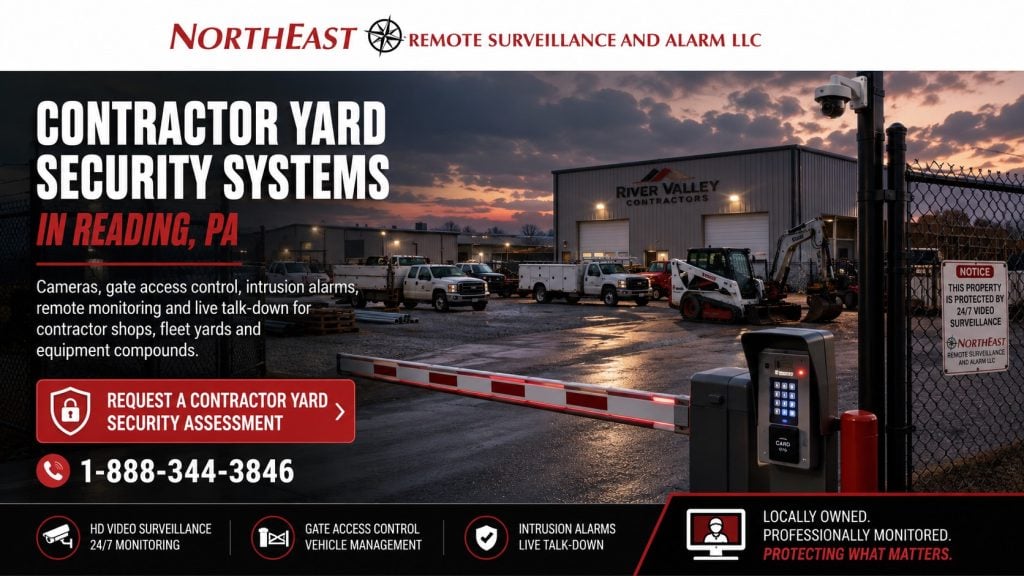
Contractor yard security systems in Reading, Pennsylvania should be designed around the way employees, service vehicles, work trucks, trailers, tools, machinery, materials, fuel, deliveries, gates, shops, storage buildings, and after-hours activity move through the property.
Northeast Remote Surveillance and Alarm, LLC designs and installs commercial video surveillance, vehicle-gate access control, license plate recognition, intrusion alarms, professional monitoring, remote video monitoring, live audio deterrence, intercoms, and low-voltage infrastructure for contractor shops, equipment compounds, fleet yards, service businesses, and outdoor material-storage properties throughout Reading.
A properly designed contractor yard security system should help authorized personnel determine:
- Which vehicle entered or left the property
- When employees or contractors arrived
- Whether equipment moved after hours
- Who approached a gate, shop, trailer, or storage area
- Whether someone crossed the perimeter
- What happened near tools, machinery, materials, or fuel
- Whether a visible event requires an immediate response
- Which camera recorded the incident
- Whether video can be located and exported later
- Whether the system can expand as the business grows
A smaller plumbing, electrical, HVAC, landscaping, roofing, or service contractor may need several outdoor cameras, a controlled vehicle gate, a commercial alarm, and secure remote viewing.
A larger excavation, paving, utility, mechanical, construction, or multi-location operation may require perimeter analytics, license plate recognition, fiber or wireless connections, remote video monitoring, outdoor speakers, several buildings, and centralized administration.
For complete commercial security planning beyond the yard, visit Commercial Security System Installation in Reading, PA.
Request a Reading Contractor Yard Security Assessment
Call 1-888-344-3846 to discuss security for a contractor shop, equipment yard, fleet property, or outdoor storage facility in Reading.
Commercial and industrial systems only • Yard cameras • Gate control • Vehicle identification • Intrusion alarms • Remote video monitoring • Small businesses through enterprise operations

Contractor Yards Require a Purpose-Built Security Plan
A contractor yard should not be treated as an ordinary parking lot.
The property may contain:
- Work trucks
- Service vans
- Trailers
- Excavators
- Skid steers
- Loaders
- Compact equipment
- Generators
- Compressors
- Copper and electrical material
- Pipe and fittings
- Lumber
- Roofing material
- Fencing
- Fuel
- Portable tools
- Attachments
- Scrap
- Containers
- Jobsite materials
- Outdoor storage racks
- Office and shop buildings
These assets may remain exposed after employees leave.
The property may also have long fence lines, limited lighting, changing material piles, trailers blocking camera views, remote gates, several buildings, and few employees present after normal hours.
A general four-camera package is rarely enough to provide dependable evidence and active after-hours protection across a complex outdoor property.
The security plan should divide the site into defined operating and protection areas, including:
- Vehicle entrance
- Employee entrance
- Visitor or delivery entrance
- Fleet parking
- Equipment storage
- Material storage
- Shop building
- Office
- Tool storage
- Fuel area
- Trailer parking
- Perimeter
- Remote buildings
- Loading or staging area
- Public-road boundary
Each proposed camera, alarm device, gate component, analytics rule, and monitored event should have a clear purpose.
Permanent Contractor Yard Security Versus Temporary Construction-Site Security
This page is intended for permanent contractor business properties such as shops, fenced equipment yards, fleet facilities, storage compounds, and operating bases.
A temporary construction site presents different conditions:
- Changing work areas
- Temporary fencing
- Limited electrical power
- Changing equipment positions
- Short-term camera locations
- Mobile surveillance requirements
- Temporary internet or cellular communication
- Frequent relocation
Temporary construction-site surveillance should be planned separately rather than added to this page solely to increase keyword coverage.
A contractor may need both types of systems: a permanent security platform at the company’s home yard and a temporary monitored solution at selected jobsites.
Commercial Video Surveillance for Contractor Yards
Commercial Video Surveillance Systems in Reading, PA explains broader camera design, image quality, recording, retention, analytics, remote access, cybersecurity, and local, cloud-managed, or hybrid platforms.
A contractor yard camera system may include:
- Fixed outdoor cameras
- Multi-sensor cameras
- Panoramic cameras
- PTZ cameras
- Low-light cameras
- Full-color nighttime cameras
- License plate recognition cameras
- Thermal cameras where appropriate
- Gate cameras
- Shop and office cameras
- Equipment-area cameras
- Perimeter detection cameras
- Cameras prepared for live monitoring
- Local or cloud-managed recording
- Multi-site video management
Camera selection should follow the required evidence.
A high-resolution camera does not automatically provide useful detail across an entire equipment yard. Distance, field of view, lens selection, mounting height, lighting, subject movement, recording settings, and physical obstructions affect the final image.
Define What Each Yard Camera Must Accomplish
A camera may be intended to provide:
- General yard overview
- Facial identification
- Vehicle identification
- License plate capture
- Equipment-area evidence
- Tool-storage coverage
- Gate verification
- Shop entrance documentation
- Fuel-area review
- Perimeter detection
- Alarm verification
- Live operator intervention
One camera should not automatically be expected to perform all of these functions.
A practical design may combine:
- A wide camera showing the overall event
- A closer camera identifying the person
- A gate camera showing the vehicle
- A dedicated camera capturing the plate
- A monitored camera detecting after-hours entry
Overview and identification views should be planned separately where one field of view cannot provide both.
Equipment and Machinery Security
Contractor equipment may be stored in open parking areas, behind buildings, along fence lines, under open-sided structures, or in changing locations throughout the yard.
Camera planning may cover:
- Excavators
- Skid steers
- Loaders
- Backhoes
- Trenchers
- Rollers
- Lifts
- Generators
- Compressors
- Attachments
- Utility trailers
- Specialty machinery
The system may help document:
- Equipment movement
- Unauthorized operation
- Loading or unloading
- After-hours access
- Vehicle damage
- Trailer attachment
- Equipment leaving the property
- Activity near ignition or storage areas
Video surveillance does not replace key control, immobilizers, GPS tracking, equipment locks, inventory procedures, or employee supervision.
These measures may work together as part of the contractor’s broader asset-protection plan.
Tool and Portable Equipment Storage
Portable tools may be kept in:
- Locked shops
- Tool rooms
- Storage containers
- Enclosed trailers
- Service vehicles
- Wire-mesh cages
- Exterior cabinets
- Mobile job boxes
Security may combine:
- Controlled doors
- Individual credentials
- Door-position monitoring
- Interior cameras
- Exterior cameras
- Intrusion detection
- Professional monitoring
- Video verification
Access control can record activity at a controlled opening, but it does not automatically identify which individual tool was removed.
Item-level accountability may require a separate barcode, RFID, checkout, or tool-management platform.
Material Storage Areas
Contractor yards may store copper, wire, pipe, conduit, lumber, roofing materials, fencing, metals, fixtures, equipment parts, and project-specific inventory.
Material storage may be exposed to:
- Theft
- Unauthorized employee access
- Vendor activity
- After-hours entry
- Weather-related relocation
- Scrap removal
- Vehicle impact
- Uncontrolled deliveries
- Changing inventory arrangements
Camera positions should account for the fact that stored material may block views as piles, racks, trailers, and containers move.
A camera layout should be reviewed with the yard operating normally—not only when the site is empty.
Fleet Vehicle Security
Contractor fleets may include:
- Service vans
- Pickup trucks
- Dump trucks
- Box trucks
- Bucket trucks
- Utility vehicles
- Crew vehicles
- Trailers
- Specialized service vehicles
A fleet-security system may help document:
- Employee arrival
- Vehicle departure
- Vehicle return
- After-hours use
- Damage
- Fuel-area activity
- Trailer attachment
- Material loading
- Unauthorized entry
- Gate activity
A commercial fleet yard differs from an ordinary employee parking lot because the vehicles may carry tools, materials, customer property, keys, fuel cards, and specialized equipment.
For general employee and visitor parking coverage, visit Reading Commercial Parking Lot Security Cameras.
Vehicle Gate Access Control
Reading Commercial Gate Access Control Systems covers vehicle-gate operators, credentials, intercoms, safety devices, cameras, remote release, and event reporting.
A contractor yard gate may need to serve:
- Employees
- Supervisors
- Service technicians
- Delivery drivers
- Vendors
- Contractors
- Customers
- Emergency responders
- After-hours arrivals
A coordinated vehicle entrance may include:
- Card or fob reader
- Mobile credential
- Keypad
- Long-range credential
- Video intercom
- Vehicle overview camera
- License plate camera
- Gate-position monitoring
- Safety loops
- Remote release
- Access schedules
- After-hours monitoring
The gate should be treated as a complete vehicle-control system.
The design should account for operator condition, safety devices, emergency access, vehicle stacking, lane width, communication, gate movement, power, and response during an outage.
A reader should not be added to an unsuitable or unsafe gate without reviewing the complete opening.
License Plate Recognition
Reading License Plate Recognition Camera Systems covers commercial plate capture, lane geometry, vehicle speed, camera position, lighting, recording, search, and gate integration.
Dedicated plate capture may help document:
- Employee vehicles
- Company vehicles
- Deliveries
- Vendor vehicles
- Trailers
- Unrecognized vehicles
- Inbound traffic
- Outbound traffic
Dependable plate capture depends on:
- Lane position
- Camera angle
- Distance
- Mounting height
- Vehicle speed
- Direction of travel
- Lighting
- Headlight exposure
- Plate size within the image
- Expected stopping location
A general yard overview camera should not automatically be expected to provide reliable plate evidence.
A dedicated plate camera may be paired with a wider vehicle view so authorized personnel can see the plate and the complete vehicle together.
Driver, Visitor, and Delivery Intercoms
Reading Commercial Intercom and Controlled Entry Systems covers video intercoms, gate stations, mobile answering, visitor communication, and approved remote release.
A contractor yard intercom may allow authorized personnel to:
- See the caller
- Communicate before granting access
- Confirm a delivery
- Direct a driver
- Review the surrounding area
- Release an approved gate
- Answer from an office or mobile device
- Record the interaction
- Manage after-hours arrivals
The intercom should be installed where a driver can use it safely.
Planning should consider:
- Vehicle position
- Mounting height
- Engine noise
- Weather exposure
- Audio quality
- Accessibility
- Network reliability
- Who answers
- What is verified
- When release is allowed
Employee and Shop Access Control
Reading Commercial Access Control Systems covers new controllers, readers, credentials, controlled doors, schedules, permissions, reporting, and multi-site administration.
Access control may be used at:
- Main employee entrance
- Shop entrance
- Office
- Tool room
- Parts room
- Storage building
- IT room
- Key room
- Fuel-control room
- Controlled material storage
- Remote building
Permissions may be organized by:
- Employee
- Department
- Shift
- Supervisor status
- Building
- Door group
- Contractor status
- Temporary assignment
- Authorization level
Former employees, contractors, vendors, and temporary users should be removed promptly.
Shared cards, shared alarm codes, and shared administrator credentials reduce accountability and make user removal more difficult.
Commercial Door Hardware
An access-control reader is only one part of a controlled opening.
The complete opening may include:
- Door
- Frame
- Lock
- Exit device
- Door closer
- Reader
- Controller
- Door-position contact
- Request-to-exit equipment
- Power supply
- Power-transfer hardware
- Automatic operator
- Emergency operation
A reader and electric lock cannot correct a door that fails to close, align, or latch.
Contractor shop doors may experience:
- Heavy daily use
- Cart or equipment impact
- Temperature changes
- Dirt
- Moisture
- Exterior exposure
- Worn closers
- Damaged exit devices
- Building movement
- Frequent propping
Door hardware should be reviewed as part of the security system rather than treated as an unrelated issue.
Commercial Intrusion Alarm Systems
Reading Commercial Intrusion Alarm Systems covers new commercial alarm panels, door protection, motion detection, partitions, panic devices, communication, verification, and monitoring.
A contractor yard alarm system may protect:
- Office
- Shop
- Storage buildings
- Tool rooms
- Material rooms
- Containers
- Remote structures
- Overhead doors
- Personnel doors
- Roof hatches
- Selected exterior areas
Protection may include:
- Door contacts
- Overhead-door contacts
- Interior motion detectors
- Glass-break detection
- Separate alarm partitions
- Panic or duress devices
- Cellular or IP communication
- Video verification
- Professional monitoring
Separate partitions may allow the office, shop, storage building, and yard-related areas to follow different operating schedules.
Alarm-zone names should identify locations clearly.
Descriptions such as “Rear Door” or “Motion 4” become difficult to interpret when a property has several buildings and exterior operating areas.
Professional Security Monitoring
Reading Commercial Security Monitoring covers communication paths, monitoring accounts, signal descriptions, contact lists, dispatch procedures, and alarm verification.
The monitoring plan should define:
- Which events are transmitted
- Who receives notifications
- Which signals result in dispatch
- Which cameras assist with verification
- Which contacts handle shop alarms
- Which contacts handle yard events
- How authorized after-hours work is handled
- What happens during communication failure
- How procedures change by schedule
- How former contacts are removed
Monitoring records should match the property’s current buildings, doors, users, and response procedures.
Remote Video Monitoring and Live Talk-Down
Reading Remote Video Monitoring and Live Talk-Down covers monitored cameras, operator verification, outdoor speakers, escalation procedures, and active after-hours intervention.
Remote video monitoring may be appropriate for contractor yards experiencing:
- Trespassing
- Equipment theft attempts
- Material theft
- Fuel theft
- Vehicle tampering
- Trailer entry
- Illegal dumping
- Unauthorized after-hours activity
- Perimeter entry
- Loitering
A properly designed monitored system may allow trained operators to:
- Review selected video events
- Determine whether activity appears authorized
- Issue live audio warnings
- Notify approved contacts
- Escalate according to written procedures
- Request law-enforcement response when appropriate
- Preserve event information
Remote video monitoring is more than sending motion notifications to a phone.
The site should be evaluated for:
- Camera position
- Detection zones
- Nighttime image quality
- Lighting
- Speaker coverage
- Network reliability
- Operating schedules
- Authorized contacts
- Escalation procedures
- Unwanted-event reduction
Existing cameras being prepared for active monitoring should use Reading Remote Video Monitoring Upgrades for a readiness assessment.
Outdoor Audio Deterrence
Outdoor speakers may support live or approved prerecorded warnings in selected yard areas.
Speaker planning should account for:
- Yard dimensions
- Equipment noise
- Traffic
- Nearby properties
- Building reflections
- Mounting locations
- Weather exposure
- Required coverage
- Network or amplifier requirements
- Monitoring procedures
Audio equipment should have a defined purpose.
Installing speakers without an operator process, schedules, contacts, and escalation instructions does not create a complete active-deterrence system.
Perimeter and Fence-Line Protection
A contractor yard may border:
- Public roads
- Wooded areas
- Railroad property
- Adjacent industrial sites
- Open fields
- Residential areas
- Shared driveways
- Vacant land
Perimeter security may use:
- Fixed cameras
- Multi-sensor cameras
- Defined analytics zones
- Thermal cameras where appropriate
- Gate monitoring
- Fence-line views
- Exterior lighting
- Remote video monitoring
- Outdoor audio
- Intrusion detection
The required objective should be identified first.
A camera may provide general visibility. An analytics rule may detect a person crossing a defined boundary. A thermal camera may improve detection under selected low-visibility conditions. A fixed identification view may show the person after entry.
No single device should automatically be expected to perform all perimeter functions.
AI Video Analytics
AI-supported analytics may help detect or search for:
- People
- Vehicles
- Direction of travel
- Line crossing
- Entry into defined areas
- Loitering
- After-hours activity
- Vehicle classification
- Activity near equipment
- Movement near material storage
- Perimeter entry
Analytics should support a specific operational goal.
A useful rule may detect a person entering a closed equipment area after hours. An overly broad rule may generate events from employees, vehicles, shadows, headlights, animals, rain, snow, or moving vegetation.
The design should establish:
- Which event matters
- Where detection applies
- When the rule is active
- Who receives the event
- Whether human verification is required
- What response is expected
- How unwanted events will be adjusted
Analytics do not correct poor camera placement, inadequate lighting, or unreliable networks.
Nighttime and Low-Light Yard Security
Many contractor yards are most vulnerable after employees leave.
Nighttime images may be affected by:
- Limited lighting
- Vehicle headlights
- Dark spaces behind trailers
- Material piles
- Building shadows
- Reflective metal
- Rain
- Snow
- Fog
- Camera infrared reflection
- Moving equipment
- Long distances
A camera that produces a strong daytime image may provide limited nighttime evidence.
The design may require:
- Improved ambient lighting
- Low-light cameras
- Full-color nighttime cameras
- Separate identification views
- Wide dynamic range
- Supplemental illumination
- Thermal detection
- Different mounting locations
- Exposure adjustments
The final design should be evaluated around the actual conditions present when the yard is closed.
Thermal Cameras for Selected Applications
Thermal cameras may support detection along:
- Remote fence lines
- Dark material-storage areas
- Open fields
- Exterior boundaries
- Long perimeter zones
- Low-visibility sections
Thermal cameras detect heat contrast rather than ordinary visible detail.
They may help detect a person or vehicle but may not provide the facial, clothing, vehicle-color, or plate evidence required for a complete investigation.
Thermal and visible-light cameras may be paired so one detects the event and the other supplies visual context.
PTZ and Multi-Sensor Cameras
PTZ cameras may help authorized operators inspect different areas of a large yard.
They may support:
- Live event review
- Gate observation
- Perimeter investigation
- Equipment-area review
- Vehicle tracking
- Remote monitoring
A PTZ camera looks in only one direction at a time.
Fixed cameras should continue recording critical gates, entrances, storage areas, and evidence points while the PTZ is viewing another section.
Multi-sensor cameras may provide broad simultaneous views across:
- Yard intersections
- Equipment parking
- Material areas
- Fleet sections
- Gate approaches
Broad coverage does not guarantee identification detail throughout the complete scene.
Shops, Garages, and Service Buildings
A contractor property may include:
- Repair shop
- Maintenance garage
- Fabrication area
- Parts room
- Office
- Employee area
- Tool storage
- Wash bay
- Fuel or fluid storage
- Small warehouse
- Detached building
Security may include:
- Interior cameras
- Exterior cameras
- Access-controlled doors
- Overhead-door contacts
- Intrusion detection
- Panic devices
- Professional monitoring
- Intercoms
- Equipment-room access
- Separate alarm partitions
For complete manufacturing-style shop and industrial building protection, visit Manufacturing Security Systems in Reading, PA.
Loading, Delivery, and Staging Areas
Contractor yards may receive or dispatch tools, equipment, job materials, trailers, and vendor deliveries.
Camera coverage may document:
- Delivery arrival
- Vehicle position
- Material unloading
- Employee interaction
- Equipment loading
- Trailer attachment
- Staging activity
- Departure
- Package or material condition
Where the operation includes formal dock doors, driver entrances, or high-volume shipping and receiving, visit Reading Loading Dock Security Systems.
Contractor Yards Versus Truck and Trailer Yards
Reading Truck and Trailer Yard Security Systems focuses on truck courts, large trailer rows, trucking operations, freight activity, vehicle lanes, and logistics perimeters.
This page focuses on contractor businesses storing:
- Work vehicles
- Trade equipment
- Tools
- Job materials
- Machinery
- Service trailers
- Fleet assets
- Outdoor inventory
A contractor yard may contain trucks and trailers, but its primary purpose is supporting field-service or construction operations rather than operating as a freight or trucking terminal.
Recording Retention for Contractor Yard Investigations
Yard incidents may not be discovered immediately.
Examples include:
- Missing tools
- Material shortages
- Equipment damage
- Vehicle damage
- Fuel discrepancies
- Trailer entry
- Unauthorized vehicle use
- Illegal dumping
- After-hours activity
- Employee incidents
- Vendor or delivery disputes
Retention should reflect how long the business normally takes to discover and investigate these events.
Storage planning may consider:
- Camera count
- Resolution
- Frame rate
- Compression
- Scene activity
- Continuous or event-based recording
- Required retention
- Future cameras
- Analytics metadata
- Cloud storage limits
- Network bandwidth
- Evidence-preservation procedures
A recorder should not be selected only by the number of available camera channels.
Video Playback and Evidence Export
Authorized personnel should be able to locate relevant footage efficiently.
Clear camera names may include:
- Main Gate – Vehicle Overview
- Main Gate – Plate Camera
- North Fence – Equipment Area
- East Yard – Material Storage
- Fleet Area – Service Vans
- Shop – Overhead Door 2
- Fuel Area – Pump Overview
- Office – Employee Entrance
- Trailer Row – West End
- South Perimeter – Fence Line
The system should allow authorized users to:
- Select the correct area
- Search a date and time
- Review synchronized cameras
- Search people or vehicles where supported
- Export a defined segment
- Capture a still image
- Verify the exported file
- Preserve important footage
- Identify which cameras supported the investigation
Generic names such as “Yard Camera 4” become difficult to manage as the property expands.
Local, Cloud-Managed, and Hybrid Systems
A contractor yard security platform may be local, cloud managed, or hybrid.
Local Systems
Local systems may retain recording and management equipment at the property.
They may continue local operation during an internet interruption but require appropriate:
- Hardware maintenance
- Storage planning
- Software updates
- Remote-access security
- Backups
- Administrator control
- Replacement planning
Cloud-Managed Systems
Cloud-managed platforms may simplify:
- Remote administration
- User management
- Software updates
- Multi-site access
- System-health monitoring
- Event notification
They may also involve:
- Recurring subscriptions
- Internet dependency
- Bandwidth requirements
- Retention limitations
- Manufacturer-specific licensing
- Cloud-account ownership concerns
Hybrid Systems
Hybrid designs may combine local recording with cloud administration, health monitoring, event management, remote access, or selected storage.
The correct approach depends on:
- Camera count
- Required retention
- Internet reliability
- Cybersecurity requirements
- Number of locations
- Internal IT capabilities
- Remote administration
- Subscription preferences
- Long-term ownership
Low-Voltage Cabling and Yard Infrastructure
Reading Commercial Low-Voltage Cabling and Security Infrastructure covers Cat6, fiber, managed PoE switching, pathways, wireless bridges, racks, cabinets, UPS equipment, and documentation.
A contractor yard project may require:
- Outdoor-rated Cat6
- Fiber between buildings
- Fiber to gates
- Alarm wiring
- Reader and lock wiring
- Intercom cabling
- Speaker cabling
- Conduit
- Trenching
- Pole-mounted enclosures
- Managed PoE switches
- Wireless bridges
- Cellular communication
- UPS equipment
- Security power supplies
- Surge-protection review
- Device labeling
Infrastructure planning should account for:
- Long distances
- Exterior exposure
- Available power
- Lightning and surge conditions
- Temperature
- Moisture
- Vibration
- Equipment impact
- Future additions
- Physical service access
A high-quality camera connected through unstable infrastructure remains unreliable.
Fiber and Wireless Connections
Fiber may be appropriate for:
- Detached shops
- Remote buildings
- Vehicle gates
- Camera poles
- Long exterior routes
- Multi-building properties
- High camera counts
Point-to-point wireless bridges may connect locations where trenching is impractical.
Successful wireless design depends on:
- Clear line of sight
- Mounting stability
- Distance
- Frequency conditions
- Bandwidth
- Available power
- Environmental exposure
- Alignment
- Network security
- Future obstructions
Wireless should not be selected only because it reduces cabling work. Long-term reliability and serviceability should be reviewed.
Backup Power and System Continuity
Yard security may depend on:
- Cameras
- PoE switches
- Wireless bridges
- Fiber equipment
- Gate controllers
- Intercoms
- Speakers
- Recorders
- Internet equipment
- Alarm panels
- Monitoring communicators
Backup planning may include:
- UPS equipment
- Panel batteries
- Supervised power supplies
- Gate backup power
- Network-switch backup
- Generator coordination
- Restart procedures
- Communication-path testing
- Surge-protection review
The system should be tested after power restoration to confirm that devices, gates, networks, recording, and remote connections return to normal operation.
Unified Contractor Yard Security
Reading Unified Commercial Security Systems covers coordinated management of video surveillance, access control, intrusion alarms, intercoms, gates, monitoring, and multiple buildings.
Useful integrations may include:
- Associating a gate credential with vehicle video
- Displaying video during an intercom call
- Recording when a gate or door is forced open
- Verifying selected alarm events
- Sending after-hours activity for operator review
- Connecting plate events with wider vehicle views
- Managing several buildings
- Applying consistent user permissions
- Centralizing multiple contractor locations
Integration should solve a specific operational problem.
It should not create unnecessary licensing, unsupported dependencies, or an environment that authorized customer personnel cannot manage.
New Systems Versus Existing-System Modernization
This page owns new contractor yard security-system design and expansion in Reading.
Existing properties with aging, inherited, unreliable, unsupported, or poorly documented equipment should begin with Reading Commercial Security System Upgrades, Retrofits, and Takeovers.
Reading Security Camera System Upgrades and Retrofits covers failed cameras, analog-to-IP migration, recorder replacement, retention, remote access, and phased video modernization.
Reading Low-Voltage Security Infrastructure Upgrades covers existing cabling, fiber, PoE switches, wireless bridges, cabinets, UPS equipment, power, and documentation.
Reading Commercial Security System Maintenance and Repair covers recurring failures, communication trouble, recording problems, damaged wiring, and defined repairs.
Existing equipment should be retained because it remains dependable, compatible, secure, and supportable—not merely because it is already installed.
Contractor Yard Security Installation Process
1. Initial Consultation
NERSA discusses the contractor’s operation, yard layout, vehicles, tools, equipment, materials, buildings, hours, current concerns, and future plans.
2. Property Assessment
The assessment may review:
- Vehicle entrance
- Employee entrance
- Perimeter
- Equipment storage
- Material storage
- Fleet parking
- Trailers
- Shop
- Office
- Tool storage
- Fuel area
- Lighting
- Existing cameras
- Camera mounting positions
- Network rooms
- Fiber routes
- Available power
- Monitoring procedures
3. Define Required Outcomes
Each camera, gate device, alarm point, analytics rule, intercom, and monitored event receives a clear purpose.
4. Design the Complete System
The design identifies equipment, recording, retention, vehicle identification, access control, alarms, monitoring, audio, cabling, networking, power, and future capacity.
5. Prepare a Written Scope
The customer should receive a defined scope identifying equipment, general locations, installation, software, licensing, infrastructure, responsibilities, exclusions, and optional work.
6. Coordinate Installation
Work can be planned around employee schedules, vehicle traffic, deliveries, gate access, shop activity, equipment movement, and approved downtime.
7. Program and Test
Testing may include:
- Day and nighttime camera views
- Recording
- Playback
- Evidence export
- License plate capture
- Analytics
- Gate operation
- Access credentials
- Alarm zones
- Monitoring signals
- Intercom communication
- Speaker coverage
- Remote viewing
- Network communication
- Backup power
8. Train Authorized Personnel
Training may cover live viewing, search, export, user permissions, gate operation, alarm procedures, event handling, and incident preservation.
9. Complete the Handoff
Handoff may include camera names, door and gate lists, user accounts, retention information, monitoring contacts, equipment locations, known limitations, and future recommendations.
What Affects Contractor Yard Security Cost?
Project cost depends on:
- Property size
- Yard layout
- Number of entrances
- Perimeter length
- Camera count
- Required image detail
- Dedicated plate cameras
- Gate equipment
- Intercom stations
- Access-controlled doors
- Intrusion-alarm points
- Remote video monitoring
- Outdoor speakers
- Recording retention
- Software and licensing
- Camera poles
- Trenching
- Conduit
- Fiber
- Wireless links
- Network and PoE capacity
- Available power
- Lighting
- Lift or bucket-truck access
- Number of buildings
- Work-hour restrictions
- Existing infrastructure
- Project phasing
A smaller service-company yard with one entrance and several vehicles has a different scope from a multi-acre equipment operation with several buildings, long fence lines, heavy machinery, remote monitoring, and centralized administration.
A site-specific assessment is required for an accurate proposal.
Common Contractor Yard Security Mistakes
Treating the Yard Like an Ordinary Parking Lot
Equipment, materials, trailers, fleet vehicles, and wide exterior boundaries require different coverage.
Relying Only on Building-Mounted Cameras
Building cameras may not show remote storage, fence lines, or activity behind vehicles and equipment.
Mounting Every Camera Too High
High cameras may provide broad views while losing identification detail.
Expecting One Camera to Cover the Entire Yard
Wide views may show an incident without showing the person, vehicle, or asset involved.
Expecting Overview Cameras to Capture Plates
Reliable license plate capture normally requires a dedicated vehicle-lane camera.
Ignoring Changing Material and Equipment Positions
Camera views should be evaluated under normal operating conditions.
Ignoring Nighttime Lighting
Strong daytime images do not establish nighttime performance.
Using Analytics Rules That Are Too Broad
Employees, vehicles, headlights, weather, animals, and vegetation can produce unnecessary events.
Installing Speakers Without a Response Procedure
Audio deterrence requires monitored events, schedules, contacts, and escalation instructions.
Ignoring Gate Safety and Emergency Operation
A gate-control project must include the complete operator, safety devices, communication, and emergency procedures.
Ignoring Network and Power Infrastructure
Weak cabling, insufficient PoE, unstable wireless communication, and inadequate backup power can interrupt security.
Selecting Too Little Recording Retention
Tool, equipment, and material loss may be discovered after footage has already been overwritten.
Using Generic Camera and Alarm Names
Names such as “Yard Camera” or “Back Motion” are difficult to interpret across a large property.
Failing to Document Administrator Ownership
Unknown cloud accounts, shared passwords, and former-provider control create long-term problems.
Maintenance and Lifecycle Planning
Outdoor systems should be reviewed periodically.
Maintenance may include:
- Confirming cameras are online
- Reviewing camera positions
- Cleaning lenses and housings
- Checking nighttime images
- Testing license plate capture
- Reviewing analytics
- Testing recording and retention
- Testing playback and export
- Inspecting poles and mounts
- Testing gates
- Testing intercoms
- Testing speakers
- Reviewing alarm zones
- Testing monitoring signals
- Checking wireless links
- Reviewing network switches and PoE
- Testing UPS equipment
- Removing former users
- Updating names and documentation
Yard conditions may change because of:
- New equipment
- Added trailers
- Different material piles
- New fencing
- Construction
- Vegetation
- Lighting changes
- Pole movement
- Vehicle impact
- Property expansion
- New buildings
- Changed traffic routes
A system that provided effective coverage when installed may need adjustment as the contractor’s operation grows.
Why Reading Contractors Choose NERSA
Commercial and Industrial Experience Since 2008
Northeast Remote Surveillance and Alarm, LLC has provided commercial security and low-voltage services since 2008.
Contractor-Yard-Focused Planning
The design considers fleet vehicles, tools, machinery, materials, gates, perimeter conditions, operating schedules, and after-hours risk.
Complete-System Evaluation
Cameras, license plate recognition, gate control, access control, intrusion alarms, monitoring, outdoor audio, cabling, networking, power, and documentation are considered together.
Small Contractors Through Enterprise Operations
NERSA supports smaller service contractors as well as large equipment compounds, multi-building properties, and multi-location organizations.
New Systems and Existing-System Support
Services include new installations, expansions, inspections, repairs, camera upgrades, infrastructure modernization, takeovers, integrations, and phased migration.
Practical Project Phasing
Installation can be coordinated around vehicle traffic, employee schedules, deliveries, equipment movement, shop operations, and available downtime.
Documented Customer Control
Authorized personnel should understand who controls the system, how users are managed, how events are reviewed, and how future support will be provided.
Reading and Nearby Contractor Markets Served
NERSA supports contractor yard security projects in:
- Reading
- West Reading
- Wyomissing
- Shillington
- Laureldale
- Temple
- Muhlenberg Township
- Exeter Township
- Spring Township
- Cumru Township
- Sinking Spring
- Mount Penn
- Kenhorst
- St. Lawrence
- Nearby Reading and Berks County commercial areas
For regional projects outside the city, begin with Greater Reading Area Commercial and Industrial Security Systems.
Frequently Asked Questions About Reading Contractor Yard Security
What is a contractor yard security system?
It is a coordinated commercial system designed to protect contractor vehicles, equipment, tools, trailers, materials, gates, shops, storage buildings, and exterior operating areas.
What types of contractors can use yard security?
Security may be appropriate for electrical, plumbing, HVAC, roofing, landscaping, excavation, paving, utility, concrete, fencing, mechanical, construction, service, and other commercial contractors.
How is a contractor yard different from a construction site?
A contractor yard is a permanent business property used to store vehicles, equipment, tools, and materials. A construction site is temporary and changes as the project progresses.
How is contractor yard security different from parking-lot security?
A contractor yard includes equipment, fleet assets, materials, tools, trailers, exterior storage, gates, and wide perimeter areas beyond ordinary employee parking.
How is contractor yard security different from a truck yard?
A contractor yard supports field-service and construction operations. A truck yard primarily supports freight, trucking, trailer storage, and logistics activity.
What security systems are commonly used?
Systems may include outdoor cameras, license plate recognition, gate access control, intrusion alarms, remote monitoring, live talk-down, intercoms, access control, and low-voltage infrastructure.
How many cameras does a contractor yard need?
Camera count depends on property size, layout, gates, buildings, perimeter, equipment locations, required evidence, lighting, and monitoring objectives.
Can building-mounted cameras cover the entire yard?
Sometimes for smaller sites, but larger or obstructed properties may require poles, remote cameras, fiber, or wireless connections.
Can cameras identify people entering the yard?
Yes, when suitable identification views are placed at predictable entrances or controlled points.
Can yard cameras read license plates?
Dependable plate capture normally requires dedicated LPR cameras positioned for the vehicle lane.
Can cameras document equipment movement?
Properly positioned cameras may show equipment arriving, leaving, loading, unloading, or moving through the property.
Can cameras track individual tools?
Cameras may provide visual evidence, but they do not replace a dedicated tool-checkout or inventory-management platform.
Can access control protect a contractor shop or tool room?
Yes. Individual credentials, controlled doors, event records, cameras, and alarm protection may be combined.
Can a vehicle gate use employee credentials?
Yes. Gates may use cards, fobs, mobile credentials, keypads, long-range credentials, or another supported method.
Can drivers or vendors call the office from the gate?
Yes. A video intercom may allow communication and approved remote gate release.
Can cameras integrate with a gate?
Yes. Compatible systems may associate credentials, plate events, intercom calls, and gate activity with video.
Can the yard use an intrusion alarm?
Yes. Shops, offices, storage buildings, overhead doors, and selected perimeter areas may be protected according to the approved design.
Can the yard be monitored after hours?
Yes. Suitable properties may use analytics, operator review, live audio warnings, and documented escalation.
Can operators speak to trespassers?
Yes, when appropriate speakers and a live monitoring procedure are included.
Can analytics detect people near equipment or material storage?
Possibly. Performance depends on camera placement, lighting, obstructions, schedules, and the configured detection rules.
Are thermal cameras useful?
Thermal cameras may support selected perimeter detection, but visible-light cameras may still be required for identification and incident detail.
Can multiple buildings be connected?
Yes. Buildings and remote yard areas may be connected using fiber, suitable networks, or properly designed wireless bridges.
Can cameras be installed where power is limited?
Selected locations may use extended cabling, fiber, wireless communication, or appropriately designed alternative power arrangements. The site must be evaluated.
Can the system continue recording if the internet fails?
Local and some hybrid systems may continue recording locally. Cloud-dependent functions may be interrupted.
Can several contractor locations be managed together?
Yes. Compatible systems may provide centralized viewing, user management, event review, and health reporting across multiple properties.
Can NERSA coordinate with our IT provider?
Yes. Coordination may include addressing, bandwidth, PoE, firewalls, segmentation, remote access, fiber, cloud platforms, and cybersecurity.
Can installation occur while the yard remains active?
Many projects can be phased around employees, vehicles, deliveries, equipment movement, and gate operation.
Can existing cameras or cabling be reused?
Possibly. Equipment should be evaluated for condition, compatibility, security, manufacturer support, and long-term reliability.
Can NERSA take over a system installed by another provider?
Sometimes. Takeover depends on authorized access, ownership, licensing, equipment condition, manufacturer restrictions, and supportability.
How much does contractor yard security cost?
Cost depends on property size, cameras, gates, perimeter coverage, monitoring, speakers, poles, fiber, wireless communication, power, recording, and project phasing.
Does NERSA support a small contractor?
Yes. A smaller contractor may need several cameras, a gate, an alarm, and remote viewing, while larger operations may require multi-building and enterprise systems.
How should a Reading contractor begin?
Begin with a site assessment covering gates, buildings, equipment, vehicles, materials, perimeter, lighting, infrastructure, operating schedules, and after-hours risks.
Request a Reading Contractor Yard Security Assessment
Contractor yard security should be designed around the property, assets, operations, and after-hours conditions it is expected to protect.
Northeast Remote Surveillance and Alarm, LLC can evaluate:
- Vehicle entrances
- Gate access control
- License plate recognition
- Driver intercoms
- Fleet parking
- Equipment storage
- Material storage
- Tool rooms
- Shop buildings
- Office entrances
- Trailers
- Fuel areas
- Perimeter fencing
- Low-light conditions
- Video analytics
- Thermal detection
- Commercial intrusion alarms
- Professional monitoring
- Remote video monitoring
- Outdoor audio
- Recording retention
- Evidence export
- Fiber and networking
- Wireless bridges
- Backup power
- Existing-system modernization
- Future expansion
Whether the project involves a smaller service contractor or a large multi-acre equipment and material yard, NERSA can develop a practical security system around the company’s present needs and long-term growth.
For complete Reading commercial-security planning, visit Commercial Security System Installation in Reading, PA.
For existing or inherited systems, visit Reading Commercial Security System Upgrades, Retrofits, and Takeovers.
Call 1-888-344-3846 to request a Reading contractor yard security assessment.
Commercial and industrial systems only • Yard surveillance • Gate control • Equipment protection • Live monitoring • Small contractors through enterprise operations