
Commercial and industrial security planning across Greater Reading starts with how your property operates.

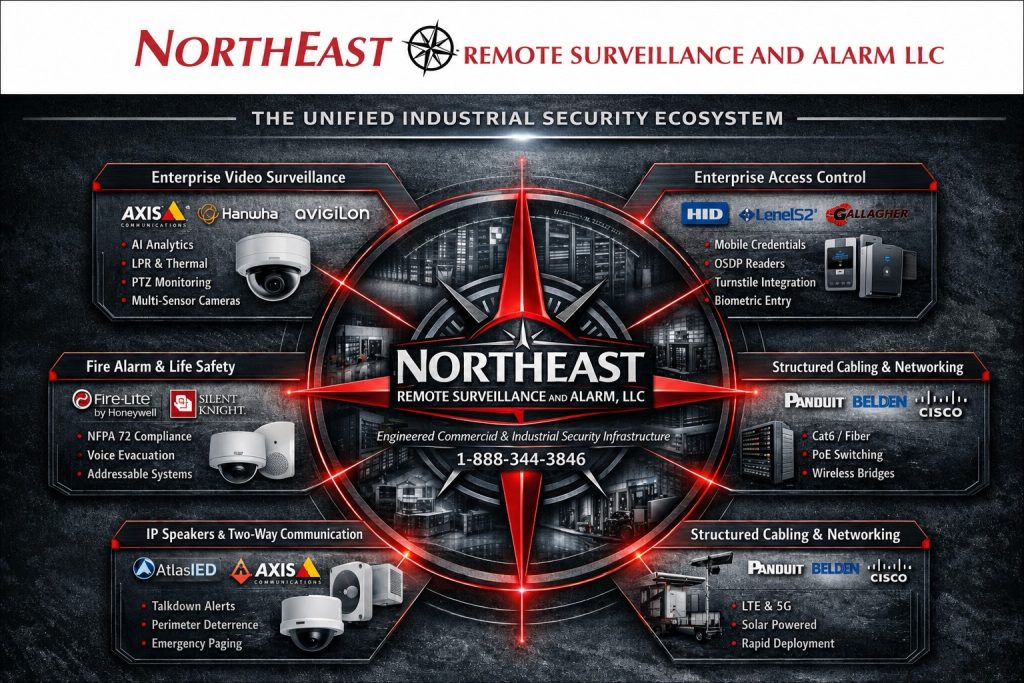
NERSA plans and installs cameras, access control, intrusion alarms and integrated systems for Reading and Berks County offices, warehouses and industrial facilities. We define entry, deliveries, after-hours response, installation scope, testing and staff training before recommending equipment. For an existing system, we also assess installed cameras, controllers, cabling and administrator access before proposing staged upgrades, retrofits or a provider takeover.
Northeast Remote Surveillance and Alarm, LLC (NERSA) plans installations, upgrades, monitoring, and support for businesses and industrial facilities.
First, identify the problem you need to solve. Then use the local and service guides below to plan a focused project or coordinate several systems.
Have a commercial security project in Reading or Berks County?
Call 1-888-344-3846 or request a quick quote.
No equipment list is required.
For properties beyond the Greater Reading area, use the Berks County commercial security guide to coordinate countywide services.
As a local example of NERSA’s industrial work, see the Drug Plastics & Glass project in Boyertown, which included network cabling, video surveillance and controlled entry.
Plan an Installation or Upgrade Around the Property
Define the work before comparing equipment
Describe what needs to improve at each entrance, camera area, or alarm zone. A request for more cameras may actually involve an obstructed view, confusing camera names, or difficulty exporting a recording. A door problem may involve hardware condition, permissions, or the way visitors request entry. Start with the task the business needs to perform, then evaluate the equipment that supports it.
For an office in Wyomissing, the initial scope might focus on reception, employee credentials, and the person responsible for visitor entry. A warehouse in the Greater Reading area may require a different discussion about driver arrivals, loading activity, shift changes, and after-hours contacts. These are planning examples, not claims about a particular completed project. The site assessment should establish the actual requirements.
Prepare useful information for an installer
Provide the property address, operating hours, affected areas, known faults, and available equipment records. Identify the facilities and IT contacts and any restrictions on installation access. If the property is leased, clarify who can approve changes to common areas, entrances, and shared infrastructure. This helps prevent a proposal from depending on permissions or access that have not been confirmed.
For an access-control project, list the doors and the groups who use them. For cameras, describe the activity that must be reviewed and the relevant lighting or work conditions. For monitoring, identify who currently receives events and which response steps are expected. Use the Reading service guides below to develop the part of the project that needs a more detailed review.
Separate installation from product supply
NERSA provides commercial security planning, installation, upgrades, and related support. An equipment list alone does not define a working system. If the request concerns a specific product, replacement component, or another specialized need, describe it directly during the assessment so availability, compatibility, and the appropriate scope can be reviewed. Do not assume that a general service page establishes stock, delivery terms, or support for every device.
Compare proposals using the same outcomes
Ask each proposal to identify equipment, installation, cabling, hardware work, programming, testing, training, and recurring charges. Keep exclusions and customer responsibilities visible. Different prices may reflect different assumptions about retained equipment, access to work areas, or the level of support included. Compare those assumptions before deciding that two proposals provide the same result.
For phased work, identify a usable outcome for each phase and document temporary limitations. Include the capacity needed for later expansion where it can be reasonably established. The operations team should understand what will change, which existing functions remain active, and who will coordinate any interruption.
Confirm the result with the people who use it
At handover, have authorized staff perform the agreed daily tasks. Review a representative recording, demonstrate a routine credential change, or walk through the relevant notification process. Coordinate alarm and monitoring tests with the responsible provider. Keep equipment names, account responsibilities, training material, and service contacts together.
Record unresolved items and distinguish them from improvements outside the approved scope. A clear handover gives future managers a practical starting point for service and expansion. It also helps owners evaluate whether the installation addressed the original business problem instead of simply adding equipment.
Commercial Security Infrastructure and Commissioning in Greater Reading
Specify the work behind the system. Greater Reading installations may require Cat6 or Cat6A cabling, tested fiber-optic connections between buildings, suitable PoE switching, equipment cabinets, network segmentation coordination, secure communications and reliable power for cameras, door controllers, intercoms and alarm equipment. NERSA can evaluate existing pathways and hardware before recommending replacement, new construction wiring or an incremental expansion. Every scope should distinguish equipment, cable and pathway work, configuration, testing, training and ongoing provider responsibilities.
Match the infrastructure to the site. A Wyomissing office entrance may depend on door hardware, visitor procedures and the tenant’s IT permissions. An operating Berks County warehouse may instead need protected loading-dock wiring, truck-entry communication, outdoor equipment enclosures and after-hours alarm zones. A remote gate or detached industrial building may call for a site-engineered point-to-point wireless link, suitable cellular signaling or power backup after a survey confirms feasibility. None of these options is a substitute for verifying conditions and obtaining required approvals.
Require documented results. Before handover, compare the installation against its agreed acceptance criteria: doors close and release appropriately, recorded views show the intended activity, intrusion and trouble signals identify the correct zone, communication failures are reported as designed, and authorized staff can retrieve records or update users. Keep the final device schedule, network and cabling responsibilities, system ownership, administrator access, test exceptions and service contacts. For deeper system-specific planning, use the Reading video-surveillance guide and Reading low-voltage infrastructure guide.
Security Planning Across Greater Reading
The area includes Reading, Wyomissing, West Reading, Muhlenberg Township, Exeter Township, Spring Township, and surrounding business communities. Older buildings may have inherited wiring and accounts, while newer facilities may need capacity for additional doors and cameras.
For example, a warehouse may prioritize driver entry and loading activity.
An office may need controlled visitor access and staff permissions.
Also review lighting, operating hours, available pathways, and the people responsible for managing the system.
For opening, closing, staff access, and manageable day-to-day operation, see Reading small-business security systems.
- Use Commercial Security Installation in Reading, PA to plan a new installation, an upgrade, or a takeover for a property within Reading city.
- Use Greater Reading Area Industrial Park Directory to identify industrial-park planning resources around Greater Reading.
- Use Reading Regional Airport Business Park Security Directory to review the security needs of airport-area business properties.
- Use Hamburg Logistics Center and Commerce Park Security Systems to explore logistics and commerce-park security planning in Hamburg.
Greater Reading Security Systems and Services
Start with the task your property needs to solve: camera coverage, controlled entry, intrusion detection, or ongoing monitoring.
For an existing system, review monitoring upgrades and provider takeovers.
Organizations with several locations should define consistent site standards before expanding.
The Reading service guides below explain each distinct scope.
Next, match each service to a defined need.
Cameras help document activity, controlled doors manage entry, and alarms report configured events.
Before connecting systems, agree on how that connection will improve everyday operation or incident review.
- Use Commercial Security Camera Installation and Video Surveillance in Reading, PA to plan useful camera coverage and recording for a Reading property.
- Use Commercial Access Control Systems in Reading, PA to organize controlled doors, credentials, and user permissions.
- Use Commercial Intrusion Alarm Systems in Reading, PA to plan intrusion detection and reporting around daily operations.
- Use Commercial Security Monitoring in Reading, PA to define event review and response responsibilities.
- Use Commercial Gate Access Control Systems in Reading, PA to review entry arrangements for commercial vehicle and pedestrian gates.
- Use Unified Commercial Security Systems in Reading, PA to coordinate supported security systems around a shared operating workflow.
- Use Multi-Site Commercial Security Systems in Reading, PA to plan consistent administration across several business locations.
- Use Commercial Fire Alarm Systems in Reading, PA to review commercial fire-alarm project planning.
- Use Fire Alarm Monitoring and Signal Review in Reading, PA to review fire-alarm reporting and monitoring considerations.
Guides for Specialized Properties
Different facilities need different access rules and operating procedures.
For example, a school, medical office, and industrial tool room should each have a plan that reflects who uses the space.
Use these guides to prepare a more specific assessment.
- Use Healthcare and Medical Office Security Systems in Reading, PA to plan security around staff, visitors, and medical-office operations.
- Use Municipal and Institutional Security Systems in Reading, PA to review controlled entry and security needs in public-serving facilities.
- Use School and Educational Facility Security Systems in Reading, PA to consider school access and everyday operating procedures.
- Use Tool Crib and Controlled Storage Access Control in Reading, PA to organize access to tools and controlled inventory storage.
Upgrades and Scalable Growth
First, inspect existing equipment and confirm authorized access to the accounts. Then identify what remains dependable and what needs repair or replacement. Reuse can make sense when the installed equipment supports the intended outcome.
For larger projects, plan spare capacity, consistent equipment names, staff permissions, and connections between buildings.
Also phase installation around occupied areas and approved downtime.
Finally, give the customer clear operating instructions, documentation, and support contacts.
- Use Reading Commercial Security System Upgrades, Retrofits and Takeovers to evaluate retained equipment and staged system improvements.
- Use Reading, PA Commercial Alarm System Upgrades and Takeovers to review existing intrusion-alarm equipment and takeover needs.
- Use Greater Reading Enterprise Security Assessment and System Planning to prepare coordinated security requirements for a larger organization.
- Use Facility assessment process to understand the information to gather for a facility review.
For a Reading-area property that needs visitor communication or supporting infrastructure, use commercial intercom and controlled-entry systems in Reading or commercial low-voltage and security infrastructure in Reading.
County Services Beyond the City
Greater Reading security projects may extend into other Berks County locations.
For those properties, continue with the county service guides and coordinate shared standards with the needs of each site.
- Use Video surveillance to plan camera systems for locations elsewhere in Berks County.
- Use Access control to review controlled-door planning across county properties.
- Use Intrusion alarms to organize intrusion protection for a county facility.
- Use Fire alarms to review commercial fire-alarm services across the county.
- Use Remote video monitoring to consider video event review and response for a county property.
- Use Cabling and fiber to plan the network pathways that support security equipment.
Industrial Sites, Vehicle Areas, and Local Information
Also consider the areas outside the main entrance: docks, parking, trailer storage, and vehicle gates.
Review real movement and lighting before choosing camera positions or entry equipment.
- Use Distribution centers to review security around receiving, inventory, and distribution operations.
- Use Manufacturing facilities to consider production-area access and manufacturing security needs.
- Use Truck yards and trailers to plan security around trailer storage and yard activity.
- Use Parking lots to review exterior camera coverage for vehicle parking areas.
- Use License plate cameras to consider dedicated camera planning for vehicle identification.
- Use Vehicle gates to review controlled entry for county commercial gates.
- Use Industrial and logistics properties to explore security needs across industrial and logistics sites.
- Use Greater Reading Chamber Alliance membership to read NERSA’s published information about its local business affiliation.
Frequently Asked Questions
Does NERSA plan both new installations and upgrades in Greater Reading?
Yes. NERSA plans commercial and industrial security installations, upgrades, monitoring, and support for Greater Reading and Berks County businesses. Start with the operating problem and installed equipment so the assessment can define a focused project or phased improvement.
What should I prepare for a Greater Reading security installation assessment?
Provide the property address, operating hours, affected areas, known faults, and available equipment records. Identify facilities and IT contacts, installation restrictions, and who can approve changes to leased or shared areas. These details help establish a workable project scope.
What should a Greater Reading security proposal include beyond equipment?
A proposal should identify installation, cabling, hardware work, programming, testing, training, recurring charges, exclusions, and customer responsibilities. Compare how each proposal addresses the same operating outcome. Confirm that the people who use the system can demonstrate the required tasks at handover.
Request a Greater Reading Assessment
Tell us how the property operates, what equipment is installed, and what needs to improve. NERSA can review a focused service need or a phased commercial and industrial project.
Request a Greater Reading Commercial Security Assessment.
Compliance, Codes & Project Standards
NERSA plans commercial and industrial security work with applicable code, documentation, inspection and authority-having-jurisdiction requirements in mind. Requirements vary by system, property and jurisdiction. These resources support project planning; they do not establish legal compliance, certification or AHJ approval.
Related guidance: Regulatory compliance & inspection readiness · NERSA project standards · Documentation, testing & inspection readiness