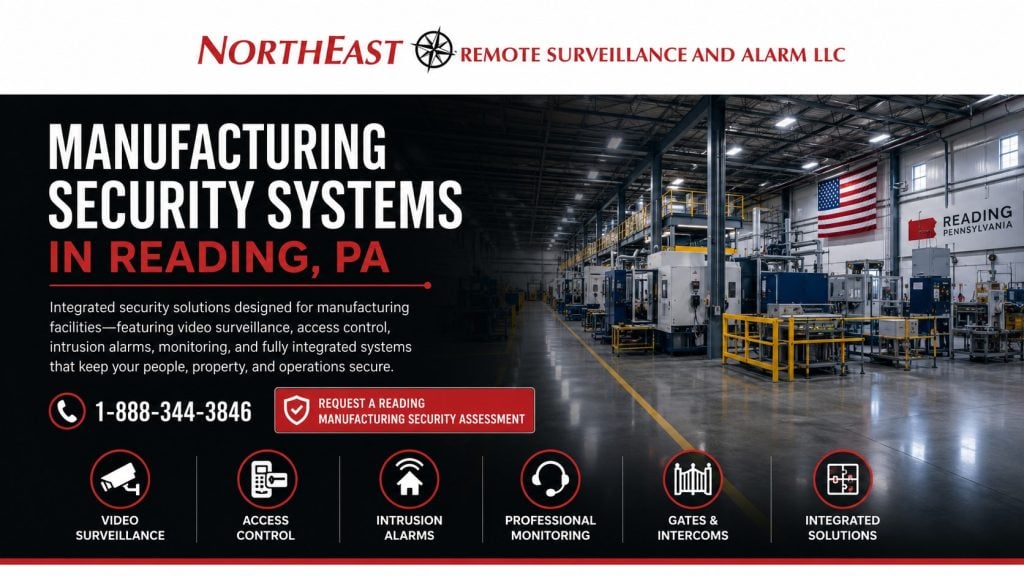
Manufacturing security systems in Reading, Pennsylvania should be designed around the way employees, contractors, visitors, delivery drivers, materials, tools, vehicles, production areas, shipping departments and restricted spaces move through the facility.
Northeast Remote Surveillance and Alarm, LLC designs and installs commercial video surveillance, access control, intrusion alarms, intercoms, professional monitoring, remote video monitoring, commercial door hardware and low-voltage infrastructure for manufacturing plants and industrial properties throughout Reading.
A manufacturing security system should do more than record general activity or restrict a few exterior doors. It should help authorized personnel manage employee access, investigate incidents, protect tools and materials, monitor loading operations, verify selected alarms, document vehicle activity and maintain appropriate separation between public, employee, production and restricted areas.
A smaller production building may require several carefully positioned cameras, controlled employee entrances and a commercial intrusion alarm. A large manufacturing plant may require hundreds of cameras, multiple access-control panels, department-based credentials, several alarm partitions, fiber between buildings, gate security, centralized administration and phased installation around continuous operations.
For broader new-system planning beyond manufacturing facilities, visit Commercial Security System Installation in Reading, PA.
For manufacturing-security guidance outside the Reading market, visit Manufacturing Plant Security Systems.
For facilities elsewhere in Reading and Berks County, begin with Greater Reading Area Commercial and Industrial Security Systems.
Request a Reading Manufacturing Security Assessment
Call 1-888-344-3846 to discuss security planning for a Reading manufacturing or industrial facility.
Commercial and industrial systems only • New installations • Plant expansions • Integrated security • Small facilities through enterprise operations

Security Designed Around the Manufacturing Operation
Manufacturing plants should not be secured using standardized commercial packages.
A production facility may operate across several shifts while its offices close at the end of the business day. Shipping and receiving may remain active after production stops. Maintenance personnel may require access to areas that ordinary employees do not. Vendors may need temporary entry without gaining access to the rest of the building.
The facility may also contain:
- Raw materials
- Finished products
- Tools and dies
- Controlled inventory
- Maintenance equipment
- Production machinery
- Quality-control areas
- Engineering offices
- Laboratories
- Server and network rooms
- Chemical or hazardous-material areas
- Shipping and receiving departments
- Outdoor storage
- Fleet vehicles
- Contractor work areas
- Multiple buildings
Each area may require a different combination of visibility, access permissions, alarm protection, monitoring and documentation.
The security design should begin by identifying how the plant operates and what management needs the completed system to accomplish.
A manufacturing security assessment may consider:
- Number of employees and shifts
- Employee and visitor entrances
- Contractor and vendor access
- Production schedules
- Shutdown periods
- Shipping and receiving activity
- Loading docks and overhead doors
- Inventory movement
- Tool and parts storage
- Restricted departments
- Research or engineering areas
- Exterior yards
- Vehicle entrances
- Employee parking
- Existing doors and hardware
- Existing cabling and network infrastructure
- Available power
- Required video retention
- Monitoring and response procedures
- Multi-building communication
- Future production or building expansion
The completed system should support the operation without creating unnecessary obstacles for employees, production, maintenance, shipping or emergency egress.
One Coordinated Manufacturing Security Environment
Manufacturing facilities often become difficult to manage when cameras, alarms, card readers, intercoms and monitoring accounts are installed separately by different providers.
A coordinated design considers how each system supports the others while allowing each platform to perform its primary function reliably.
Manufacturing Video Surveillance
Reading Commercial Video Surveillance Systems explains new commercial camera design, image quality, recording, retention, analytics, remote access and local, cloud-managed or hybrid video platforms.
Manufacturing video surveillance may help authorized personnel review:
- Employee entrances
- Production floors
- Shipping and receiving
- Loading docks
- Tool rooms
- Maintenance areas
- Finished-goods storage
- Raw-material storage
- Exterior yards
- Vehicle gates
- Parking areas
- Restricted rooms
- After-hours activity
Each camera should have a defined purpose.
A broad camera may show general activity across a production floor but fail to identify a person, tool or specific action. A closer camera may be required at an employee entrance, controlled storage room, shipping counter or other location where identification is important.
Manufacturing camera placement should account for:
- High ceilings
- Machinery
- Vibration
- Dust
- Heat
- Steam or moisture
- Variable lighting
- Welding or bright production processes
- Moving forklifts
- Tall inventory
- Changing storage layouts
- Long interior distances
- Restricted installation areas
Camera resolution alone does not determine whether the recorded image will be useful. Lens selection, field of view, mounting height, lighting, distance, frame rate and recording settings all affect the evidence the system can produce.
Production-Floor Camera Coverage
Production-floor cameras may provide general visibility, incident documentation and authorized operational review.
The design should identify whether each view is intended to show:
- General production activity
- Employee movement
- Material handling
- Equipment interaction
- Restricted-area entry
- Quality-control activity
- A specific production station
- The path of a product or component
- An incident involving machinery or vehicles
Cameras should be positioned so they do not interfere with equipment, safety barriers, cranes, ventilation, material movement or maintenance access.
A camera placed above a production floor may provide useful context while a separate detail camera documents activity at a critical station or controlled area.
Manufacturing Loading-Dock Surveillance
Reading Loading Dock Security Systems covers dock cameras, trailer-position views, overhead-door monitoring, driver entry, shipping documentation, intercoms, lighting and alarm coordination.
Manufacturing loading docks combine employees, drivers, trailers, forklifts, materials and frequent movement within a concentrated area.
A coordinated dock design may include:
- Exterior trailer-position cameras
- Dock-door overview cameras
- Driver identification views
- Shipping and receiving desk coverage
- Overhead-door contacts
- Controlled personnel doors
- Driver intercoms
- Vehicle entrance cameras
- Lighting improvements
- Video associated with access or alarm events
A general dock overview may document the sequence of an event, while separate identification views show the driver, vehicle, pallet, package or door involved.
Parking and Exterior Cameras
Reading Commercial Parking Lot Security Cameras covers employee parking, pedestrian routes, building entrances, vehicle movement, low-light performance and incident evidence.
Manufacturing parking and exterior surveillance may support:
- Employee safety
- Vehicle incident investigations
- Exterior-door activity
- Shift-change documentation
- After-hours detection
- Contractor and visitor activity
- Loading-area visibility
- General perimeter awareness
A wide parking-lot camera may provide situational awareness but may not provide dependable facial or plate identification across the entire lot.
Overview, entrance-identification and dedicated plate-capture views should be treated as separate design objectives.
License Plate Recognition
Reading License Plate Recognition Camera Systems covers commercial plate capture, vehicle-lane geometry, mounting position, lighting, speed, search and gate integration.
Dedicated plate capture may be useful at:
- Employee vehicle entrances
- Shipping gates
- Truck entrances
- Contractor entrances
- Controlled parking areas
- Remote industrial buildings
Successful license plate recognition depends on lane width, camera angle, distance, vehicle speed, lighting, mounting height and plate size within the recorded image.
An ordinary overview camera should not automatically be expected to provide reliable plate evidence.
Manufacturing Access Control Systems
Reading Commercial Access Control Systems covers new controllers, readers, credentials, access levels, schedules, reporting, controlled doors and multi-site administration.
Manufacturing access control helps management determine who may enter particular buildings, departments, rooms or gates and when that access is permitted.
Credentials may be organized according to:
- Employee
- Department
- Shift
- Job function
- Supervisor status
- Contractor
- Vendor
- Building
- Tenant
- Temporary assignment
- Authorization level
Access control may be appropriate for:
- Employee entrances
- Production areas
- Tool rooms
- Maintenance departments
- Engineering offices
- Laboratories
- Quality-control rooms
- Server and network rooms
- Electrical rooms
- Inventory cages
- Finished-goods storage
- Exterior buildings
- Vehicle gates
The objective is not necessarily to control every interior door.
Controlled openings should be selected according to actual operational, accountability and security requirements.
Employee Entrance Security
Reading Commercial Employee Entrance Security Systems covers employee credentials, identification cameras, controlled doors, visitor separation, forced-door conditions, held-open alerts and shift-based permissions.
Employee entrances are often where video surveillance, access control, intrusion alarms and commercial door hardware intersect.
A coordinated employee entrance may include:
- Card, fob or mobile credential reader
- Identification camera
- General vestibule camera
- Door-position monitoring
- Forced-door notification
- Held-open-door notification
- Request-to-exit equipment
- Intercom communication
- Visitor-routing procedures
- Shift-based schedules
- Video associated with access events
Former employees, contractors and temporary users should be removed promptly through an organized credential-management process.
Access permissions should not depend on shared credentials or undocumented administrative accounts.
Tool Cribs and Controlled Storage
Reading Tool Crib and Controlled Storage Access Control covers restricted tools, parts, maintenance supplies, inventory cages, credential permissions, cameras and door monitoring.
Tool rooms and controlled-storage areas often require more detailed accountability than ordinary employee entrances.
A coordinated system may document:
- Who entered
- When access occurred
- Which door was used
- Whether the door remained open
- Which camera recorded the event
- Whether access occurred outside the person’s normal schedule
Controlled storage may include:
- Tools
- Dies
- Replacement parts
- Maintenance supplies
- High-value inventory
- Electronic components
- Keys
- Testing equipment
- Specialized machinery
- Regulated or sensitive materials where applicable
The access-control system should support the customer’s operating procedures rather than replace inventory-management or supervisory responsibilities.
Department and Shift-Based Permissions
Manufacturing plants may require different access schedules for production, maintenance, administration, shipping, quality control and contractors.
Permissions may be structured so that:
- Production employees enter during approved shifts
- Maintenance staff access equipment areas as required
- Office personnel do not automatically enter production rooms
- Contractors receive temporary permissions
- Vendors enter only designated areas
- Supervisors receive broader access
- Restricted areas require separate authorization
- Local managers control only their assigned facility
The system should be designed so authorized administrators can understand and maintain the access structure without relying on one former employee or installer.
Commercial Door Hardware for Manufacturing Facilities
Reading Commercial Door Access and Electrified Hardware covers electric strikes, electrified locks, exit devices, request-to-exit equipment, door contacts, power supplies and coordinated controlled-opening design.
The card reader is only one component of an access-controlled opening.
The complete opening may include:
- Door
- Frame
- Lock
- Exit device
- Door closer
- Reader
- Controller
- Door-position contact
- Request-to-exit device
- Power supply
- Power-transfer equipment
- Automatic operator
- Emergency-release operation
A new reader will not correct a door that drags, fails to close, does not latch or has unsuitable locking hardware.
Manufacturing doors may also be affected by:
- Heavy use
- Forklift or cart impact
- Building movement
- Temperature changes
- Exterior exposure
- Oversized doors
- Existing panic hardware
- Fire-rating requirements
- Automatic operators
- Air-pressure differences
Controlled egress, panic hardware, fire-rated doors, magnetic locks, delayed-egress arrangements and automatic operators require project-specific review and coordination.
Manufacturing Intrusion Alarm Systems
Reading Commercial Intrusion Alarm Systems covers new alarm panels, door protection, overhead-door contacts, motion detection, partitions, panic devices, communication and professional monitoring.
Manufacturing intrusion alarms should reflect how the facility is occupied and armed.
A plant may include:
- Offices that close before production
- Production areas operating overnight
- Shipping departments with separate hours
- Maintenance areas requiring after-hours access
- Exterior storage buildings
- Multiple tenants
- Several buildings
- Weekend operations
- Seasonal shutdown periods
A single alarm partition may not provide the flexibility needed for a complex facility.
Partitions can allow authorized users to arm or disarm selected areas without changing the protection status of the entire property.
Manufacturing Alarm Devices
Depending on the building and approved design, protection may include:
- Exterior-door contacts
- Overhead-door contacts
- Interior motion detectors
- Glass-break detection
- Roof-hatch contacts
- Restricted-room protection
- Equipment or environmental alerts
- Panic and duress devices
- Separate building partitions
- Cellular or IP communication
- Video verification
Alarm-zone descriptions should identify the protected location clearly.
Generic labels such as “Zone 4” or “Rear Motion” make alarm response, testing and troubleshooting more difficult as the facility expands.
Professional Security Monitoring
Reading Commercial Security Monitoring covers signal communication, monitoring accounts, contact lists, dispatch instructions, opening and closing reports and alarm verification.
Professional monitoring connects alarm activity with a documented notification and response process.
The customer should understand:
- Which signals are transmitted
- Who receives notifications
- Which conditions result in dispatch
- What information the monitoring center receives
- Which contacts are authorized
- How call lists are updated
- How opening and closing reports are handled
- What happens when communication fails
- How false alarms are reviewed
Manufacturing monitoring may involve several buildings, alarm partitions, shifts and response contacts.
The account should be organized so signal descriptions and instructions match the current facility.
Remote Video Monitoring and Live Intervention
Reading Remote Video Monitoring and Live Talk-Down covers monitored cameras, analytics, operator review, outdoor speakers, escalation procedures, site schedules and after-hours intervention.
Remote video monitoring may be useful for manufacturing properties with:
- Exterior yards
- Remote buildings
- Equipment storage
- Truck courts
- Employee parking
- Vehicle gates
- Loading docks
- Recurring trespassing
- After-hours vehicle activity
- Large perimeter areas
A properly designed monitored system may allow trained operators to review selected events, issue live audio warnings, notify approved contacts and escalate activity according to documented procedures.
Remote monitoring requires more than enabling motion alerts.
The site should be evaluated for:
- Camera position
- Image quality
- Detection areas
- Analytics
- Lighting
- Network reliability
- Event transmission
- Audio coverage
- Operating schedules
- Authorized contacts
- Escalation instructions
Manufacturing Intercom and Controlled Entry Systems
Reading Commercial Intercom and Controlled Entry Systems covers video intercoms, visitor communication, loading-dock stations, gate entry, mobile answering and remote release.
Manufacturing intercoms may support:
- Main visitor entrances
- Employee entrances
- Shipping gates
- Loading docks
- Remote buildings
- Contractor entrances
- Secure production areas
- After-hours delivery points
A coordinated system may allow authorized personnel to see the visitor, communicate with the person, review the surrounding area and release an approved door or gate.
The intercom should support a clear entry procedure rather than simply adding another device at the entrance.
Gate Access and Vehicle Control
Reading Commercial Gate Access Control Systems covers vehicle gates, operators, credentials, intercoms, safety devices, cameras, remote release and event reporting.
A manufacturing vehicle entrance may need to distinguish among:
- Employees
- Delivery drivers
- Contractors
- Vendors
- Fleet vehicles
- Visitors
- Emergency responders
- After-hours arrivals
A coordinated gate project may include:
- Credential readers
- Keypads
- Mobile entry
- Long-range credentials
- Gate intercoms
- Vehicle cameras
- License plate recognition
- Gate-position monitoring
- Safety loops
- Remote release
- Access schedules
- After-hours monitoring
Gate access should be designed as a complete vehicle-control system rather than as a reader attached to an operator without considering safety, communication, visibility and emergency procedures.
Low-Voltage Cabling, Fiber and Network Infrastructure
Reading Commercial Low-Voltage Cabling and Security Infrastructure covers new Cat6, fiber, alarm wiring, reader cabling, pathways, PoE switching, wireless bridges, racks, UPS equipment and system documentation.
Manufacturing security devices depend on the infrastructure supporting them.
A plant installation may require:
- Cat6 or Cat6A
- Fiber between buildings
- Alarm wiring
- Reader wiring
- Door-control wiring
- Conduit
- Cable tray
- Managed PoE switches
- Equipment racks
- Network cabinets
- Wireless bridges
- UPS equipment
- Security-system power supplies
- Backup batteries
- Equipment labeling
- Network documentation
Infrastructure planning should account for:
- Long distances
- Multiple network rooms
- Electrical interference
- High ceilings
- Outdoor routes
- Temperature
- Moisture
- Dust
- Future additions
- Access for service
- Network segmentation
- PoE capacity
- Backup power
A modern camera installed on failing cabling remains unreliable. An access-control platform connected to weak power or damaged door wiring may continue producing trouble. A recorder connected to an undersized network may lose video or perform poorly.
Unified Manufacturing Security Systems
Reading Unified Commercial Security Systems covers coordinated management of cameras, access control, intrusion alarms, intercoms, monitoring, vehicle gates and multiple buildings.
Useful manufacturing integrations may include:
- Displaying video with an access event
- Recording when a door is forced open
- Reviewing denied access attempts
- Verifying selected alarm events
- Associating dock video with overhead-door activity
- Connecting gate access with vehicle video
- Releasing an approved entrance through an intercom
- Managing several buildings from one interface
- Applying consistent user permissions
- Centralizing event reporting
Integration should solve an operational problem.
It should not force the facility into unnecessary subscriptions, unsupported dependencies or a platform that becomes too complex for authorized personnel to manage.
New Manufacturing Systems Versus Existing-System Modernization
This page owns new and expanded manufacturing security-system design in Reading.
Existing plants with aging, inherited, unsupported, unreliable or poorly documented equipment should begin with Reading Commercial Security System Upgrades, Retrofits and Takeovers, which evaluates cameras, access control, alarms, monitoring, door hardware, cabling, power, networks and administrative control before replacement decisions are made.
Reading Security Camera System Upgrades and Retrofits covers analog-to-IP migration, camera replacement, DVR-to-NVR modernization, recording retention, remote access and phased video improvements.
Reading Access Control Upgrades and Door Hardware Retrofits addresses existing controllers, readers, credentials, access levels, electric locks, exit devices, power supplies and controlled-door corrections.
Reading Commercial Alarm System Upgrades and Takeovers covers inherited alarm panels, zones, users, partitions, communicators, monitoring transfers and provider takeovers.
Reading Commercial Security System Maintenance and Repair covers failed equipment, intermittent trouble, recording problems, communication faults, damaged wiring and defined repairs.
Reading Low-Voltage Security Infrastructure Upgrades addresses existing cabling, fiber, PoE switching, wireless links, network cabinets, racks, UPS equipment and labeling.
Reading Security Monitoring Upgrades covers monitoring-provider changes, communication-path improvements, contact-list corrections, signal testing and response procedures.
Reading Security-System Documentation and Administrator Recovery helps authorized manufacturers recover system control, rebuild records and document cameras, doors, alarm zones, cloud accounts, networks and licenses.
Reading Multi-Site Security-System Standardization helps organizations establish consistent equipment, credentials, naming, monitoring, permissions and documentation across existing facilities.
Reading Remote Video Monitoring Upgrades evaluates whether existing cameras, analytics, lighting, speakers and networks can support active remote monitoring.
Reading Commercial Door Access System Retrofits focuses on existing controlled doors, locks, exit devices, readers, request-to-exit equipment, power supplies and required life-safety coordination.
Security Planning by Manufacturing Area
A manufacturing plant should not be treated as one undivided security zone.
Production, administration, shipping, maintenance, engineering, employee parking, exterior storage, and utility areas may operate on different schedules and present different risks.
The design should identify what each area requires rather than applying the same cameras, credentials, alarm devices, or monitoring procedures throughout the entire property.
Production Areas
Production-floor security may support incident review, restricted-area control, operational visibility, and after-hours protection.
Possible security measures include:
- Wide-area production cameras
- Detail cameras at selected workstations
- Access control on restricted production rooms
- Door-position monitoring
- Employee identification at controlled entrances
- Intrusion protection during shutdown periods
- Video associated with forced-door or denied-access events
- Separate permissions for employees, supervisors, maintenance personnel, and contractors
Camera placement should account for machinery, safety barriers, material movement, overhead cranes, ventilation, changing production lines, and maintenance access.
A broad camera can provide context across the production floor, while closer views may be needed where identification, process review, or controlled access is important.
Shipping and Receiving Areas
Shipping and receiving areas combine employees, drivers, forklifts, trailers, pallets, packages, exterior doors, and frequent vehicle movement.
Reading Loading Dock Security Systems explains dock cameras, driver entry, overhead-door monitoring, shipping documentation, intercoms, lighting, and coordinated alarm protection.
A manufacturing shipping area may require:
- Trailer-position cameras
- Exterior dock approaches
- Driver identification views
- Dock-door overview cameras
- Shipping desk surveillance
- Receiving-area cameras
- Overhead-door contacts
- Controlled personnel entrances
- Vehicle entrance coverage
- Intercom communication
- Video retention suitable for later delivery investigations
The system should help authorized personnel determine:
- When the vehicle arrived
- Which dock was used
- Who entered the building
- When loading or unloading began
- What material moved
- Whether the overhead door remained open
- When the vehicle departed
A general dock overview may show the sequence of activity, but separate detail views may be needed to identify the driver, package, pallet, trailer, or specific door involved.
Warehouse and Inventory Areas
Reading Warehouse Security Systems covers high-bay cameras, inventory areas, employee entrances, loading docks, overhead doors, trailer yards, access control, alarms, and integrated warehouse protection.
Manufacturing plants with attached warehouses may require surveillance across:
- Raw-material storage
- Work-in-process inventory
- Finished products
- Parts storage
- Shipping staging
- Receiving areas
- High-value inventory
- Restricted cages
- Returned goods
- Scrap or recycling areas
Warehouse camera placement should account for high shelving, changing inventory, long aisles, forklifts, blind intersections, and high ceilings.
Inventory discrepancies may not be discovered immediately, so recording retention should be selected around the company’s investigation cycle rather than a default number of days.
Access control may also be appropriate where specific inventory, components, or finished goods should be limited to approved employees.
Distribution and Fulfillment Operations
Reading Distribution Center Security Systems covers large logistics environments involving receiving, storage, picking, packing, shipping, employee entrances, truck courts, and centralized security administration.
Manufacturing facilities with high-volume distribution operations may need coordinated visibility across:
- Receiving lanes
- Staging areas
- Picking zones
- Packing stations
- Shipping lanes
- Dock doors
- Trailer lots
- Employee entrances
- Inventory-control areas
- Vehicle gates
The completed system should help management investigate missing products, document vehicle movement, review loading activity, verify access, and maintain consistent coverage across large operating areas.
Tool Rooms, Parts Storage, and Maintenance Areas
Reading Tool Crib and Controlled Storage Access Control addresses restricted tools, parts, maintenance supplies, credential permissions, door monitoring, and associated camera evidence.
Manufacturing tool rooms may contain:
- Precision tools
- Dies
- Molds
- Replacement components
- Electrical equipment
- Calibration devices
- Maintenance supplies
- Specialized machinery
- Keys
- Portable test equipment
A coordinated system may document who entered, when access occurred, whether the door was left open, and which nearby camera recorded the event.
Access permissions may be limited by:
- Department
- Shift
- Job function
- Supervisor approval
- Temporary assignment
- Contractor status
Security controls should support the company’s inventory and accountability procedures without pretending to replace tool-management or supervisory processes.
Engineering, Research, and Quality-Control Areas
Engineering offices, testing rooms, laboratories, prototype spaces, and quality-control departments may require more restrictive access than general production areas.
Possible controls include:
- Department-based credentials
- Visitor escort procedures
- Door-position monitoring
- Entry cameras
- Restricted remote viewing
- Separate alarm zones
- Individual administrator permissions
- Audit reporting where supported
- Controlled storage for drawings, prototypes, or test equipment
The design should distinguish legitimate confidentiality or operational requirements from unnecessary restrictions that interfere with normal work.
Access levels should be understandable and maintainable by authorized company personnel.
Server Rooms, Network Closets, and Electrical Rooms
Technology and utility spaces often support the entire manufacturing operation.
Security may include:
- Credentialed access
- Door-position monitoring
- Entry cameras
- Intrusion protection
- Temperature or selected environmental notifications
- Individual user accounts
- Event reporting
- Restricted administrator permissions
Reading Commercial Access Control Systems covers new readers, controllers, credentials, schedules, reporting, and controlled-door administration for commercial facilities.
These rooms should not be controlled solely because electronic equipment is present. The system should reflect the company’s IT, maintenance, safety, and emergency-access procedures.
Chemical, Hazardous, or Special-Process Areas
Some manufacturing facilities contain materials or processes requiring restricted entry, specialized equipment, or additional safety procedures.
Security planning may involve:
- Restricted credentials
- Separate authorization levels
- Door-status monitoring
- Entry cameras
- Visitor and contractor procedures
- Intercom communication
- Alarm reporting
- Coordination with safety and facilities personnel
Security equipment used near hazardous or classified environments must be selected and installed appropriately for the specific location.
Ordinary cameras, readers, power supplies, or wiring methods should not be installed in specialized areas without project-specific review.
Administrative Offices Within Manufacturing Plants
Reading Office Building Security Systems covers employee access, visitor entry, reception cameras, server rooms, parking surveillance, alarms, panic devices, and multi-tenant administration.
Manufacturing offices may require security for:
- Reception
- Human resources
- Accounting
- Executive offices
- Engineering departments
- Records rooms
- Server rooms
- Employee entrances
- Visitor areas
- Rear office doors
Office and production areas may operate on different schedules.
The access-control and intrusion-alarm design may allow the office section to be secured while production continues elsewhere in the building.
Employee Parking and Shift Changes
Reading Commercial Parking Lot Security Cameras covers parking-area overview, pedestrian routes, building entrances, low-light performance, vehicle movement, and incident evidence.
Manufacturing parking areas may experience concentrated activity during shift changes.
A parking-security design may include:
- General lot overview
- Employee walkway coverage
- Building entrance cameras
- Vehicle entrance and exit views
- Exterior lighting review
- Accessible parking coverage
- Rear or remote employee parking
- Monitored after-hours activity
Parking cameras should be designed according to the required evidence.
A wide camera may show the general sequence of an incident but fail to identify a person or vehicle. Identification views should be positioned separately where necessary.
Truck Courts, Trailer Lots, and Fleet Areas
Reading Truck and Trailer Yard Security Systems covers truck courts, fleet facilities, trailer storage, vehicle gates, plate capture, outdoor cameras, perimeter analytics, speakers, and after-hours monitoring.
Manufacturing properties with truck and trailer activity may face:
- Cargo theft
- Trailer entry
- Fuel theft
- Unauthorized vehicle movement
- Trespassing
- Vandalism
- Illegal dumping
- After-hours loitering
- Unverified trailer arrivals or departures
A coordinated yard system may use:
- Fixed perimeter cameras
- Multi-sensor cameras
- Dedicated vehicle views
- License plate recognition
- Gate access control
- Video analytics
- Outdoor speakers
- Remote video monitoring
- Building intrusion alarms
- Cellular or wireless connectivity
The design should account for long distances, weather, lighting, changing trailer positions, vehicle headlights, available power, and network access.
Outdoor Equipment and Material Storage
Reading Contractor Yard Security Systems covers equipment compounds, exterior materials, fleet vehicles, perimeter detection, gate cameras, monitored video, and active after-hours intervention.
Manufacturing properties may store equipment, raw materials, containers, scrap, vehicles, or machinery outside the main building.
Outdoor security planning should consider:
- Fence lines
- Vehicle access
- Pedestrian entry
- Lighting
- Equipment movement
- Nearby public roads
- Adjacent properties
- Vegetation
- Weather
- Mounting structures
- Network connectivity
- Available power
The system should distinguish normal activity from events requiring attention.
Poorly configured outdoor analytics can generate unnecessary alarms from animals, shadows, headlights, rain, snow, or moving vegetation.
Visitor, Vendor, and Contractor Management
Manufacturing facilities regularly receive delivery drivers, service technicians, contractors, inspectors, vendors, and visitors.
The security system should support a clear entry process.
Possible measures include:
- Designated visitor entrance
- Video intercom
- Reception communication
- Temporary credentials
- Limited access permissions
- Visitor badges
- Escort procedures
- Entry cameras
- Gate communication
- Credential expiration
- Contractor access schedules
Reading Commercial Intercom and Controlled Entry Systems covers visitor communication, video intercoms, gate stations, reception control, mobile answering, and approved remote release.
Temporary access should expire automatically where the platform supports it.
A contractor credential should not remain active indefinitely after the project ends.
Panic and Duress Protection
Panic or duress devices may be appropriate in selected manufacturing locations, including:
- Reception
- Shipping offices
- Guard stations
- Cash-handling areas
- Human resources
- Remote employee work areas
- Public-facing counters
- Management offices
The response procedure should be established before devices are installed.
Planning should define:
- Which event the device reports
- Whether the signal is silent or local
- Who receives the notification
- Whether monitoring dispatch is required
- Which cameras assist with verification
- How employees are trained
- How devices are tested
- How accidental activation is handled
A panic device should not be added without a clear response plan.
Fire Alarm Systems and Life-Safety Coordination
Reading Commercial Fire Alarm Systems and Monitoring covers commercial fire alarm installation, monitoring, communication, sprinkler supervision, testing, documentation, and building-system coordination.
Fire alarm work must remain separate from ordinary security-system work.
Manufacturing life-safety projects may involve:
- Fire alarm control equipment
- Smoke or heat detection
- Manual pull stations
- Notification appliances
- Fire alarm communicators
- Sprinkler waterflow supervision
- Valve-tamper supervision
- Elevator interfaces
- HVAC shutdown
- Door-release interfaces
- Monitoring
- Testing
- Inspection support
- Documentation
The final scope depends on the occupancy, manufacturing process, building arrangement, existing system, adopted codes, equipment listings, permit requirements, and authority having jurisdiction.
Access control, magnetic locks, stairwell doors, automatic operators, and fire-rated openings may require coordination with the fire alarm system and approved emergency operation.
Security devices must not interfere with required egress or life-safety functions.
Local, Cloud-Managed, and Hybrid Manufacturing Systems
Manufacturing security platforms may be local, cloud managed, or hybrid.
The correct architecture depends on the customer’s operation rather than a claim that one model is always superior.
Local Systems
A local platform may keep recording, access-control databases, alarm programming, or other management functions at the facility.
This can provide direct on-site operation but requires appropriate:
- Hardware maintenance
- Backups
- Software support
- Remote-access protection
- Storage planning
- Administrator control
- Replacement planning
Cloud-Managed Systems
Cloud-managed systems may simplify:
- Remote administration
- User management
- Software updates
- Multi-site access
- Health monitoring
- Event notifications
- Credential administration
They may also involve:
- Recurring subscriptions
- Internet dependence
- Manufacturer-specific licensing
- Storage limits
- Bandwidth requirements
- Cloud-account ownership concerns
Hybrid Systems
A hybrid design may combine local operation with cloud-based administration, health monitoring, event management, remote access, or selected storage.
The evaluation should consider:
- Number of buildings
- Internet reliability
- Cybersecurity policies
- Internal IT capabilities
- Required video retention
- Remote administration
- Subscription preferences
- Local operation during outages
- Long-term ownership
- Manufacturer support
Cybersecurity and Manufacturing Security Systems
Cameras, recorders, access controllers, cloud platforms, intercoms, and monitoring communicators may connect to the customer’s network.
Cybersecurity planning may include:
- Unique device credentials
- Removal of default passwords
- Individual user accounts
- Multi-factor authentication where available
- Role-based permissions
- Network segmentation
- Secure remote access
- Supported firmware
- Removal of unused accounts
- Cloud-account ownership
- Encrypted communication where supported
- Firewall coordination
- Administrator documentation
- Backup and recovery planning
- Manufacturer support status
Shared administrator accounts should be avoided.
Former employees, contractors, and vendors should be removed promptly from video, access-control, alarm, intercom, and cloud platforms.
The customer’s IT department or network provider may need to coordinate:
- IP addressing
- Virtual networks
- PoE switching
- Firewall rules
- Bandwidth
- Internet access
- Domain-name services
- Time synchronization
- Remote access
- Cloud applications
- Cybersecurity standards
Security systems should not be exposed directly to the internet through unnecessary port forwarding when safer supported methods are available.
Network and PoE Capacity
IP cameras, intercoms, access controllers, and other devices depend on dependable network and power infrastructure.
The design should account for:
- Device bandwidth
- Recording traffic
- Remote viewing
- PoE power
- Switch capacity
- Network uplinks
- Cable distance
- Fiber requirements
- Network segmentation
- Future devices
- Backup power
A network switch may have enough available ports while lacking sufficient total PoE capacity for every connected device.
High-power equipment may include:
- PTZ cameras
- Multi-sensor cameras
- Outdoor heated cameras
- Intercoms
- Speakers
- Wireless bridges
- Specialized network devices
Available ports and available power should be reviewed separately.
Fiber and Inter-Building Connectivity
Manufacturing campuses may require connections among production buildings, warehouses, guard stations, offices, remote network rooms, and vehicle gates.
Fiber may be appropriate for:
- Long distances
- Separate buildings
- High-bandwidth camera traffic
- Electrical isolation
- Future system expansion
- Centralized security management
A complete fiber design should include:
- Cable type
- Pathways
- Enclosures
- Terminations
- Network equipment
- Power
- Environmental protection
- Labeling
- Testing
- Service access
Point-to-point wireless bridges may be suitable where trenching or cable pathways are impractical, but line of sight, mounting stability, bandwidth, interference, weather, security, and long-term reliability must be evaluated.
Backup Power and System Continuity
Manufacturing security systems may depend on:
- Camera power
- PoE switches
- Recorders
- Servers
- Access-control panels
- Door power supplies
- Alarm panels
- Communicators
- Intercoms
- Wireless links
- Internet equipment
A power failure at any critical point may interrupt recording, monitoring, access administration, or remote communication.
Backup planning may include:
- UPS equipment
- Panel batteries
- Supervised power supplies
- Network-switch backup
- Recorder shutdown procedures
- Generator coordination
- Surge-protection review
- Restart testing
- Communication-path verification
The system should be tested after power restoration to confirm that devices, switches, recorders, applications, and remote connections return to normal operation.
Multi-Building Manufacturing Security
Manufacturing campuses may contain production buildings, warehouses, maintenance shops, offices, gatehouses, exterior storage, and utility structures.
A multi-building system may centralize:
- Camera viewing
- Access-control administration
- Alarm reporting
- Intercom communication
- Monitoring procedures
- User permissions
- System-health information
- Equipment documentation
Reading Multi-Site Commercial Security Systems covers newly designed centralized systems for organizations managing several facilities or locations.
The design should also consider local operation when the network or internet connection between buildings is unavailable.
One building should not become entirely dependent on another location if that dependency creates unacceptable operational risk.
Multi-Location Manufacturing Organizations
A company operating several manufacturing plants may benefit from consistent standards for:
- Camera platforms
- Credential technology
- Door names
- Access levels
- Alarm zones
- Monitoring
- Video retention
- User administration
- Network requirements
- Documentation
- Service procedures
Centralized administration may allow corporate security, IT, facilities, or operations personnel to manage several locations while preserving appropriate authority for local managers.
For organizations inheriting inconsistent existing systems, Reading Multi-Site Security-System Standardization addresses existing equipment, credentials, naming, permissions, monitoring, documentation, and phased migration.
Security Installation During Active Production
Many manufacturing security projects can be completed while the facility remains operational.
Project planning may account for:
- Production schedules
- Employee shifts
- Sanitation periods
- Maintenance shutdowns
- Loading schedules
- Restricted work areas
- Lift access
- Ceiling access
- Machinery
- Noise
- Dust control
- Network changes
- Door availability
- Testing
- System cutover
Work may be completed by:
- Building
- Department
- Production line
- Entrance
- Shift
- System type
- Project phase
The written scope should identify any expected interruptions to recording, access control, alarm protection, monitoring, network service, or building operation.
Manufacturing Security for New Construction
New construction and major renovation allow security planning to be coordinated with architectural, electrical, networking, door, and life-safety work.
Early planning can help establish:
- Camera mounting positions
- Conduit
- Cable tray
- Network-room locations
- Fiber pathways
- Door hardware
- Access-control power
- Gate infrastructure
- Intercom locations
- Equipment racks
- Backup power
- Future expansion capacity
Camera positions should be reviewed before ceilings, machinery, ductwork, walls, exterior finishes, and production equipment restrict the available views.
Controlled-door requirements should be coordinated before frames, doors, panic hardware, automatic operators, and locking hardware are ordered.
Manufacturing Plant Expansions
Facility growth may require:
- Additional cameras
- New controlled doors
- More alarm zones
- New production departments
- Building additions
- Additional loading docks
- Vehicle gates
- Increased video retention
- Fiber between buildings
- More employee credentials
- Centralized administration
- Remote monitoring
Expansion planning should review:
- Controller capacity
- Camera licensing
- Recorder storage
- Network bandwidth
- PoE power
- Cable pathways
- Software support
- Cloud subscriptions
- Equipment availability
- Manufacturer support
A suitable system should have enough capacity to support realistic growth without requiring premature platform replacement.
Documentation and Administrative Control
A manufacturing security system should not depend on one employee, former contractor, shared password, or unknown cloud account.
Reading Security-System Documentation and Administrator Recovery helps authorized businesses recover control and rebuild records for cameras, doors, alarm zones, cloud platforms, networks, licenses, and monitoring accounts.
Depending on the project, documentation may include:
- Camera names and locations
- Door schedules
- Access levels
- Credential-administration procedures
- Alarm-zone descriptions
- Alarm partitions
- Monitoring contacts
- Communication-path information
- Equipment locations
- Panel locations
- Network-switch information
- Power-supply locations
- Administrator accounts
- Software and license information
- Known limitations
- Future recommendations
Documentation reduces dependence on one individual and improves future service, expansion, troubleshooting, and employee transitions.
Training for Manufacturing Personnel
Training should match the responsibilities of each authorized user.
Security administrators may need instruction in:
- Adding and removing credentials
- Changing access schedules
- Reviewing access events
- Managing alarm users
- Updating contacts
- Searching video
- Exporting evidence
- Preserving incidents
- Managing remote access
- Reviewing system-health notifications
Operators or local managers may require only the functions relevant to their building or department.
Not every user should receive administrator authority.
Permissions should be limited to the functions and locations required for the person’s role.
Manufacturing Security Assessment and Installation Process
A manufacturing security project should begin with an understanding of the plant, its operating schedule, its people, and the specific problems the completed system is expected to solve.
Selecting cameras, card readers, alarm devices, or software before evaluating the facility can result in blind spots, weak infrastructure, unnecessary licensing, incorrect door hardware, difficult administration, and a system that cannot grow with the operation.
1. Initial Manufacturing Security Consultation
The initial consultation identifies the facility’s priorities, concerns, operating conditions, and future plans.
Topics may include:
- Theft or inventory-loss concerns
- Employee entrances
- Visitor and contractor procedures
- Loading-dock activity
- Production-floor visibility
- Tool and parts accountability
- Restricted areas
- Exterior storage
- Truck and trailer activity
- Vehicle gates
- Parking areas
- After-hours protection
- Existing systems
- Network and IT requirements
- Planned additions or renovations
- Multi-building or multi-location administration
The discussion should establish what the customer needs to see, control, detect, verify, document, or manage.
2. Site Assessment
A site assessment may review:
- Exterior entrances
- Employee doors
- Visitor entrances
- Shipping and receiving
- Loading docks
- Overhead doors
- Production floors
- Tool rooms
- Maintenance areas
- Engineering and quality-control spaces
- Server and electrical rooms
- Raw-material storage
- Finished-goods storage
- Exterior yards
- Parking areas
- Vehicle entrances
- Gate equipment
- Network rooms
- Equipment racks
- Existing cabling
- Available power
- Lighting
- Building construction
- Ceiling heights
- Inter-building pathways
The assessment should distinguish immediate security needs from optional improvements and future expansion.
3. Define the Objective for Each Area
Every device should have a defined function.
A camera may be intended to provide:
- General situational awareness
- Facial identification
- Vehicle identification
- License plate capture
- Production review
- Loading documentation
- Restricted-area evidence
- Perimeter detection
- Alarm verification
- Live operator intervention
An access-controlled door may be intended to:
- Restrict entry
- Separate departments
- limit access by shift
- document employee entry
- protect tools or inventory
- control contractor access
- manage multiple tenants or buildings
An alarm device may be intended to:
- Protect an exterior door
- Monitor an overhead door
- detect movement after hours
- protect a remote building
- generate a panic or duress signal
- identify communication failure
Defining these objectives helps prevent equipment from being installed without a measurable purpose.
4. Design the Complete System
The design may include:
- Camera types and locations
- Recording architecture
- Video-retention assumptions
- Access-control panels
- Credential technology
- Door hardware
- Alarm devices and partitions
- Monitoring communication
- Intercoms
- Vehicle gates
- Remote video monitoring
- Cabling and fiber
- Network switches
- Power supplies
- UPS equipment
- Software and licensing
- System integrations
- Administrator roles
- Future expansion capacity
The system should be practical for the customer’s employees, facilities personnel, management, and IT department to operate and support.
5. Coordinate With Other Project Participants
Manufacturing security work may require coordination with:
- Customer management
- Facility personnel
- IT departments
- General contractors
- Electrical contractors
- Door and hardware suppliers
- Fire alarm contractors
- Gate contractors
- Network providers
- Architects
- Engineers
- Authorities having jurisdiction where applicable
Early coordination can prevent incorrect door preparation, missing conduit, undersized network equipment, inaccessible camera locations, insufficient power, and conflicts with other building systems.
6. Prepare a Defined Written Scope
The written scope should identify:
- Equipment quantities
- General device locations
- System architecture
- Recording and retention assumptions
- Access-control operation
- Alarm protection
- Monitoring
- Intercom functions
- Door hardware
- Cabling and pathways
- Network requirements
- Power requirements
- Software and licensing
- Integrations
- Training
- Documentation
- Customer responsibilities
- Exclusions
- Optional work
- Known project conditions
A commercial proposal should not leave the customer guessing whether cabling, mounting, programming, recording, remote access, testing, or training is included.
7. Coordinate Installation Around Operations
Manufacturing installation may be organized around:
- Production shifts
- Scheduled shutdowns
- Maintenance periods
- Loading schedules
- Employee entrances
- Restricted departments
- Sanitation requirements
- Lift access
- Ceiling access
- Network cutovers
- Door availability
- Testing windows
Work may be completed by building, department, entrance, production area, system type, or project phase.
8. Program and Test the System
Testing may include:
- Camera positioning
- Daytime images
- Nighttime images
- Video recording
- Playback
- Evidence export
- Remote access
- User permissions
- Access schedules
- Door locking and release
- Request-to-exit operation
- Door-position monitoring
- Alarm zones
- Alarm partitions
- Communication paths
- Monitoring signals
- Intercom communication
- Gate operation
- Backup power
- Approved integrations
Testing should confirm that the system performs the functions identified during design.
9. Train Authorized Personnel
Training may be divided according to user responsibility.
Security or system administrators may need instruction in:
- Adding and removing users
- Managing credentials
- Changing access schedules
- Reviewing door events
- Searching video
- Exporting evidence
- Preserving incidents
- Managing alarm users
- Updating monitoring contacts
- Reviewing system-health notifications
- Managing remote access
Department managers may require access only to selected buildings, doors, cameras, or reports.
Not every user should receive full administrator authority.
10. Complete the Customer Handoff
Depending on the project, the customer may receive:
- Camera names and locations
- Controlled-door list
- Access levels and schedules
- Alarm-zone descriptions
- Alarm partitions
- Monitoring contact information
- User-account structure
- Administrator information
- Recording-retention details
- Equipment locations
- Power-supply locations
- Network-switch information
- Training
- Known limitations
- Recommended future phases
- Service and support information
The completed system should be understandable to authorized customer personnel and should not depend on undocumented accounts or one unavailable technician.
What Affects Manufacturing Security-System Cost?
The cost of a Reading manufacturing security system depends on the facility, systems involved, building conditions, and required outcomes.
Important cost factors include:
- Number of cameras
- Camera type and image requirements
- Controlled-door count
- Required commercial door hardware
- Alarm-point count
- Number of alarm partitions
- Intercom stations
- Vehicle gates
- License plate recognition
- Required video retention
- Local, cloud-managed, or hybrid architecture
- Software and licensing
- Monitoring
- Remote video monitoring
- Cabling distances
- Fiber requirements
- Network and PoE capacity
- Ceiling height
- Lift access
- Exterior installation
- Building construction
- Number of buildings
- Required project phasing
- Work-hour restrictions
- Door and frame conditions
- Existing infrastructure
- Permit, design, testing, or inspection requirements
- Documentation and training
A smaller manufacturing facility may require several cameras, two employee entrances, an alarm system, and professional monitoring.
A large manufacturing campus may require hundreds of cameras, controlled doors throughout several buildings, multiple alarm partitions, vehicle gates, intercoms, remote monitoring, fiber infrastructure, centralized administration, and extended recording retention.
An accurate proposal requires a site-specific assessment.
Lowest Initial Price Versus Long-Term System Value
The lowest initial equipment price does not always provide the lowest long-term cost.
A poorly planned system may create additional expense through:
- Missing camera evidence
- Inadequate video retention
- Insufficient network capacity
- Undersized PoE switching
- Unreliable remote access
- Poorly selected door hardware
- Repeated false alarms
- Unsupported software
- Unavailable replacement equipment
- Excessive subscriptions
- Proprietary restrictions
- Difficult evidence export
- Missing administrator control
- Premature platform replacement
- Incomplete documentation
- Repeated service visits
Long-term planning should consider reliability, manufacturer support, equipment availability, licensing, expansion capacity, cybersecurity, and customer administration.
What a Manufacturing Security Proposal Should Define
A detailed proposal should clearly explain what the customer is purchasing.
Depending on the project, it should define:
- Camera models and quantities
- Camera purposes or general locations
- Recording equipment
- Storage assumptions
- Software and licenses
- Controlled doors
- Credential technology
- Locking hardware
- Alarm devices
- Monitoring communication
- Intercom equipment
- Gate interfaces
- Cabling
- Fiber
- Network switching
- Power supplies
- UPS equipment
- Remote access
- User permissions
- System integrations
- Testing
- Training
- Documentation
- Customer-provided network or power
- Work-hour assumptions
- Exclusions
- Optional items
- Warranty terms
- Future recommendations
Clear scope language helps reduce misunderstandings during installation and provides a reference for system acceptance.
Common Manufacturing Security Design Mistakes
Installing Cameras Without Defined Objectives
A camera should not be installed merely because a wall or ceiling location is available.
The design should identify whether the camera must provide overview, identification, production review, plate capture, alarm verification, or monitored detection.
Mounting Cameras Too High
High mounting can provide broad coverage while reducing useful facial, object, or transaction detail.
Overview and identification views may require separate cameras.
Expecting One Camera to Cover an Entire Department
A single wide camera may show general activity without documenting the specific person, item, machine, door, or event involved.
Large production and warehouse areas often require a combination of wide and detailed views.
Ignoring Nighttime Conditions
Camera performance should be reviewed during the lighting conditions that exist after hours.
An excellent daytime image does not guarantee useful nighttime evidence.
Using Access Control to Correct Defective Doors
A reader and electric lock cannot correct a door that fails to close, align, latch, or operate safely.
The complete opening must be evaluated.
Creating Access Levels That Are Too Complicated
Overly complicated access structures become difficult to maintain and may lead to inappropriate permissions.
Access levels should reflect clear departments, roles, shifts, buildings, and authorization requirements.
Using Shared Credentials
Shared access cards, alarm codes, and administrator accounts reduce accountability.
Individual users should be used wherever practical.
Failing to Remove Former Users
Former employees, contractors, vendors, and temporary workers should be removed promptly from all applicable systems.
Installing Alarm Devices Without Reviewing Operations
Motion detectors, door contacts, and alarm partitions must match the building’s actual occupancy and shift schedules.
A facility operating around the clock cannot be treated like an office that closes completely each evening.
Ignoring Network and Power Capacity
A system may become unreliable when connected to overloaded switches, insufficient PoE power, weak cabling, unstable wireless links, or inadequate backup power.
Failing to Plan for Expansion
The design should account for building additions, new production lines, additional doors, more cameras, increased storage, new shifts, and acquired facilities.
Failing to Document the System
Unclear camera names, unknown passwords, generic alarm zones, missing network information, and undocumented cloud accounts make future service and administration more difficult.
Maintenance and Lifecycle Planning
Manufacturing security systems should be reviewed periodically.
A maintenance review may include:
- Confirming cameras are online
- Reviewing camera positions
- Cleaning lenses and housings
- Checking nighttime images
- Testing recording
- Confirming retention
- Testing playback and export
- Reviewing user accounts
- Removing former users
- Testing controlled doors
- Reviewing door alignment
- Checking locks and exit devices
- Testing alarm zones
- Testing monitoring signals
- Reviewing batteries
- Checking power supplies
- Reviewing network switches
- Testing intercoms
- Confirming gate operation
- Reviewing analytics
- Checking remote access
- Updating documentation
- Reviewing software and firmware support
Manufacturing environments may cause cameras or devices to shift or deteriorate because of vibration, dust, moisture, temperature, machinery, material movement, cleaning procedures, impact, or facility changes.
Shelving, equipment, storage, trailers, signs, partitions, and production lines may also obstruct previously useful camera views.
For defined troubleshooting, failed devices, recurring communication problems, and preventive service, visit Reading Commercial Security System Maintenance and Repair.
When an Existing System Should Be Upgraded Instead of Expanded
An existing platform may not be suitable for expansion when:
- The system is unsupported
- Administrator credentials are unavailable
- New licenses cannot be obtained
- Replacement equipment is unavailable
- The recorder cannot provide sufficient retention
- The access-control panel cannot support more doors
- The alarm panel cannot support additional zones or partitions
- Remote access is unreliable
- Cybersecurity is unacceptable
- Devices are failing repeatedly
- The system is locked to the former provider
- Cloud-account ownership is unclear
- The network cannot support additional devices
- Existing cabling is unreliable
- Documentation is missing
- The platform cannot meet future requirements
Manufacturing facilities with aging, inherited, or unreliable systems should begin with Reading Commercial Security System Upgrades, Retrofits and Takeovers.
That assessment can determine whether the correct path is repair, expansion, retrofit, provider takeover, phased modernization, integration, or replacement.
Phased Manufacturing Security Modernization
A phased plan can address immediate risks while reducing disruption and spreading investment across several stages.
A practical sequence may include:
Phase 1: Restore Administrative Control
Recover authorized accounts, remove former users, document equipment, confirm monitoring contacts, and identify unsupported systems.
Phase 2: Correct Immediate Failures
Repair failed recording, communication trouble, defective doors, critical blind spots, unreliable alarm devices, and other urgent conditions.
Phase 3: Improve Core Infrastructure
Upgrade network switches, power supplies, cabling, fiber, racks, UPS equipment, communicators, or central controllers required for future phases.
Phase 4: Modernize Priority Areas
Improve employee entrances, loading docks, high-value storage, production areas, parking, gates, or exterior yards.
Phase 5: Expand and Integrate
Add buildings, controlled doors, cameras, alarm points, intercoms, monitoring, analytics, or centralized administration.
Phase 6: Document and Train
Update names, lists, permissions, procedures, monitoring information, administrator records, and future recommendations.
The plan should identify what is being completed now, what is being retained temporarily, and what will eventually require replacement.
Privacy, Policy, and Authorized System Use
Manufacturing security systems should be used for legitimate security, safety, operational, and investigative purposes.
Businesses should establish internal policies addressing:
- Who may view live video
- Who may search recordings
- Who may export evidence
- How long video is retained
- How incidents are preserved
- Who may manage credentials
- How former users are removed
- How alarm codes are assigned
- Whether audio is used
- Which areas are excluded from surveillance
- How cloud accounts are controlled
- How law-enforcement or third-party requests are handled
- How administrator access is documented
Cameras should not be installed in areas where individuals reasonably expect privacy.
Audio recording may involve additional legal, policy, labor, and workplace considerations and should not be enabled casually.
The customer remains responsible for determining the policies and legal requirements applicable to its intended use.
Why Reading Manufacturers Choose NERSA
Commercial and Industrial Experience Since 2008
Northeast Remote Surveillance and Alarm, LLC has provided commercial security and low-voltage services since 2008.
Manufacturing-Focused Planning
The system is designed around production, shifts, loading operations, employee movement, restricted areas, tools, materials, parking, and future plant growth.
Complete-System Evaluation
Cameras, access control, alarms, monitoring, intercoms, commercial door hardware, gates, cabling, networks, power, users, and documentation are considered together.
Small Facilities Through Enterprise Operations
NERSA supports smaller production buildings as well as large manufacturing plants, campuses, multi-building operations, and multi-location organizations.
New Installations and Existing-System Support
Services include new installations, expansions, maintenance, repairs, upgrades, retrofits, provider takeovers, system integration, monitoring changes, and phased modernization.
Local, Cloud-Managed, and Hybrid Options
System architecture is selected according to facility requirements, internet reliability, retention, cybersecurity, administration, licensing, and long-term support.
Practical Installation Phasing
Projects can be planned around production schedules, employee shifts, loading operations, shutdown periods, restricted work areas, and available downtime.
Customer Administrative Control
Authorized customer personnel should understand who controls the system, how users are managed, what is monitored, and how the installation will be supported.
Reading and Nearby Manufacturing Areas Served
NERSA supports manufacturing and industrial security projects in:
- Reading
- West Reading
- Wyomissing
- Shillington
- Laureldale
- Temple
- Muhlenberg Township
- Exeter Township
- Spring Township
- Cumru Township
- Sinking Spring
- Mount Penn
- Kenhorst
- St. Lawrence
- Nearby Reading and Berks County industrial areas
Manufacturing properties in Hamburg, Kutztown, Fleetwood, Boyertown, Birdsboro, Morgantown, Wernersville, and other Berks County markets can begin with Greater Reading Area Commercial and Industrial Security Systems.
For broader manufacturing planning outside the local market, visit Manufacturing Plant Security Systems.
Frequently Asked Questions About Reading Manufacturing Security Systems
Does NERSA install residential security systems?
No. NERSA focuses on commercial, industrial, manufacturing, warehouse, educational, municipal, healthcare, institutional, and other non-residential properties.
What systems can NERSA install in a manufacturing plant?
NERSA installs commercial video surveillance, access control, intrusion alarms, monitoring equipment, remote video monitoring, intercoms, gate security, commercial door hardware, fire alarm communication equipment, low-voltage cabling, fiber, and integrated security systems.
Can NERSA support a small manufacturing facility?
Yes. A smaller plant may need several cameras, controlled employee entrances, an intrusion alarm, monitoring, or improved cabling.
Can NERSA support a large manufacturing campus?
Yes. Systems can be designed for multiple buildings, hundreds of cameras and users, vehicle gates, loading docks, fiber infrastructure, centralized administration, and phased deployment.
Can cameras be installed on an active production floor?
Often, yes. Installation can be coordinated around shifts, equipment, maintenance windows, sanitation requirements, restricted areas, and available lift access.
Can cameras help investigate production incidents?
Yes. Properly positioned cameras may help authorized personnel review equipment interaction, employee movement, material handling, production flow, and specific events.
Can cameras monitor loading docks?
Yes. Dock coverage may document trailers, drivers, pallets, forklifts, overhead doors, shipping activity, and vehicle arrival and departure.
Can security cameras read license plates?
Dependable plate capture normally requires dedicated camera placement and configuration. Visit Reading License Plate Recognition Camera Systems for that application.
Can access control be organized by department or shift?
Yes. Permissions may be structured around departments, shifts, buildings, job functions, contractors, supervisors, and authorization levels.
Can access control protect tool rooms and parts storage?
Yes. Controlled storage can combine individual credentials, door monitoring, event records, and camera coverage.
Can existing commercial doors be converted to access control?
Often, yes. The door, frame, lock, exit device, closer, wiring, power, fire rating, accessibility, and emergency operation must be evaluated before equipment is selected.
Can access control work with manufacturing cameras?
Yes. Compatible systems may associate video with credential activity, denied entries, forced doors, held-open conditions, or gate events.
Can a manufacturing alarm system use separate partitions?
Yes. Offices, production areas, shipping departments, warehouses, remote buildings, or tenant spaces may be divided into independently managed alarm partitions.
Can overhead doors be alarmed?
Yes. Suitable commercial contacts and protection methods may be used according to the door, environment, operation, and approved design.
Does NERSA provide professional alarm monitoring?
Yes. Monitoring options depend on the alarm system, communication path, required signals, contacts, and approved response procedures.
Can NERSA provide remote video monitoring?
Yes. Suitable exterior yards, loading areas, gates, parking areas, and remote buildings may use analytics, operator review, live audio warnings, and documented escalation.
Can video intercoms be installed at shipping entrances or gates?
Yes. Intercoms can support visitors, drivers, vendors, contractors, remote release, and controlled entry.
Can several manufacturing buildings be connected?
Yes. Buildings may be connected through fiber, suitable existing networks, or properly designed wireless bridges.
Can NERSA coordinate with our IT department?
Yes. Coordination may involve network addressing, segmentation, PoE, bandwidth, firewalls, cybersecurity, cloud services, remote access, and user administration.
Can the system continue operating if the internet goes down?
Local and some hybrid systems may continue operating locally during an internet outage. Cloud-dependent features may be interrupted. The result depends on the selected architecture.
Is cloud-managed security better than an on-site system?
Not universally. Cloud, local, and hybrid systems have different requirements involving subscriptions, retention, cybersecurity, administration, internet reliability, and ownership.
Can a manufacturing security project be completed in phases?
Yes. Priority entrances, production areas, loading docks, exterior yards, buildings, or infrastructure may be completed first, with later phases planned around budget and operations.
Can existing cameras, readers, locks, or wiring be reused?
Possibly. Existing equipment should be tested and evaluated for condition, compatibility, support, security, and long-term reliability before reuse is approved.
Can NERSA take over a system installed by another provider?
Sometimes. A takeover depends on authorized access, equipment ownership, licensing, manufacturer restrictions, system condition, and supportability.
Can NERSA repair an existing system without replacing everything?
Yes, when the existing platform remains supportable and the issue can be corrected through troubleshooting, repair, reprogramming, or replacement of failed components.
How much does a manufacturing security system cost?
Cost depends on the facility, number of systems, cameras, controlled doors, alarms, cabling, fiber, network requirements, door hardware, monitoring, licensing, number of buildings, and project phasing. A site assessment is needed for an accurate proposal.
What documentation should the customer receive?
Depending on the project, documentation may include camera names, door schedules, access levels, alarm-zone descriptions, monitoring contacts, administrator information, equipment locations, network details, known limitations, and future recommendations.
How should a Reading manufacturer begin?
Begin with a manufacturing security assessment so the operation, shifts, buildings, entrances, production areas, loading docks, infrastructure, risks, and future plans can be reviewed before equipment is selected.
Request a Reading Manufacturing Security Assessment
Manufacturing security should be designed around the operation it is expected to protect.
Northeast Remote Surveillance and Alarm, LLC can evaluate:
- Production-floor surveillance
- Employee entrances
- Access-control permissions
- Tool rooms and controlled storage
- Shipping and receiving
- Loading docks
- Warehouse areas
- Truck and trailer activity
- Vehicle gates
- Parking areas
- Exterior storage
- Intrusion alarms
- Professional monitoring
- Remote video monitoring
- Intercoms
- Commercial door hardware
- Fire alarm communication
- Cabling and fiber
- Networks and PoE
- Multi-building administration
- Existing-system modernization
- Future expansion
Whether the project involves a smaller production facility or a multi-building manufacturing campus, NERSA can design a practical system around the company’s present requirements, operating schedule, and long-term growth.
For complete Reading security-system planning, visit Commercial Security System Installation in Reading, PA.
For aging or inherited systems, visit Reading Commercial Security System Upgrades, Retrofits and Takeovers.
Call 1-888-344-3846 to request a Reading manufacturing security assessment.
Commercial and industrial systems only • New installations • Plant expansions • Existing-system modernization • Small facilities through enterprise operations