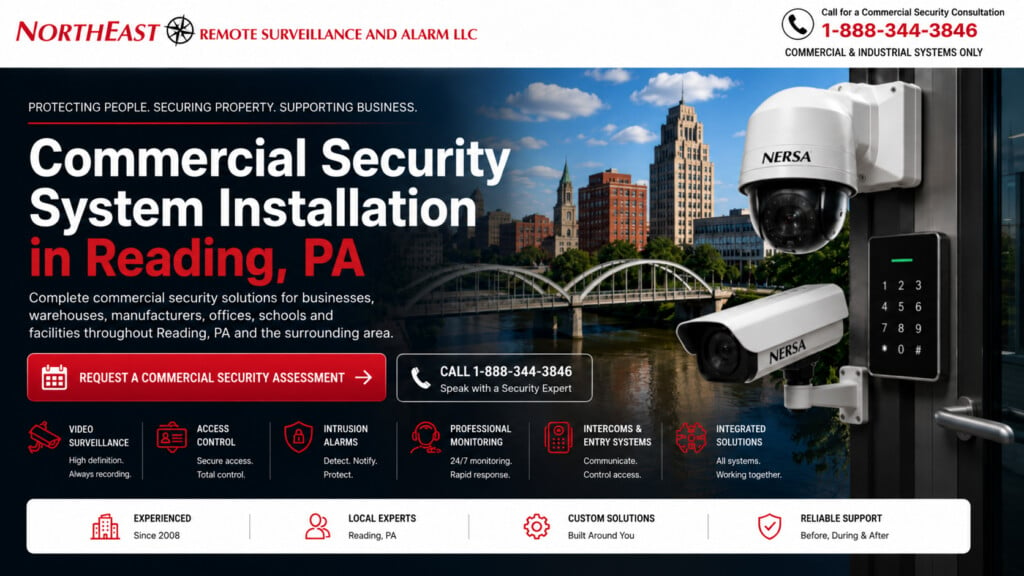
NERSA provides commercial security camera installation, CCTV and video surveillance systems for Reading, PA businesses, industrial facilities, and professionally managed properties.
Request a Reading commercial camera installation assessment
For coordinated planning across cameras, doors, alarms, and other systems, visit Commercial Security Installation in Reading, PA.
Commercial Camera and CCTV Installation in Reading
Northeast Remote Surveillance and Alarm, LLC is a family-owned and operated commercial and industrial security specialist serving Reading and Berks County manufacturing, warehouse and business facilities.
We handle security camera installation from the site assessment through mounting, structured cabling, recording setup, testing and user handoff.
For manufacturing campuses or remote buildings, our fiber-optic installation, maintenance, testing and link-certification services help support dependable security-system connectivity.
Whether you call the project CCTV installation or an IP video surveillance system, the starting point is the footage your staff need to retrieve and use.
A new installation can cover one commercial building or a defined combination of interiors, parking areas, loading positions, and exterior approaches. We establish the required views, equipment locations, recording arrangement, and installation responsibilities before work begins. Existing-system replacement and expansion have their own planning considerations; use the Camera Upgrades guide below when equipment is already in place.
Plan Useful Views Around Your Reading Property
An occupied storefront, a restaurant with evening deliveries, and a warehouse with changing pallet positions need different camera layouts. During the assessment, identify the entrances, transactions, materials, vehicles, and routes that matter at your property. Separate a broad overview from a view intended to show a face, a package handoff, or a vehicle at a controlled lane.
Check the site during representative operating conditions. An open loading door can create glare, a parked trailer can block a view, and a nighttime entrance may look different from its daytime image. Mounting positions, lighting, lens selection, and obstructions should be considered together. Where existing pathways are difficult to reach, plan access and any necessary building work before installation is scheduled.
Coordinate Cabling, Recording, and Authorized Access
We plan camera connections and recording with the people responsible for facilities and IT. The scope should identify cable routes, PoE switching, equipment space, available power, and any approved network connections. Exterior runs or separate buildings may need additional infrastructure; the assessment establishes what is appropriate for the actual distance and site conditions.
Recording capacity should follow the agreed retention period, image quality, camera count, and recording schedule. Confirm how authorized managers will view live cameras, retrieve stored footage, and export an incident. Remote viewing requires suitable connectivity and permissions. Document who controls administrator accounts, which users have access, and any recurring service requirements included in the proposal.
Advanced Commercial Camera Installation for Reading and Berks County
On Reading manufacturing campuses, distribution properties and detached service yards, NERSA evaluates the complete route from camera to usable recording. Options may include certified fiber-optic links between buildings, Cat6/PoE cabling, engineered point-to-point wireless bridges where trenching is impractical, and site-appropriate cellular connectivity. Remote sites without utility service require an engineered solar array, battery reserve, power budget and winter-operation plan; a solar label alone does not demonstrate reliable recording.
Thermal Imaging, Analytics and Early Heat-Risk Alerts
For low-light perimeter approaches, equipment areas and certain high-risk processing operations, NERSA can assess industrial thermal imaging alongside visible cameras and suitable analytics.
Temperature alerts can prompt investigation of abnormal heat; they do not themselves prevent fires or replace code-required detection.
When a fire-alarm initiating function is proposed, only appropriately listed equipment, such as a device listed under UL 2684 where applicable, should be considered within a coordinated approved design.
See the listed thermal fire-detection guide for the distinction.
Document expected views, lighting, communication failures, alert recipients and test recordings at handover.
Reading Commercial Camera Installation: Plate Capture, Analytics and Acceptance Criteria
Different business problems need different camera views.
At Reading and Berks County industrial sites, an overview of the yard is not equivalent to a plate-reading view at a truck entrance or an identification view at an employee doorway.
NERSA can scope dedicated license plate recognition, panoramic coverage, low-light equipment and supported human/vehicle analytics based on the actual lane, traffic speed, distance, lighting and retention goal.
Plate capture should be tested on representative vehicles rather than promised from a generic parking camera; the Reading license plate camera guide covers that narrower application.
Test analytics as part of the installed system.
A loading-dock detection zone or after-hours restricted-area rule should be reviewed against truck movements, shift changes, deliveries, shadows, weather and camera positioning.
Where compatible analytics are included, distinguish recorded evidence from configured notifications and identify who receives and responds to each event.
If monitoring personnel must actively watch cameras or respond to alerts, specify that service separately from normal recording.
Our industrial video analytics guide explains the specialized detection and operational choices.
Preserve the customer’s evidence and ownership. On a new Reading camera installation, upgrade or takeover, confirm usable daytime and nighttime views, camera and recorder naming, storage calculations, playback, a representative clip export, time synchronization, administrator handover, power and network failure behavior, and documented cable or fiber routes. For industrial buildings linked across a property, specify test and certification requirements for the agreed fiber infrastructure. Any temperature-warning or thermal option must be tested for its intended equipment conditions and never presented as a replacement for required fire protection.
Installation, Testing, and Handoff
NERSA coordinates installation around access to the building and the agreed work areas. Cameras and cable connections should be identified consistently so the names on the recorder match the locations staff recognize. Before handoff, review representative views, confirm recording and playback, and have an authorized user retrieve and export a sample event.
Include day and night image checks where the operating requirement calls for both. Record coverage limits, inaccessible areas, outstanding work, and any dependency on customer network or electrical work. Provide the agreed equipment and connection records, user guidance, account ownership information, and support contact so the system remains understandable after the installation team leaves.
Reading-Area Project Experience
Our Mama’s Pizza multi-location security case study includes Reading and Shillington locations.
For a different Berks County setting, NERSA’s Drug Plastics & Glass installation in Boyertown included video surveillance in production and clean-room areas, supported by structured network cabling.
For the Mama’s Pizza locations, the documented scope covers structured cabling, video surveillance, and intrusion detection, with mobile and remote viewing of company operations.
It illustrates how camera installation can be coordinated with the connections and day-to-day needs of an operating business.
Each new project is assessed on its own requirements.
Choose a Starting Point for Your Camera Project
For a Reading property with a missing or unclear view, start with the camera application for that location: parking, a vehicle lane, or a controlled entrance. If the problem spans several areas, choose the facility guide first so the camera plan follows the movement of employees, visitors, deliveries, and materials. Use upgrades or maintenance when existing equipment cannot produce or retain the required footage.
Bring a recorded example of the problem, the camera’s location, and the time and conditions under which it occurs. A daytime live image may not explain a nighttime recording gap. State what staff need to identify or follow, how soon incidents are normally discovered, and who is allowed to review or export the result.
Before choosing analytics or monitoring, decide who receives an event and what action is expected. Confirm the recording, network, power, and account dependencies of the proposed change. At handover, have an authorized user find and export a representative incident, review the relevant day and night views, and record any coverage or retention limits. These checks connect the chosen guide to a practical result at your property.
Camera Applications
Parking Lot Cameras — Plan useful views of parked vehicles and pedestrian routes.
License Plate Recognition — Capture vehicle identifiers at planned entry and exit points.
Gate Access and Vehicle Entry — Coordinate camera views with controlled vehicle entrances.
AI Video Analytics — Explore event detection for industrial camera systems.
Facility Planning
Warehouses — Coordinate camera coverage with warehouse operations.
Manufacturing Facilities — Connect production-area surveillance with facility security planning.
Distribution Centers — Review security across freight movement and employee activity.
Loading Docks — Plan visibility around loading activity and dock approaches.
Truck and Trailer Yards — Organize security around vehicle movement and trailer storage.
Contractor Yards — Plan coverage around equipment and outdoor storage.
Office Buildings — Review security planning for commercial office properties.
Healthcare and Medical Offices — Coordinate surveillance with patient-facing facility needs.
Schools and Educational Facilities — Review security planning for educational properties.
Municipal and Institutional Facilities — Coordinate security across public-service properties.
Employee Entrances — Plan controlled workforce entry and supporting camera views.
Monitoring and Connected Systems
Commercial Security Monitoring — Choose monitoring around the events that require a response.
Remote Video Monitoring and Live Talk-Down — Explore operator verification and voice intervention.
Unified Security Systems — Connect cameras with compatible security systems.
Multi-Site Security and Standardization — Coordinate camera administration, shared standards, and existing systems across Reading-area properties.
Access Control — Link authorized entry with relevant video records.
Intrusion Alarms — Coordinate intrusion events with camera verification.
Intercom and Controlled Entry — Support visitor entry with communication and video.
Upgrades and Support
Camera Upgrades — Improve existing camera coverage and recording.
Remote Monitoring Upgrades — Prepare existing cameras for remote monitoring.
Security Monitoring Upgrades — Review existing monitoring connections and response requirements.
Maintenance and Repair — Restore reliable operation of existing commercial systems.
System Documentation Cleanup — Organize system records and administrative handoff.
Security Cabling and Infrastructure — Plan the connections that support cameras and recording.
Infrastructure Upgrades — Improve existing pathways and security network connections.
Reading Camera Installation Questions
Do you install commercial CCTV systems as well as IP cameras?
Yes. Businesses often use CCTV to describe a security camera system. NERSA assesses the required views and recording arrangement and specifies equipment for the project. If existing cameras or a recorder will remain, compatibility must be checked before reuse is included in the scope.
Can installation be coordinated while our business remains open?
Installation can be planned around agreed access, work areas, and operating hours. Tell us about receiving schedules, customer areas, restricted rooms, and tasks that cannot be interrupted. Any required outage or after-hours work should be agreed before scheduling.
What should we provide for a camera installation assessment?
Bring the property address, operating hours, areas that need coverage, and any available drawings or equipment information. Explain what staff need to identify or review, how long recordings need to remain available, and who will manage the system.
Review Your Reading Camera Installation Proposal
Ask for a coverage plan tied to the activity you need to review: visitors at an entrance, vehicles at a gate, loading activity, or movement between work areas. The proposal should identify each camera location, intended view, lighting conditions, cable or wireless route, recording equipment, storage assumptions, and authorized remote viewers.
How do you know the installed views are useful?
Agree on representative checks before the project starts. Review a person or vehicle in the intended area, confirm time settings and playback, export a sample clip, and check a relevant low-light view. Define retention expectations around the selected recording settings instead of relying on a camera count alone.
For controlled entrances, coordinate camera views with Reading access-control installation.
If someone must receive and act on configured activity after hours, discuss remote video monitoring and live talk-down as a separate operational scope.
Reading Camera Networks: Fiber, Point-to-Point Wireless, Cellular and Solar
A camera installation is only as dependable as its power, network and recording path. NERSA examines suitable copper pathways and PoE budget inside buildings, certified fiber connections between distant areas where appropriate, and surveyed point-to-point bridges for structures that cannot economically be connected by cable. A cellular or solar-supported camera may serve a remote yard or temporary area when its data budget, energy requirements, recording method and maintenance access are suitable. Verify loss-of-network recording and the alerting process rather than assuming a wireless link guarantees continuous video.
Evidence Quality at Berks Loading Docks, Gates and Exterior Yards
Reading-area warehouses, office properties and production facilities often need different image goals. A general multi-imager overview provides context, while a vehicle-entry lane may require deliberately positioned license-plate capture and a shipping door may need recognition detail at night. For each location, specify distance, angle, traffic speed, headlight glare, illumination, recording retention and a testable image example. Thermal cameras and heat-risk analytics can support industrial observation and earlier investigation, but are not replacements for required fire-alarm detection or listed life-safety systems.
Video Installation Handover and Existing-System Modernization
Before replacing an older recorder or camera system, check existing coax or IP wiring, PoE switching, bandwidth, VMS licenses, retention needs, account ownership and actual sample footage. A phased retrofit can retain usable infrastructure while addressing poor night images, unsupported recorders, weak remote administration or coverage gaps. Handover includes timestamps, sample playback and export, account roles, network diagram, camera labels, documented outages and maintenance responsibilities. The owner should be able to retrieve useful footage without relying on the installer.
Request a Reading Camera Installation Assessment
Request a Reading commercial camera installation assessment to review your property, the views staff need, existing equipment and proposed work.
Compliance, Codes & Project Standards
NERSA plans commercial and industrial security work with applicable code, documentation, inspection and authority-having-jurisdiction requirements in mind. Requirements vary by system, property and jurisdiction. These resources support project planning; they do not establish legal compliance, certification or AHJ approval.
Related guidance: Regulatory compliance & inspection readiness · NERSA project standards · Documentation, testing & inspection readiness